She died at the San Diego border. A surveillance camera was in plain sight
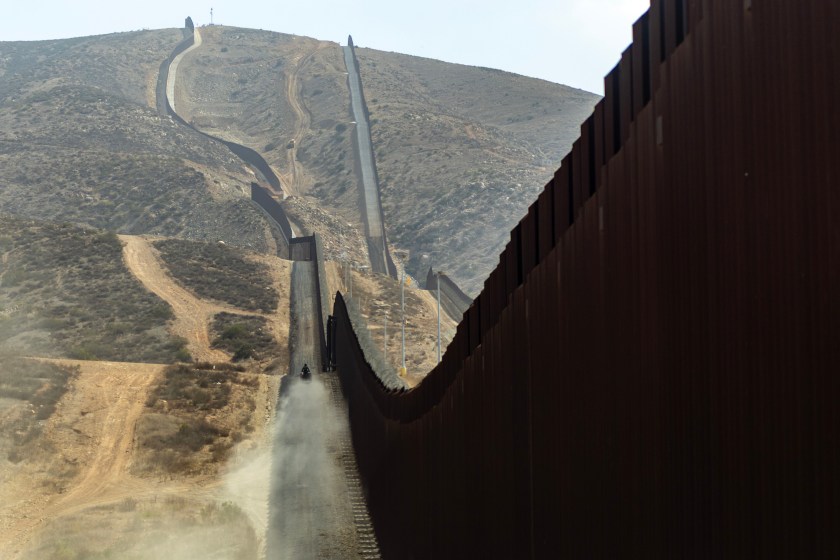
She had only walked for a couple of hours, and already she was lost. It was early afternoon on Sept. 14, 2025, when 30-year-old Graciela Gómez Hernández crossed the border from the eastern edge of Tijuana into Southern California, sending voice messages to her mother and sister as she walked. This story is part of Dying on Camera, a collaboration between MIT Technology Review and Times of San Diego. Journalists in both newsrooms spent the past year examining the failures of border surveillance technology and uncovering the stories of the people who die in the borderlands. Gómez Hernández did not tell her family about her plan until the day before. Once she arrived in California, she hoped to work and send money back to her three children and her parents in southern Mexico. Her oldest son, age 11, had asked for a bicycle. She either climbed a ladder over the border wall or slipped through a section in steep terrain where fencing has yet to be built. Dozens of game trails cut through the dust on hillsides of sagebrush and manzanita. It was the first segment of a hike through the Otay Mountain Wilderness. The eastern edge of San Diego is just a mile away, but countless migrants hike 10 or 20 miles north through the mountains to evade the Border Patrol, emerging in smaller towns and on distant highways with fewer checkpoints. A border agent rides an ATV along the U.S.-Mexico border outside San Diego, September 2026. While the mountainous terrain makes some areas difficult to access, the area is blanketed with interconnected surveillance technology.ANNIE BARKER/TIMES OF SAN DIEGO/CATCHLIGHT LOCAL/REPORT FOR AMERICA Between 2 and 3 p.m., her sister said, Gómez Hernández sent a final message to her mother. “I can’t do it anymore,” she whispered into her phone. By the time a forensic crew came to collect her, two weeks later, most of her body had disappeared into the earth. She died on her own, but she was not, strictly speaking, alone. She was in one of the most heavily surveilled strips of land in the world. Before she died, Gómez Hernández told her family in a WhatsApp message that she could see helicopters overhead and white Border Patrol trucks making periodic laps on the road below. And even if none of those agents saw her or knew she was in distress, something else had a clear view. Supervising the whole territory, from a nearby hilltop, was a slender gray surveillance tower. That tower, made by General Dynamics and in place since 2019, boasts two sets of electro-optical and infrared cameras with long-range lenses that can track targets 5 to 7 miles away. Gómez Hernández was just one mile away. Surveillance towers have proliferated in recent years, as contractors added newer camera systems that use artificial intelligence to distinguish border-crossers from other people and animals, and track their movements, at an overall cost of more than a billion dollars. Yet as the cameras scan the terrain, migrants continue to die in plain sight. Thousands of migrants have died while crossing the border in the past two decades, many of them near to Border Patrol surveillance installations. But the phenomenon is especially pronounced in the Otay Mountain Wilderness, just outside San Diego. A Times of San Diego analysis counted hundreds of cases along the California border—including at least 138 in the past four years—where migrants’ remains were found within the range of the very cameras designed to help track and intercept them. A topographical analysis conducted as part of an MIT Technology Review investigation estimated that more than half of these remains were found in a spot where a camera would have a clear view of a person, without terrain blocking the line of sight. Some of these migrants died swiftly, falling from the border wall or drowning in a canal or river. But dozens suffered slow deaths of exposure in the wilderness, deaths that might have been averted with emergency aid. People who died in Southern California came from just across the border, or from as far away as Africa. They were as old as 70 and as young as 5. They died in the heat or the cold. But they all died within range of a surveillance camera. Found in July 2023: Marcia Dutra, a 36-year-old woman from Brazil who likely died of heat exposure next to a border fence. According to a medical examiner’s report, a group of migrants told the Border Patrol about her body when they were apprehended. An AI-equipped surveillance tower sits 2,000 feet northeast above the edge of a plateau, out of sight of the slope where she was found. Found in February 2024: Elvi Vasquez Bortolon, a 28-year-old Mexican man who died of suspected hypothermia on a ridge near the border wall. He had been dead for more than five days when a Border Patrol agent in a helicopter spotted his body from above. A remote video tower stands about 1,400 feet away, hidden from view by the ridge above the canyon. Found in August 2024: Ramón Montenegro, a 51-year-old man from Mexico who died of possible heatstroke in the mountains near Dulzura. An AI surveillance tower, invisible on the other side of a hill, sits 1,300 feet away — roughly the length of the parking lot at the San Diego Zoo. More than 120 surveillance towers stand along the California border, according to documents and live observations collected by the Electronic Frontier Foundation. The towers are not the only form of surveillance in the region. The border is blanketed by an interconnected network of trail cameras, underground movement detectors, radar, infrared sensors, drones, and even blimps. In March 2025, the Trump administration directed the Department of Defense to use satellites to watch the border as well. Even when mountains or vegetation block a tower’s view, other devices may pick up the trail. Local advocates say surveillance technology in the Otay Mountain Wilderness is almost unavoidable. Agents in Border Patrol gear hike a ridge in
She died at the San Diego border. A surveillance camera was in plain sight Read Post »