YouZum

Uncategorized

AI, Committee, ข่าว, Uncategorized

Brain-computer interface trials are taking off

This week, I covered the story of Casey Harrell—a man with ALS who is “the first power user” of a brain implant, according to the researchers who worked with him. Harrell is paralyzed and unable to speak coherently without the device. He has now spent almost three years using a brain-computer interface (BCI) that enables him to “speak,” surf the web, and perform his job as a climate activist, largely independently. Since Harrell was implanted with the device, in July 2023, a team at the University of California, Davis, has worked with him to adjust and improve its offerings. They’ve refined its accuracy, for example. And they’ve introduced settings including a privacy mode and a “profanity filter” that lets Harrell talk to his daughter without risking accidental swearing. Harrell told me that, for him, the device is “nothing short of revolutionary!” It has enabled him to maintain an income, reconnect with friends and family, and read to his daughter.  The team that developed his BCI is one of several working on ways to use technology to allow people with paralysis to communicate, engage with the online world, and regain some independence. And Harrell is one of a growing number of people volunteering their brains to, as he puts it, “pay it forward and do the scientific research … [and] get some personal benefit.” Over the past couple of years, the number of BCI trial volunteers has soared. This year, China became the first country to approve a BCI for medical use. Advances in technology are allowing engineers to provide more features than ever. BCI research is properly taking off. I should first point out that BCIs come in different forms. Harrell’s device includes a set of electrodes embedded in his brain that pick up the electrical activity associated with speech. Those electrodes are connected to two docking ports on top of his head that can be plugged into a computer. That computer is loaded with software trained to decode his brain signals into phonemes (units of sound in speech) and predict what Harrell wants to say. He can then use an eye gaze tracker to make any corrections before the speech is played out loud. But some BCIs don’t need to be “plugged in”—they’re fully implanted and wireless. Others are less invasive; they might involve placing wired electrodes on the surface of the brain or simply wearing a cap of electrodes, for example. There are trade-offs—the closer you get to the neurons you want to record from, the better your signal will be. But generally speaking, the more invasive the surgery, the higher the risk of complications. BCIs can also have different functions. Harrell has ALS, but most BCIs in use today are sitting in the brains of people with spinal cord injuries. Typically, these individuals have some degree of paralysis; for example, they may be unable to move their arms and legs, but their face and ability to speak are unaffected. In those cases, BCIs can be used to control other kinds of devices that might help with mobility. In 2024, Michelle Patrick-Krueger, then at the University of Houston, and her colleagues published a roundup of all trials of BCIs conducted between 1998, which is when they believe the first device was implanted, and the end of 2023. They identified 21 research groups that, among them, had trialed BCIs in a total of 67 volunteers. “Since then, that number has increased a lot,” says Mariska Vansteensel, a BCI researcher at University Medical Center Utrecht. In January, Neuralink (the BCI company founded by trillionaire Elon Musk) announced that it has implanted 21 people with its device in the past two years. Synchron, another BCI company, is currently testing its devices in trials in North America and Australia. Shanghai-based Neuracle has been trialing a BCI since November 2024, and it recently obtained approval for the device to be used outside of clinical trials. Precision Neuroscience, cofounded by a former co-creator of rival Neuralink, is also trialing its BCI, which sits on the surface of the brain. At the same time, academic research has continued. The UC Davis team that worked with Harrell is part of BrainGate—a BCI research effort that has been running for the past two decades. Other academic teams are exploring a variety of devices, from the fully implanted to the minimally invasive. Since 2024, when Patrick-Krueger’s paper was published, the number of people who have been implanted with a brain electrode has more than doubled, according to Vansteensel. “My current estimation would be around 150 people,” she says. The technology is improving too. Take the BrainGate trial, for example. The first 17 years of that trial focused on the use of what researchers call “point-and-click” communication—allowing users to control a cursor and “click” with their brain activity. But in recent years the team has pivoted toward decoding speech, says David Brandman, the lead investigator on the team (and the person who implanted Harrell’s electrodes). Today, Harrell’s device uses a voice clone—the speech it produces is based on previous recordings of Harrell’s voice. But BCIs are still experimental. And plenty of questions remain about who might benefit from them—and how long the devices will last. So far, most BCIs have been implanted in people with spinal cord injuries. We know even less about how they might benefit other people who have ALS, for example. In some cases where the devices initially helped people with ALS—even someone who was completely locked in—the BCIs eventually stopped working. And scientists don’t really know why. The only way they’ll find out is through more research—and the participation of volunteers like Harrell. So it’s exciting to see trials truly take off. And I promise I’ll update you on where they stand two years from now. This article first appeared in The Checkup, MIT Technology Review’s weekly biotech newsletter. To receive it in your inbox every Thursday, and read articles like this first, sign up here.

Brain-computer interface trials are taking off Read Post »

AI, Committee, ข่าว, Uncategorized

The inevitable weakness of metrics

There are plenty of useful things a metric can reveal. There are even more it can obscure or corrupt. It took me well over a decade of tracking my own life in ever greater detail to fully appreciate this duality, which probably reveals something about both me and the nature of measurement. Like a lot of people bitten by the self-quantifying bug, I initially started gathering personal data to pursue a nebulous collection of goals and desires. As a sedentary technology journalist, I wanted to feel better physically and emotionally, to get outside more, and—where possible—to bring order to some of the messiness and uncertainty of my daily existence. These all seemed to be things that could be improved with the cool clarity of numbers. Self-quantifiers often get stereotyped as obsessive self-optimizers (and many of them are), but my reasons for producing and collecting personal data were less about life-maxxing and more about life meaning—at least at first. As most people who know me will attest, I do not have now, nor have I ever possessed, a “productivity mindset.” I’m also not all that interested in life hacks, shortcuts, or new ways to compare myself with other people. Instead, what I wanted out of metrics—what I hoped I could divine from a never-ending stream of numbers about my health, work, and social life—was something more elusive: self-knowledge. This was my first mistake.  The idea that the more we know, the better is so profoundly embedded in our culture that it feels weird to even point it out. Since at least as far back as the Enlightenment, the primary way we’ve all agreed to go about knowing more has been through measurement and quantification. After all, more knowledge—more data—leads to better decisions, which leads to happier, more fulfilled people. Or so we’re told, and with increasing frequency in the era of AI.  When two Wired magazine editors, Gary Wolf and Kevin Kelly, coined the term “quantified self” in 2007 and helped launch the movement we are all now helplessly a part of, they were essentially selling this very idea. “Unless something can be measured, it cannot be improved,” wrote Kelly in an early blog post, doing his best impression of Lord Kelvin. “So we are on a quest to collect as many personal tools that will assist us in quantifiable measurement of ourselves.” Almost 20 years later, that quest is easier than ever thanks to a flood of devices, apps, and websites all designed to help us build our self-­knowledge through numbers.  My first tool was a small, plastic clip-on Fitbit I started using in 2011. It did one thing: count the number of steps I took in a day. As a lifelong video game player, I was already well acquainted with the motivational power of simple scoring systems, and I hoped my new gadget would offer the gentle numerical nudge I thought I needed to step away from my Twitter feed and, if not touch grass, at least walk next to some. Walking also seemed to be one of the few times I had what could charitably be called intelligent ideas, which seemed like another promising by-product of doing more of it. Alas, that was short-lived. I can’t tell you precisely when “getting out into nature more” or “thinking smarter thoughts” stopped mattering to me as goals, but I suspect it took no more than a few weeks. What I can say with certainty is that my initial goal of 6,000 daily steps quickly turned into 10,000, which then jumped to 15,000 and eventually settled at 20,000 for years. Stories about becoming a “steps guy” are clichéd at this point, and they’ve earned that status for a reason.   It didn’t take long for me to trade in pedometers for heart-rate monitors (I also started running), smartwatches, sleep-tracking rings, and an embarrassing number of macronutrient-­tabulating apps. Outside the health and fitness realm, my early career as a journalist also happened to coincide with the rise of social media and web analytics tools like Chartbeat, which promised to further quantify ­difficult-to-measure aspects of my life, like “job success” and “impact,” by tracking things like page views, followers, retweets, likes, and all sorts of other attentional metrics that now carry great weight. Metrics inevitably redefine your core sense of what’s important, whether you’re aware of the trap or not. Ultimately, during the 10-plus years I diligently tracked my heart rate, steps, active calories, sleep, story engagement time, stress levels, and other metrics, I gained virtually nothing in terms of greater self-knowledge. (I suppose I did learn that I liked to make numbers go up and down, but who doesn’t?) The swirl of data that followed me everywhere did not lend additional meaning or insight to the way I relate to myself, my work, or the important people in my life. In fact, the more I used numerical proxies, the worse I felt about pretty much everything.  What I did learn were two important lessons about what happens when you try to quantify the minutiae of your life. First and foremost, whatever the amount of data you’re currently collecting about yourself, it will never feel sufficient. There’s always a new metric around the corner, a better way for a tracker to remix its readings and more accurately measure what’s “important”: heart rate variability, daily stress, exercise “readiness,” cardiovascular or “fitness” ages. Measurement begets more measurement. You can count on it.  The Score: How to Stop Playing Somebody Else’s GameC. Thi NguyenPENGUIN PRESS, 2026 The second lesson was less obvious but no less significant. The more personal or nuanced your goals are when you set off on your self-quantifying journey, the more likely it is you will ultimately replace them with some simplified metric or ranking. Want to become a better journalist? Why not use page views and leaderboards as a proxy for success? Enjoy cooking and want to improve? Foodie metrics dictate that more complicated recipes with longer ingredient lists are the

The inevitable weakness of metrics Read Post »

AI, Committee, ข่าว, Uncategorized

Liquid AI Introduces LFM2.5-Embedding-350M and LFM2.5-ColBERT-350M: Dense Bi-Encoder and Late-Interaction Models for Fast Multilingual Search Across 11 Languages

This week, Liquid AI released two new retrieval models. They are LFM2.5-ColBERT-350M and LFM2.5-Embedding-350M. Both hold 350M parameters. Both are the first bidirectional members of the LFM family. They build on LFM2.5-350M-Base, released in March. The pair targets fast multilingual and cross-lingual search across 11 languages. Their footprint is small enough to run almost anywhere. Both are available now on Hugging Face under the LFM Open License v1.0. LFM2.5 Retrievers The two models share one backbone but represent text differently. LFM2.5-Embedding-350M is a dense bi-encoder. It turns each document into a single vector. Pick it when you want the fastest search and the smallest, cheapest index. LFM2.5-ColBERT-350M is a late-interaction model. It converts each token into a vector rather than one vector per document. This lets it match queries word-by-word for higher accuracy and better generalization. The trade-off is a larger index. Pick it when accuracy matters more than storage. Its query length is capped at 32 tokens. It can also rerank a first-stage retriever’s results without building an index. Both target short-context search. Good fits include product catalogs, FAQ knowledge bases, and support docs. Liquid AI positions both as a drop-in replacement for an existing RAG pipeline. The Architecture Change: Causal to Bidirectional Both models start from LFM2.5-350M-Base, a mid-trained general-purpose checkpoint. Liquid AI applies a small set of bidirectional patches to the LFM2 architecture. These adapt it from a causal decoder to a bidirectional encoder. In a causal setup, each token uses only itself and previous tokens. That suits left-to-right generation but is less natural for retrieval. The team replaces the causal attention mask with a bidirectional one. Now every token can attend to both left and right context. They also make the LFM2 short convolutions non-causal. These mix local information symmetrically around each token, not only from the past. This preserves the LFM2 backbone’s efficiency while producing the full-context representations retrieval needs. Each model has 17 layers: 10 convolution, 6 attention, and 1 pooling or dense. Context length reaches 32,768 tokens, though documents are tuned to 512 tokens. From the shared encoder, the two models differ only in output. Embedding uses CLS-style pooling for one 1024-dim vector. ColBERT keeps 128-dim per-token embeddings for MaxSim late interaction. Training and Data Both models follow the same three-stage recipe: Stage one is large-scale contrastive pretraining in English. Stage two is multilingual and cross-lingual distillation from a strong teacher across all 11 languages. Stage three is final fine-tuning on hard-mined negatives. The Embedding model receives slightly more cross-lingual data than ColBERT. Cross-lingual retrieval emerges more naturally in the late-interaction setup. Training data combines curated internal data with open-source English retrieval datasets. LLM-based translation expands the multilingual and cross-lingual pairs. Benchmark Liquid AI evaluated two capabilities. The first is multilingual retrieval with NanoBEIR. The second is cross-lingual open-domain QA with MKQA-11. Both report results across all 11 languages: Arabic, German, English, Spanish, French, Italian, Japanese, Korean, Norwegian, Portuguese, and Swedish. On average, both models lead their class. Here are the comparison details: Model Type NanoBEIR ML (NDCG@10) MKQA-11 (Recall@20) LFM2.5-ColBERT-350M late interaction 0.605 0.694 LFM2.5-Embedding-350M dense 0.577 0.691 Qwen/Qwen3-Embedding-0.6B dense 0.556 0.638 LFM2-ColBERT-350M late interaction 0.540 0.646 Alibaba-NLP/gte-multilingual-base dense 0.528 0.675 lightonai/GTE-ModernColBERT-v1 late interaction 0.489 0.459 BAAI/bge-large-en-v1.5 dense 0.359 0.413 ColBERT leads on both averages. Embedding is close behind on MKQA-11 at 0.691. Both beat Qwen3-Embedding-0.6B, a larger model. The new ColBERT also improves on the earlier LFM2-ColBERT-350M, from 0.540 to 0.605 on NanoBEIR. Liquid AI also notes that NanoBEIR English tracks the more expensive full BEIR. The two stay highly correlated, with NanoBEIR scoring a near-constant ~15% higher. The research team therefore uses NanoBEIR as a practical proxy during training runs. Latency and Edge Deployment Liquid AI released GGUF variants for llama.cpp. These let both models run on CPUs, laptops, and edge devices. The figures below use a MacBook Pro M4 Max at FP16. Queries are 32 tokens; documents are 256 tokens. Model Stage Docs cached p50 LFM2.5-Embedding-350M Query embedding yes 7.3 ms LFM2.5-ColBERT-350M Query embedding + MaxSim yes 8.2 ms LFM2.5-ColBERT-350M Query + Doc embedding + MaxSim no 34.3 ms When document embeddings are pre-computed, median (p50) query latency stays under 10 ms. Encoding documents at query time pushes ColBERT to 34.3 ms. For enterprise scale, Liquid AI also built an internal GPU stack. On an H100 at FP16, it observes latencies as low as 1 ms. Embedding query latency there is 1.5 ms p50. Use Cases With Examples E-commerce: Search a product catalog across many languages with one index. A shopper types a Korean query and the system surfaces an English product listing. Cross-lingual retrieval makes this work without per-language indexes. FAQ and support knowledge bases: Retrieve the right answer reliably across customer-facing surfaces. A French support question maps to an English help article. On-device semantic search: Search files, emails, and notes locally on consumer hardware. The GGUF build keeps data on the device at near-zero cost. Enterprise knowledge assistants: Retrieve internal legal, financial, and technical documents across languages. ColBERT suits this when answer accuracy outranks index size. Code: Getting Started The Embedding model runs through sentence-transformers. Always pass the asymmetric prompts, query: and document:. Omitting them silently degrades retrieval quality. Copy CodeCopiedUse a different Browser from sentence_transformers import SentenceTransformer model = SentenceTransformer( “LiquidAI/LFM2.5-Embedding-350M”, trust_remote_code=True, ) queries = [“What is the capital of France?”] documents = [“Paris is the capital and largest city of France.”] q_emb = model.encode(queries, prompt_name=”query”, normalize_embeddings=True) d_emb = model.encode(documents, prompt_name=”document”, normalize_embeddings=True) scores = q_emb @ d_emb.T # shape: (n_queries, n_documents) The ColBERT model runs through PyLate. Its PLAID index uses FastPLAID for efficient similarity search. Copy CodeCopiedUse a different Browser from pylate import indexes, models, retrieve model = models.ColBERT( model_name_or_path=”LiquidAI/LFM2.5-ColBERT-350M”, trust_remote_code=True, ) model.tokenizer.pad_token = model.tokenizer.eos_token index = indexes.PLAID(index_folder=”pylate-index”, index_name=”index”, override=True) docs_emb = model.encode([“document 1 text”, “document 2 text”], is_query=False) index.add_documents(documents_ids=[“1”, “2”], documents_embeddings=docs_emb) retriever = retrieve.ColBERT(index=index) q_emb = model.encode([“a search query”], is_query=True) scores = retriever.retrieve(queries_embeddings=q_emb, k=10) To rerank an existing first-stage pipeline instead, skip the index and use rank.rerank. Copy CodeCopiedUse a different Browser from

Liquid AI Introduces LFM2.5-Embedding-350M and LFM2.5-ColBERT-350M: Dense Bi-Encoder and Late-Interaction Models for Fast Multilingual Search Across 11 Languages Read Post »

AI, Committee, ข่าว, Uncategorized

A startup claims it broke through a bottleneck that’s holding back LLMs

Miami-based AI startup Subquadratic came out of stealth mode last month with a huge claim. It announced that it had solved a mathematical bottleneck that had been holding back large language models for almost a decade. The details were thin, and many people were unconvinced. But Subquadratic has started to bring the receipts, sharing the results of an independent evaluation of its new tech. The results suggest that the company’s claims might be worth paying attention to. According to Subquadratic, it has developed a new kind of LLM, called SubQ, that is faster and cheaper and uses a lot less energy than any other model on the market. The company also claims that SubQ is able to process up to 12 times as much text at once than most other models, allowing it to carry out a range of data-heavy tasks, such as analyzing hundreds of documents or entire code bases. What’s more, Subquadratic says, SubQ does this while more or less matching the performance of the best models put out by Google DeepMind, OpenAI, and Anthropic on key tasks like coding. The problem was that the company at first provided little evidence for its claims beyond a handful of self-published test scores. And it has yet to make SubQ widely available for people to try out themselves. So it’s no surprise that Subquadratic’s claims were met with skepticism. Dan McAteer, an artificial intelligence engineer, captured the overall response on X: “SubQ is either the biggest breakthrough since the Transformer … or it’s AI Theranos.” A month on, the company has published more information about its model, including the results of additional independent tests run by third-party firm Appen. “We expected healthy skepticism,” says Subquadratic cofounder and chief technology officer Alex Whedon. “In hindsight, releasing the third-party benchmarks alongside the initial announcement would have preempted much of the skepticism, which is why we’re taking the time to make sure any future results are fully verified before putting them out.” Subquadratic asked Appen, which evaluates other companies’ models, to run its tests on SubQ. The results seem to back up a lot of Subquadratic’s claims. “That was really exciting to me, it validated their architecture,” says Jeanine Sinanan-Singh, Appen’s director of generative AI research. “I was like, ‘Wow, this could be a game changer,’ because models struggle with speed and inefficiency,” she adds. “But when you have kind of shocking results, it’s really not as credible when you say it yourself.” SubQ won’t replace existing top models across the board, but it could offer huge increases in speed at a fraction of the typical cost for certain tasks. Subquadratic insists that in the long run, though, its breakthrough could change how LLMs are built. “We hope we’re kicking off a new age of efficiency,” says Justin Dangel, the firm’s cofounder and CEO. “We don’t think anybody will be building on transformers in a few years.” Attention! To understand why Subquadratic’s claims are a big deal, let’s dig into how most LLMs work. The key mechanism inside an LLM is a type of neural network called a transformer, which runs a process known as dense attention. Today’s LLMs typically chain together multiple transformers. (The foundational paper of the LLM era, published by researchers at Google in 2017, was titled “Attention Is All You Need.”) Dense attention works like this: When a transformer processes a chunk of text, it first encodes each word (or part of a word, known as a token) with a number. To capture the meaning of the full text, it then multiplies each of those numbers with every other number for that text. For example, a piece of text 10,000 words long would kick off almost 50 million individual multiplications. That’s a lot of computation and the main reason that LLMs are notorious power hogs. “If you want to summarize The Great Gatsby, you have to look at the first word and the last word together, and then you have to look at every other combination,” says Dangel. As the length of the text increases, the number of computations skyrockets. That’s because each additional number must be multiplied by all other previous numbers. Double the number of words, and you roughly quadruple the number of computations, a rate of increase known as a quadratic expansion. (You can picture this yourself: Draw a circle and mark dots around its edge. Each dot is a token. Then draw lines between pairs of dots to represent the multiplication of those two tokens. A circle with five dots will have 10 lines crossing it. Make it 10 dots and you will have 45 lines, 20 dots and you will have 190 lines, and so on.) Slashing costs Subquadratic’s solution is to ditch dense attention, the core operation of a transformer, in favor of what’s known as sparse attention, which slashes the number of computations needed. Instead of multiplying the number assigned to each token by every other number, sparse attention selects just some of the numbers to multiply. The idea is that not all relationships between words in a piece of text matter. “Sparse attention says not all of those relationships are important, because they’re not,” says Whedon. “If you’re reading a book, you’re not going to look at the first and second words, first and third—that’s insane.” It’s a simple approach, and Subquadratic is not the first to try it. “Pretty much everything under the sun has been attempted,” says Will Depue, an independent AI researcher who previously worked at OpenAI. “It’s not impossible, but it’s akin to running a four-minute mile.” Previous techniques for selecting which numbers to multiply and which to ignore have not produced a mechanism that can capture the meaning of a document as well as dense attention can. Subquadratic claims to have cracked the problem at last. It pitches SubQ as the first sparse-attention LLM that rivals mainstream dense-attention models in performance. “Historically, most mechanisms have used fixed patterns, like always comparing the first word to

A startup claims it broke through a bottleneck that’s holding back LLMs Read Post »

AI, Committee, ข่าว, Uncategorized

The Download: AI bottleneck debates, and BCI trials take off

This is today’s edition of The Download, our weekday newsletter that provides a daily dose of what’s going on in the world of technology. A startup claims it broke through a bottleneck that’s holding back LLMs AI startup Subquadratic came out of stealth last month with a huge claim: it had solved a mathematical bottleneck that had held back large language models for almost a decade. The purported breakthrough comes from slashing the number of computations transformers need to carry out to generate answers. The result is a faster and cheaper LLM that uses far less energy than any other model on the market. Many experts remained skeptical—but Subquadratic has started to share the receipts. They suggest that their approach might be worth paying attention to. Here’s how the system works—and why some researchers still aren’t convinced. —Will Douglas Heaven Brain-computer interface trials are taking off —Jessica Hamzelou This week, I covered the story of Casey Harrell—a man with ALS who is “the first power user” of a brain implant. The device has enabled him to maintain an income, reconnect with friends and family, and read to his daughter. He told me that it’s “nothing short of revolutionary.”  Over the past couple of years, the number of BCI trial volunteers has soared. This year, China became the first country to approve a BCI for medical use. Advances in technology are allowing engineers to provide more features than ever. BCI research is properly taking off. Find out how the technology is edging from the lab towards the market. This story is from The Checkup, our weekly newsletter giving you the inside track on all things biotech. Sign up to receive it in your inbox every Thursday. The must-reads I’ve combed the internet to find you today’s most fun/important/scary/fascinating stories about technology. 1 Amazon workers who backed data center limits may face terminationThe engineers say they’re under investigation by the company. (NYT $)+ And could face discipline, including potential termination. (The Verge)+They had testified at meetings about pausing data centers. (CNBC)+ They’ve filed a joint complaint to Seattle’s Office for Civil Rights. (Wired $) 2 A new fossil discovery has rewritten 150 years of evolutionary theoryIt suggests early land vertebrates skipped the tadpole stage. (New Scientist $)+ And raises questions about how vertebrates adapted to land. (404 Media)+ Sponges may have been the first animals. (MIT Technology Review) 3 Bernie Sanders plans to give the public direct ownership of AI firmsHe’s unveiled new legislation to create an AI sovereign wealth fund. (AP News)+ It would be funded through a one-time tax on AI companies’ stock. (Quartz)+ And make annual payments directly to Americans. (Washington Post $)  4 Investors in China secretly acquired stakes in SpaceX before its IPOOne had ties to Chinese military contractors. (ProPublica)+ The US fears China has got one of ASML’s top machines. (Reuters $) 5 Researchers have figured out Russia’s nuclear-powered missileThey call it “a terrible idea”—but not an impossible one. (NPR)+ NASA is building a nuclear reactor-powered spacecraft. (MIT Technology Review) 6 Longevity medicine faces a do-or-die moment in a landmark trialIt will test whether cellular aging can be safely reversed in humans. (Axios)+ The next step is “chemical reprogramming.” (MIT Technology Review) 7 Studies suggest AI may already be deskilling professionalsOver-reliance appears to weaken doctors’ and engineers’ abilities. (Nature) 8 Tech workers who maxed out their AI use are now trying to minimize itSpiralling costs mean “tokenminning” has replaced “tokenmaxxing.” (NYT $) 9 Scientists say the human genome’s structure may confound AI modelsWhich would constrain AI-based models of biology and disease. (Quanta) 10 A new robotic self-driving toilet brings the bathroom to youThe Xiaoban also cleans up and empties itself all on its own. (The Verge) Quote of the day “They hated me. They were doing everything they could to knock me down. And look at them now.”  —Donald Trump mocks Mark Zuckerberg and Jeff Bezos in a conversation with Elon Musk that’s recounted in a new book, Wired reports.  One More Thing PABLO DELCAN Technology can help us feed the world, if we look beyond profit The pandemic exposed the weak spots in our interconnected food system. They’re the result of decades’ worth of technological advances, from globe-spanning shipping to refrigeration networks. But technology is not inherently opposed to sustainable and resilient food systems. Powerful technologies like genetic modification can create stronger local agriculture and a healthier food system—but they normally aren’t. The challenge is ensuring they serve food security and human well-being, rather than simply maximizing profits. Dive into our food system’s problems and the solutions that technology can provide. —Fabio Parasecoli We can still have nice things A place for comfort, fun, and distraction to brighten up your day. (Got any ideas? Drop me a line.) + This intriguing video tracks the covert reality of Japan’s shinobi.+ Dive into this admirably obsessive archive covering over 100 different ways to tie your shoes.+ One of the world’s largest digital collections of plants and fungi is now available for free to everyone.+ A grand orchestra has beautifully covered Michael Jackson’s “Human Nature” at Abbey Road Studios.

The Download: AI bottleneck debates, and BCI trials take off Read Post »

AI, Committee, ข่าว, Uncategorized

The search for dark matter has been blown wide open

Underneath an Apennine massif, below the Jinping Mountains of Sichuan, and at the bottom of a South Dakota mine, there is a cosmic hunt afoot. Isolated deep beneath these rocky shields, massive detectors filled with liquid xenon aim to make the first direct detections of dark matter, the long-sought invisible substance whose gravity has sculpted our universe. The hope is that someday, a bit of dark matter called a weakly interacting massive particle (a WIMP, for short) will collide with a xenon atom, creating a burst of light and electric charge. After running for years, these experiments have recently begun seeing infrequent blips from a particle that glides ethereally through ordinary matter until it crashes into the detectors. Unfortunately, the new signal is not produced by dark matter. Instead, the detectors are picking up on something similarly insubstantial but much more mundane: neutrinos, the featherweight subatomic particles that the sun and other stars produce in massive quantities. Physicists’ failure to find dark matter where they thought it was has led to a cornucopia of proposals for new ways to search: quantum sensors, liquid-helium-based detectors, searches in Jupiter’s atmosphere, and more. Physicists have known for decades that this neutrino background was there; they were just hoping to discover WIMP dark matter first. Now the chance is looking slim. Some of today’s WIMP detectors are simply so large and sensitive that they are entering the so-called “neutrino fog,” in which the ordinary particles are likely to drown out any signal from the main target. There is no shielding these detectors from neutrinos, which easily slip through the Earth itself. That means the next experiment to use this long-standing approach for seeking WIMP dark matter may be the last.  Hitting the neutrino fog does not, however, mean an end to the search for dark matter. Researchers just have to shift the focus of their hunt. “We haven’t seen WIMP dark matter,” says Kathryn Zurek, a theoretical particle physicist at the California Institute of Technology. Nor, she says, have scientists found new particles in the Large Hadron Collider (LHC), the powerful proton-smashing facility that straddles the border between France and Switzerland. “And so people naturally broaden their scope,” Zurek says. As they do, there are plenty more candidates waiting in the wings In other words, the hunt is transforming from a narrow probe into a kind of free-for-all. It’s a big shift. Today, particle physicists are less sure about dark matter’s identity than when they began looking for it. They’ll freely admit that they cannot presume the basics—for example, if the stuff that makes up dark matter is heavier than the Earth or lighter than a radio wave, or if dark matter is one kind of particle or a dozen.  The uncertainty can be frustrating, even humbling. “The potential range where the candidates could be is so enormous that the odds of any one small experiment finding it are very, very small,” says Hugh Lippincott, a dark matter experimentalist at the University of California, Santa Barbara.  But physicists’ failure to find dark matter where they thought it was has also led to a cornucopia of proposals for new ways to search: quantum sensors, liquid-helium-based detectors, searches in Jupiter’s atmosphere, and more. “Now there’s a great deal of excitement. And finally, there’s technology there,” says Gray Rybka, a University of Washington physicist who co-leads an experiment looking for axions, an ultra-lightweight dark matter candidate.  Still, with so many places to look, where does it make sense for physicists to begin again?  Astronomical ignorance For starters: the birth of the universe. Dark matter has been with us since the beginning, and there’s much to learn from those early eons. Maps of the cosmic microwave background—the first light from the universe’s early years—are full of fluctuations caused by the clumpiness of under­lying matter. Reading these cosmic dregs, researchers can tell that only 17% of the matter in the universe is made of ordinary particles like protons and neutrons. The remaining 83% is dark matter, which has little to no interaction with light or ordinary matter other than through gravity. We can tell quite a bit about dark matter from those gravitational effects. We know that the Milky Way contains a halo of the stuff. Our own solar system orbits the galactic center far too quickly to be bound by the tug of ordinary matter alone: without dark matter’s gravitational tether, we would be flung off into intergalactic space. We can also see how the heft of a galaxy’s dark matter bends the path of light as it makes its way to Earth’s telescopes. And on the grandest scale, we can see how superclusters of galaxies are distributed in space like dewdrops on a spiderweb. No cosmological theory without dark matter can explain all these phenomena.  But all the astronomical and cosmological evidence has little to say about what dark matter is actually made of. “It does not tell you anything about the individual constituents. It just tells you the effect of a bunch of them together,” says Lippincott, who has led the LZ experiment, a WIMP dark matter detector currently in operation at the former Homestake Mine in South Dakota. The idea of WIMPs emerged during the 1980s. At the time, theorists were exploring add-ons to the standard model, the overarching theory of particle physics that describes all the universe’s fundamental particles and their interactions. The standard model is powerful but doesn’t account for everything—notably, it omits gravity—so some adjustments seemed necessary. The most popular idea, a class of theories called supersymmetry (SUSY, informally), called for pairing each known particle type in the universe with an as-yet-unseen “super­partner.” To have avoided detection, superpartners would have to have a lot of mass (putting them outside the reach of existing colliders) and be weakly interacting, able to pass ghostlike through matter. That is to say, they would be WIMPs. It didn’t take too long for physicists to realize that the WIMP was also an excellent dark matter candidate:

The search for dark matter has been blown wide open Read Post »

AI, Committee, ข่าว, Uncategorized

The KV Cache Compression Race: TurboQuant vs OSCAR vs EpiCache

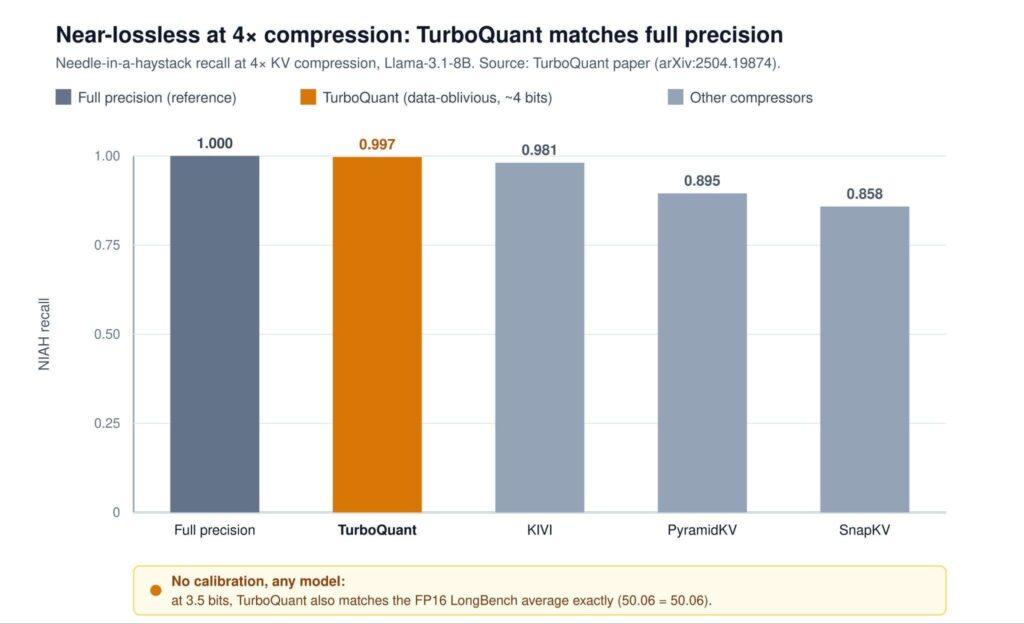
Long-context large language models (LLMs) face a memory bottleneck that has nothing to do with model weights. During decoding, transformers cache the key and value (KV) vectors for every token at every layer so they don’t have to recompute attention. This cache grows linearly with sequence length and batch size, and at long context with high concurrency it can dwarf the model’s own footprint. Consider Llama-3.1-70B in BF16. Its KV cache costs about 0.31 MB per token (80 layers × 8 KV heads × 128 head-dim × 2 tensors × 2 bytes). At 128K tokens that is ~40 GB; at 1M tokens it exceeds 300 GB — more than the 140 GB of weights themselves. Worse, every newly decoded token has to stream the entire cache out of high-bandwidth memory (HBM), which makes decoding memory-bandwidth-bound rather than compute-bound. Shrinking the KV cache is therefore the most direct lever for cutting both cost and decode latency. Current approaches fall into roughly five families: token eviction (H2O, SnapKV), quantization (KIVI, GEAR), low-rank projection (Palu), merging (KVMerger), and architectural sharing (MLA). Recent 2026 work has pushed hard on the ultra-low-bit quantization frontier. Google and NYU’s TurboQuant (ICLR 2026) and Together AI’s OSCAR attack the same problem from opposite directions, while Apple’s EpiCache tackles a problem neither one addresses. Most KV quantizers are fighting the same underlying enemy: outlier channels — a handful of channels with disproportionately large magnitudes that dominate the quantization range and squeeze the rest of the signal into just a few representable levels. This is why naive INT2 quantization (only four levels) collapses to near-zero accuracy. KIVI established the standard baseline here. It showed that key vectors have fixed outlier channels across tokens while value vectors do not, so it quantizes keys per-channel and values per-token. That tuning-free 2-bit recipe cuts end-to-end peak memory (weights included) by about 2.6×, and it is the reference point the newer methods build on. TurboQuant: data-oblivious and theoretically optimal TurboQuant handles outliers without ever looking at your data, in two stages: Stage one: each vector is randomly rotated so its coordinates become nearly independent and approximately Gaussian, which lets an optimal precomputed scalar (Lloyd–Max) quantizer be applied per coordinate. Stage two: a 1-bit Quantized Johnson–Lindenstrauss (QJL) transform is applied to the residual, giving a provably unbiased estimate of attention logits with no normalization-constant overhead. The selling point is theoretical: TurboQuant’s distortion is provably within a small constant factor (≈ 2.7×) of the information-theoretic lower bound. In practice it reaches essentially full-precision recall on Needle-in-a-Haystack at 4× compression, and the paper reports absolute quality neutrality at 3.5 bits and only marginal degradation at 2.5 bits per channel. Because it needs no calibration, it works on any model untouched and doubles as a fast vector-database quantizer. One caveat worth flagging: the widely repeated “8× faster attention on H100” figure comes from Google’s blog, not the paper, and refers to a narrow attention-logit microbenchmark. TurboQuant’s documented sweet spot is the 3–4 bit near-lossless regime. Image source: Data from the TurboQuant paper – https://arxiv.org/abs/2504.19874 OSCAR: attention-aware and deployment-ready OSCAR bets the opposite way. Its premise is that at INT2’s four levels, a data-oblivious rotation is the wrong tool — blindly smoothing ranges isn’t enough when there’s almost no precision to spare. So OSCAR computes an attention-aware rotation from a one-time offline calibration pass: keys are rotated into the eigenbasis of the query covariance, values into the score-weighted value covariance. A Hadamard transform plus a bit-reversal permutation then spread channel importance evenly across the quantization groups. What sets OSCAR apart is that it ships as a complete system, not just an algorithm: Mixed-precision paged cache: sink and recent tokens stay in BF16 while the history compresses to INT2 — at 128K context only ~0.24% of tokens remain in BF16. Fused Triton kernels with full SGLang integration (paged-attention and prefix-cache compatible). Precomputed rotations (a “RotationZoo”) for Qwen3-4B/8B/32B, GLM-4.7-FP8, and MiniMax-M2.7 — no recalibration needed. At an effective 2.28 bits, OSCAR lands within 1.42 points of BF16 on Qwen3-8B and is essentially on par on Qwen3-32B (a 0.02-point gap). On GLM-4.7-FP8 — where naive INT2 collapses to zero and data-oblivious baselines reach only low single digits — OSCAR matches BF16 and even edges slightly ahead on the reported benchmarks (within noise). Together AI reports up to 7.83× job-level throughput and roughly 8× KV-cache memory reduction at 100K context, with up to ~3× faster decoding. Image Source- Data from the OSCAR paper: https://arxiv.org/abs/2605.17757 So which one wins? Neither — and that’s the honest answer. For deployable INT2 at 128K tokens on supported models, OSCAR is currently the only demonstrated option that doesn’t collapse, and it comes with production-ready SGLang support. For training-free, model-agnostic quantization in the 3–4 bit regime, TurboQuant offers far broader generality. OSCAR’s paper reports that TurboQuant drops by more than 40 points at a comparable budget — but that evaluation runs inside OSCAR’s own framework, quantizes all layers, uses a single random seed, and operates well below TurboQuant’s intended bit-width, so it’s a weak basis for a head-to-head verdict. The more interesting possibility is that the two are complementary: pairing a calibration-aware rotation with an optimal scalar quantizer is a promising combination nobody has shipped yet. (Both teams have publicly noted the same idea.) Image source: Data from the OSCAR paper- https://arxiv.org/abs/2605.17757 The third axis: EpiCache TurboQuant and OSCAR are both built for a single long context. Neither handles extended multi-turn conversations, where history piles up across many exchanges. Apple’s EpiCache is a training-free KV-cache management framework aimed exactly at that gap: Block-wise prefill processes history in blocks to keep peak memory bounded. Episodic clustering segments the conversation into coherent semantic “episodes,” each with its own compressed cache. Episode-matched retrieval routes each query to the most relevant episode at inference time. Adaptive layer-wise budget allocation measures each layer’s sensitivity to eviction and distributes the memory budget accordingly. Across LongMemEval, RealTalk, and LoCoMo, EpiCache reports up to 40% higher accuracy than eviction baselines, near-full-cache accuracy at 4–6× compression, and

The KV Cache Compression Race: TurboQuant vs OSCAR vs EpiCache Read Post »

AI, Committee, ข่าว, Uncategorized

Geoengineering still faces major practical challenges

Solar geoengineering is often portrayed as a sort of emergency brake. Something along the lines of Pull in case of climate emergency to scatter light-reflecting particles to bounce sunlight out of the atmosphere and cool the planet. But it might be less like a simple brake and more like a complicated, entirely unsolved puzzle. Some researchers are starting to look into how nations or companies would go about trying to cool the planet—and there’s a lot to figure out. My colleague James Temple dug into these engineering challenges in his latest feature story. My biggest takeaway? This all might be a lot harder than I thought. I’ll admit, I’ve always thought of geoengineering as a relatively low-tech solution. That’s partly because over the years we’ve seen some companies do their own low-cost guerrilla “experiments,” tossing balloons up into the atmosphere and claiming to have made some small dent in climate change. But to actually actively cool the planet in a significant way, and to make sure we understand exactly what effect we’re having, there’s a lot that researchers still need to learn.  First, there’s the problem of getting up into the atmosphere. Generally, the target for solar geoengineering efforts is the stratosphere, since the air there is drier and more stable, so particles deposited there would stay aloft and move around the planet, lowering temperatures over a wider area and for a longer time. You can release the particles in balloons, but balloons may not go where you want them to. And at a large scale, you’d be leaving a lot of litter all over the planet. That leaves aircraft, but conventional planes aren’t suited to fly around in the stratosphere. (Commercial aircraft generally fly at around 12 kilometers above the Earth’s surface, while geoengineering would require reaching roughly 20 kilometers.) The air is thinner higher up, so aircraft with massive wings would probably fare better than more conventional designs. One design, from a startup called Iris Aero, shows just how much rethinking of our current flight technologies might be needed—the plane is almost unsettling in its proportions. Its wings are so long, on a stubby little body. It reminds me of a water strider, those bugs that have super-long legs to scurry around on a pond’s surface. And that’s just the beginning. There’s also the question of what, exactly, would be best to scatter up in the stratosphere. The idea behind geoengineering comes from volcanoes—after an eruption, sulfuric acid ends up floating around in the atmosphere, and it can temporarily cool the planet. But that chemical is sticky and would be heavy to carry, so scattering some sort of precursor to sulfuric acid would probably be better. Researchers, including some at the University of Chicago, one of the leading institutions in this field, are working to figure out the best formula.  I’m struck by how complicated this turns out to be, and I’m also left with a big question: As research turns from modeling and simulations to the practical aspects of this incredibly controversial technology, what does it mean to be doing this work? There are major concerns about what effects might come from large-scale attempts to cool the planet. The effects could be positive for some parts of the globe and negative for others. Established weather patterns, like the monsoon season in South Asia, could shift. There are major questions about what the governance for the use of geoengineering should look like, and who gets to decide whether to go ahead.  Experts who champion research in geoengineering often draw a line between a desire to support learning more about the technology and a call to deploy it. Many would argue that we should understand it better, so we can make informed decisions. But to me, there’s a clear difference between atmospheric modeling and detailed engineering work on an aircraft. If there’s public research that essentially amounts to a set of practical instructions, I can’t help but feel like it could enable any number of individual actors or nations to take geoengineering into their own hands. It also might normalize the idea of using the technology.  Some experts shared concerns along these lines with James, arguing that the shift to practical engineering work requires more oversight. Some called research in this area dangerous. One alternative perspective I found interesting came from Shuchi Talati, executive director of the nonprofit Alliance for Just Deliberation on Solar Geoengineering. Rather than further practical research making a slippery slope slipperier, it could have the opposite effect, she told James. “The actual practice of R&D will be a sticky slope, because there will be more real-world problems that come up that we haven’t even thought of yet,” she says. Engineering research could challenge the “idealized notions” of how easy the technology would actually be, she adds. It’s hard to argue against better understanding potential tools to address climate change. But if we draw a map towards a potential future, it might become difficult to control who follows it.  This article is from The Spark, MIT Technology Review’s weekly climate newsletter. To receive it in your inbox every Wednesday, sign up here. 

Geoengineering still faces major practical challenges Read Post »

AI, Committee, ข่าว, Uncategorized

The Download: a new hunt for dark matter and Kenya’s case for going solar

This is today’s edition of The Download, our weekday newsletter that provides a daily dose of what’s going on in the world of technology. The search for dark matter has been blown wide open For decades, physicists have hunted for weakly interacting massive particles (WIMPs), a leading candidate for dark matter. But their search has run into a new problem: neutrinos.  These tiny particles from the sun and other stars can create a “neutrino fog” that drowns out any signal of dark matter. Hitting the neutrino fog does not, however, mean an end to the search. Researchers just have to shift the focus of their hunt. They’re now casting a much wider net. New proposals include quantum sensors, liquid-helium detectors, and even searches in Jupiter’s atmosphere. Find out how the search for dark matter has entered entirely new territory. —Dan Garisto This story is from the next edition of our magazine, which is all about engineering. Subscribe now to get a copy when it lands! Entrepreneurs in Nairobi are making the case for going solar Shops with diesel-powered grain mills are common in Nairobi. Milcah Wanjiru’s is different: it runs on either solar energy or the grid. About a quarter of Kenya’s population still lacks centralized electricity, and off-grid solar is being promoted as a route to universal access by 2030. In Wanjiru’s case, it cuts operating costs and can improve profits once the upfront investment is recovered. Read the full story on the rise of solar milling systems across Kenya and beyond. —Geoffrey Kamadi Geoengineering still faces major practical challenges —Casey Crownhart Solar geoengineering is often portrayed as a sort of emergency brake. Something along the lines of “Pull in case of climate emergency to scatter light-reflecting particles to bounce sunlight out of the atmosphere and cool the planet.” But it might be less like a simple brake the more like a complicated, entirely unsolved puzzle. My colleague James Temple dug into these engineering challenges in his latest feature story. My biggest takeaway? This all looks a lot harder than I thought. Read the full piece to find out why. This article is from The Spark, our weekly newsletter giving you the inside track on all things climate. Sign up to receive it in your inbox every Wednesday. The must-reads I’ve combed the internet to find you today’s most fun/important/scary/fascinating stories about technology. 1 The Pentagon says it used Grok in strikes on IranIts AI chief said it helped fire over 2,000 munitions. (Le Monde)+ He spoke in defense of xAI in a data center pollution lawsuit. (NYT $)+ Officials claim the company is essential to national security. (AP News)+ Conversational AI has entered the war room. (MIT Technology Review)   2 Apple will raise prices due to the memory chip shortageTim Cook said price increases are “unavoidable.” (WSJ $)+ AI’s demand for data centers has led to dwindling supplies. (Reuters $)+ iPhone prices could rise by $200 or more. (WSJ $) 3 Strikes beyond battlefields are pumping demand for counter-drone techThe market for airport and infrastructure defenses is booming. (Reuters $)+ Worried by China, Taiwan is teaching its citizens to fly drones. (Guardian)+ Europe has a drone-filled vision for future war. (MIT Technology Review) 4 Anthropic and DeepMind’s CEOs have called for a US-led AI coalitionThey want the alliance to shape AI rules and standards. (CNBC)+ Anthropic’s CEO told G7 leaders to “resist the temptation to splinter.” (FT $) 5 American developers are turning to cheaper Chinese AIThey say DeepSeek is good enough for a fraction of the cost. (Rest of World)+ What’s next for Chinese open-source AI? (MIT Technology Review) 6 Two-thirds of Americans think AI is advancing too quicklyPew Research found increasing use but negative views. (The Verge)+ AI is sprinting, and we’re struggling to keep up. (MIT Technology Review) 7 Elon Musk’s next move may be a megamerger of SpaceX and TeslaShareholders might object, but there’s little they could do. (NYT $) 8 White House aims for Anthropic to block jailbreaks may be impossibleSecurity experts say it simply isn’t technically feasible. (Wired $) 9 Ancient DNA is rewriting the history of plagueGenomic data suggests it emerged thousands of years earlier. (Economist $) 10 AI image generator Midjourney is shifting to full-body ultrasound scansIt also plans to build a spa in San Francisco. (The Verge) Quote of the day “We had a great meeting with AI.”  —President Trump says negotiations with Anthropic over restoring access to the company’s latest AI models are going well, the Wall Street Journal reports. One More Thing GETTY IMAGES Why can’t tech fix its gender problem? Women remain grossly underrepresented in the technology industry. At the core of the problem is money: tech has generated enormous personal fortunes, and most of that wealth has gone to men. White and Asian men manage 93% of venture dollars. In 2021, only 2% of venture capital funding went to startups founded solely by women. The lack of investor and founder diversity doesn’t only determine who gets rich. It also shapes the kinds of problems technology companies set out to solve. Discover why tech’s gender problem has proved so hard to fix—and why a new generation of activists believes change is finally possible. —Margaret O’Mara We can still have nice things A place for comfort, fun, and distraction to brighten up your day. (Got any ideas? Drop me a line.) + Meet one of the world’s most wonderfully weird animals: the aardwolf.+ Escape into this dreamy, minimalist photo collection about the Pacific surf.+ Admire the casual football skills of this Venetian gondolier executing a stylish backheel while on the job.+ Explore an interactive prehistoric globe simulation and browse an endless timeline at The Dinosaur Database.

The Download: a new hunt for dark matter and Kenya’s case for going solar Read Post »

We use cookies to improve your experience and performance on our website. You can learn more at นโยบายความเป็นส่วนตัว and manage your privacy settings by clicking Settings.

ตั้งค่าความเป็นส่วนตัว

You can choose your cookie settings by turning on/off each type of cookie as you wish, except for essential cookies.

ยอมรับทั้งหมด
จัดการความเป็นส่วนตัว
  • เปิดใช้งานตลอด

บันทึกการตั้งค่า
th