YouZum

Uncategorized

AI, Committee, ข่าว, Uncategorized

How to Build a Neuro-Symbolic Hybrid Agent that Combines Logical Planning with Neural Perception for Robust Autonomous Decision-Making

In this tutorial, we demonstrate how to combine the strengths of symbolic reasoning with neural learning to build a powerful hybrid agent. We focus on creating a neuro-symbolic architecture that uses classical planning for structure, rules, and goal-directed behavior, while neural networks handle perception and action refinement. As we walk through the code, we see how both layers interact in real time, allowing us to navigate an environment, overcome uncertainty, and adapt intelligently. At last, we understand how neuro-symbolic systems bring interpretability, robustness, and flexibility together in a single agentic framework. Check out the FULL CODES here. Copy CodeCopiedUse a different Browser import numpy as np import matplotlib.pyplot as plt from dataclasses import dataclass, field from typing import List, Dict, Tuple, Set, Optional from collections import deque import warnings warnings.filterwarnings(‘ignore’) @dataclass class State: robot_pos: Tuple[int, int] holding: Optional[str] = None visited: Set[Tuple[int, int]] = field(default_factory=set) objects_collected: Set[str] = field(default_factory=set) def __hash__(self): return hash((self.robot_pos, self.holding)) class SymbolicPlanner: def __init__(self, grid_size: int = 8): self.grid_size = grid_size self.actions = [‘up’, ‘down’, ‘left’, ‘right’, ‘pickup’, ‘drop’] def get_successors(self, state: State, obstacles: Set[Tuple[int, int]], objects: Dict[str, Tuple[int, int]]) -> List[Tuple[str, State]]: successors = [] x, y = state.robot_pos moves = {‘up’: (x, y-1), ‘down’: (x, y+1), ‘left’: (x-1, y), ‘right’: (x+1, y)} for action, new_pos in moves.items(): nx, ny = new_pos if (0 <= nx < self.grid_size and 0 <= ny < self.grid_size and new_pos not in obstacles): new_state = State(new_pos, state.holding, state.visited | {new_pos}, state.objects_collected.copy()) successors.append((action, new_state)) if state.holding is None: for obj_name, obj_pos in objects.items(): if state.robot_pos == obj_pos and obj_name not in state.objects_collected: new_state = State(state.robot_pos, obj_name, state.visited.copy(), state.objects_collected.copy()) successors.append((‘pickup’, new_state)) if state.holding is not None: new_state = State(state.robot_pos, None, state.visited.copy(), state.objects_collected | {state.holding}) successors.append((‘drop’, new_state)) return successors def heuristic(self, state: State, goal: Tuple[int, int]) -> float: return abs(state.robot_pos[0] – goal[0]) + abs(state.robot_pos[1] – goal[1]) def a_star_plan(self, start_state: State, goal: Tuple[int, int], obstacles: Set[Tuple[int, int]], objects: Dict[str, Tuple[int, int]]) -> List[str]: counter = 0 frontier = [(self.heuristic(start_state, goal), counter, 0, start_state, [])] visited = set() while frontier: frontier.sort() _, _, cost, state, plan = frontier.pop(0) counter += 1 if state.robot_pos == goal and len(state.objects_collected) >= len(objects): return plan state_key = (state.robot_pos, state.holding) if state_key in visited: continue visited.add(state_key) for action, next_state in self.get_successors(state, obstacles, objects): new_cost = cost + 1 new_plan = plan + [action] priority = new_cost + self.heuristic(next_state, goal) frontier.append((priority, counter, new_cost, next_state, new_plan)) counter += 1 return [] We lay the foundation for our symbolic reasoning system and define how states, actions, and transitions work. We implement classical planning logic using A* search to generate goal-directed, interpretable action sequences. As we build this part, we establish the rule-based backbone that guides the agent’s high-level decisions. Check out the FULL CODES here. Copy CodeCopiedUse a different Browser class NeuralPerception: def __init__(self, grid_size: int = 8): self.grid_size = grid_size self.W1 = np.random.randn(grid_size * grid_size, 64) * 0.1 self.b1 = np.zeros(64) self.W2 = np.random.randn(64, 32) * 0.1 self.b2 = np.zeros(32) self.W3 = np.random.randn(32, grid_size * grid_size) * 0.1 self.b3 = np.zeros(grid_size * grid_size) def relu(self, x): return np.maximum(0, x) def sigmoid(self, x): return 1 / (1 + np.exp(-np.clip(x, -500, 500))) def perceive(self, noisy_grid: np.ndarray) -> np.ndarray: x = noisy_grid.flatten() h1 = self.relu(x @ self.W1 + self.b1) h2 = self.relu(h1 @ self.W2 + self.b2) out = self.sigmoid(h2 @ self.W3 + self.b3) return out.reshape(self.grid_size, self.grid_size) class NeuralPolicy: def __init__(self, state_dim: int = 4, action_dim: int = 4): self.W = np.random.randn(state_dim, action_dim) * 0.1 self.b = np.zeros(action_dim) self.action_map = [‘up’, ‘down’, ‘left’, ‘right’] def softmax(self, x): exp_x = np.exp(x – np.max(x)) return exp_x / exp_x.sum() def get_action_probs(self, state_features: np.ndarray) -> np.ndarray: logits = state_features @ self.W + self.b return self.softmax(logits) def select_action(self, state_features: np.ndarray, symbolic_action: str) -> str: probs = self.get_action_probs(state_features) if symbolic_action in self.action_map: sym_idx = self.action_map.index(symbolic_action) probs[sym_idx] += 0.7 probs = probs / probs.sum() return np.random.choice(self.action_map, p=probs) We introduce the neural components that allow our agent to sense and adapt. We design a lightweight neural network to denoise the environment and a simple policy network to refine actions based on features. As we integrate these elements, we ensure that our agent can handle uncertainty and adjust behavior dynamically. Check out the FULL CODES here. Copy CodeCopiedUse a different Browser class NeuroSymbolicAgent: def __init__(self, grid_size: int = 8): self.grid_size = grid_size self.planner = SymbolicPlanner(grid_size) self.perception = NeuralPerception(grid_size) self.policy = NeuralPolicy() self.obstacles = {(3, 3), (3, 4), (4, 3), (5, 5), (6, 2)} self.objects = {‘key’: (2, 6), ‘gem’: (6, 6)} self.goal = (7, 7) def create_noisy_observation(self, true_grid: np.ndarray) -> np.ndarray: noise = np.random.randn(*true_grid.shape) * 0.2 return np.clip(true_grid + noise, 0, 1) def extract_state_features(self, pos: Tuple[int, int], goal: Tuple[int, int]) -> np.ndarray: return np.array([pos[0]/self.grid_size, pos[1]/self.grid_size, goal[0]/self.grid_size, goal[1]/self.grid_size]) def execute_mission(self, verbose: bool = True) -> Tuple[List, List]: start_state = State(robot_pos=(0, 0), visited={(0, 0)}) symbolic_plan = self.planner.a_star_plan(start_state, self.goal, self.obstacles, self.objects) if verbose: print(f” Symbolic Plan Generated: {len(symbolic_plan)} steps”) print(f” Plan: {symbolic_plan[:10]}{‘…’ if len(symbolic_plan) > 10 else ”}n”) true_grid = np.zeros((self.grid_size, self.grid_size)) for obs in self.obstacles: true_grid[obs[1], obs[0]] = 1.0 noisy_obs = self.create_noisy_observation(true_grid) perceived_grid = self.perception.perceive(noisy_obs) if verbose: print(f” Neural Perception: Denoised obstacle map”) print(f” Perception accuracy: {np.mean((perceived_grid > 0.5) == true_grid):.2%}n”) trajectory = [(0, 0)] current_pos = (0, 0) actions_taken = [] for i, sym_action in enumerate(symbolic_plan[:30]): features = self.extract_state_features(current_pos, self.goal) refined_action = self.policy.select_action(features, sym_action) if sym_action in [‘up’,’down’,’left’,’right’] else sym_action actions_taken.append(refined_action) if refined_action == ‘up’: current_pos = (current_pos[0], max(0, current_pos[1]-1)) elif refined_action == ‘down’: current_pos = (current_pos[0], min(self.grid_size-1, current_pos[1]+1)) elif refined_action == ‘left’: current_pos = (max(0, current_pos[0]-1), current_pos[1]) elif refined_action == ‘right’: current_pos = (min(self.grid_size-1, current_pos[0]+1), current_pos[1]) if current_pos not in self.obstacles: trajectory.append(current_pos) return trajectory, actions_taken We bring the symbolic and neural layers together into a unified agent. We generate a symbolic plan, perceive the environment through neural processing, and refine each planned action using the neural policy. As we execute the mission loop, we observe how both systems interact seamlessly to produce robust behavior. Check out the FULL CODES here. Copy CodeCopiedUse a different Browser def visualize_execution(agent: NeuroSymbolicAgent, trajectory: List, title: str = “Neuro-Symbolic Agent Execution”): fig, axes = plt.subplots(1, 2, figsize=(14, 6)) ax = axes[0] grid

How to Build a Neuro-Symbolic Hybrid Agent that Combines Logical Planning with Neural Perception for Robust Autonomous Decision-Making Read Post »

AI, Committee, ข่าว, Uncategorized

Agent0: A Fully Autonomous AI Framework that Evolves High-Performing Agents without External Data through Multi-Step Co-Evolution

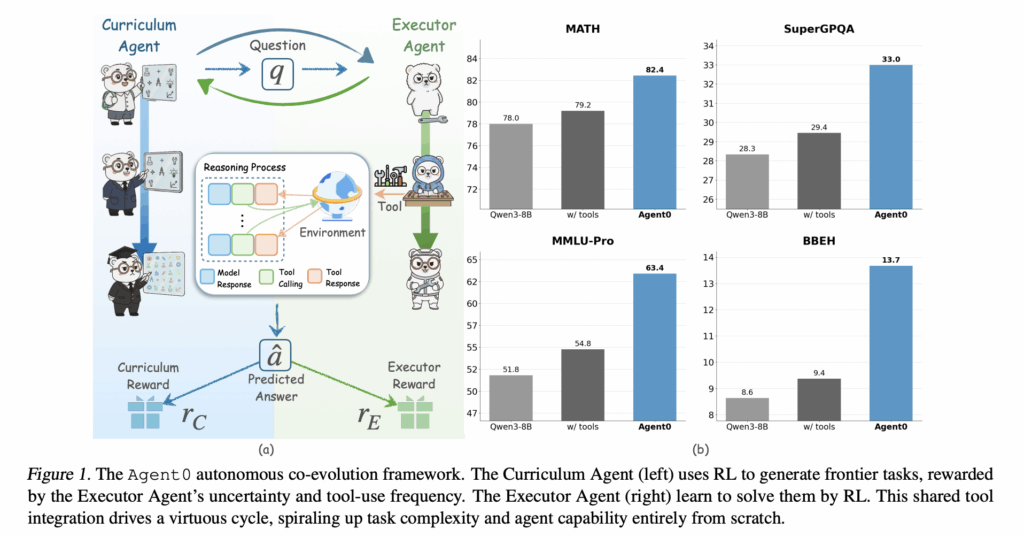
Large language models need huge human datasets, so what happens if the model must create all its own curriculum and teach itself to use tools? A team of researchers from UNC-Chapel Hill, Salesforce Research and Stanford University introduce ‘Agent0’, a fully autonomous framework that evolves high-performing agents without external data through multi-step co-evolution and seamless tool integration Agent0 targets mathematical and general reasoning. It shows that careful task generation and tool integrated rollouts can push a base model beyond its original capabilities, across ten benchmarks. https://arxiv.org/pdf/2511.16043 Two agents from one base model Agent0 starts from a base policy π_base, for example Qwen3 4B Base or Qwen3 8B Base. It clones this policy into: a Curriculum Agent πθ that generates tasks, an Executor Agent πϕ that solves those tasks with a Python tool. Training proceeds in iterations with two stages per iteration: Curriculum evolution: The curriculum agent generates a batch of tasks. For each task, the executor samples multiple responses. A composite reward measures how uncertain the executor is, how often it uses the tool and how diverse the batch is. πθ is updated with Group Relative Policy Optimization (GRPO) using this reward. Executor evolution: The trained curriculum agent is frozen. It generates a large pool of tasks. Agent0 filters this pool to keep only tasks near the executor’s capability frontier, then trains the executor on these tasks using an ambiguity aware RL objective called Ambiguity Dynamic Policy Optimization (ADPO). This loop creates a feedback cycle. As the executor becomes stronger by using the code interpreter, the curriculum must generate more complex, tool reliant problems to keep its reward high. https://arxiv.org/pdf/2511.16043 How the curriculum agent scores tasks? The curriculum reward combines three signals: Uncertainty reward: For each generated task x, the executor samples k responses and majority votes a pseudo answer. Self consistency p̂(x) is the fraction of responses that agree with this majority. The reward is maximal when p̂ is close to 0.5 and low when tasks are too easy or too hard. This encourages tasks that are challenging but still solvable for the current executor. Tool use reward: The executor can trigger a sandboxed code interpreter using python tags and receives results tagged as output. Agent0 counts the number of tool calls in a trajectory and gives a scaled, capped reward, with a cap C set to 4 in experiments. This favors tasks that actually require tool calls rather than pure mental arithmetic. Repetition penalty: Within each curriculum batch, Agent0 measures pairwise similarity between tasks using a BLEU based distance. Tasks are clustered, and a penalty term increases with cluster size. This discourages the curriculum from generating many near duplicates. A composite reward multiplies a format check with a weighted sum of uncertainty and tool rewards minus the repetition penalty. This composite value feeds into GRPO to update πθ. How the executor learns from noisy self labels? The executor is also trained with GRPO but on multi turn, tool integrated trajectories and pseudo labels instead of ground truth answers. Frontier dataset construction: After curriculum training in an iteration, the frozen curriculum generates a large candidate pool. For each task, Agent0 computes self consistency p̂(x) with the current executor and keeps only tasks where p̂ lies in an informative band, for example between 0.3 and 0.8. This defines a challenging frontier dataset that avoids trivial or impossible problems. Multi turn tool integrated rollouts: For each frontier task, the executor generates a trajectory that can interleave: natural language reasoning tokens, python code segments, output tool feedback. Generation pauses when a tool call appears, executes the code in a sandboxed interpreter built on VeRL Tool, then resumes conditioned on the result. The trajectory terminates when the model produces a final answer inside {boxed …} tags. A majority vote across sampled trajectories defines a pseudo label and a terminal reward for each trajectory. ADPO, ambiguity aware RL: Standard GRPO treats all samples equally, which is unstable when labels come from majority voting on ambiguous tasks. ADPO modifies GRPO in two ways using p̂ as an ambiguity signal. It scales the normalized advantage with a factor that increases with self consistency, so trajectories from low confidence tasks contribute less. It sets a dynamic upper clipping bound for the importance ratio, which depends on self consistency. Empirical analysis shows that fixed upper clipping mainly affects low probability tokens. ADPO relaxes this bound adaptively, which improves exploration on uncertain tasks, as visualized by the up clipped token probability statistics. https://arxiv.org/pdf/2511.16043 Results on mathematical and general reasoning Agent0 is implemented on top of VeRL and evaluated on Qwen3 4B Base and Qwen3 8B Base. It uses a sandboxed Python interpreter as the single external tool. The research team evaluate on ten benchmarks: Mathematical reasoning: AMC, Minerva, MATH, GSM8K, Olympiad Bench, AIME24, AIME25. General reasoning: SuperGPQA, MMLU Pro, BBEH. They report pass@1 for most datasets and mean@32 for AMC and AIME tasks. For Qwen3 8B Base, Agent0 reaches: math average 58.2 versus 49.2 for the base model, overall general average 42.1 versus 34.5 for the base model. Agent0 also improves over strong data free baselines such as R Zero, Absolute Zero, SPIRAL and Socratic Zero, both with and without tools. On Qwen3 8B, it surpasses R Zero by 6.4 percentage points and Absolute Zero by 10.6 points on the overall average. It also beats Socratic Zero, which relies on external OpenAI APIs. Across three co evolution iterations, average math performance on Qwen3 8B increases from 55.1 to 58.2 and general reasoning also improves per iteration. This confirms stable self improvement rather than collapse. Qualitative examples show that curriculum tasks evolve from basic geometry questions to complex constraint satisfaction problems, while executor trajectories mix reasoning text with Python calls to reach correct answers. Key Takeaways Fully data free co evolution: Agent0 eliminates external datasets and human annotations. Two agents, a curriculum agent and an executor agent, are initialized from the same base LLM and co evolve only via reinforcement learning and a Python tool. Frontier curriculum from self

Agent0: A Fully Autonomous AI Framework that Evolves High-Performing Agents without External Data through Multi-Step Co-Evolution Read Post »

AI, Committee, ข่าว, Uncategorized

Selective Rotary Position Embedding

arXiv:2511.17388v1 Announce Type: new Abstract: Position information is essential for language modeling. In softmax transformers, Rotary Position Embeddings (textit{RoPE}) encode positions through textit{fixed-angle} rotations, while in linear transformers, order is handled via input-dependent (selective) gating that decays past key-value associations. Selectivity has generally been shown to improve language-related tasks. Inspired by this, we introduce textit{Selective RoPE}, an textit{input-dependent} rotary embedding mechanism, that generalizes textit{RoPE}, and enables rotation in textit{arbitrary angles} for both linear and softmax transformers. We show that softmax attention already performs a hidden form of these rotations on query-key pairs, uncovering an implicit positional structure. We further show that in state-space models and gated linear transformers, the real part manages forgetting while the imaginary part encodes positions through rotations. We validate our method by equipping gated transformers with textit{Selective RoPE}, demonstrating that its input-dependent rotations improve performance in language modeling and on difficult sequence tasks like copying, state tracking, and retrieval.

Selective Rotary Position Embedding Read Post »

AI, Committee, ข่าว, Uncategorized

An Efficient Computational Framework for Discrete Fuzzy Numbers Based on Total Orders

arXiv:2511.17080v1 Announce Type: cross Abstract: Discrete fuzzy numbers, and in particular those defined over a finite chain $L_n = {0, ldots, n}$, have been effectively employed to represent linguistic information within the framework of fuzzy systems. Research on total (admissible) orderings of such types of fuzzy subsets, and specifically those belonging to the set $mathcal{D}_1^{L_nrightarrow Y_m}$ consisting of discrete fuzzy numbers $A$ whose support is a closed subinterval of the finite chain $L_n = {0, 1, ldots, n}$ and whose membership values $A(x)$, for $x in L_n$, belong to the set $Y_m = { 0 = y_1

An Efficient Computational Framework for Discrete Fuzzy Numbers Based on Total Orders Read Post »

AI, Committee, ข่าว, Uncategorized

Cognitive BASIC: An In-Model Interpreted Reasoning Language for LLMs

arXiv:2511.16837v1 Announce Type: cross Abstract: Cognitive BASIC is a minimal, BASIC-style prompting language and in-model interpreter that structures large language model (LLM) reasoning into explicit, stepwise execution traces. Inspired by the simplicity of retro BASIC, we repurpose numbered lines and simple commands as an interpretable cognitive control layer. Modern LLMs can reliably simulate such short programs, enabling transparent multi-step reasoning inside the model. A natural-language interpreter file specifies command semantics, memory updates, and logging behavior. Our mental-model interpreter extracts declarative and procedural knowledge, detects contradictions, and produces resolutions when necessary. A comparison across three LLMs on a benchmark of knowledge extraction, conflict detection, and reasoning tasks shows that all models can execute Cognitive BASIC programs, with overall strong but not uniform performance.

Cognitive BASIC: An In-Model Interpreted Reasoning Language for LLMs Read Post »

AI, Committee, ข่าว, Uncategorized

NVIDIA AI Releases Nemotron-Elastic-12B: A Single AI Model that Gives You 6B/9B/12B Variants without Extra Training Cost

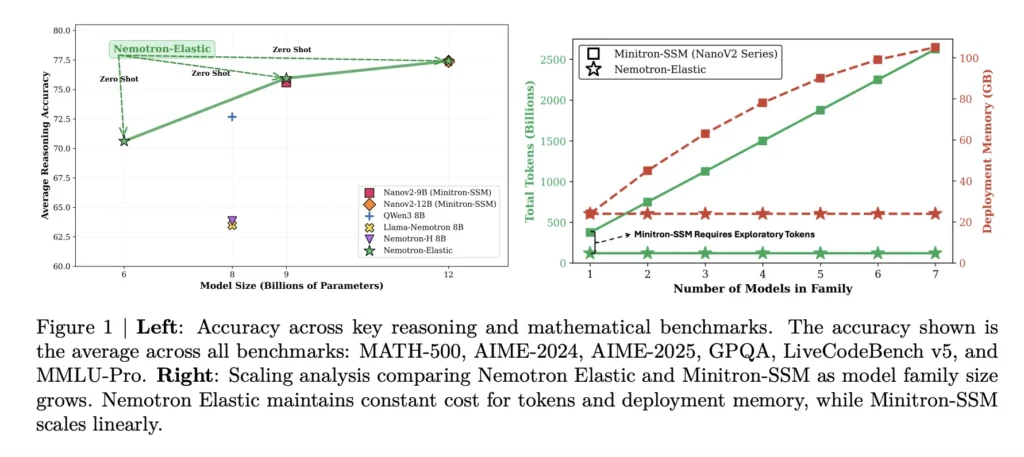
Why are AI dev teams still training and storing multiple large language models for different deployment needs when one elastic model can generate several sizes at the same cost? NVIDIA is collapsing the usual ‘model family’ stack into a single training job. NVIDIA AI team releases Nemotron-Elastic-12B, a 12B parameter reasoning model that embeds nested 9B and 6B variants in the same parameter space, so all three sizes come from one elastic checkpoint with no extra distillation runs per size. Many in one model family Most production systems need several model sizes, a larger model for server side workloads, a mid size model for strong edge GPUs, and a smaller model for tight latency or power budgets. The usual pipeline trains or distills each size separately, so token cost and checkpoint storage scale with the number of variants. Nemotron Elastic takes a different route. It starts from the Nemotron Nano V2 12B reasoning model and trains an elastic hybrid Mamba Attention network that exposes multiple nested submodels. The released Nemotron-Elastic-12B checkpoint can be sliced into 9B and 6B variants, Nemotron-Elastic-9B and Nemotron-Elastic-6B, using a provided slicing script, without any extra optimization. All variants share weights and routing metadata, so training cost and deployment memory are tied to the largest model, not to the number of sizes in the family. https://arxiv.org/pdf/2511.16664v1 Hybrid Mamba Transformer with elastic masks Architecturally, Nemotron Elastic is a Mamba-2 Transformer hybrid. The base network follows the Nemotron-H style design, where most layers are Mamba-2 based sequence state space blocks plus MLP, and a small set of attention layers preserve global receptive field. Elasticity is implemented by turning this hybrid into a dynamic model controlled by masks: Width, embedding channels, Mamba heads and head channels, attention heads, and FFN intermediate size can be reduced through binary masks. Depth, layers can be dropped according to a learned importance ordering, with residual paths preserving signal flow. A router module outputs discrete configuration choices per budget. These choices are converted to masks with Gumbel Softmax, then applied to embeddings, Mamba projections, attention projections, and FFN matrices. The research team adds several details to keep the SSM structure valid: Group aware SSM elastification that respects Mamba head and channel grouping. Heterogeneous MLP elastification where different layers can have distinct intermediate sizes. Normalized MSE based layer importance to decide which layers stay when depth is reduced. Smaller variants are always prefix selections in the ranked component lists, which makes the 6B and 9B models true nested subnetworks of the 12B parent. https://arxiv.org/pdf/2511.16664v1 Two stage training for reasoning workloads Nemotron Elastic is trained as a reasoning model with a frozen teacher. The teacher is the original Nemotron-Nano-V2-12B reasoning model. The elastic-12B student is optimized jointly for all three budgets, 6B, 9B, 12B, using knowledge distillation plus language modeling loss. Training runs in two stages: Stage 1: short context, sequence length 8192, batch size 1536, around 65B tokens, with uniform sampling over the three budgets. Stage 2: extended context, sequence length 49152, batch size 512, around 45B tokens, with non uniform sampling that favors the full 12B budget. https://arxiv.org/pdf/2511.16664v1 The second stage is important for reasoning tasks. The above table shows that for AIME 2025, the 6B model improves from 56.88 to 68.13, a 19.8 percent relative gain, while the 9B model gains 9.7 percent and the 12B model gains 4.0 percent after extended context training. Budget sampling is also tuned. In Stage 2, non uniform weights of 0.5, 0.3, 0.2 for 12B, 9B, 6B avoid degradation of the largest model and keep all variants competitive on Math 500, AIME 2025, and GPQA. Benchmark results Nemotron Elastic is evaluated on reasoning heavy benchmarks, MATH 500, AIME 2024, AIME 2025, GPQA, LiveCodeBench v5, and MMLU Pro. The below table summarizes pass at 1 accuracy. https://arxiv.org/pdf/2511.16664v1 The 12B elastic model matches the NanoV2-12B baseline on average, 77.41 versus 77.38, while also providing 9B and 6B variants from the same run. The 9B elastic model tracks the NanoV2-9B baseline closely, 75.95 versus 75.99. The 6B elastic model reaches 70.61, slightly below Qwen3-8B at 72.68 but still strong for its parameter count given that it is not trained separately. Training token and memory savings Nemotron Elastic targets the cost problem directly. The below table compares the token budgets needed to derive 6B and 9B models from a 12B parent: NanoV2 pretraining for 6B and 9B, 40T tokens total. NanoV2 Compression with Minitron SSM, 480B exploratory plus 270B final, 750B tokens. Nemotron Elastic, 110B tokens in a single elastic distillation run. https://arxiv.org/pdf/2511.16664v1 The research team reports that this gives around 360 times reduction versus training the two extra models from scratch, and around 7 times reduction versus the compression baseline. Deployment memory is reduced as well. The below table states that storing Nemotron Elastic 6B, 9B, and 12B together requires 24GB of BF16 weights, while storing NanoV2 9B plus 12B requires 42GB. This is a 43 percent memory reduction while also exposing an extra 6B size. https://arxiv.org/pdf/2511.16664v1 Comparison System Sizes (B) Avg reasoning score* Tokens for 6B + 9B BF16 memory Nemotron Elastic 6, 9, 12 70.61 / 75.95 / 77.41 110B 24GB NanoV2 Compression 9, 12 75.99 / 77.38 750B 42GB Qwen3 8 72.68 n / a n / a Key Takeaways Nemotron Elastic trains one 12B reasoning model that contains nested 9B and 6B variants which can be extracted zero shot without extra training. The elastic family uses a hybrid Mamba-2 and Transformer architecture plus a learned router that applies structured masks over width and depth to define each submodel. The approach needs 110B training tokens to derive 6B and 9B from the 12B parent which is about 7 times fewer tokens than the 750B token Minitron SSM compression baseline and about 360 times fewer than training extra models from scratch. On reasoning benchmarks such as MATH 500, AIME 2024 and 2025, GPQA, LiveCodeBench and MMLU Pro the 6B, 9B and 12B elastic models reach average scores of about 70.61, 75.95 and 77.41 which are on par

NVIDIA AI Releases Nemotron-Elastic-12B: A Single AI Model that Gives You 6B/9B/12B Variants without Extra Training Cost Read Post »

AI, Committee, ข่าว, Uncategorized

Lean4: How the theorem prover works and why it’s the new competitive edge in AI

Large language models (LLMs) have astounded the world with their capabilities, yet they remain plagued by unpredictability and hallucinations – confidently outputting incorrect information. In high-stakes domains like finance, medicine or autonomous systems, such unreliability is unacceptable. Enter Lean4, an open-source programming language and interactive theorem prover becoming a key tool to inject rigor and certainty into AI systems. By leveraging formal verification, Lean4 promises to make AI safer, more secure and deterministic in its functionality. Let’s explore how Lean4 is being adopted by AI leaders and why it could become foundational for building trustworthy AI. What is Lean4 and why it matters Lean4 is both a programming language and a proof assistant designed for formal verification. Every theorem or program written in Lean4 must pass a strict type-checking by Lean’s trusted kernel, yielding a binary verdict: A statement either checks out as correct or it doesn’t. This all-or-nothing verification means there’s no room for ambiguity – a property or result is proven true or it fails. Such rigorous checking “dramatically increases the reliability” of anything formalized in Lean4. In other words, Lean4 provides a framework where correctness is mathematically guaranteed, not just hoped for. This level of certainty is precisely what today’s AI systems lack. Modern AI outputs are generated by complex neural networks with probabilistic behavior. Ask the same question twice and you might get different answers. By contrast, a Lean4 proof or program will behave deterministically – given the same input, it produces the same verified result every time. This determinism and transparency (every inference step can be audited) make Lean4 an appealing antidote to AI’s unpredictability. Key advantages of Lean4’s formal verification: Precision and reliability: Formal proofs avoid ambiguity through strict logic, ensuring each reasoning step is valid and results are correct. Systematic verification: Lean4 can formally verify that a solution meets all specified conditions or axioms, acting as an objective referee for correctness. Transparency and reproducibility: Anyone can independently check a Lean4 proof, and the outcome will be the same – a stark contrast to the opaque reasoning of neural networks. In essence, Lean4 brings the gold standard of mathematical rigor to computing and AI. It enables us to turn an AI’s claim (“I found a solution”) into a formally checkable proof that is indeed correct. This capability is proving to be a game-changer in several aspects of AI development. Lean4 as a safety net for LLMs One of the most exciting intersections of Lean4 and AI is in improving LLM accuracy and safety. Research groups and startups are now combining LLMs’ natural language prowess with Lean4’s formal checks to create AI systems that reason correctly by construction. Consider the problem of AI hallucinations, when an AI confidently asserts false information. Instead of adding more opaque patches (like heuristic penalties or reinforcement tweaks), why not prevent hallucinations by having the AI prove its statements? That’s exactly what some recent efforts do. For example, a 2025 research framework called Safe uses Lean4 to verify each step of an LLM’s reasoning. The idea is simple but powerful: Each step in the AI’s chain-of-thought (CoT) translates the claim into Lean4’s formal language and the AI (or a proof assistant) provides a proof. If the proof fails, the system knows the reasoning was flawed – a clear indicator of a hallucination. This step-by-step formal audit trail dramatically improves reliability, catching mistakes as they happen and providing checkable evidence for every conclusion. The approach that has shown “significant performance improvement while offering interpretable and verifiable evidence” of correctness. Another prominent example is Harmonic AI, a startup co-founded by Vlad Tenev (of Robinhood fame) that tackles hallucinations in AI. Harmonic’s system, Aristotle, solves math problems by generating Lean4 proofs for its answers and formally verifying them before responding to the user. “[Aristotle] formally verifies the output… we actually do guarantee that there’s no hallucinations,” Harmonic’s CEO explains. In practical terms, Aristotle writes a solution in Lean4’s language and runs the Lean4 checker. Only if the proof checks out as correct does it present the answer. This yields a “hallucination-free” math chatbot – a bold claim, but one backed by Lean4’s deterministic proof checking. Crucially, this method isn’t limited to toy problems. Harmonic reports that Aristotle achieved a gold-medal level performance on the 2025 International Math Olympiad problems, the key difference that its solutions were formally verified, unlike other AI models that merely gave answers in English. In other words, where tech giants Google and OpenAI also reached human-champion level on math questions, Aristotle did so with a proof in hand. The takeaway for AI safety is compelling: When an answer comes with a Lean4 proof, you don’t have to trust the AI – you can check it. This approach could be extended to many domains. We could imagine an LLM assistant for finance that provides an answer only if it can generate a formal proof that it adheres to accounting rules or legal constraints. Or, an AI scientific adviser that outputs a hypothesis alongside a Lean4 proof of consistency with known physics laws. The pattern is the same – Lean4 acts as a rigorous safety net, filtering out incorrect or unverified results. As one AI researcher from Safe put it, “the gold standard for supporting a claim is to provide a proof,” and now AI can attempt exactly that. Building secure and reliable systems with Lean4 Lean4’s value isn’t confined to pure reasoning tasks; it’s also poised to revolutionize software security and reliability in the age of AI. Bugs and vulnerabilities in software are essentially small logic errors that slip through human testing. What if AI-assisted programming could eliminate those by using Lean4 to verify code correctness? In formal methods circles, it’s well known that provably correct code can “eliminate entire classes of vulnerabilities [and] mitigate critical system failures.” Lean4 enables writing programs with proofs of properties like “this code never crashes or exposes data.” However, historically, writing such verified code has been labor-intensive and required specialized expertise. Now, with

Lean4: How the theorem prover works and why it’s the new competitive edge in AI Read Post »

AI, Committee, ข่าว, Uncategorized

Moonshot AI Researchers Introduce Seer: An Online Context Learning System for Fast Synchronous Reinforcement Learning RL Rollouts

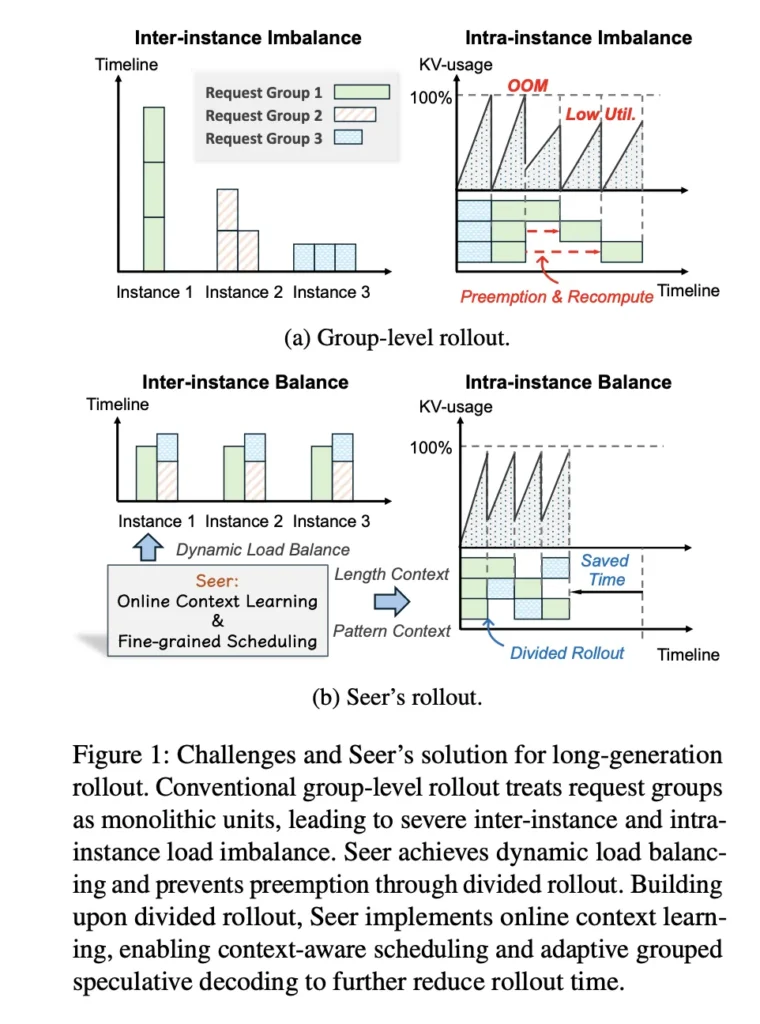
How do you keep reinforcement learning for large reasoning models from stalling on a few very long, very slow rollouts while GPUs sit under used? a team of researchers from Moonshot AI and Tsinghua University introduce ‘Seer’, a new online context learning system that targets a specific systems bottleneck in reinforcement learning for large language models. In synchronous on policy setups, the rollout phase dominates the cost of each iteration. Seer restructures this phase and reports rollout throughput gains of 74 percent to 97 percent and tail latency reductions of 75 percent to 93 percent compared with a strong synchronous baseline called veRL. https://arxiv.org/pdf/2511.14617 Why synchronous rollout is slow for reasoning models? Modern reasoning RL workloads use long chain of thought style outputs. In the Seer experiments, the researchers apply GRPO to three different models, Moonlight, Qwen2 VL 72B and Kimi K2. These workloads run on 32 compute nodes with 8 H800 GPUs per node. The three tasks use 32, 128 and 256 GPUs respectively, with 400, 600 and 800 prompts per iteration and 8 or 16 responses per prompt. Maximum generation length is large. Moonlight is configured for 65,536 tokens, Qwen2 VL 72B for 40,960 tokens and Kimi K2 for 98,304 tokens. A single long chain of thought request can grow from a few hundred megabytes of KVCache to tens of gigabytes as decoding progresses. This memory growth forces instances to reduce concurrency or to preempt requests, which triggers expensive re decoding. The research team defines tail requests as the last 10 percent of requests to finish in a rollout. For Moonlight and Qwen2 VL 72B, this tail alone can consume up to 50 percent of the total rollout time in the baseline system. Rollout already dominates iteration time, so this tail effect directly slows RL. https://arxiv.org/pdf/2511.14617 Seer architecture on top of Mooncake and vLLM Seer keeps the RL algorithm identical to synchronous veRL. Each training iteration uses only data from the current rollout iteration, so the system preserves on policy behavior. The training phase uses Megatron for distributed optimization. The rollout phase uses an in house implementation of vLLM as the inference engine. To support aggressive request scheduling, Seer relies on a Global KVCache Pool built on the Mooncake disaggregated KVCache architecture used in production for Kimi. Mooncake provides a two tier DRAM and SSD KV cache store shared across inference nodes, which allows Seer to migrate requests without recomputing prefills. On top of this substrate, Seer introduces three key mechanisms: Divided Rollout Context Aware Scheduling Adaptive Grouped Speculative Decoding These are orchestrated by a Request Buffer, a Context Manager and an Inference Engine Pool connected to the Global KVCache Pool. https://arxiv.org/pdf/2511.14617 Divided Rollout, fine grained scheduling and migration Conventional synchronous rollout assigns whole GRPO groups to inference instances. A group is a set of requests that share one prompt. Once assigned, a group stays on the same instance until all responses finish. Due to large variance in output lengths, this leads to load imbalance and long running stragglers. Seer breaks groups down in two steps. It first decomposes each group into individual requests. It then divides each request into multiple chunks based on generation length. When the scheduler dispatches a request from the Request Buffer, it sets a small max tokens value such as 8,000 tokens for that chunk. After each chunk, the request is re enqueued until it reaches an end of sequence token or its original max tokens limit. Because KVCache is stored in the Global KVCache Pool, divided requests can move between instances at chunk boundaries without re running the prefill. The scheduler maintains a concurrency level that keeps memory utilization high while avoiding preemption. This reduces waste and smooths KVCache usage across the iteration. Context Aware Scheduling using group length statistics The research team observe that different requests in the same group tend to have correlated output lengths. Seer uses this structure as online context. For each prompt group, it designates one request as the speculative request. The scheduler keeps speculative requests in a high priority queue and serves them with a smallest first policy based on generated tokens so far. Short requests complete quickly and exit. Long requests remain and identify groups that are potential tail candidates. The Context Manager maintains a length estimate for each group. It updates this estimate to the maximum generated length among completed requests in the group. If no request has finished, it uses the original max tokens as a conservative bound. Once speculative requests are in flight or done, Seer schedules remaining requests with an approximate longest first policy at group level. This design achieves throughput and tail behavior close to an oracle scheduler that knows all output lengths in advance. https://arxiv.org/pdf/2511.14617 Adaptive Grouped Speculative Decoding Seer adds Adaptive Grouped Speculative Decoding on top of the previous two components to accelerate decoding, especially for long requests in the tail. It introduces a Distributed Grouped Draft Server, or DGDS. DGDS maintains a Compressed Suffix Tree for each group and aggregates token sequences from all requests in that group. Instances asynchronously append generated tokens to DGDS, periodically fetch updated suffix trees and perform local speculative decoding based on the shared pattern statistics. The system adjusts draft length and the number of paths according to model architecture, batch size and measured acceptance length. For dense and Mixture of Experts models, it pre-computes different speculation thresholds and uses them to bound draft depth for each batch. In late tail stages, concurrency is low, so Seer increases draft depth and enables multi path drafting to raise accepted tokens per step. Ablation results show that divided rollout yields up to 35 percent throughput improvement over the baseline. Adding Context Aware Scheduling increases this to up to 47 percent over baseline. Enabling grouped speculative decoding raises the total speedup to 77 percent to 87 percent over the baseline in the evaluated iteration. End to end impact on RL training The research team evaluate Seer on three RL tasks built on Moonlight, Qwen2

Moonshot AI Researchers Introduce Seer: An Online Context Learning System for Fast Synchronous Reinforcement Learning RL Rollouts Read Post »

We use cookies to improve your experience and performance on our website. You can learn more at นโยบายความเป็นส่วนตัว and manage your privacy settings by clicking Settings.

ตั้งค่าความเป็นส่วนตัว

You can choose your cookie settings by turning on/off each type of cookie as you wish, except for essential cookies.

ยอมรับทั้งหมด
จัดการความเป็นส่วนตัว
  • เปิดใช้งานตลอด

บันทึกการตั้งค่า
th