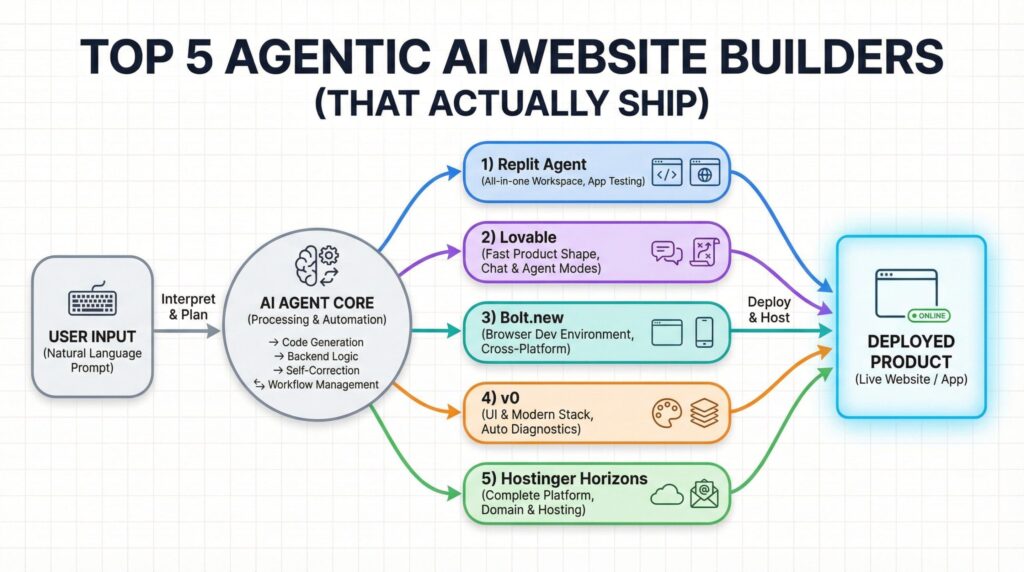
Top 5 Agentic AI Website Builders (That Actually Ship)
I have been building a payment platform using vibe coding, and I do not have a frontend background.
Top 5 Agentic AI Website Builders (That Actually Ship) Read Post »


I have been building a payment platform using vibe coding, and I do not have a frontend background.
Top 5 Agentic AI Website Builders (That Actually Ship) Read Post »

This is today’s edition of The Download, our weekday newsletter that provides a daily dose of what’s going on in the world of technology. What it’s like to be banned from the US for fighting online hate Just before Christmas the Trump administration dramatically escalated its war on digital rights by banning five people from entering the US. One of them, Josephine Ballon, is a director of HateAid, a small German nonprofit founded to support the victims of online harassment and violence. The organization is a strong advocate of EU tech regulations, and so finds itself attacked in campaigns from right-wing politicians and provocateurs who claim that it engages in censorship. EU officials, freedom of speech experts, and the five people targeted all flatly reject these accusations. Ballon told us that their work is fundamentally about making people feel safer online. But their experiences over the past few weeks show just how politicized and besieged their work in online safety has become. Read the full story. —Eileen Guo TR10: AI companions Chatbots are skilled at crafting sophisticated dialogue and mimicking empathetic behavior. They never get tired of chatting. It’s no wonder, then, that so many people now use them for companionship—forging friendships or even romantic relationships. 72% of US teenagers have used AI for companionship, according to a study from the nonprofit Common Sense Media. But while chatbots can provide much-needed emotional support and guidance for some people, they can exacerbate underlying problems in others—especially vulnerable people or those with mental health issues. Although some early attempts to regulate this space are underway, AI companionship is going nowhere. Read why we made it one of our 10 Breakthrough Technologies this year, and check out the rest of the list. And, if you want to learn more about what we predict for AI this year, sign up to join me for our free LinkedIn Live event tomorrow at 12.30pm ET. Why inventing new emotions feels so good Have you ever felt “velvetmist”? It’s a “complex and subtle emotion that elicits feelings of comfort, serenity, and a gentle sense of floating.” It’s peaceful, but more ephemeral and intangible than contentment. It might be evoked by the sight of a sunset or a moody, low-key album. If you haven’t ever felt this sensation—or even heard of it—that’s not surprising. A Reddit user generated it with ChatGPT, along with advice on how to evoke the feeling. Don’t scoff: Researchers say more and more terms for these “neo-emotions” are showing up online, describing new dimensions and aspects of feeling. Read our story to learn more about why. —Anya Kamenetz This story is from the latest print issue of MIT Technology Review. If you haven’t already, subscribe now to receive the next edition as soon as it lands (and benefit from some hefty seasonal discounts too!) The must-reads I’ve combed the internet to find you today’s most fun/important/scary/fascinating stories about technology. 1 Ads are coming to ChatGPT For American users initially, with plans to expand soon. (CNN)+ Here’s how they’ll work. (Wired $) 2 What will we be able to salvage after the AI bubble bursts? It will be ugly, but there are plenty of good uses for AI that we’ll want to keep. (The Guardian) + What even is the AI bubble? (MIT Technology Review) 3 It’s almost impossible to mine Greenland’s natural resources It has vast supplies of rare earth elements, but its harsh climate and environment make them very hard to access. (The Week) 4 Iran is now 10 days into its internet shutdownIt’s one of the longest and most extreme we’ve ever witnessed. (BBC)+ Starlink isn’t proving as helpful as hoped as the regime finds ways to jam it. (Reuters $)+ Battles are raging online about what’s really going on inside Iran. (NYT $) 5 America is heading for a polymarket disaster Prediction markets are getting out of control, and some people are losing a lot of money. (The Atlantic $)+ They were first embraced by political junkies, but now they’re everywhere. (NYT $) 6 How to fireproof a city Californians are starting to fight fires before they can even start. (The Verge $)+ How AI can help spot wildfires. (MIT Technology Review) 7 Stoking ‘deep state’ conspiracy theories can be dangerous Especially if you’re then given the task of helping run one of those state institutions, as Dan Bongino is now learning. (WP $)+ Why everything is a conspiracy now. (MIT Technology Review) 8 Why we’re suddenly all having a ‘Very Chinese Time’ It’s a fun, flippant trend—but it also shows how China’s soft power is growing around the globe. (Wired $) 9 Why there’s no one best way to store informationEach one involves trade-offs between space and time. (Quanta $) 10 Meat may play a surprising role in helping people reach 100Perhaps because it can assist with building stronger muscles and bones. (New Scientist $) Quote of the day “That’s the level of anxiety now – people watching the skies and the seas themselves because they don’t know what else to do.” —A Greenlander tells The Guardian just how seriously she and her fellow compatriots are taking Trump’s threat to invade their country. One more thing KATHERINE LAM Inside a romance scam compound—and how people get tricked into being there Gavesh’s journey started, seemingly innocently, with a job ad on Facebook promising work he desperately needed. Instead, he found himself trafficked into a business commonly known as “pig butchering”—a form of fraud in which scammers form close relationships with targets online and extract money from them. The Chinese crime syndicates behind the scams have netted billions of dollars, and they have used violence and coercion to force their workers, many of them trafficked like Gavesh, to carry out the frauds from large compounds, several of which operate openly in the quasi-lawless borderlands of Myanmar. Big Tech may hold the key to breaking up the scam syndicates—if these companies can be persuaded or compelled to act. Read the full story. —Peter Guest & Emily Fishbein We can still have nice things A place for comfort, fun and distraction to brighten up your day. (Got any ideas? Drop me a line or skeet ’em at me.) + Blue Monday isn’t real (but it is an absolute banger of a track.) + Some great advice here about
The Download: the US digital rights crackdown, and AI companionship Read Post »
In this tutorial, we build an end-to-end streaming voice agent that mirrors how modern low-latency conversational systems operate in real time. We simulate the complete pipeline, from chunked audio input and streaming speech recognition to incremental language model reasoning and streamed text-to-speech output, while explicitly tracking latency at every stage. By working with strict latency budgets and observing metrics such as time to first token and time to first audio, we focus on the practical engineering trade-offs that shape responsive voice-based user experiences. Check out the FULL CODES here. Copy CodeCopiedUse a different Browser import time import asyncio import numpy as np from collections import deque from dataclasses import dataclass from typing import List, AsyncIterator from enum import Enum import matplotlib.pyplot as plt @dataclass class LatencyMetrics: audio_chunk_received: float = 0.0 asr_started: float = 0.0 asr_partial: float = 0.0 asr_complete: float = 0.0 llm_started: float = 0.0 llm_first_token: float = 0.0 llm_complete: float = 0.0 tts_started: float = 0.0 tts_first_chunk: float = 0.0 tts_complete: float = 0.0 def get_time_to_first_audio(self) -> float: return self.tts_first_chunk – self.asr_complete if self.tts_first_chunk and self.asr_complete else 0.0 def get_total_latency(self) -> float: return self.tts_complete – self.audio_chunk_received if self.tts_complete else 0.0 @dataclass class LatencyBudgets: asr_processing: float = 0.1 asr_finalization: float = 0.3 llm_first_token: float = 0.5 llm_token_generation: float = 0.02 tts_first_chunk: float = 0.2 tts_chunk_generation: float = 0.05 time_to_first_audio: float = 1.0 class AgentState(Enum): LISTENING = “listening” PROCESSING_SPEECH = “processing_speech” THINKING = “thinking” SPEAKING = “speaking” INTERRUPTED = “interrupted” We define the core data structures and state representations that allow us to track latency across the entire voice pipeline. We formalize timing signals for ASR, LLM, and TTS to ensure consistent measurement across all stages. We also establish a clear agent state machine that guides how the system transitions during a conversational turn. Check out the FULL CODES here. Copy CodeCopiedUse a different Browser class AudioInputStream: def __init__(self, sample_rate: int = 16000, chunk_duration_ms: int = 100): self.sample_rate = sample_rate self.chunk_duration_ms = chunk_duration_ms self.chunk_size = int(sample_rate * chunk_duration_ms / 1000) async def stream_audio(self, text: str) -> AsyncIterator[np.ndarray]: chars_per_second = (150 * 5) / 60 duration_seconds = len(text) / chars_per_second num_chunks = int(duration_seconds * 1000 / self.chunk_duration_ms) for _ in range(num_chunks): chunk = np.random.randn(self.chunk_size).astype(np.float32) * 0.1 await asyncio.sleep(self.chunk_duration_ms / 1000) yield chunk We simulate real-time audio input by breaking speech into fixed-duration chunks that arrive asynchronously. We model realistic speaking rates and streaming behavior to mimic live microphone input. We use this stream as the foundation for testing downstream latency-sensitive components. Check out the FULL CODES here. Copy CodeCopiedUse a different Browser class StreamingASR: def __init__(self, latency_budget: float = 0.1): self.latency_budget = latency_budget self.silence_threshold = 0.5 async def transcribe_stream( self, audio_stream: AsyncIterator[np.ndarray], ground_truth: str ) -> AsyncIterator[tuple[str, bool]]: words = ground_truth.split() words_transcribed = 0 silence_duration = 0.0 chunk_count = 0 async for chunk in audio_stream: chunk_count += 1 await asyncio.sleep(self.latency_budget) if chunk_count % 3 == 0 and words_transcribed < len(words): words_transcribed += 1 yield ” “.join(words[:words_transcribed]), False audio_power = np.mean(np.abs(chunk)) silence_duration = silence_duration + 0.1 if audio_power < 0.05 else 0.0 if silence_duration >= self.silence_threshold: await asyncio.sleep(0.2) yield ground_truth, True return yield ground_truth, True We implement a streaming ASR module that produces partial transcriptions before emitting a final result. We progressively reveal words to reflect how modern ASR systems operate in real time. We also introduce silence-based finalization to approximate end-of-utterance detection. Check out the FULL CODES here. Copy CodeCopiedUse a different Browser class StreamingLLM: def __init__(self, time_to_first_token: float = 0.3, tokens_per_second: float = 50): self.time_to_first_token = time_to_first_token self.tokens_per_second = tokens_per_second async def generate_response(self, prompt: str) -> AsyncIterator[str]: responses = { “hello”: “Hello! How can I help you today?”, “weather”: “The weather is sunny with a temperature of 72°F.”, “time”: “The current time is 2:30 PM.”, “default”: “I understand. Let me help you with that.” } response = responses[“default”] for key in responses: if key in prompt.lower(): response = responses[key] break await asyncio.sleep(self.time_to_first_token) for word in response.split(): yield word + ” ” await asyncio.sleep(1.0 / self.tokens_per_second) class StreamingTTS: def __init__(self, time_to_first_chunk: float = 0.2, chars_per_second: float = 15): self.time_to_first_chunk = time_to_first_chunk self.chars_per_second = chars_per_second async def synthesize_stream(self, text_stream: AsyncIterator[str]) -> AsyncIterator[np.ndarray]: first_chunk = True buffer = “” async for text in text_stream: buffer += text if len(buffer) >= 20 or first_chunk: if first_chunk: await asyncio.sleep(self.time_to_first_chunk) first_chunk = False duration = len(buffer) / self.chars_per_second yield np.random.randn(int(16000 * duration)).astype(np.float32) * 0.1 buffer = “” await asyncio.sleep(duration * 0.5) In this snippet, we model a streaming language model and a streaming text-to-speech engine working together. We generate responses token by token to capture time-to-first-token behavior. We then convert incremental text into audio chunks to simulate early and continuous speech synthesis. Check out the FULL CODES here. Copy CodeCopiedUse a different Browser class StreamingVoiceAgent: def __init__(self, latency_budgets: LatencyBudgets): self.budgets = latency_budgets self.audio_stream = AudioInputStream() self.asr = StreamingASR(latency_budgets.asr_processing) self.llm = StreamingLLM( latency_budgets.llm_first_token, 1.0 / latency_budgets.llm_token_generation ) self.tts = StreamingTTS( latency_budgets.tts_first_chunk, 1.0 / latency_budgets.tts_chunk_generation ) self.state = AgentState.LISTENING self.metrics_history: List[LatencyMetrics] = [] async def process_turn(self, user_input: str) -> LatencyMetrics: metrics = LatencyMetrics() start_time = time.time() metrics.audio_chunk_received = time.time() – start_time audio_gen = self.audio_stream.stream_audio(user_input) metrics.asr_started = time.time() – start_time async for text, final in self.asr.transcribe_stream(audio_gen, user_input): if final: metrics.asr_complete = time.time() – start_time transcription = text metrics.llm_started = time.time() – start_time response = “” async for token in self.llm.generate_response(transcription): if not metrics.llm_first_token: metrics.llm_first_token = time.time() – start_time response += token metrics.llm_complete = time.time() – start_time metrics.tts_started = time.time() – start_time async def text_stream(): for word in response.split(): yield word + ” ” async for _ in self.tts.synthesize_stream(text_stream()): if not metrics.tts_first_chunk: metrics.tts_first_chunk = time.time() – start_time metrics.tts_complete = time.time() – start_time self.metrics_history.append(metrics) return metrics We orchestrate the full voice agent by wiring audio input, ASR, LLM, and TTS into a single asynchronous flow. We record precise timestamps at each transition to compute critical latency metrics. We treat each user turn as an isolated experiment to enable systematic performance analysis. Check out the FULL CODES here. Copy CodeCopiedUse a different Browser async def run_demo(): budgets = LatencyBudgets( asr_processing=0.08, llm_first_token=0.3, llm_token_generation=0.02, tts_first_chunk=0.15, time_to_first_audio=0.8 ) agent = StreamingVoiceAgent(budgets) inputs = [ “Hello, how are you today?”, “What’s
Microsoft Research has released OptiMind, an AI based system that converts natural language descriptions of complex decision problems into mathematical formulations that optimization solvers can execute. It targets a long standing bottleneck in operations research, where translating business intent into mixed integer linear programs usually needs expert modelers and days of work. What OptiMind Is And What It Outputs? OptiMind-SFT is a specialized 20B parameter Mixture of Experts model in the gpt oss transformer family. About 3.6B parameters are active per token, so inference cost is closer to a mid sized model while keeping high capacity. The context length is 128,000 tokens, which allows long specifications and multi step reasoning traces inside a single request. The model takes a natural language description of an optimization problem as input. The output is a mathematical formulation along with executable Python code that uses GurobiPy. The generated script defines decision variables, constraints, and objective, calls the Gurobi solver, and prints the optimal objective value and decisions. OptiMind acts as a formulation layer between domain experts and standard MILP solvers. It does not replace the solver, it generates the MILP that the solver will optimize. Architecture, Training Setup, And Datasets The base model is openai/gpt-oss-20b, fine tuned into microsoft/OptiMind-SFT using cleaned optimization datasets. The architecture is a Mixture of Experts transformer, with routing that activates a subset of experts per token. The model is released under the MIT license. Training uses 8 NVIDIA B200 GPUs, and inference and evaluation in the reference setup use 8 NVIDIA H100 GPUs. Reported fine tuning time is about 8 hours. For regular use, the team recommends at least 32 GB of GPU memory on hardware such as A100, H100, or B200. For supervised fine tuning, the research team construct cleaned versions of OR Instruct and OptMATH Train. For testing, they use expert validated and re-cleaned versions of IndustryOR, Mamo Complex, and OptMATH. These benchmarks cover hard formulation tasks where existing models often reach only 20 to 50 percent accuracy on the original noisy versions. Class Based Error Analysis And Data Cleaning A key technical idea in OptiMind is to combine optimization expertise with LLM training. The research team classifies problems from OR-Instruct and OptMATH into 53 seed classes, for example set cover, flow shop scheduling, or traveling salesman problem. For each class, they run the gpt-oss-20b-base model on a sample of problems and select instances where the model output disagrees with the ground truth. Optimization experts inspect these items, identify the recurring formulation mistakes, and write short error descriptions and preventive hints. These hints describe correct constraints, variable bounds, or modeling tricks, such as the proper Miller Tucker Zemlin constraints for TSP. The research team then uses a semi-automated pipeline. They regenerate solutions with a larger model that is prompted with the class specific hints, apply majority voting across samples to improve solution quality, and drop items that remain inconsistent. They also detect missing parameters and ambiguous statements and regenerate problem descriptions when needed. The result is a cleaned training corpus that is better aligned with correct mathematical formulations. Inference Pipeline, Hints, And Test Time Scaling At inference time, OptiMind behaves as a multi stage system, not just a single prompt. The default pipeline first classifies each test instance into one of the 53 optimization classes used during error analysis. It then augments the prompt with the error summary and hint pairs associated with that class. The model then generates a reasoning trace, the mathematical formulation, and the GurobiPy code. When more compute is available, the system can apply self consistency with majority voting. It generates several candidate scripts, executes them, and selects the solution that appears most often within set numerical tolerances. A multi turn correction mode can also be enabled. The system runs the generated code, captures solver logs or execution errors, feeds this feedback back to the model, and lets the model revise the formulation and code for a few rounds. This closes some modeling and coding errors at the cost of higher latency. Quantitative Gains On Optimization Benchmarks On cleaned versions of IndustryOR, Mamo-Complex, and OptMATH, the OptiMind framework significantly improves solution accuracy. The fine-tuned model improves formulation accuracy by 20.7 percent across multiple optimization benchmarks, with further gains when test time scaling techniques such as self consistency and multi turn feedback are applied. Across these benchmarks, OptiMind improves absolute accuracy over the gpt-oss-20b-base model and outperforms other open source models of similar or larger size. It reaches performance that is competitive with proprietary frontier models such as GPT-o4 mini and GPT-5 under the evaluation settings. These results rely on careful cleaning of both training and test data. The research team report that many apparent model errors on original benchmarks actually came from missing data, ambiguous descriptions, or incorrect reference solutions, and that re-cleaning can lift apparent accuracy for a fixed model from about 40 to 60 percent into the 70 to 90 percent range on the corrected sets. Key Takeaways OptiMind is a 20B parameter Mixture of Experts transformer in the gpt-oss-family that takes natural language optimization problems as input and outputs both a mathematical formulation and executable GurobiPy code, with about 3.6B parameters activated per token and a 128,000 token context length. The model is fine tuned from openai/gpt-oss-20b on cleaned optimization datasets such as OR-Instruct and OptMATH, and evaluated on expert validated benchmarks including IndustryOR and Mamo Complex, focusing on mixed integer linear programming formulations. OptiMind uses class based error analysis and expert written hints for 53 optimization classes, then applies these hints both in data cleaning and at inference time, which systematically reduces common modeling mistakes in generated MILPs. The framework improves formulation accuracy by 20.7 percent across multiple optimization benchmarks compared to the base model, and with test time scaling methods such as self consistency and multi turn feedback it reaches performance that is competitive with larger proprietary systems. OptiMind-SFT is released as microsoft/OptiMind-SFT on Hugging Face and as microsoft-optimind-sft in Azure AI Foundry, where it can be
arXiv:2601.11020v1 Announce Type: new Abstract: Advances in mechanistic interpretability have identified special attention heads, known as retrieval heads, that are responsible for retrieving information from the context. However, the role of these retrieval heads in improving model performance remains unexplored. This work investigates whether retrieval heads can be leveraged to enhance the long-context capabilities of LLMs. Specifically, we propose RetMask, a method that generates training signals by contrasting normal model outputs with those from an ablated variant in which the retrieval heads are masked. This mechanism-based approach achieves substantial improvements: +2.28 points on HELMET at 128K for Llama-3.1, with +70% gains on generation with citation and +32% on passage re-ranking, while preserving performance on general tasks. Experiments across three model families reveal that the effectiveness depends on retrieval head organization: models with concentrated patterns of retrieval heads respond strongly, while those with distributed patterns show limited gains. This mechanistic relationship validates the function of retrieval heads and demonstrates that mechanistic insights can be transformed into performance enhancements.
arXiv:2512.17776v2 Announce Type: replace Abstract: As large language models advance, deep research systems capable of generating expert-level reports through multi-step reasoning and evidence-based synthesis are emerging. However, evaluating such reports remains challenging. Existing benchmarks often lack systematic evaluation criteria, rely heavily on LLM-based judges that may miss issues requiring expert judgment, and verify only a limited subset of explicitly cited statements rather than report-wide factual reliability. To address these limitations, we introduce DEER, a benchmark for evaluating expert-level deep research reports. DEER comprises 50 report-writing tasks spanning 13 domains, along with an expert-grounded evaluation taxonomy with seven dimensions and 25 subdimensions, operationalized into 101 fine-grained rubric items. To improve evaluation consistency, DEER provides task-specific Expert Evaluation Guidance to support LLM-based judging. Complementing rubric-based assessment, we propose a document-level fact-checking architecture that verifies both cited and uncited claims and quantifies the quality and reliability of the supporting evidence. Experimental results show that DEER exhibits strong correlation with human expert judgments and yields interpretable diagnostics of system strengths and weaknesses.
DEER: A Benchmark for Evaluating Deep Research Agents on Expert Report Generation Read Post »
arXiv:2601.10321v2 Announce Type: replace Abstract: Finding the most relevant person for a job proposal in real time is challenging, especially when resumes are long, structured, and multilingual. In this paper, we propose a re-ranking model based on a new generation of late cross-attention architecture, that decomposes both resumes and project briefs to efficiently handle long-context inputs with minimal computational overhead. To mitigate historical data biases, we use a generative large language model (LLM) as a teacher, generating fine-grained, semantically grounded supervision. This signal is distilled into our student model via an enriched distillation loss function. The resulting model produces skill-fit scores that enable consistent and interpretable person-job matching. Experiments on relevance, ranking, and calibration metrics demonstrate that our approach outperforms state-of-the-art baselines.
arXiv:2601.10532v2 Announce Type: replace Abstract: Large Language Models (LLMs) are increasingly deployed in human-centric applications, yet they often fail to provide substantive emotional support. While Reinforcement Learning (RL) has been utilized to enhance empathy of LLMs, existing reward models typically evaluate empathy from a single perspective, overlooking the inherently bidirectional interaction nature of empathy between the supporter and seeker as defined by Empathy Cycle theory. To address this limitation, we propose Psychology-grounded Empathetic Reward Modeling (PERM). PERM operationalizes empathy evaluation through a bidirectional decomposition: 1) Supporter perspective, assessing internal resonation and communicative expression; 2) Seeker perspective, evaluating emotional reception. Additionally, it incorporates a bystander perspective to monitor overall interaction quality. Extensive experiments on a widely-used emotional intelligence benchmark and an industrial daily conversation dataset demonstrate that PERM outperforms state-of-the-art baselines by over 10%. Furthermore, a blinded user study reveals a 70% preference for our approach, highlighting its efficacy in generating more empathetic responses. Our code, dataset, and models are available at https://github.com/ZhengWwwq/PERM.
PERM: Psychology-grounded Empathetic Reward Modeling for Large Language Models Read Post »
It was early evening in Berlin, just a day before Christmas Eve, when Josephine Ballon got an unexpected email from US Customs and Border Protection. The status of her ability to travel to the United States had changed—she’d no longer be able to enter the country. At first, she couldn’t find any information online as to why, though she had her suspicions. She was one of the directors of HateAid, a small German nonprofit founded to support the victims of online harassment and violence. As the organization has become a strong advocate of EU tech regulations, it has increasingly found itself attacked in campaigns from right-wing politicians and provocateurs who claim that it engages in censorship. It was only later that she saw what US Secretary of State Marco Rubio had posted on X: For far too long, ideologues in Europe have led organized efforts to coerce American platforms to punish American viewpoints they oppose. The Trump Administration will no longer tolerate these egregious acts of extraterritorial censorship. Today, @StateDept will take steps to… — Secretary Marco Rubio (@SecRubio) December 23, 2025 Rubio was promoting a conspiracy theory about what he has called the “censorship-industrial complex,” which alleges widespread collusion between the US government, tech companies, and civil society organizations to silence conservative voices—the very conspiracy theory HateAid has recently been caught up in. Then Undersecretary of State Sarah B. Rogers posted on X the names of the individuals targeted by travel bans. The list included Ballon, as well as her HateAid co-director, Anna Lena von Hodenberg. Also named were three others doing similar or related work: former EU commissioner Thierry Breton, who had helped author Europe’s Digital Services Act (DSA); Imran Ahmed of the Center for Countering Digital Hate, which documents hate speech on social media platforms; and Clare Melford of the Global Disinformation Index, which provides risk ratings warning advertisers about placing ads on websites promoting hate speech and disinformation. It was an escalation in the Trump administration’s war on digital rights—fought in the name of free speech. But EU officials, freedom of speech experts, and the five individuals targeted all flatly reject the accusations of censorship. Ballon, von Hodenberg, and some of their clients tell me that their work is fundamentally about making people feel safer online. And their experiences over the past few weeks show just how politicized and besieged their work in online safety has become. They almost certainly won’t be the last people targeted in this way. Ballon was the one to tell von Hodenberg that both their names were on the list. “We kind of felt a chill in our bones,” von Hodenberg told me when I caught up with the pair in early January. But she added that they also quickly realized, “Okay, it’s the old playbook to silence us.” So they got to work—starting with challenging the narrative the US government was pushing about them. Within a few hours, Ballon and von Hodenberg had issued a strongly worded statement refuting the allegations: “We will not be intimidated by a government that uses accusations of censorship to silence those who stand up for human rights and freedom of expression,” they wrote. “We demand a clear signal from the German government and the European Commission that this is unacceptable. Otherwise, no civil society organisation, no politician, no researcher, and certainly no individual will dare to denounce abuses by US tech companies in the future.” Those signals came swiftly. On X, Johann Wadephul, the German foreign minister, called the entry bans “not acceptable,” adding that “the DSA was democratically adopted by the EU, for the EU—it does not have extraterritorial effect.” Also on X, French president Emmanuel Macron wrote that “these measures amount to intimidation and coercion aimed at undermining European digital sovereignty.” The European Commission issued a statement that it “strongly condemns” the Trump administration’s actions and reaffirmed its “sovereign right to regulate economic activity in line with our democratic values.” Ahmed, Melford, Breton, and their respective organizations also made their own statements denouncing the entry bans. Ahmed, the only one of the five based in the United States, also successfully filed suit to preempt any attempts to detain him, which the State Department had indicated it would consider doing. But alongside the statements of solidarity, Ballon and von Hodenberg said, they also received more practical advice: Assume the travel ban was just the start and that more consequences could be coming. Service providers might preemptively revoke access to their online accounts; banks might restrict their access to money or the global payment system; they might see malicious attempts to get hold of their personal data or that of their clients. Perhaps, allies told them, they should even consider moving their money into friends’ accounts or keeping cash on hand so that they could pay their team’s salaries—and buy their families’ groceries. These warnings felt particularly urgent given that just days before, the Trump administration had sanctioned two International Criminal Court judges for “illegitimate targeting of Israel.” As a result, they had lost access to many American tech platforms, including Microsoft, Amazon, and Gmail. “If Microsoft does that to someone who is a lot more important than we are,” Ballon told me, “they will not even blink to shut down the email accounts from some random human rights organization in Germany.” “We have now this dark cloud over us that any minute, something can happen,” von Hodenberg added. “We’re running against time to take the appropriate measures.” Helping navigate “a lawless place” Founded in 2018 to support people experiencing digital violence, HateAid has since evolved to defend digital rights more broadly. It provides ways for people to report illegal online content and offers victims advice, digital security, emotional support, and help with evidence preservation. It also educates German police, prosecutors, and politicians about how to handle online hate crimes. Once the group is contacted for help, and if its lawyers determine that the type of harassment has likely violated the law, the
What it’s like to be banned from the US for fighting online hate Read Post »
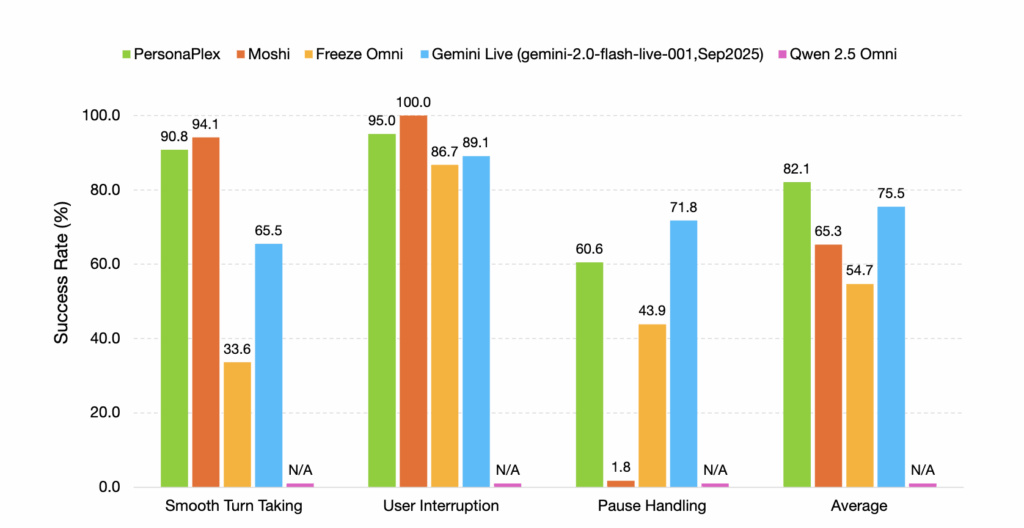
NVIDIA Researchers released PersonaPlex-7B-v1, a full duplex speech to speech conversational model that targets natural voice interactions with precise persona control. From ASR→LLM→TTS to a single full duplex model Conventional voice assistants usually run a cascade. Automatic Speech Recognition (ASR) converts speech to text, a language model generates a text answer, and Text to Speech (TTS) converts back to audio. Each stage adds latency, and the pipeline cannot handle overlapping speech, natural interruptions, or dense backchannels. PersonaPlex replaces this stack with a single Transformer model that performs streaming speech understanding and speech generation in one network. The model operates on continuous audio encoded with a neural codec and predicts both text tokens and audio tokens autoregressively. Incoming user audio is incrementally encoded, while PersonaPlex simultaneously generates its own speech, which enables barge in, overlaps, rapid turn taking, and contextual backchannels. PersonaPlex runs in a dual stream configuration. One stream tracks user audio, the other stream tracks agent speech and text. Both streams share the same model state, so the agent can keep listening while speaking and can adjust its response when the user interrupts. This design is directly inspired by Kyutai’s Moshi full duplex framework. Hybrid prompting, voice control and role control PersonaPlex uses two prompts to define the conversational identity. The voice prompt is a sequence of audio tokens that encodes vocal characteristics, speaking style, and prosody. The text prompt describes role, background, organization information, and scenario context. Together, these prompts constrain both the linguistic content and the acoustic behavior of the agent. On top of this, a system prompt supports fields such as name, business name, agent name, and business information, with a budget up to 200 tokens. Architecture, Helium backbone and audio path The PersonaPlex model has 7B parameters and follows the Moshi network architecture. A Mimi speech encoder that combines ConvNet and Transformer layers converts waveform audio into discrete tokens. Temporal and depth Transformers process multiple channels that represent user audio, agent text, and agent audio. A Mimi speech decoder that also combines Transformer and ConvNet layers generates the output audio tokens. Audio uses a 24 kHz sample rate for both input and output. PersonaPlex is built on Moshi weights and uses Helium as the underlying language model backbone. Helium provides semantic understanding and enables generalization outside the supervised conversational scenarios. This is visible in the ‘space emergency’ example, where a prompt about a reactor core failure on a Mars mission leads to coherent technical reasoning with appropriate emotional tone, even though this situation is not part of the training distribution. Training data blend, real conversations and synthetic roles Training has 1 stage and uses a blend of real and synthetic dialogues. Real conversations come from 7,303 calls, about 1,217 hours, in the Fisher English corpus. These conversations are back annotated with prompts using GPT-OSS-120B. The prompts are written at different granularity levels, from simple persona hints like ‘You enjoy having a good conversation’ to longer descriptions that include life history, location, and preferences. This corpus provides natural backchannels, disfluencies, pauses, and emotional patterns that are difficult to obtain from TTS alone. Synthetic data covers assistant and customer service roles. NVIDIA team reports 39,322 synthetic assistant conversations, about 410 hours, and 105,410 synthetic customer service conversations, about 1,840 hours. Qwen3-32B and GPT-OSS-120B generate the transcripts, and Chatterbox TTS converts them to speech. For assistant interactions, the text prompt is fixed as ‘You are a wise and friendly teacher. Answer questions or provide advice in a clear and engaging way.’ For customer service scenarios, prompts encode organization, role type, agent name, and structured business rules such as pricing, hours, and constraints. This design lets PersonaPlex disentangle natural conversational behavior, which comes mainly from Fisher, from task adherence and role conditioning, which come mainly from synthetic scenarios. Evaluation on FullDuplexBench and ServiceDuplexBench PersonaPlex is evaluated on FullDuplexBench, a benchmark for full duplex spoken dialogue models, and on a new extension called ServiceDuplexBench for customer service scenarios. FullDuplexBench measures conversational dynamics with Takeover Rate and latency metrics for tasks such as smooth turn taking, user interruption handling, pause handling, and backchanneling. GPT-4o serves as an LLM judge for response quality in question answering categories. PersonaPlex reaches smooth turn taking TOR 0.908 with latency 0.170 seconds and user interruption TOR 0.950 with latency 0.240 seconds. Speaker similarity between voice prompts and outputs on the user interruption subset uses WavLM TDNN embeddings and reaches 0.650. PersonaPlex outperforms many other open source and closed systems on conversational dynamics, response latency, interruption latency, and task adherence in both assistant and customer service roles. https://research.nvidia.com/labs/adlr/personaplex/ Key Takeaways PersonaPlex-7B-v1 is a 7B parameter full duplex speech to speech conversational model from NVIDIA, built on the Moshi architecture with a Helium language model backbone, code under MIT and weights under the NVIDIA Open Model License. The model uses a dual stream Transformer with Mimi speech encoder and decoder at 24 kHz, it encodes continuous audio into discrete tokens and generates text and audio tokens at the same time, which enables barge in, overlaps, fast turn taking, and natural backchannels. Persona control is handled by hybrid prompting, a voice prompt made of audio tokens sets timbre and style, a text prompt and a system prompt of up to 200 tokens defines role, business context, and constraints, with ready made voice embeddings such as NATF and NATM families. Training uses a blend of 7,303 Fisher conversations, about 1,217 hours, annotated with GPT-OSS-120B, plus synthetic assistant and customer service dialogs, about 410 hours and 1,840 hours, generated with Qwen3-32B and GPT-OSS-120B and rendered with Chatterbox TTS, which separates conversational naturalness from task adherence. On FullDuplexBench and ServiceDuplexBench, PersonaPlex reaches smooth turn taking takeover rate 0.908 and user interruption takeover rate 0.950 with sub second latency and improved task adherence. Check out the Technical details, Model weights and Repo. Also, feel free to follow us on Twitter and don’t forget to join our 100k+ ML SubReddit and Subscribe to our Newsletter. Wait! are you on telegram? now you can join us on telegram as well. The post NVIDIA
We use cookies to improve your experience and performance on our website. You can learn more at นโยบายความเป็นส่วนตัว and manage your privacy settings by clicking Settings.


