YouZum

Uncategorized

AI, Committee, ニュース, Uncategorized

The Download: climate tech goes public and the AI Hype Index returns

This is today’s edition of The Download, our weekday newsletter that provides a daily dose of what’s going on in the world of technology. Climate tech companies are going public. What’s next? Solar and battery company Solv Energy went public in February, hitting a $6 billion valuation. X-energy, which builds small modular nuclear reactors, followed at $11.5 billion. Then came geothermal company Fervo Energy, reaching a market cap of about $12.4 billion. All three have been IPO success stories. And it doesn’t feel like a coincidence that they’re racing to provide electricity in an era of rising demand, driven partly by data centers. What does this boom reveal about the future of the grid? And what comes next? Read the full story to find out. —Casey Crownhart This story is from The Spark, our weekly newsletter giving you the inside track on all things climate. Sign up to receive it in your inbox every Wednesday. The AI Hype Index Separating AI reality from hyped-up fiction isn’t always easy. That’s why we’ve created the AI Hype Index—a simple, at-a-glance summary of what’s shaping the industry right now. The latest edition includes billionaire road trips, students booing, made-up quotes, and too much sci-fi. See where it all landed on this month’s index. The must-reads I’ve combed the internet to find you today’s most fun/important/scary/fascinating stories about technology. 1 Illinois just passed what could become America’s strongest AI safety lawIt would require third-party safety audits. (Wired $)+ But it still needs the governor’s approval. (NBC News)+ The US is divided over AI regulation. (MIT Technology Review) 2 A Google engineer has been charged with insider tradingHe allegedly bet on who’d be the most-searched people of 2025 on Polymarket. (BBC)+ And used internal data to rack up more than $1.2 million in winnings. (Verge)+ He’s been charged with fraud and money laundering over the bets. (NPR) 3 ByteDance is developing custom CPUs amid a massive AI chip squeezeThe TikTok owner is struggling with severe supply shortages. (Reuters $)+ Google, Amazon, and Microsoft are also building custom CPUs. (CNBC)+ Taiwan’s “silicon shield” could be weakening. (MIT Technology Review) 4 Four tech giants have backed a clean energy push for AI data centersAmazon, Google, Meta, and Microsoft have joined the initiative. (Quartz)+ Investor Elemental Impact will deploy up to $5 million per project. (Axios) 5 Nvidia’s CEO is joining the board of Beijing’s Tsinghua UniversityHis appointment comes as Nvidia struggles to export chips to China. (FT $)+ President Xi is an alumnus of Tsinghua, aka “China’s Harvard.” (Reuters $) 6 The Trump administration is in talks to fund drone firmsOne of which counts Donald Trump Jr. as a shareholder. (WSJ $)+ Drone dominance has been described ​as a “presidential priority.” (Reuters $) 7 London has reclaimed its position as Europe’s leading tech hubIt’s overtaken Paris in new global rankings. (Euronews)+ And now sits fourth, behind the Bay Area, New York and Boston. (Reuters $) 8 OpenAI and Anthropic disagree over AI’s impact on jobsAnthropic is emphasizing the risks, while OpenAI is sounding rosier. (Axios)+ The AI jobs hysteria needs a reality check. (MIT Technology Review) 9 Researchers claim to have achieved perfect randomness for the first timeThanks to entangled quantum chips. (Interesting Engineering)+ The milestone could lead to better cybersecurity. (Scientific American) 10 Embryo organoids are showing why many pregnancies failThey’ve led to improvements in IVF and pregnancy treatments. (New Scientist $)+ New tech is transforming reproductive medicine. (MIT Technology Review) Quote of the day “How can we be happy about Google coming? We’ll all be scattered. It feels very sad.” —Pyla Kondamma, a 42-year-old in Visakhapatnam, India, tells the Wall Street Journal her concerns about Google building data centers in her city. One More Thing NICO ORTEGA Why venture capital doesn’t build the things we really need Venture capital has been the engine of US innovation for years. This largely white, largely male corner of finance has backed software companies that grow fast—but generate large amounts of money for a shrinking number of Americans. It’s also creating fewer jobs for ordinary people. And recently, venture capitalists have struggled to find ideas that fit their preferred pattern. Here’s what’s going wrong with the funding model that made Silicon Valley a global hub. —Elizabeth MacBride We can still have nice things A place for comfort, fun, and distraction to brighten up your day. (Got any ideas? Drop me a line.) + Never miss a great movie again with this worldwide release tracker.+ These quirky word puzzles use emoji hints to help you find answers.+ The digital museum of plugs and sockets is a treasure trove of global connectors.+ Michael Jackson’s “Smooth Criminal” becomes a Bach-style fugue played on classical guitar.

The Download: climate tech goes public and the AI Hype Index returns 投稿を読む »
AI, Committee, ニュース, Uncategorized

NVIDIA Releases Polar, a Token-Faithful Rollout Framework for GRPO Training Across Codex, Claude Code, and Qwen Code

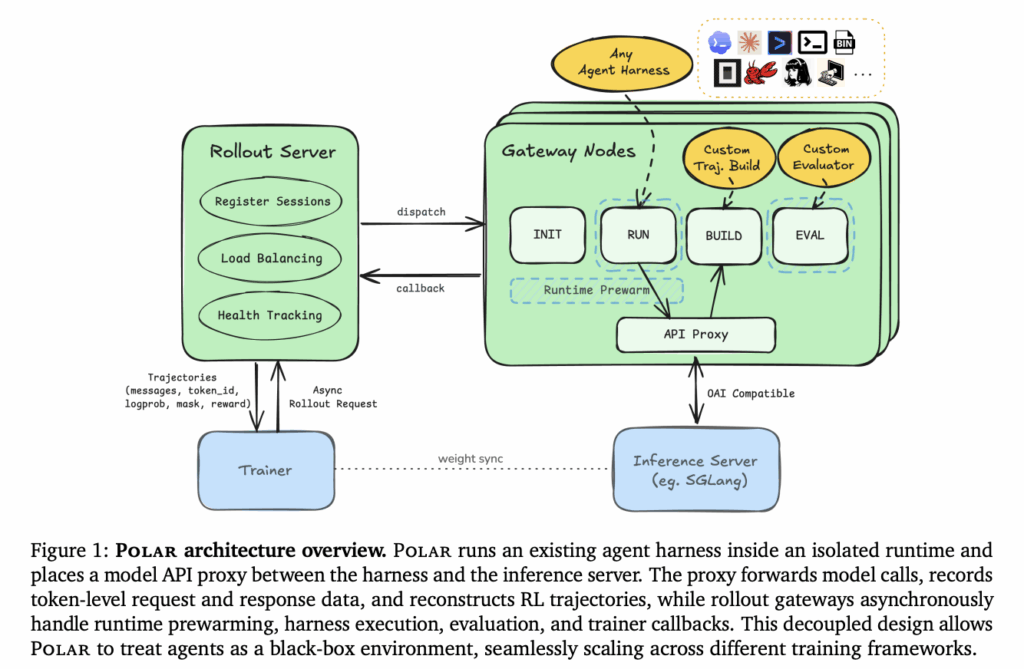
Reinforcement learning for language agents is growing more complex. Agents now manage multi-turn tool use, long-running contexts, and multi-agent orchestration. The main engineering challenge is connecting existing agent software to training pipelines without breaking how those tools work. NVIDIA’s research team introduced Polar, a rollout framework that lets researchers run reinforcement learning over any agent harness without modifying that harness. The Core Problem Polar Solves An ‘agent harness’ is a tool like Codex CLI, Claude Code, Qwen Code, or Pi. These harnesses manage system prompts, tool formatting, context engineering, and how the agent submits patches. These details directly affect agent behavior at evaluation time. Traditional RL infrastructure requires harness logic to be rewritten behind a framework-owned environment API — typically env.init(), env.step(), env.reset() in the OpenAI Gym style. Every new harness requires new integration code. That integration can also lose execution details specific to the native harness path. Polar’s key observation is that every LLM-based agent must call a model. That model API boundary is a common interface outside the agent itself. Instead of integrating inside the harness, Polar places a proxy at that boundary. How the Proxy Works For each incoming model request, the gateway proxy performs four steps: Detect the provider API — using the request path and headers, it distinguishes Anthropic Messages, OpenAI Chat Completions, OpenAI Responses, and Google generateContent-style calls. Normalize the request — converts roles, content parts, tool definitions, and generation parameters into the OpenAI Chat Completions shape used by the local inference server. Capture token-level data — stores request messages, response messages, prompt token IDs, sampled response token IDs, finish reason, and log probabilities. Return the provider shape — transforms the response back into the schema the harness expects. For streaming requests, Polar obtains a non-streaming upstream response and emits a synthetic provider-shaped stream. This preserves compatibility with harnesses that expect server-sent events while ensuring complete token capture. The only required change to an existing harness is pointing its model base URL at the gateway. https://arxiv.org/pdf/2605.24220 Architecture: Rollout Server and Gateway Nodes Polar has two core components: The rollout server accepts a TaskRequest and expands it into num_samples independent sessions. Each session carries a session ID, task ID, timeout budget, runtime specification, agent specification, trajectory builder, evaluator, and callback URL. The server dispatches sessions to gateway nodes and accepts callbacks when sessions complete. Gateway nodes own the lifecycle of each session — starting the runtime, running the harness, building trajectories, evaluating output, and teardown. The gateway also hosts the proxy endpoint for that session’s model calls, keeping completion capture tied to the session registry. Within each gateway, isolated worker pools handle INIT, RUNNING, and POSTRUN stages. A bounded READY buffer holds initialized runtimes until a run slot is available. CPU-heavy runtime preparation and evaluator prewarm proceed off the critical path, without blocking active GPU-bound agent execution. If a harness times out after model calls have been captured, the gateway still enters POSTRUN so partial traces can be recovered. Built-in evaluators include a session-completion reward, a configurable test-on-output evaluator, and a SWE-Bench/SWE-Gym harness evaluator. Custom evaluators can be added through a registry interface. Polar currently supports Docker and rootless Apptainer runtimes. Built-in harness shortcuts include codex, claude_code, gemini_cli, qwen_code, opencode, and pi. Trajectory Reconstruction: Per Request vs. Prefix Merging After a session completes, Polar reconstructs trainable trajectories from captured model calls. Two strategies are available: The per_request builder treats every model call as one independent trace. It is lossless per individual call but fragments multi-turn sessions. A single coding problem can produce hundreds of per-request traces, increasing the burden on downstream trainers. The prefix_merging builder reconstructs longer traces where the harness session preserves append-only conversation histories. It partitions completions into ordered chains by verifying a strict token-prefix relation between adjacent completions. Sub-agents, context compaction boundaries, and parallel agent branches naturally form separate chains. Within each merged trace, only sampled assistant tokens are marked trainable. Canonical interstitial tokens receive a loss mask of zero. Ablation Results The research team benchmarks both strategies on the same model, hardware, and topology over three training steps. Metric per_request prefix_merging Trainer updates 1,185 218 Wall-clock time 189.5 min 35.2 min Speedup — 5.39× Avg. rollout GPU utilization 20.4% 87.7% SWE-Bench Verified Results Training uses standard GRPO on the Qwen3.5-4B base model. The dataset is SkyRL-v0-293-data SWE-Gym (293 tasks, 1 epoch, rollout batch size 4, 16 samples per prompt) with the Slime trainer. All experiments use prefix_merging for trajectory construction. Training Rollout Reward Progress (pass@1) Harness First 10 Steps Last 10 Steps Codex 9.5% 54.5% Claude Code 28.8% 67.0% Qwen Code 61.6% 66.0% Pi 61.6% 76.2% SWE-Bench Verified Final Scores Harness Base Polar RL Gain Codex 3.8% 26.4% +22.6 pts Claude Code 29.8% 34.6% +4.8 pts Qwen Code 34.6% 35.2% +0.6 pts Pi 34.2% 40.4% +6.2 pts The largest gain is under Codex. Codex presents an unfamiliar action protocol and patch-submission style to a Qwen model not originally trained on that harness. Polar attaches the reward signal to the actual sampled tokens flowing through the Codex execution path, so GRPO optimizes the behavior the model uses at evaluation time. Under the native Qwen Code harness, where the base model is already well-aligned, Polar still delivers a 0.6 point gain. Offline SFT Data Generation Polar can also serve as a distributed offline data generation service with no changes to the runtime. The research team demonstrates this using Qwen3.5-122B-A10B on an 8×H100 server (TP=8, max_model_len=32,768) with the pi harness against 1,638 instances from seven SWE-Gym repositories. A trajectory is accepted into the SFT corpus only if the SWE-Bench evaluation harness confirms the agent’s patch resolves every FAIL_TO_PASS test and leaves every PASS_TO_PASS test green. Repository Attempts Accepted Rate getmoto/moto 343 184 53.6% python/mypy 257 101 39.3% conan-io/conan 71 27 38.0% pydantic/pydantic 81 24 29.6% iterative/dvc 219 45 20.5% pandas-dev/pandas 477 98 19.7% dask/dask 141 25 17.7% Total 1,638 504 30.8% The run cost roughly 64 GPU-hours. Accepted trajectories average 104 messages per session and 51 assistant turns. Framework Comparison System Async RL

NVIDIA Releases Polar, a Token-Faithful Rollout Framework for GRPO Training Across Codex, Claude Code, and Qwen Code 投稿を読む »

AI, Committee, ニュース, Uncategorized

Uncertainty-Aware Budget Allocation for Adaptive Test-Time Reasoning

arXiv:2605.26849v1 Announce Type: new Abstract: Sampling multiple responses improves language model reasoning, but uniform compute allocation is inefficient: easy questions are over-sampled while hard questions remain under-explored. We propose Uncertainty-Aware Budget Allocation (UAB), a concave integer optimization framework that reallocates a fixed sampling budget based on per-question uncertainty estimated at no additional inference cost. In Phase 1, every question receives one generation; its average negative log-likelihood (ANLL), extracted directly from output log-probabilities, serves as a difficulty signal while the generation contributes to the final vote. In Phase 2, the remaining budget is allocated by a marginal-greedy algorithm that solves a concave coverage-maximization surrogate exactly: uncertain questions receive more sampling budget while confident questions receive fewer additional samples. Evaluated on six open-weight and black-box models spanning 1.5B to 27B parameters and five reasoning benchmarks covering math, logic, and preference tasks, UAB outperforms baselines by up to +3% in average accuracy and up to +5% on individual benchmarks, with the largest gains in low-resource settings, requiring no auxiliary model or additional LLM call. Code is publicly available at https://github.com/manhitv/UAB.

Uncertainty-Aware Budget Allocation for Adaptive Test-Time Reasoning 投稿を読む »

AI, Committee, ニュース, Uncategorized

MEMO: A Modular Framework for Training a Dedicated Memory Model on New Knowledge Without Modifying LLM Parameters

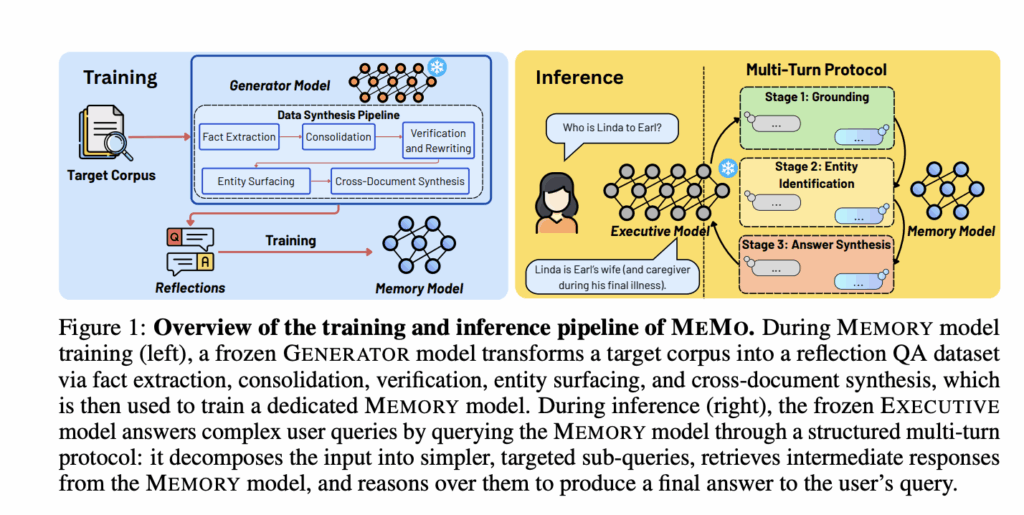
Large language models become static after pretraining. Their knowledge does not update as the world changes. Retraining a full LLM is too expensive at modern scales. Fine-tuning risks degrading previously learned knowledge. Retrieval-augmented generation (RAG) struggles when answers require reasoning across many documents. A team of researchers from the National University of Singapore, MIT CSAIL, A*STAR, and the Singapore-MIT Alliance for Research and Technology (SMART) proposes a new approach called MEMO (Memory as a Model). What Problem Does MEMO Solve? Existing methods for integrating new knowledge into LLMs fall into three categories. Non-parametric methods like RAG retrieve documents at inference time. They are sensitive to retrieval noise and struggle with cross-document reasoning. Parametric methods such as continual pretraining or supervised fine-tuning internalize knowledge into model weights. They are computationally expensive and cause catastrophic forgetting, where new training degrades previously acquired knowledge. Latent memory methods compress knowledge into soft tokens. These representations are tightly bound to the model that produced them — a limitation the research team calls representation coupling which limits transferability across LLMs. MEMORY as a Separate Model MEMO separates memory from reasoning. The MEMORY model is a small, dedicated language model trained to internalize knowledge from a target corpus. The EXECUTIVE model is the main LLM — frozen and queried only through its standard input-output interface. In experiments, the MEMORY model is Qwen2.5-14B-Instruct. The EXECUTIVE model is either Qwen2.5-32B-Instruct or Gemini-3-Flash, a proprietary closed-source model. Because MEMO treats the EXECUTIVE model as a black box, it does not require weight access or output logits. https://arxiv.org/pdf/2605.15156 How the MEMORY Model is Trained Training begins with a five-step data synthesis pipeline guided by a GENERATOR model — Qwen2.5-32B-Instruct in experiments. The pipeline converts a raw document corpus into a reflection QA dataset: question-answer pairs that represent corpus knowledge under diverse query variations. The five steps are: Fact extraction — direct extraction of explicitly stated facts, and indirect extraction of inferred information, run in parallel per document chunk. Consolidation — QA pairs sharing a common context (entity, time period, relationship) are merged into multi-fact pairs. Verification and rewriting — each QA pair is checked for self-containment. Pairs with unresolved pronouns or implicit references are rewritten using the source chunk or discarded. Entity surfacing — QA pairs are generated where questions encode entity attributes and relationships, and answers reveal entity identities. This targets the reversal curse, where models trained on “A is B” fail to infer “B is A.” Cross-document synthesis — the GENERATOR model constructs QA pairs spanning multiple documents. It identifies two types of cross-document connections: converging clues (multiple documents about the same entity) and parallel properties (different entities sharing a common attribute or role). Step-5 is the most critical component. A leave-one-out ablation shows that removing it drops accuracy from 24.00% to 6.37% on NarrativeQA. It is also the dominant source of training pairs in the final dataset. The MEMORY model is then trained via supervised fine-tuning (SFT). The loss is computed over answer tokens only. Source documents are never provided at inference. The model must answer from internalized parametric knowledge. Inference: The Structured Multi-Turn Protocol At inference, the EXECUTIVE model queries the MEMORY model through a structured multi-turn protocol with three sequential stages. Stage 1: Grounding. The EXECUTIVE model decomposes the query into atomic sub-questions. Each targets a single identifying constraint. The MEMORY model answers each independently. Stage 2: Entity identification. Using the grounding responses, the EXECUTIVE model issues targeted follow-up sub-queries. It iteratively narrows down candidate entities until one is confirmed or the stage budget runs out. Stage 3: Answer seeking and synthesis. Conditioned on the identified entity, the EXECUTIVE model queries the MEMORY model for supporting facts. It then synthesizes all retrieved responses into a final answer. The MEMORY model’s responses are compact natural-language snippets. Their length is independent of corpus size, so retrieval cost does not scale with the number of documents. This contrasts with RAG, where inference cost grows with the corpus. Experimental Results MEMO is evaluated on three benchmarks: BrowseComp-Plus (multi-hop deep-research), NarrativeQA (discourse understanding over books and movie scripts), and MuSiQue (2–4 hop reasoning over Wikipedia paragraphs). Baselines include BM25, NV-Embed-V2, HippoRAG2, and Cartridges. Cartridges requires white-box access to the EXECUTIVE model and scored 0.00% on BrowseComp-Plus and 3.75% on NarrativeQA. On NarrativeQA with Gemini-3-Flash, MEMO achieves 53.58%. HippoRAG2 reaches 23.21% on the same setup. On MuSiQue, MEMO achieves 60.20% against HippoRAG2’s 57.00%. On BrowseComp-Plus, MEMO achieves 66.67% against HippoRAG2’s 66.33%. With Qwen2.5-32B-Instruct as EXECUTIVE model, MEMO achieves 54.22% on BrowseComp-Plus and 48.30% on MuSiQue. Switching to Gemini-3-Flash yields gains of 12.45%, 26.73%, and 11.90% on the three benchmarks. The MEMORY model is not retrained when the EXECUTIVE model changes. Robustness to retrieval noise: The research team evaluates performance when distractor documents are added to the corpus. NV-Embed-V2 and HippoRAG2 drop by up to 6.22% on BrowseComp-Plus when one negative document is added per evidence document. MEMO’s accuracy on the same benchmark changes by +0.55% — within one standard deviation. MEMORY model architecture robustness: The research team also tests three MEMORY model families at similar parameter scale: Qwen2.5-1.5B-Instruct, Gemma3-1B-IT, and LFM2.5-1.2B-Instruct (a hybrid state-space and transformer architecture). Performance is largely consistent across all three, indicating the framework is not sensitive to the specific pretraining lineage of MEMORY model. Continual Knowledge Integration via Model Merging MEMO supports incremental knowledge updates through model merging. When a new corpus arrives, a separate MEMORY model is trained on it independently. Its task vector — the parameter difference from the base model — is then merged with the existing MEMORY model in parameter space. The research team test this on NarrativeQA using TIES merging (ρ=0.3). For K=2 corpora, merging accumulates 48 GPU-hours versus 72 GPU-hours for full retraining — a 33% reduction. At K=10, merging scales as Θ(K) while full retraining scales as Θ(K²), yielding a 5.5× saving (240 vs. 1,320 GPU-hours). The merged MEMORY model trails full retraining by 11.04% under Qwen2.5-32B-Instruct (15.81% vs. 26.85%). It trails by 19.11% under Gemini-3-Flash (34.47% vs. 53.58%). Despite

MEMO: A Modular Framework for Training a Dedicated Memory Model on New Knowledge Without Modifying LLM Parameters 投稿を読む »

AI, Committee, ニュース, Uncategorized

Meet EAGLE 3.1: The Speculative Decoding Algorithm That Fixes Attention Drift in LLM Inference

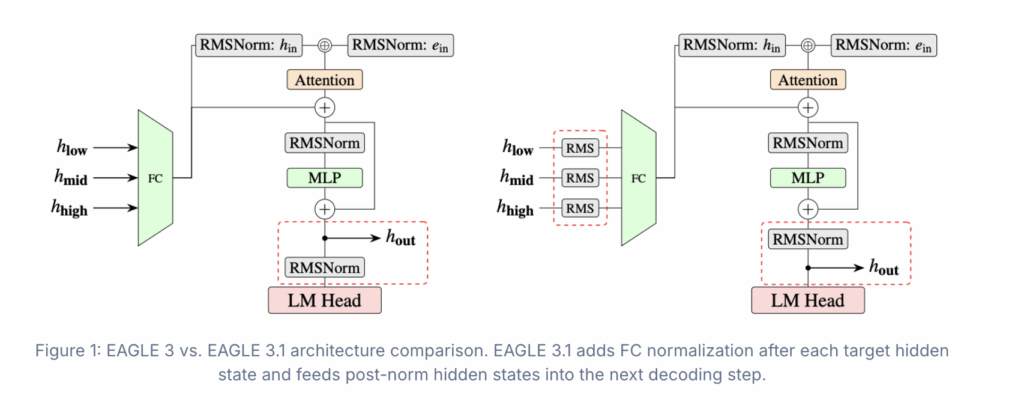
Speculative decoding is a technique for speeding up large language model inference. A small, fast draft model proposes several tokens. The large target model verifies them in parallel. If accepted, inference is faster. If rejected, the system falls back gracefully. EAGLE Team, vLLM Team, and TorchSpec Team has launched the EAGLE series including EAGLE 1, EAGLE 2, and EAGLE 3 has become one of the most widely adopted and practically deployed families of speculative decoding algorithms across both research and production systems. Today, that family gets a targeted reliability upgrade with introduction of EAGLE 3.1. What was Going Wrong While speculative decoding performs well in controlled settings, performance often degrades under different chat templates, long-context inputs, or out-of-distribution system prompts. The EAGLE team traced this fragility to a phenomenon called attention drift as speculation depth increases, the drafter gradually shifts attention away from sink tokens and toward its own generated tokens. In simpler terms: the drafter is a small model that predicts future tokens. As speculation gets deeper, it starts attending to its own prior outputs instead of the original context. This degrades acceptance length and output stability. Two underlying issues were identified. First, the fused input representation becomes increasingly imbalanced as higher-layer hidden states dominate the drafter input. Second, hidden-state magnitude grows across speculation steps due to the unnormalized residual path. Together, these effects make the drafter progressively less stable at deeper speculation depths. Two Architectural Fixes in EAGLE 3.1 To address attention drift, EAGLE 3.1 comes with two key architectural improvements: FC normalization after each target hidden state and before the FC layer, and feeding post-norm hidden states into the next decoding step. FC normalization stabilizes the hidden states that the drafter receives from the target model. Without it, hidden-state magnitude grows across steps, making the drafter increasingly unreliable. Applying normalization at each step keeps the inputs bounded. The post-norm design makes the method behave more like recursively invoking the drafter across decoding steps, rather than simply appending additional layers to the target model. https://vllm.ai/blog/2026-05-26-eagle-3-1 What These Fixes Deliver Compared with EAGLE 3, EAGLE 3.1 demonstrates: better training-time to inference-time extrapolation, stronger long-context robustness, higher resilience to chat template and system prompt variation, and more stable acceptance length across diverse serving environments. In long-context workloads, EAGLE 3.1 achieves up to 2× longer acceptance length compared with EAGLE 3. Training Infrastructure: TorchSpec TorchSpec now provides efficient training support for EAGLE 3.1 and future speculative decoding algorithms. By lowering training overhead and simplifying experimentation workflows, TorchSpec helps accelerate iteration and exploration for next-generation speculative decoding research and deployment. Based on TorchSpec and vLLM, the research team also trained and open-sourced an EAGLE 3.1 draft model for Kimi K2.6, available on HuggingFace. The model serves as an example of deploying EAGLE 3.1 with TorchSpec training and vLLM serving support on a real-world serving model vLLM Integration: Config-Driven and Backward-Compatible EAGLE 3.1 lands in vLLM as a config-driven extension of the existing EAGLE 3 implementation. The integration includes FC normalization support, post-norm hidden-state feedback, and removal of hardcoded assumptions around target hidden states. Backward compatibility with existing EAGLE 3 checkpoints is fully preserved. EAGLE 3.1 draft models can be plugged directly through the same speculative-decoding code path. Copy CodeCopiedUse a different Browser vllm serve nvidia/Kimi-K2.6-NVFP4 –trust-remote-code –tensor-parallel-size 4 –tool-call-parser kimi_k2 –enable-auto-tool-choice –reasoning-parser kimi_k2 –attention-backend tokenspeed_mla –speculative-config ‘{“model”:”lightseekorg/kimi-k2.6-eagle3.1-mla”,”method”:”eagle3″,”num_speculative_tokens”:3}’ –language-model-only Benchmark Results on Kimi K2.6 The research team benchmarked the Kimi K2.6 EAGLE 3.1 draft model on Kimi-K2.6-NVFP4 with vLLM (TP=4, GB200, non-disagg) on the SPEED-Bench coding dataset. EAGLE 3.1 delivers 2.03× higher per-user output throughput at concurrency 1. The speedup stays meaningful as concurrency scales: 1.71× at C=4 and 1.66× at C=16. Marktechpost’s Visual Explainer 01 / 07 vLLM · May 26, 2026 Meet EAGLE 3.1 The EAGLE team, vLLM team, and TorchSpec team jointly released EAGLE 3.1 — a targeted fix for speculative decoding instability in production LLM serving. #speculative-decoding #vLLM #LLM inference #performance 02 / 07 Background What is Speculative Decoding? A technique for speeding up LLM inference using two models working together. A small, fast draft model proposes several tokens ahead The large target model verifies all proposed tokens in one pass Accepted tokens are kept — rejected tokens fall back gracefully Result: higher output throughput with no change in output quality 03 / 07 The Problem Attention Drift in EAGLE 3 EAGLE 3 performance degraded in real-world deployments under three conditions: Different chat templates Long-context inputs Out-of-distribution system prompts Root cause: attention drift — as speculation depth increases, the drafter shifts attention away from sink tokens toward its own generated tokens. 04 / 07 Root Cause Two Underlying Issues The fused input representation becomes increasingly imbalanced — higher-layer hidden states dominate the drafter input Hidden-state magnitude grows across speculation steps due to the unnormalized residual path Together, these make the drafter progressively less stable at deeper speculation depths 05 / 07 Architecture Two Architectural Fixes Fix 1 FC normalization applied after each target hidden state and before the FC layer. Keeps hidden-state magnitude bounded across decoding steps. Fix 2 Post-norm hidden-state feedback — normalized hidden states fed into the next decoding step, making the drafter behave like recursive invocation rather than appended layers. 06 / 07 Benchmarks · SPEED-Bench Coding · GB200 TP=4 Per-User Throughput vs. No-Spec Baseline 2.03×Concurrency 1 1.71×Concurrency 4 1.66×Concurrency 16 In long-context workloads, EAGLE 3.1 achieves up to 2× longer acceptance length compared with EAGLE 3. Tested on Kimi-K2.6-NVFP4 with vLLM. 07 / 07 Deployment · vLLM v0.22.0 How to Deploy EAGLE 3.1 Backward-compatible with EAGLE 3 checkpoints. Already merged in vLLM main. Stable release: v0.22.0. vllm serve nvidia/Kimi-K2.6-NVFP4 –trust-remote-code –tensor-parallel-size 4 –tool-call-parser kimi_k2 –enable-auto-tool-choice –reasoning-parser kimi_k2 –attention-backend tokenspeed_mla –speculative-config ‘{“model”:”lightseekorg/kimi-k2.6-eagle3.1-mla”, “method”:”eagle3″, “num_speculative_tokens”:3}’ –language-model-only ← Prev 1 / 7 Next → Marktechpost AI & ML Research, Simplified. Key Takeaways EAGLE 3.1 fixes attention drift — a newly identified instability where the drafter loses focus on sink tokens at deeper speculation depths. Two architectural changes — FC normalization and post-norm hidden-state feedback — stabilize the

Meet EAGLE 3.1: The Speculative Decoding Algorithm That Fixes Attention Drift in LLM Inference 投稿を読む »

AI, Committee, ニュース, Uncategorized

The Download: keeping up with AI, and the future of IVF

This is today’s edition of The Download, our weekday newsletter that provides a daily dose of what’s going on in the world of technology. Stay on top of what’s going on in AI this summer Here at MIT Technology Review, we understand exactly how relentless the pace of news from the world of artificial intelligence feels. New models and capabilities crop up as fast as we can cover them, and the ripple effects they send through tech and wider society are never far behind. Our unique strength lies in cutting through the day-to-day noise to help you understand what’s really happening, and what lies around the corner. That’s why we created our list of 10 Things That Matter in AI Right Now, unveiled at our flagship AI event EmTech AI a few weeks back (check the list out if you haven’t already!) And it’s why we publish so many stories dedicated to explaining how AI works, and what’s coming next. We also regularly run live subscriber-only Roundtables events—you can still catch up on last week’s session, where we explored how AI might enter the physical realm via world models. Right now, there’s a 25% discount on subscriptions. Sign up now to deepen your understanding of AI this summer. You can also join the conversation by subscribing to The Algorithm, our free weekly newsletter all about the latest in AI. MIT Technology Review Narrated: what’s next for IVF IVF has brought millions of babies into the world over the last four decades. But the process can still be slow, painful, and expensive—and far from guaranteed to work. Now, a wave of new technologies aims to change that.  Researchers are using AI to identify promising sperm and embryos, developing robotic systems that could automate parts of the IVF process, and even exploring controversial genetic editing techniques designed to prevent inherited disease. The technologies could make IVF more effective and accessible. But they’re also raising difficult ethical questions about how far reproductive medicine should go. —Jessica Hamzelou This is our latest story to be turned into an MIT Technology Review Narrated podcast, which we publish each week on Spotify and Apple Podcasts. Just navigate to MIT Technology Review Narrated on either platform, and follow us to get all our new content as it’s released. The must-reads I’ve combed the internet to find you today’s most fun/important/scary/fascinating stories about technology. 1 NASA unveiled plans for three uncrewed missions to the Moon this yearThey’re part of preparations for a crewed landing in 2028. (The Verge)+ And steps to build the first lunar base at the Moon’s south pole. (NBC News)+ Jeff Bezos’s Blue Origin will lead the first uncrewed mission. (WP $)+ NASA is building the first nuclear reactor-powered spacecraft. (MIT Technology Review) 2 Samsung’s largest unions have approved a landmark bonus schemeThe deal averts a massive strike at the world’s largest memory-chip maker. (WSJ $)+ Chip workers will get an average bonus of about $340,000. (Bloomberg $)+ The dispute centered on who profits from the AI boom. (BI)+ Resistance to AI is growing. (MIT Technology Review) 3 Elon Musk accused the Pentagon of misusing Starlink for dronesHe says military use of the system violates SpaceX rules. (Ars Technica)+ The DoD is disputing a Starlink price hike during the Iran war. (Reuters $)+ Stratospheric internet could take off this year. (MIT Technology Review) 4 China has overhauled the world’s biggest surveillance network with AIBeijing is pushing law enforcement towards predictive policing. (FT $)+ Police use of smart glasses is also booming in China. (Gizmodo)+ LLMs could supercharge mass surveillance. (MIT Technology Review) 5 Space Force is awarding SpaceX $2 billion for a military data networkIt will connect military sensors and weapons platforms worldwide. (Reuters $)+ The contract comes amid concerns about SpaceX’s AI business. (WSJ $)+ Speculation is growing around a possible SpaceX-Tesla merger.  (CNBC) 6 Taiwan suspects Nvidia chips were smuggled to China via JapanTo circumvent US restrictions. (Bloomberg $)+ Is China about to win the AI race? (MIT Technology Review) 7 Booming AI chip demand has created two new $1 trillion companiesSouth Korea’s SK Hynix and the US’ Micron have hit the landmark. (BBC) 8 AI has sparked a surge in demand for cybersecurity expertsThanks to a glut of new code and alarm over powerful models. (NYT $)+ AI is making online swindles easier. (MIT Technology Review) 9 Internet is coming back in Iran after a three-month blackoutAlthough it isn’t clear if the reconnection is permanent. (Wired $) 10 Physicists are rethinking the role of gravity in quantum mechanicsThere’s a new theory for how our everyday world emerges. (New Scientist $) Quote of the day “AI and its capabilities represent something analogous to the Second Coming.”  —Jeremy Nixon, the cofounder of AGI House and a former Google Brain researcher, tells the New York Times how Silicon Valley’s innovations could affect the pope. One More Thing ANDREW MERRITT Inside the experimental world of animal infrastructure In the mid-2000s, toads were meeting a gruesome end near Ede, a leafy old town in the Netherlands. Residents responded by building wildlife tunnels beneath the road to help them reach their breeding ponds safely. The crossings became popular. But a few years later, researchers found the local toad population had crashed from more than 10,000 to fewer than 1,000. The case reflects a wider global push to build wildlife crossings and other forms of “animal infrastructure.” But do they actually help animal populations recover? Read the full story to find out. —Matthew Ponsford We can still have nice things A place for comfort, fun, and distraction to brighten up your day. (Got any ideas? Drop me a line.) + The votes for “International Mollusc of the Year” are finally in.+ Track aircraft in real time across a gorgeous 3D digital globe using live flight data.+ NASA’s Psyche spacecraft has delivered breathtaking new close-up images of Mars.+ This deep dive into instant coffee reveals the extraordinary engineering effort behind making it vaguely drinkable.

The Download: keeping up with AI, and the future of IVF 投稿を読む »

AI, Committee, ニュース, Uncategorized

It’s time to address the looming crisis in entry-level work.

Artificial intelligence has not so far produced a clean story of mass unemployment. Aggregate employment in developed countries remains broadly stable, and recent assessments have found limited evidence that AI has shifted the headline numbers. But a troubling change may be hiding beneath the surface: the quiet weakening of the first rung of the career ladder. The most worrisome evidence is showing up exactly where we should expect it first: in early-career hiring. A working paper released in November 2025 by the Stanford Digital Economy Lab found that workers aged 22 to 25 in the most AI-exposed occupations experienced a 16% relative decline in employment after the spread of generative AI, even after controlling for other factors that might affect firms’ employment decisions. An Anthropic report from March 2026 provides suggestive evidence that led to a similar conclusion. More experienced workers in those same occupations did not suffer the same decline. Employment is not also declining in the entry-level jobs with low AI exposure. The concern is specific to early-career jobs that are exposed to AI. That is not a minor signal. It suggests that firms may be using AI to substitute for the junior tasks through which people traditionally gain their first foothold—at least for those in jobs where generative AI is used extensively, like software developers, customer service representatives, computer programmers, and information systems managers. The time is now to make changes in the way we train, prepare, and support young people who are about to enter the workforce. Educational institutions need to reorient for the era of an AI-augmented workforce. Governments must incentivize businesses to hire and train early-career workers. Businesses, in turn, need to recognize the importance of developing a long-term workforce experienced in AI—a process that begins with entry-level workers. And students themselves should take on the responsibility of not only becoming AI fluent but learning how to apply that knowledge in various fields. In short, we must change the way we have traditionally thought of entry-level work. This is especially true because the broader labor market for recent graduates is also softening. The Federal Reserve Bank of New York reported that in the fourth quarter of 2025, the unemployment rate for recent college graduates rose to 5.6%, while the underemployment rate (the share of graduates working in jobs that typically do not require a college degree) reached 42.5%, its highest level since the covid pandemic. No single statistic can prove that AI is the sole cause of that deterioration. Hiring in general is way down post-pandemic, and young people are particularly vulnerable to the slowdown. But it would be a mistake to ignore the possibility that AI is accelerating an already difficult transition from school to work. Behind these statistics is a great deal of personal distress. Recent graduates today often submit hundreds of applications before they receive a single offer, and surveys consistently find elevated rates of anxiety, financial precarity, and burnout among young workers in extended job searches. If AI quietly closes the door on typical early jobs, people will pay the price in delayed independence, postponed family formation, and the sense that their first serious professional efforts have been refused. It also matters because entry-level jobs are part of the economy’s training system. Junior analysts learn which numbers can be trusted. Young software developers learn how production systems fail. New marketers learn how customers behave outside the neat language of dashboards. Early-career legal and financial staff learn how rules, judgment, deadlines, and human relationships actually interact. If AI absorbs more of the drafting, triage, coding, summarizing, and administrative preparation that once helped train entry-level workers, firms may become more efficient in the short run while society becomes less capable in the longer run. The right way to improve the skills of young workers is not to tell them, “Learn to code.” That advice, which shaped more than a decade of federal initiatives and university expansion, rested on the premise that coding was a stable, scalable skill almost anyone could learn and parlay into a middle-class job. The premise no longer holds. The layer of work AI handles well—translating a specification into routine code, reproducing standard patterns, debugging predictable errors—is precisely the layer that “learn to code” programs were built around. Supervising AI systems in their work is now a much more relevant skill. So understanding the outputs AI systems produce will become very important. To help people develop such skills, we should require universities, community colleges, and professional programs to embed AI literacy, data literacy, prompt-based workflow skills, verification skills, and domain judgment into ordinary degrees. Every graduate should know how to use AI tools, check their output, understand their limits, and combine them with human expertise. This matters even for graduates entering occupations that look relatively safe from AI, such as those in health care. Almost every job contains tasks—drafting, summarizing, scheduling, research, basic data work, routine communication—for which AI is already a substantial productivity tool. The competition most young workers will experience is not human versus machine but colleague versus AI-augmented colleague. For most young workers, the realistic path to making themselves valuable is not to avoid AI but to become fluent in the technology and combine that with domain judgment, contextual reasoning, and human relationship skills. To this end, schools should emphasize paid co-ops, apprenticeships, and employer-linked projects so students build judgment in real workplaces before they graduate. Governments should also create targeted tax credits, wage subsidies, and training grants for employers that hire early-career workers into structured, AI-augmented roles. The architecture for this kind of conditional, behavior-linked subsidy already exists in US tax policy. What is missing is a version of these instruments built specifically around early-career AI-augmented work. Firms, for their part, should stop making hiring decisions based only on short-run cost savings from AI. Young workers are not valuable only for the tasks they perform this quarter. Their value lies in learning, skill formation, institutional memory, and future productivity. Entry-level hiring is not just

It’s time to address the looming crisis in entry-level work. 投稿を読む »

We use cookies to improve your experience and performance on our website. You can learn more at プライバシーポリシー and manage your privacy settings by clicking Settings.

Privacy Preferences

You can choose your cookie settings by turning on/off each type of cookie as you wish, except for essential cookies.

Allow All
Manage Consent Preferences
  • Always Active

Save
ja