YouZum

Uncategorized

AI, Committee, ニュース, Uncategorized

The Download: introducing the Engineering issue

This is today’s edition of The Download, our weekday newsletter that provides a daily dose of what’s going on in the world of technology. Introducing: the Engineering issue We can’t fix everything, but we can be ambitious. We can take on the challenge of making the world better through human ingenuity. That’s what the new Engineering issue of MIT Technology Review is all about.  Sometimes the challenges we face are giant, like tunneling beneath the seafloor. Some exist at the nanoscale, as with a new ASML machine powering the future of chipmaking. Others represent problems at a planetary scale and in truly unknown territory, like replicating a volcano’s mechanism to cool the Earth on purpose. These incredible engineering stories show we can come together to get to work and, when the smoke clears, find we’ve made real progress. Subscribe now to read all of them—and more—in the full print issue. Stripe, Anthropic, and OpenAI are backing an effort to stop respiratory infections The common cold comes for us all—often more than once a year. And there is no way to prevent it. The best you can do is take vitamin C and stay away from people with the sniffles. Now, the payment company Stripe is funding a new $500-million nonprofit aiming to prevent both the common cold and the flu. Its eventual goal is to get rid of respiratory viruses altogether. Anthropic, OpenAI, and Bill Gates have also backed the venture, which will investigate whether modern technologies can counter the common cold and the flu. Dive into the nonprofit’s plans. —Antonio Regalado MIT Technology Review Narrated: inside the hunt for the most dangerous asteroid ever As asteroid 2024 YR4 hurtled toward Earth, astronomers determined that this massive rock posed a higher risk of impact than any object of its size in recorded history. Then, just as quickly as history was made, experts declared that the danger had passed.  This is the inside story of the network of global scientists who found, followed, planned for, and finally dismissed the most dangerous asteroid ever discovered —all under the tightest of timelines and with the highest of stakes. —Robin George Andrews This is our latest story to be turned into an MIT Technology Review Narrated podcast, which we publish each week on Spotify and Apple Podcasts. Just navigate to MIT Technology Review Narrated on either platform, and follow us to get all our new content as it’s released. The must-reads I’ve combed the internet to find you today’s most fun/important/scary/fascinating stories about technology. 1 China has taken the US’s crown for the world’s fastest supercomputer Shenzhen’s LineShine overtook California’s El Capitan. (Axios)+ China had not had a machine at the top of the list since 2017. (NYT $)+ But the supercomputer race isn’t geared for AI work. (Reuters $) 2 Mythos reportedly found flaws in classified US government systemsA US official said Anthropic’s model identified certain vulnerabilities. (AP News)+ The model has now been suspended over US security concerns. (BBC)+ The NSA has lost access to Anthropic’s tools in fallout. (Engadget)+ The feud raises new questions about AI safety. (MIT Technology Review)  3 A US pilot reported seeing Iranian drones swarm in “jellyfish” formationWhich would represent an alarming advance in Iranian drone capabilities. (CNN)+ The US is heading toward a drone-filled future. (MIT Technology Review) 4 Mark Zuckerberg directed Meta to create a prediction markets appIt will be similar to Polymarket and Kalshi. (NYT $)+ But won’t let users wager real money. (The Verge) + Another new app, Meta Photos, will create media with AI. (Reuters $) 5 SpaceX’s “Starfall” just launched a secretive test flightThe orbital delivery spacecraft blasted off for the first time yesterday. (Axios)+ It could also support space manufacturing. (New Scientist $) 6 Alibaba has sued the US for being linked to the Chinese militaryIt wants to be removed from a Pentagon blacklist. (Reuters $) 7 Nvidia’s banned AI chips have doubled in price on China’s black marketThe DGX B300 now costs more than $1.1 million. (Financial Times $) 8 Tesla claims a driver “manually overrode self-driving” in a deadly crashIt said the accelerator was pressed “all the way to 100%.” (The Verge $) 9 The US science retreat has created an opportunity for EuropeBut questions about funding and innovation remain. (Nature)+ Trump has dealt many blows to US science. (MIT Technology Review) 10 Meta’s new smart glasses ditch Ray-Bans for Kylie Jenner Meta logos and Jenner designs have replaced the Ray-Ban branding. (Wired $) Quote of the day “It’s blasphemy against AI if ‌you say it’s a bubble.” —SoftBank founder and CEO Masayoshi Son tells shareholders that the AI boom is still in its early stages, Reuters reports. One More Thing ERIK CARTER Video games are dividing South Korea They say StarCraft was the game that changed everything. When the science fiction strategy game arrived in South Korea in 1998, it wasn’t just a hit—it was an awakening. Out of 11 million copies sold worldwide, 4.5 million were in the country. The game was so popular that it triggered another boom: “PC bangs,” pay-as-you-go gaming cafés. StarCraft and PC bangs spoke to a generation of young South Koreans boxed in by economic anxiety and rising academic pressures. But they also sparked arguments about game addiction. They’ve led to feuds between government departments—and a national debate over policy. Read the full story. —Max S. Kim We can still have nice things A place for comfort, fun, and distraction to brighten up your day. (Got any ideas? Drop me a line.) + This archive lovingly documents the beautiful design of over 1,700 obsolete objects.+ Classic TV theme tunes like Hey Arnold! Have been revived in a musician’s marvellous samples.+ Marvel at the mind-boggling geometry of nature and see how bees perfectly construct honeycombs.+ Hear the ominous, deeply atmospheric tones of a custom string instrument built inside a plastic drainage pipe.

The Download: introducing the Engineering issue 投稿を読む »

AI, Committee, ニュース, Uncategorized

The $400 million machine powering the future of chipmaking

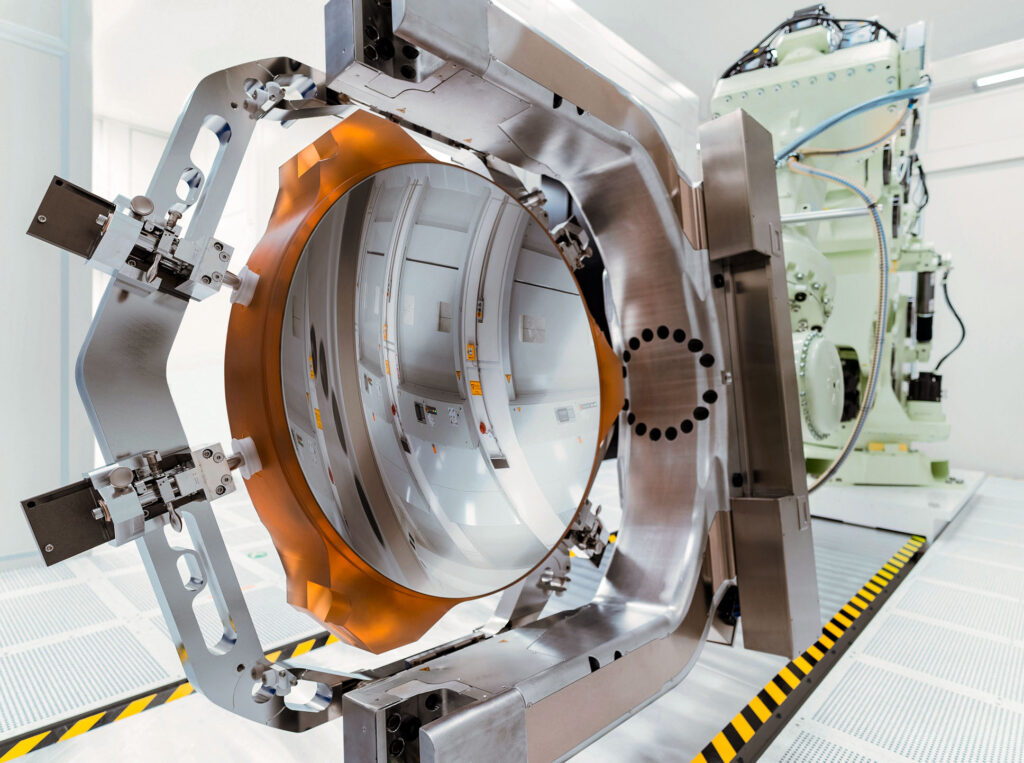
Jos Benschop is climbing a ladder to get to the top of his newest machine.  It’s a bit of a schlep. The contraption is the size of a double-decker bus—more than 150 tons of gleaming precision-milled aluminum covered in thousands of snaking tubes, colored cables, and pressurized tanks. From the ground, it looks like a futuristic V8 engine. When I reach the top with Benschop we’re looking down from about 15 feet in the air, with bunny-suited technicians scurrying around below. It’s more than 200 cubic meters of tech—“mechatronic devices that hold a few mirrors in a position with atomic precision,” he says, gesturing at the gargantuan apparatus. Benschop, a tall and grizzled 66-year-old, has spent over a decade working with his engineers to design this thing, but even so, he’ll sometimes look at it and go: Oh my God. Benschop is the executive vice president of technology for ASML, a Dutch company that is the linchpin of the microchip industry. If you want to make powerful chips to power phones or AI, a lithography machine like the one we’re standing on is what you need to create increasingly tiny circuitry. Lithography is the art and science of shining light on a silicon wafer to pattern out the transistors, wiring, and other components of the microchips that will be cut from it. The chipmaking field is essentially controlled by only two big players: ASML, which creates the lithography machines, and TSMC, the chipmaking giant. Nine years ago, ASML began selling machines that use a daring new way of patterning chip features. These machines employ extreme-ultraviolet light, or EUV—radiation well outside the visible spectrum that they produce by shooting lasers at tiny molten drops of tin, tens of thousands of times a second. Those first machines—the result of an R&D moonshot that lasted 16 years and cost about $10 billion—can craft transistor features with a resolution of 13 nanometers. This new machine can do even better: It has a resolution of just eight nanometers, the width of about 40 silicon atoms. The devices are now shipping to chipmaking factories, or fabs, at an eye-watering price: $400 million each. But chipmakers will fork that cash over, because they are in a desperate race to produce new and improved chips every year. That means getting their mitts on machines that can make ever smaller components and cram them together ever more densely—part of a long-standing recipe for creating faster and more energy-­efficient chips.  For years now, ASML’s tools have been critical to keeping Moore’s Law alive. Without the company’s advanced chipmaking technology it is very possible that chip density—and the ability to perform ever more calculations—would have plateaued.  The AI industry has produced new and ravenous demand for denser chips, as firms like OpenAI and Anthropic scramble to erect server farms that train and deploy new, ever-more-powerful models, which require new, ever-more-powerful hardware. ASML’s latest machine promises to help keep the AI party raging for at least another decade.  “We can allow customers to go to smaller and smaller features, and that opens up the space for whatever we see now today in AI, which is absolutely mind-blowing,” Marco Pieters, ASML’s CTO, told me. “I think we’ve only seen the tip of the iceberg.”  Its relentless push for “shrink”—as they call it in the chipmaking industry—has made ASML a dominant force: The company produces about 90% of all chip-­lithography tools worldwide. If you make chips, ASML is unavoidable. But that monopoly position makes some people, and governments, uneasy. The chipmaking field is essentially controlled by only two big players: ASML, which creates the lithography machines, and TSMC, the chipmaking giant in Taiwan, which uses ASML’s machines to craft the vast majority of all microchips. This duopoly is so powerful that it has geopolitical implications. In an effort to prevent China from developing advanced AI, the US government pressured the Dutch government to impose an embargo in 2019: ASML isn’t allowed to sell high-end machines to any Chinese firm. Geopolitically, “chips are the new oil,” says Marc Hijink, the author of Focus: The ASML Way. Being deprived of them can be as disastrous as being deprived of oil. And in that metaphor, you might say, ASML is the Strait of Hormuz. James Proud, the cofounder and CEO of the lithography startup Substrate, says the situation is not ideal. The US is “dangerously reliant” on a supply chain that’s overseas and increasingly pricey, Substrate says on its website. “There’s a huge concentration in a small number of players,” Proud says. “And the supply chain is just very expensive.”  Which is why, after two decades of ASML’s dominance, would-be competitors are now gunning for its territory. China is hungrily pouring billions into trying to replicate ASML’s tech. And startups like Substrate are trying to get in the game as well, setting their sights on creating lithography machines that are cheaper, smaller, and even more capable than ASML’s behemoths. Will any of them succeed? The near future clearly belongs to ASML, but as its engineers well know, you can unseat a giant with the right trick of the light. Making chips is, oddly, a bit like silk-screening a T-shirt. To print a pattern on a silicon wafer, you start with a pattern on a reticle—a mask that carries the design. Shining a light on the reticle transfers that pattern to the wafer. The light interacts with a layer of chemicals on the wafer, fixing the pattern in place.  The size of a chip’s features is partly set by the wavelength of light the machine uses: The smaller the wavelength, the teensier the circuitry you can create. You can stretch the capabilities of a wavelength somewhat; increasing what’s known as the numerical aperture, which usually means swapping in a bigger lens, can further focus the light and thus lay down patterns for smaller and smaller components. Eventually, though, this trick hits its limit, and you need to find a new form of light with a smaller wavelength. 

The $400 million machine powering the future of chipmaking 投稿を読む »

AI, Committee, ニュース, Uncategorized

Prime Intellect Releases prime-rl 0.6.0 to Train Trillion-Parameter MoE Models on Agentic RL Workloads

Prime Intellect has released prime-rl version 0.6.0. The framework targets reinforcement learning on trillion-parameter Mixture-of-Experts (MoE) models. It focuses on heavy agentic workloads, like long-horizon software-engineering tasks. The research team trained GLM-5 on SWE tasks at up to 131k sequence length. Step times stayed under five minutes. The batch size was 256 rollouts. The run used only 28 H200 nodes. TL;DR prime-rl 0.6.0 trains trillion-parameter MoE models on agentic RL workloads. GLM-5 trained on SWE at 131k sequence length, sub-5-minute steps, 28 H200 nodes. Asynchronous RL disaggregates trainer and inference for independent optimization. Inference uses FP8, Wide EP, P/D disaggregation, KV offloading, and router replay. Training uses 3-D parallelism (FSDP, EP, CP) plus block-scaled FP8. What is prime-rl 0.6.0? prime-rl is an open framework for asynchronous reinforcement learning. It post-trains large open-source models on agentic tasks. Version 0.6.0 extends this to trillion-parameter MoE scale. The example model in the announcement is zai-org/GLM-5.1. The optimizations also apply to other large MoE models. Examples include moonshotai/Kimi-K2.7-Code and nvidia/NVIDIA-Nemotron-3-Ultra-550B-A55B-BF16. A full GLM-5.1 run starts with one command on a Slurm cluster. Copy CodeCopiedUse a different Browser uv run rl @ examples/glm5_llmd/rl.toml –output-dir /shared/outputs/glm5-llmd Role of asynchronous RL Agentic tasks have long-tail outliers. Some coding rollouts run for hours. Waiting for them before each policy update would idle GPUs. Asynchronous RL avoids this. The trainer and inference systems are disaggregated. They run and scale independently. The inference policy updates as soon as the optimizer step finishes. There is one synchronization point: the policy update. prime-rl pushes new weights as soon as they exist. Already-dispatched rollouts keep their active prefix cache. So a single rollout may mix tokens from several policy versions. New rollouts behave differently. They repopulate their own KV cache, even when prefixes match. A KV-cache salt forces this. Requests from too old a policy are dropped. The max_off_policy_steps value controls that threshold. Inference optimizations Inference is usually the throughput bottleneck in an RL system. prime-rl optimizes for throughput, while keeping latency bounded. FP8 inference: Lower precision speeds up prefill and decode. prime-rl uses FP8 with DeepEP and DeepGEMM kernels. Wide Expert Parallelism: Wide EP spreads experts across ≥32 GPUs. It pairs with a large data-parallel rank, for example 32. Each GPU holds separate experts and serves as an endpoint. Synchronization happens per-layer, through dispatch and combine operations. Prefill and Decode Disaggregation: Some modelenv pairs hit a 4:1 prefill:decode token ratio. Shared workers would inflate end-to-end latency. That reduces the benefits of PipelineRL. P/D disaggregation separates prefill and decode workers. Long tool outputs then stop throttling decode workers. KV cache management: High concurrency needs large KV cache space. prime-rl supports tiered offloading to CPU and disk. vLLM native offloading creates one pool per worker. Mooncake Store instead pools RAM and disk across all nodes centrally. Request routing: prime-rl ships a fork of vllm-router by default. It also supports the NVIDIA Dynamo router as a drop-in. Routers score workers using KV cache reuse, queue depth, and live load. Router replay (R3): Trainerinference mismatch silently kills training. Router replay captures inference routing decisions. It replays them directly on the trainer. This cuts KL mismatch by roughly an order of magnitude. Routed experts have shape [num_layers, top_k, seq_len]. This payload can grow to hundreds of GB. At scale, the data rate reaches tens of Gbps. So prime-rl treats it as an opaque payload. Optimized PyTorch operations handle the processing. Training optimizations The trainer builds on torchtitan, a PyTorch-native training codebase. It relies on 3-D parallelism: FSDP, CP, and EP. The GLM-5 case study uses all three. Strategy What it shards Primary use Key detail FSDP (FSDP2) Parameters, gradients, optimizer states Baseline memory amortization Gathers weights on demand per layer via fully_shard Expert Parallelism (EP) Experts within a layer Shrinks active layer memory all2all dispatch/combine; torch-native or DeepEP Context Parallelism (CP) The sequence dimension Long-context activation memory Ulysses (default) or Ring Attention EP exists because layers stay huge after FSDP. With 78 layers and 800B params in float32, one layer’s all-gather needs roughly 40GB. Overlapping one layer pushes that near 80GB. Setting EP=8 dispatches tokens instead of gathering full experts. torch-native all2all is slightly faster within one node. DeepEP wins when EP spans multiple nodes. CP matters at 131k+ sequence length. There, activations dominate memory, not parameters. GLM-5 uses DSA, which neither Ulysses nor Ring Attention parallelizes directly. So prime-rl ships a custom context-parallel implementation for it. FP8 training. prime-rl uses DeepGEMM block-scaled FP8, as proposed by DeepSeek V3. This rarely raises throughput, due to quantization overhead. Its real value is matching trainer and inference precision. That reduces KL mismatch and stabilizes training. Interactive Explainer Use cases with examples Long-horizon SWE agents: Train a model on real repository issues. Rollouts can span 100s of turns and tool calls. P/D disaggregation keeps decode latency predictable here. 1T-scale post-training on fewer nodes: The GLM-5 run fit on 28 H200 nodes. Wide EP and KV offloading raise concurrency and throughput. Stable agentic RL at scale: Router replay and FP8 training both reduce trainerinference KL mismatch. Lower mismatch means steadier training. Check out the Technical details. Also, feel free to follow us on Twitter and don’t forget to join our 150k+ML SubReddit and Subscribe to our Newsletter. Wait! are you on telegram? now you can join us on telegram as well. Need to partner with us for promoting your GitHub Repo OR Hugging Face Page OR Product Release OR Webinar etc.? Connect with us The post Prime Intellect Releases prime-rl 0.6.0 to Train Trillion-Parameter MoE Models on Agentic RL Workloads appeared first on MarkTechPost.

Prime Intellect Releases prime-rl 0.6.0 to Train Trillion-Parameter MoE Models on Agentic RL Workloads 投稿を読む »

AI, Committee, ニュース, Uncategorized

Elephant alert! AI warning systems aim to avoid deadly clashes

India is home to about 60% of the world’s wild Asian elephants, and around 80% of the animals’ habitat lies outside protected areas, according to the Ministry of Environment, Forest, and Climate Change. That brings people and wildlife into close contact, and clashes can turn lethal: There have been some 3,000 human casualties in the last five years and over 1,000 elephant deaths since 2014. In places where elephants tend to wander, warnings from ground-based patrols can sometimes take hours to reach populated areas like villages and farms, so they have failed to prevent much of the damage. In response, state forest departments, NGOs, and locals are beginning to design, test, and deploy a range of artificially intelligent systems that can cut response and warning times to minutes—or even seconds.  Kanika Gupta is an independent journalist and documentary filmmaker based in New Delhi.

Elephant alert! AI warning systems aim to avoid deadly clashes 投稿を読む »

AI, Committee, ニュース, Uncategorized

The Download: the future of chipmaking and Anthropic’s government clash

This is today’s edition of The Download, our weekday newsletter that provides a daily dose of what’s going on in the world of technology. The $400 million machine powering the future of chipmaking It’s a bit of a schlep to get to the top of ASML’s newest machine. It’s about the size of a double-decker bus, weighs more than 150 tons, and costs $400 million. But if you want to make the world’s most powerful chips, a lithography system like this is essential. The AI era needs ever faster chips, and ASML’s machines make that possible. They pattern chip features with extreme-ultraviolet light, or EUV—radiation outside the visible spectrum, produced by shooting lasers at tiny molten drops of tin tens of thousands of times a second. ASML now makes about 90% of all chip-lithography tools worldwide. That dominance has made some people, and governments, uneasy. And would-be competitors are now gunning for its territory. Read the full story on ASML’s $400 million machine—and the growing threats to its position. —Clive Thompson Three things to watch amid Anthropic’s latest feud with the government In April, Anthropic said it had built an AI model called Mythos that could pose a cybersecurity risk. It then released a safer version called Fable. Days later, the US government placed export controls on it. Within hours, Anthropic revoked access to both models. “Doomers” have long warned about catastrophic AI risk. But this intervention came over a coding model—not a bioweapon or rogue AI—and the response so far looks less like a safety plan than a reactive policy move. Here are three things to watch in Anthropic’s standoff with Washington. —James O’Donnell This story is from The Algorithm, our weekly newsletter giving you the inside track on all things AI. Sign up to receive it in your inbox every Monday. Longevity’s next frontier: “reprogramming” your body Billions of dollars are flooding into efforts to reverse aging as scientists explore ways to return cells to a younger state. But how far off are these experimental treatments? Will they really work? At an upcoming virtual Roundtables event, MIT Technology Review will examine the science behind the hype. Science editor Mary Beth Griggs and senior biotechnology reporter Jessica Hamzelou will explore longevity’s latest frontier in a subscriber-only discussion on Tuesday, June 30. Register here to join the session at 11:30 AM ET / 8:30 AM PT / 16:30 GMT. The must-reads I’ve combed the internet to find you today’s most fun/important/scary/fascinating stories about technology. 1 Meta is pausing an AI training program that tracks workers’ keystrokesThe move comes after sensitive data was leaked. (Business Insider)+ Meta declined to say how ⁠long the pause would last. (Reuters $)+ The program tracked staff keystrokes and mouse movements. (BBC)+ AI is supercharging surveillance. (MIT Technology Review) 2 Trump is throwing his weight behind quantum computingHe’s signed an order for a system for scientific research by 2028. (Reuters $)+ A second order aims to protect government ‌systems from the tech. (TNW) 3 A trial was reportedly won using an AI lawyerAn AI law firm in England won the landmark case over an unpaid debt. (Guardian)+ Courts have been flooded with AI lawsuits. (MIT Technology Review) 4 Tesla faces a federal probe after a Model 3 killed a 76-year-oldThe car crashed into the woman’s Texas home. (NYT $)+ Police said Tesla’s driver-assistance system has been engaged. (CNBC) 5 Google DeepMind has partnered with movie studio A24 to build AI toolsIt’s invested $75 million into the company as well. (The Verge)+ The deal aims to develop new movie production tech. (WSJ $) 6 Nvidia says its new data center design can significantly cut water use The breakthrough lies in a “closed-loop” cooling system. (Gizmodo)+ But there are major caveats to Nvidia’s claims. (The Verge)+ We did the math on AI’s energy footprint. (MIT Technology Review) 7 SpaceX today plans to test a spacecraft for moving cargo from orbitStarfall is designed to deliver payloads anywhere on Earth. (Ars Technica)+ Commercial space stations are gaining traction. (MIT Technology Review) 8 People training new AI models admit they just get chatbots to do itWhich may reduce the usefulness of future models. (New Scientist $)+ AI trained on AI garbage spits out AI garbage. (MIT Technology Review) 9 A woman with Alzheimer’s regained speech after taking psilocybinShe had only spoken in monosyllables before the dose. (Vice)+ But psychedelics are falling short in clinical trials. (MIT Technology Review) 10 Elon Musk and NASA’s chief are dreaming of antimatter propulsionThey argue it could enable travel beyond our solar system. (Gizmodo) Quote of the day “If AI is to help build a better ​future, it must be honest about what it costs us now.”  —UN Secretary-General António Guterres calls on AI firms to come clean on environmental costs during his address at London Climate Action Week. One More Thing The entrepreneur dreaming of a factory of unlimited organs When her daughter was diagnosed with a fatal lung disease, entrepreneur Martine Rothblatt started a biotechnology company. Her goal was to create what she calls an “unlimited supply of transplantable organs.” Back then, Rothblatt’s vision seemed not only impossible but “phantasmagoric.” But genetically engineered pig organs have already been transplanted into humans, while United Therapeutics is also developing 3D-printed lungs.  Rothblatt believes every body part could eventually be 3D-printed. She envisions a pipeline of readily available transplantable organs, saving countless lives—including her daughter’s. Read the full story on her bet that the future of medicine lies in organs on demand. —Antonio Regalado We can still have nice things A place for comfort, fun, and distraction to brighten up your day. (Got any ideas? Drop me a line.) + George Washington’s original beer recipe is a delicious taste of American history.+ Korn’s “Falling Away From Me” has been lovingly reconstructed as a jazz fusion brass track.+ Brighten your morning with a massive, cheering gallery of 99 incredibly derpy animal faces.+ This 20-legged omnidirectional robot moves seamlessly in any direction like a mechanical sea urchin.

The Download: the future of chipmaking and Anthropic’s government clash 投稿を読む »

AI, Committee, ニュース, Uncategorized

Three things to watch amid Anthropic’s latest feud with the government

This story originally appeared in The Algorithm, our weekly newsletter on AI. To get stories like this in your inbox first, sign up here. For those of you enjoying your summer unaware of Anthropic’s latest feud with the US government, here’s a recap: In April the company said it had built an AI model called Mythos that was so good at working with code it could pose a global cybersecurity threat. Anthropic gave access to a small group of cybersecurity experts so they could see what they were up against. Then it released a modified version called Fable which it said was safer to the public on Tuesday, June 9. That Friday, the federal government told the company it was a threat to national security and placed export controls on the new release. Anthropic revoked access to both models hours later. People worried about catastrophic effects of AI—broadly labeled “doomers”—have said for years that the technology poses a threat to humanity and published proposals for how the government should intervene in its development. The doomers just got their government intervention—not over a bioweapon or rogue AI, but in response to an AI model that’s basically just really good at coding. And the result so far looks less like a safety plan than like a superficial reaction. There’s plenty to dissect about what happened in those few days that led to such drastic action from the government, and it’s notable that Amazon CEO Andy Jassy was the one who told government officials that Fable would be dangerous (Amazon is both invested in Anthropic and building its own competing AI models). It’s also possible this will be a short-lived ban from the government that doesn’t survive legal scrutiny (it’s not clear that Anthropic’s offering access to Fable really counts as “exporting” it, for example).  But there are ripple effects happening already.  For one, this is making a whole lot of people not want to rely on American AI companies. TheFrench politician Bruno Retailleau described it as a “wake-up call” that should motivate Europe to build more AI. But any vision of turning Paris into Silicon Valley—touted by many other European leaders following the shutdown of Anthropic’s models—is complicated by one big thing: China.  Open-source models from China are very capable and incredibly cheap, and they can be downloaded to run on anyone’s servers with no rules or guardrails. (This makes them attractive to companies that don’t want access turned off on the basis of a decision from the White House—but equally attractive to cybercriminals, the type that Anthropic hoped to fend off by building safety guardrails into its models.)  It’s possible that companies, including those in the US and Europe, will decide that working with Chinese models is just easier, as the skyrocketing of shares in the Chinese startup Zhipu suggests. Playing this forward, is it possible the government’s next drastic decision will be to say that US companies using models from China pose a threat to national security? I wouldn’t write it off.  Second, it’s possible that shutting off access to Anthropic’s models will leave the country morevulnerable to cybersecurity attacks, not less. Leading cybersecurity experts have said as much in an open letter to the government, writing that access to Anthropic’s models was helping researchers prepare defenses, and that the company’s models are no more dangerous than other leading models that are widely available. Such is the risk of applying the concept of nonproliferation to software—trying to control and restrict dangerous AI models in the manner of the uranium used for nuclear weapons.  The third thing worth watching is how US lawmakers will react. Remember that following Anthropic’s last feud with the government over how the Pentagon could or could not use its models, a slate of new bills was introduced that would define the limits of military AI. Right now, the biggest players shaping how AI gets used are the companies and the White House. There’s been much talk about more federal AI regulation, and polling suggests most Americans want it. Lawmakers are still figuring out whether to form rules on how kids use chatbots and are far from a clear answer on the extent to which the government should vet the safety of AI models. But with every drastic action from the White House, the pressure for regulations rises. To state the obvious, predictions are hard when the administration’s attitudes toward AI  change with the wind. When President Trump took office, he threw out the restrictive rulebook for how to make AI safe and promised to get out of the way of tech companies. The White House has now called the most valuable AI startup a risk to national security once in the spring, and again in summer. What will fall bring?

Three things to watch amid Anthropic’s latest feud with the government 投稿を読む »

We use cookies to improve your experience and performance on our website. You can learn more at プライバシーポリシー and manage your privacy settings by clicking Settings.

Privacy Preferences

You can choose your cookie settings by turning on/off each type of cookie as you wish, except for essential cookies.

Allow All
Manage Consent Preferences
  • Always Active

Save
ja