YouZum

Uncategorized

AI, Committee, ニュース, Uncategorized

What to be thankful for in AI in 2025

Hello, dear readers. Happy belated Thanksgiving and Black Friday! This year has felt like living inside a permanent DevDay. Every week, some lab drops a new model, a new agent framework, or a new “this changes everything” demo. It’s overwhelming. But it’s also the first year I’ve felt like AI is finally diversifying — not just one or two frontier models in the cloud, but a whole ecosystem: open and closed, giant and tiny, Western and Chinese, cloud and local. So for this Thanksgiving edition, here’s what I’m genuinely thankful for in AI in 2025 — the releases that feel like they’ll matter in 12–24 months, not just during this week’s hype cycle. 1. OpenAI kept shipping strong: GPT-5, GPT-5.1, Atlas, Sora 2 and open weights As the company that undeniably birthed the “generative AI” era with its viral hit product ChatGPT in late 2022, OpenAI arguably had among the hardest tasks of any AI company in 2025: continue its growth trajectory even as well-funded competitors like Google with its Gemini models and other startups like Anthropic fielded their own highly competitive offerings. Thankfully, OpenAI rose to the challenge and then some. Its headline act was GPT-5, unveiled in August as the next frontier reasoning model, followed in November by GPT-5.1 with new Instant and Thinking variants that dynamically adjust how much “thinking time” they spend per task. In practice, GPT-5’s launch was bumpy — VentureBeat documented early math and coding failures and a cooler-than-expected community reaction in “OpenAI’s GPT-5 rollout is not going smoothly,” but it quickly course corrected based on user feedback and, as a daily user of this model, I’m personally pleased with it and impressed with it. At the same time, enterprises actually using the models are reporting solid gains. ZenDesk Global, for example, says GPT-5-powered agents now resolve more than half of customer tickets, with some customers seeing 80–90% resolution rates. That’s the quiet story: these models may not always impress the chattering classes on X, but they’re starting to move real KPIs. On the tooling side, OpenAI finally gave developers a serious AI engineer with GPT-5.1-Codex-Max, a new coding model that can run long, agentic workflows and is already the default in OpenAI’s Codex environment. VentureBeat covered it in detail in “OpenAI debuts GPT-5.1-Codex-Max coding model and it already completed a 24-hour task internally.” Then there’s ChatGPT Atlas, a full browser with ChatGPT baked into the chrome itself — sidebar summaries, on-page analysis, and search tightly integrated into regular browsing. It’s the clearest sign yet that “assistant” and “browser” are on a collision course. On the media side, Sora 2 turned the original Sora video demo into a full video-and-audio model with better physics, synchronized sound and dialogue, and more control over style and shot structure, plus a dedicated Sora app with a full fledged social networking component, allowing any user to create their own TV network in their pocket. Finally — and maybe most symbolically — OpenAI released gpt-oss-120B and gpt-oss-20B, open-weight MoE reasoning models under an Apache 2.0–style license. Whatever you think of their quality (and early open-source users have been loud about their complaints), this is the first time since GPT-2 that OpenAI has put serious weights into the public commons. 2. China’s open-source wave goes mainstream If 2023–24 was about Llama and Mistral, 2025 belongs to China’s open-weight ecosystem. A study from MIT and Hugging Face found that China now slightly leads the U.S. in global open-model downloads, largely thanks to DeepSeek and Alibaba’s Qwen family. Highlights: DeepSeek-R1 dropped in January as an open-source reasoning model rivaling OpenAI’s o1, with MIT-licensed weights and a family of distilled smaller models. VentureBeat has followed the story from its release to its cybersecurity impact to performance-tuned R1 variants. Kimi K2 Thinking from Moonshot, a “thinking” open-source model that reasons step-by-step with tools, very much in the o1/R1 mold, and is positioned as the best open reasoning model so far in the world. Z.ai shipped GLM-4.5 and GLM-4.5-Air as “agentic” models, open-sourcing base and hybrid reasoning variants on GitHub. Baidu’s ERNIE 4.5 family arrived as a fully open-sourced, multimodal MoE suite under Apache 2.0, including a 0.3B dense model and visual “Thinking” variants focused on charts, STEM, and tool use. Alibaba’s Qwen3 line — including Qwen3-Coder, large reasoning models, and the Qwen3-VL series released over the summer and fall months of 2025 — continues to set a high bar for open weights in coding, translation, and multimodal reasoning, leading me to declare this past summer as “ Qwen’s summer.“ VentureBeat has been tracking these shifts, including Chinese math and reasoning models like Light-R1-32B and Weibo’s tiny VibeThinker-1.5B, which beat DeepSeek baselines on shoestring training budgets. If you care about open ecosystems or on-premise options, this is the year China’s open-weight scene stopped being a curiosity and became a serious alternative. 3. Small and local models grow up Another thing I’m thankful for: we’re finally getting good small models, not just toys. Liquid AI spent 2025 pushing its Liquid Foundation Models (LFM2) and LFM2-VL vision-language variants, designed from day one for low-latency, device-aware deployments — edge boxes, robots, and constrained servers, not just giant clusters. The newer LFM2-VL-3B targets embedded robotics and industrial autonomy, with demos planned at ROSCon. On the big-tech side, Google’s Gemma 3 line made a strong case that “tiny” can still be capable. Gemma 3 spans from 270M parameters up through 27B, all with open weights and multimodal support in the larger variants. The standout is Gemma 3 270M, a compact model purpose-built for fine-tuning and structured text tasks — think custom formatters, routers, and watchdogs — covered both in Google’s developer blog and community discussions in local-LLM circles. These models may never trend on X, but they’re exactly what you need for privacy-sensitive workloads, offline workflows, thin-client devices, and “agent swarms” where you don’t want every tool call hitting a giant frontier LLM. 4. Meta + Midjourney: aesthetics as a service One of the stranger twists this year: Meta

What to be thankful for in AI in 2025 投稿を読む »

AI, Committee, ニュース, Uncategorized

NVIDIA AI Releases Orchestrator-8B: A Reinforcement Learning Trained Controller for Efficient Tool and Model Selection

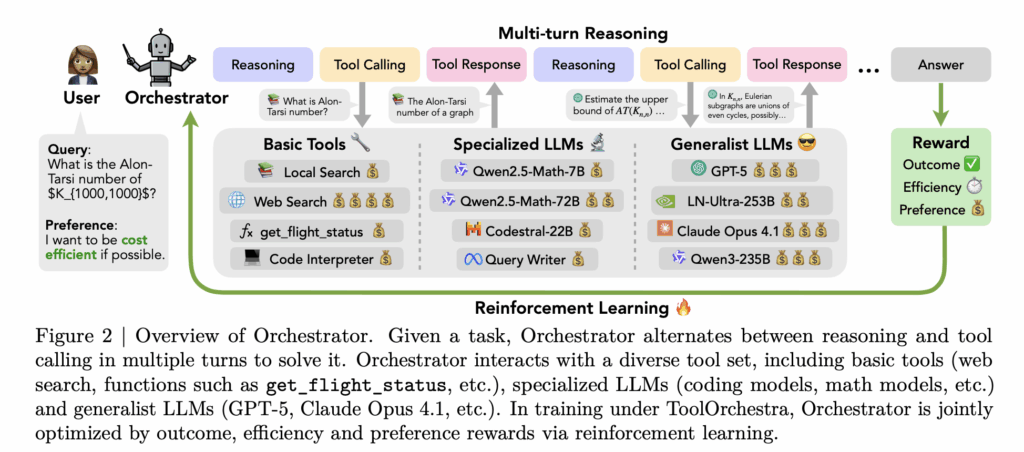
How can an AI system learn to pick the right model or tool for each step of a task instead of always relying on one large model for everything? NVIDIA researchers release ToolOrchestra, a novel method for training a small language model to act as the orchestrator- the ‘brain’ of a heterogeneous tool-use agent https://arxiv.org/pdf/2511.21689 From Single Model Agents to an Orchestration Policy Most current agents follow a simple pattern. A single large model such as GPT-5 receives a prompt that describes available tools, then decides when to call web search or a code interpreter. All high level reasoning still stays inside the same model. ToolOrchestra changes this setup. It trains a dedicated controller model called as ‘Orchestrator-8B‘, that treats both classic tools and other LLMs as callable components. A pilot study in the same research shows why naive prompting is not enough. When Qwen3-8B is prompted to route between GPT-5, GPT-5 mini, Qwen3-32B and Qwen2.5-Coder-32B, it delegates 73 percent of cases to GPT-5. When GPT-5 acts as its own orchestrator, it calls GPT-5 or GPT-5 mini in 98 percent of cases. The research team call these self enhancement and other enhancement biases. The routing policy over uses strong models and ignores cost instructions. ToolOrchestra instead trains a small orchestrator explicitly for this routing problem, using reinforcement learning over full multi turn trajectories. What is Orchestrator 8B? Orchestrator-8B is an 8B parameter decoder only Transformer. It is built by fine tuning Qwen3-8B as an orchestration model and released on Hugging Face. At inference time, the system runs a multi turn loop that alternates reasoning and tool calls. The rollout has three main steps. First, Orchestrator 8B reads the user instruction and an optional natural language preference description, for example a request to prioritize low latency or to avoid web search. Second, it generates internal chain of thought style reasoning and plans an action. Third, it chooses a tool from the available set and emits a structured tool call in a unified JSON format. The environment executes that call, appends the result as an observation and feeds it back into the next step. The process stops when a termination signal is produced or a maximum of 50 turns is reached. Tools cover three main groups. Basic tools include Tavily web search, a Python sandbox code interpreter and a local Faiss index built with Qwen3-Embedding-8B. Specialized LLMs include Qwen2.5-Math-72B, Qwen2.5-Math-7B and Qwen2.5-Coder-32B. Generalist LLM tools include GPT-5, GPT-5 mini, Llama 3.3-70B-Instruct and Qwen3-32B. All tools share the same schema with names, natural language descriptions and typed parameter specs. End to End Reinforcement Learning with Multi Objective Rewards ToolOrchestra formulates the whole workflow as a Markov Decision Process. The state contains the conversation history, past tool calls and observations, and user preferences. Actions are the next text step, including both reasoning tokens and a tool call schema. After up to 50 steps, the environment computes a scalar reward for the full trajectory. The reward has three components. Outcome reward is binary and depends on whether the trajectory solves the task. For open-ended answers, GPT-5 is used as a judge to compare the model output with the reference. Efficiency rewards penalize both monetary cost and wall clock latency. Token usage for proprietary and open source tools is mapped to monetary cost using public API and Together AI pricing. Preference reward measures how well tool usage matches a user preference vector that can increase or decrease the weight on cost, latency or specific tools. These components are combined into a single scalar using the preference vector. The policy is optimized with Group Relative Policy Optimization GRPO, a variant of policy gradient reinforcement learning that normalizes rewards within groups of trajectories for the same task. The training process includes filters that drop trajectories with invalid tool call format or weak reward variance to stabilize optimization. https://arxiv.org/pdf/2511.21689 To make this training possible at scale, the research team plans to introduce ToolScale, a synthetic dataset of multi step tool calling tasks. For each domain, an LLM generates a database schema, database entries, domain specific APIs and then diverse user tasks with ground truth sequences of function calls and required intermediate information. Benchmark results and cost profile NVIDIA research team evaluates Orchestrator-8B on three challenging benchmarks, Humanity’s Last Exam, FRAMES and τ² Bench. These benchmarks target long horizon reasoning, factuality under retrieval and function calling in a dual control environment. On Humanity’s Last Exam text only questions, Orchestrator-8B reaches 37.1 percent accuracy. GPT-5 with basic tools reaches 35.1 percent in the same setting. On FRAMES, Orchestrator-8B achieves 76.3 percent versus 74.0 percent for GPT-5 with tools. On τ² Bench, Orchestrator-8B scores 80.2 percent versus 77.7 percent for GPT-5 with basic tools. https://arxiv.org/pdf/2511.21689 The efficiency gap is larger. In the configuration that uses basic tools plus specialized and generalist LLM tools, Orchestrator-8B has average cost 9.2 cents and latency 8.2 minutes per query, averaged over Humanity’s Last Exam and FRAMES. In the same configuration, GPT-5 costs 30.2 cents and takes 19.8 minutes on average. The model card summarizes this as about 30 percent of the monetary cost and 2.5 times faster for Orchestrator-8B compared to GPT-5. Tool use analysis supports this picture. Claude Opus 4.1 used as an orchestrator calls GPT-5 most of the time. GPT-5 used as an orchestrator prefers GPT-5 mini. Orchestrator-8B spreads calls more evenly across strong models, cheaper models, search, local retrieval and the code interpreter, and reaches higher accuracy at lower cost for the same turn budget. https://arxiv.org/pdf/2511.21689 Generalization experiments replace the training time tools with unseen models such as OpenMath Llama-2-70B, DeepSeek-Math-7B-Instruct, Codestral-22B-v0.1, Claude Sonnet-4.1 and Gemma-3-27B. Orchestrator-8B still achieves the best trade off between accuracy, cost and latency among all baselines in this setting. A separate preference aware test set shows that Orchestrator-8B also tracks user tool usage preferences more closely than GPT-5, Claude Opus-4.1 and Qwen3-235B-A22B under the same reward metric. Key Takeaways ToolOrchestra trains an 8B parameter orchestration model, Orchestrator-8B, that selects and sequences tools and LLMs to solve multi

NVIDIA AI Releases Orchestrator-8B: A Reinforcement Learning Trained Controller for Efficient Tool and Model Selection 投稿を読む »

AI, Committee, ニュース, Uncategorized

Tencent Hunyuan Releases HunyuanOCR: a 1B Parameter End to End OCR Expert VLM

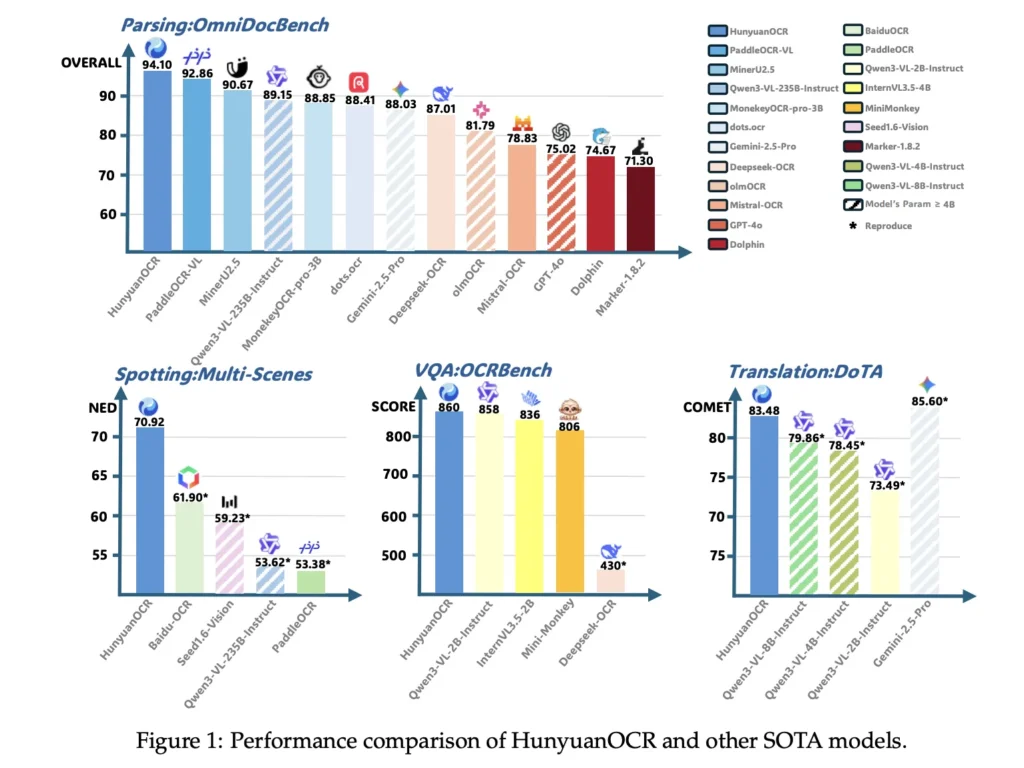
Tencent Hunyuan has released HunyuanOCR, a 1B parameter vision language model that is specialized for OCR and document understanding. The model is built on Hunyuan’s native multimodal architecture and runs spotting, parsing, information extraction, visual question answering, and text image translation through a single end to end pipeline. HunyuanOCR is a lightweight alternative to general VLMs such as Gemini 2.5 and Qwen3 VL that still matches or surpasses them on OCR centric tasks. It targets production use cases like document parsing, card and receipt extraction, video subtitle extraction, and multilingual document translation. https://github.com/Tencent-Hunyuan/HunyuanOCR/blob/main/HunyuanOCR_Technical_Report.pdf Architecture, Native Resolution ViT plus Lightweight LLM HunyuanOCR uses 3 main modules, a Native Resolution Visual Encoder called Hunyuan ViT, an Adaptive MLP Connector, and a Lightweight Language Model. The encoder is based on SigLIP-v2-400M and is extended to support arbitrary input resolutions through adaptive patching that preserves the original aspect ratio. Images are split into patches according to their native proportions and processed with global attention, which improves recognition on long text lines, long documents, and low quality scans. The Adaptive MLP Connector performs learnable pooling on the spatial dimension. It compresses the dense visual tokens into a shorter sequence, while keeping information from text dense regions. This reduces sequence length passed to the language model and lowers compute, while preserving OCR relevant details. The language model is based on the densely architected Hunyuan 0.5B model and uses XD RoPE. XD RoPE splits rotary position embeddings into 4 subspaces for text, height, width, and time. This gives the model a native way to align 1D token order with 2D layout and 3D spatiotemporal structure. As a result, the same stack can handle multi column pages, cross page flows, and sequences of video frames. Training and inference follow a fully end to end paradigm. There is no external layout analysis or post processing model in the loop. All tasks are expressed as natural language prompts and handled in a single forward pass. This design removes error propagation across pipeline stages and simplifies deployment. Data and Pre Training Recipe The data pipeline builds more than 200M image text pairs, across 9 real world scenarios, including street views, documents, advertisements, handwritten text, screenshots, cards and certificates and invoices, game interfaces, video frames, and artistic typography. The corpus covers more than 130 languages. Synthetic data comes from a multilingual generator that supports right to left scripts and paragraph level rendering. The pipeline controls font, language, rotation, and RGB values, and applies warping, blur, and local lighting changes to simulate mobile captures and other hard conditions. https://github.com/Tencent-Hunyuan/HunyuanOCR/blob/main/HunyuanOCR_Technical_Report.pdf Pre training follows 4 stages. Stage-1 performs vision language alignment with pure text, synthetic parsing and recognition data, and general caption data, using 50B tokens and 8k context. Stage-2 runs multimodal pre training on 300B tokens that mix pure text with synthetic spotting, parsing, translation, and VQA samples. Stage-3 extends context length to 32k with 80B tokens focused on long documents and long text. Stage-4 is application oriented supervised fine tuning on 24B tokens of human annotated and hard negative data, keeping 32k context and unified instruction templates. Reinforcement Learning with Verifiable Rewards After supervised training, HunyuanOCR is further optimized with reinforcement learning. The research team use Group Relative Policy Optimization GRPO and a Reinforcement Learning with Verifiable Rewards setup for structured tasks. For text spotting, the reward is based on intersection over union matching of boxes combined with normalized edit distance over text. For document parsing, the reward uses normalized edit distance between the generated structure and the reference. For VQA and translation, the system uses an LLM as a judge. VQA uses a binary reward that checks semantic match. Translation uses a COMET style scoring LLM with scores in [0, 5], normalized to [0, 1]. The training framework enforces length limits and strict formats, and assigns zero reward when outputs overflow or break schema, which stabilizes optimization and encourages valid JSON or structured outputs. Benchmark Results, a 1B Model Competing with Larger VLMs On the internal text spotting benchmark of 900 images across 9 categories, HunyuanOCR reaches an overall score of 70.92. It outperforms traditional pipeline methods like PaddleOCR and BaiduOCR and also general VLMs such as Gemini 2.5 Pro, Qwen3 VL 2B, Qwen3 VL 235B, and Seed 1.6 Vision, despite using far fewer parameters. On OmniDocBench, HunyuanOCR achieves 94.10 overall, with 94.73 on formulas and 91.81 on tables. On the Wild OmniDocBench variant, which prints and recaptures documents under folds and lighting changes, it scores 85.21 overall. On DocML, a multilingual parsing benchmark across 14 non Chinese and non English languages, it reaches 91.03, and the paper reports state of the art results across all 14 languages. For information extraction and VQA, HunyuanOCR reaches 92.29 accuracy on cards, 92.53 on receipts, and 92.87 on video subtitles. On OCRBench, it scores 860, higher than DeepSeek OCR at similar scale and close to larger general VLMs like Qwen3 VL 2B Instruct and Gemini 2.5 Pro. In text image translation, HunyuanOCR uses the DoTA benchmark and a DocML based internal set. It achieves a strong COMET score on DoTA for English to Chinese document translation, and the model wins first place in Track 2.2 OCR free Small Model of the ICDAR 2025 DIMT competition. https://github.com/Tencent-Hunyuan/HunyuanOCR/blob/main/HunyuanOCR_Technical_Report.pdf Key Takeaways Compact end to end OCR VLM: HunyuanOCR is a 1B parameter OCR focused vision language model that connects a 0.4B native resolution ViT to a 0.5B Hunyuan language model through an MLP adapter, and runs spotting, parsing, information extraction, VQA and translation in one end to end instruction driven pipeline without external layout or detection modules. Unified support for diverse OCR scenarios: The model is trained on more than 200M image text pairs across 9 scenarios, including documents, street views, advertisements, handwritten content, screenshots, cards and invoices, game interfaces and video frames, with coverage of over 130 languages in training and support for more than 100 languages in deployment. Data pipeline plus reinforcement learning: Training uses a 4 stage recipe, vision language alignment, multimodal pre training,

Tencent Hunyuan Releases HunyuanOCR: a 1B Parameter End to End OCR Expert VLM 投稿を読む »

AI, Committee, ニュース, Uncategorized

Moving toward LessOps with VMware-to-cloud migrations

Today’s IT leaders face competing mandates to do more (“make us an ‘AI-first’ enterprise—yesterday”) with less (“no new hires for at least the next six months”). VMware has become a focal point of these dueling directives. It remains central to enterprise IT, with 80% of organizations using VMware infrastructure products. But shifting licensing models are prompting teams to reconsider how they manage and scale these workloads, often on tighter budgets. DOWNLOAD THE ARTICLE For many organizations, the path forward involves adopting a LessOps model, an operational strategy that makes hybrid environments manageable without increasing headcount. This operational philosophy minimizes human intervention through extensive automation and selfservice capabilities while maintaining governance and compliance. In practice, VMware-to-cloud migrations create a “two birds, one stone” opportunity. They present a practical moment to codify the automation and governance practices LessOps depends on—laying the groundwork for a leaner, more resilient IT operating model. Download the full article. This content was produced by Insights, the custom content arm of MIT Technology Review. It was not written by MIT Technology Review’s editorial staff. This content was researched, designed, and written by human writers, editors, analysts, and illustrators. This includes the writing of surveys and collection of data for surveys. AI tools that may have been used were limited to secondary production processes that passed thorough human review.

Moving toward LessOps with VMware-to-cloud migrations 投稿を読む »

AI, Committee, ニュース, Uncategorized

This year’s UN climate talks avoided fossil fuels, again

If we didn’t have pictures and videos, I almost wouldn’t believe the imagery that came out of this year’s UN climate talks. Over the past few weeks in Belem, Brazil, attendees dealt with oppressive heat and flooding, and at one point a literal fire broke out, delaying negotiations. The symbolism was almost too much to bear. While many, including the president of Brazil, framed this year’s conference as one of action, the talks ended with a watered-down agreement. The final draft doesn’t even include the phrase “fossil fuels.” As emissions and global temperatures reach record highs again this year, I’m left wondering: Why is it so hard to formally acknowledge what’s causing the problem? This is the 30th time that leaders have gathered for the Conference of the Parties, or COP, an annual UN conference focused on climate change. COP30 also marks 10 years since the gathering that produced the Paris Agreement, in which world powers committed to limiting global warming to “well below” 2.0 °C above preindustrial levels, with a goal of staying below the 1.5 °C mark. (That’s 3.6 °F and 2.7 °F, respectively, for my fellow Americans.) Before the conference kicked off this year, host country Brazil’s president, Luiz Inácio Lula da Silva, cast this as the “implementation COP” and called for negotiators to focus on action, and specifically to deliver a road map for a global transition away from fossil fuels. The science is clear—burning fossil fuels emits greenhouse gases and drives climate change. Reports have shown that meeting the goal of limiting warming to 1.5 °C would require stopping new fossil-fuel exploration and development. The problem is, “fossil fuels” might as well be a curse word at global climate negotiations. Two years ago, fights over how to address fossil fuels brought talks at COP28 to a standstill. (It’s worth noting that the conference was hosted in Dubai in the UAE, and the leader was literally the head of the country’s national oil company.) The agreement in Dubai ended up including a line that called on countries to transition away from fossil fuels in energy systems. It was short of what many advocates wanted, which was a more explicit call to phase out fossil fuels entirely. But it was still hailed as a win. As I wrote at the time: “The bar is truly on the floor.” And yet this year, it seems we’ve dug into the basement. At one point about 80 countries, a little under half of those present, demanded a concrete plan to move away from fossil fuels. But oil producers like Saudi Arabia were insistent that fossil fuels not be singled out. Other countries, including some in Africa and Asia, also made a very fair point: Western nations like the US have burned the most fossil fuels and benefited from it economically. This contingent maintains that legacy polluters have a unique responsibility to finance the transition for less wealthy and developing nations rather than simply barring them from taking the same development route.  The US, by the way, didn’t send a formal delegation to the talks, for the first time in 30 years. But the absence spoke volumes. In a statement to the New York Times that sidestepped the COP talks, White House spokesperson Taylor Rogers said that president Trump had “set a strong example for the rest of the world” by pursuing new fossil-fuel development. To sum up: Some countries are economically dependent on fossil fuels, some don’t want to stop depending on fossil fuels without incentives from other countries, and the current US administration would rather keep using fossil fuels than switch to other energy sources.  All those factors combined help explain why, in its final form, COP30’s agreement doesn’t name fossil fuels at all. Instead, there’s a vague line that leaders should take into account the decisions made in Dubai, and an acknowledgement that the “global transition towards low greenhouse-gas emissions and climate-resilient development is irreversible and the trend of the future.” Hopefully, that’s true. But it’s concerning that even on the world’s biggest stage, naming what we’re supposed to be transitioning away from and putting together any sort of plan to actually do it seems to be impossible. This article is from The Spark, MIT Technology Review’s weekly climate newsletter. To receive it in your inbox every Wednesday, sign up here.

This year’s UN climate talks avoided fossil fuels, again 投稿を読む »

AI, Committee, ニュース, Uncategorized

The Download: the fossil fuel elephant in the room, and better tests for endometriosis

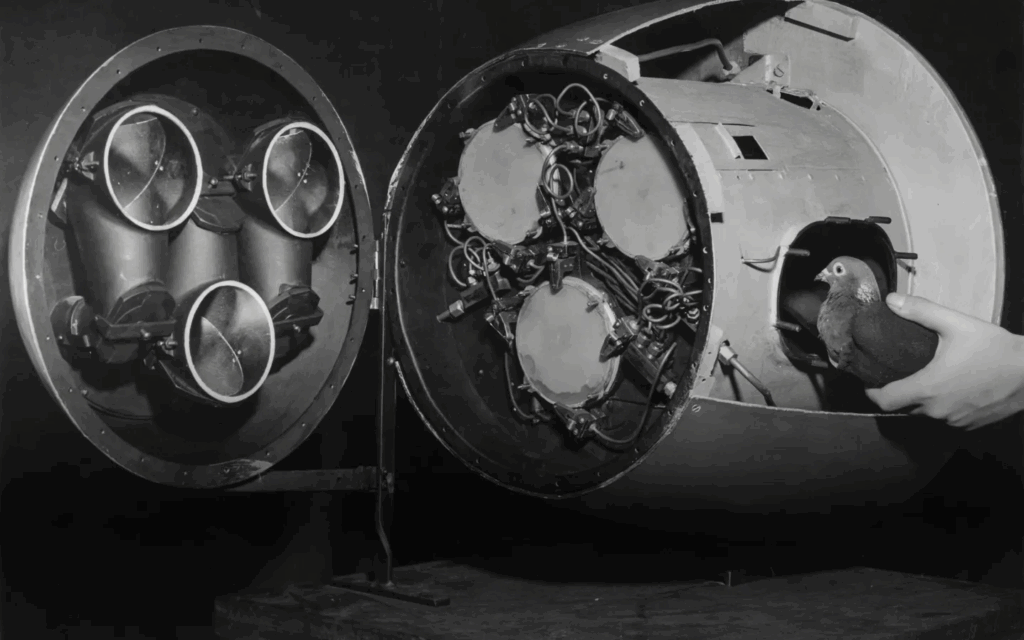
This is today’s edition of The Download, our weekday newsletter that provides a daily dose of what’s going on in the world of technology. This year’s UN climate talks avoided fossil fuels, again Over the past few weeks in Belem, Brazil, attendees of this year’s UN climate talks dealt with oppressive heat and flooding, and at one point a literal fire broke out, delaying negotiations. The symbolism was almost too much to bear. While many, including the president of Brazil, framed this year’s conference as one of action, the talks ended with a watered-down agreement. The final draft doesn’t even include the phrase “fossil fuels.” As emissions and global temperatures reach record highs again this year, I’m left wondering: Why is it so hard to formally acknowledge what’s causing the problem? —Casey Crownhart This article is from The Spark, MIT Technology Review’s weekly climate newsletter. To receive it in your inbox every Wednesday, sign up here. New noninvasive endometriosis tests are on the rise Endometriosis inflicts debilitating pain and heavy bleeding on more than 11% of reproductive-­age women in the United States. Diagnosis takes nearly 10 years on average, partly because half the cases don’t show up on scans, and surgery is required to obtain tissue samples. But a new generation of noninvasive tests are emerging that could help accelerate diagnosis and improve management of this poorly understood condition. Read the full story. —Colleen de Bellefonds This story is from the last print issue of MIT Technology Review magazine, which is full of fascinating stories about the body. If you haven’t already, subscribe now to receive future issues once they land. The must-reads I’ve combed the internet to find you today’s most fun/important/scary/fascinating stories about technology. 1 OpenAI claims a teenager circumvented its safety features before ending his lifeIt says ChatGPT directed Adam Raine to seek help more than 100 times. (TechCrunch)+ OpenAI is strongly refuting the idea it’s liable for the 16-year old’s death. (NBC News)+ The looming crackdown on AI companionship. (MIT Technology Review) 2 The CDC’s new deputy director prefers natural immunity to vaccinesAnd he wasn’t even the worst choice among those considered for the role. (Ars Technica)+ Meet Jim O’Neill, the longevity enthusiast who is now RFK Jr.’s right-hand man. (MIT Technology Review) 3 An MIT study says AI could already replace 12% of the US workforceResearchers drew that conclusion after simulating a digital twin of the US labor market. (CNBC)+ Separate research suggests it could replace 3 million jobs in the UK, too. (The Guardian)+ AI usage looks unlikely to keep climbing. (Economist $) 4 An Italian defense group has created an AI-powered air shield systemIt claims the system allows defenders to generate dome-style missile shields. (FT $)+ Why Trump’s “golden dome” missile defense idea is another ripped straight from the movies. (MIT Technology Review) 5 The EU is considering a ban on social media for under-16sFollowing in Australia’s footsteps, whose own ban comes into power next month. (Politico)+ The European Parliament wants parents to decide on access. (The Guardian) 6 Why do so many astronauts keep getting stuck in space?America, Russia and now China have had to contend with this situation. (WP $)+ A rescue craft for three stranded Chinese astronauts has successfully reached them. (The Register) 7 Uploading pictures of your hotel room could help trafficking victimsA new app uses computer vision to determine where pictures of generic-looking rooms were taken. (IEEE Spectrum) 8 This browser tool turns back the clock to a pre-AI slop webBack to the golden age of pre-November 30 2022. (404 Media)+ The White House’s slop posts are shockingly bad. (NY Mag $)+ Animated neo-Nazi propaganda is freely available on X. (The Atlantic $) 9 Grok’s “epic roasts” are as tragic as you’d expectTest it out at parties at your own peril. (Wired $) 10 Startup founders dread explaining their jobs at Thanksgiving Yes Grandma, I work with computers. (Insider $) Quote of the day “AI cannot ever replace the unique gift that you are to the world.” —Pope Leo XIV warns students about the dangers of over-relying on AI, New York Magazine reports. One more thing Why we should thank pigeons for our AI breakthroughs People looking for precursors to artificial intelligence often point to science fiction or thought experiments like the Turing test. But an equally important, if surprising and less appreciated, forerunner is American psychologist B.F. Skinner’s research with pigeons in the middle of the 20th century. Skinner believed that association—learning, through trial and error, to link an action with a punishment or reward—was the building block of every behavior, not just in pigeons but in all living organisms, including human beings. His “behaviorist” theories fell out of favor in the 1960s but were taken up by computer scientists who eventually provided the foundation for many of the leading AI tools. Read the full story. —Ben Crair We can still have nice things A place for comfort, fun and distraction to brighten up your day. (Got any ideas? Drop me a line or skeet ’em at me.) + I hope you had a happy, err, Green Wednesday if you partook this year.+ Here how to help an endangered species from the comfort of your own home.+ Polly wants to FaceTime—now! (thanks Alice!)+ I need Macaulay Culkin’s idea for another Home Alone sequel to get greenlit, stat.

The Download: the fossil fuel elephant in the room, and better tests for endometriosis 投稿を読む »

AI, Committee, ニュース, Uncategorized

Does Understanding Inform Generation in Unified Multimodal Models? From Analysis to Path Forward

arXiv:2511.20561v1 Announce Type: cross Abstract: Recent years have witnessed significant progress in Unified Multimodal Models, yet a fundamental question remains: Does understanding truly inform generation? To investigate this, we introduce UniSandbox, a decoupled evaluation framework paired with controlled, synthetic datasets to avoid data leakage and enable detailed analysis. Our findings reveal a significant understanding-generation gap, which is mainly reflected in two key dimensions: reasoning generation and knowledge transfer. Specifically, for reasoning generation tasks, we observe that explicit Chain-of-Thought (CoT) in the understanding module effectively bridges the gap, and further demonstrate that a self-training approach can successfully internalize this ability, enabling implicit reasoning during generation. Additionally, for knowledge transfer tasks, we find that CoT assists the generative process by helping retrieve newly learned knowledge, and also discover that query-based architectures inherently exhibit latent CoT-like properties that affect this transfer. UniSandbox provides preliminary insights for designing future unified architectures and training strategies that truly bridge the gap between understanding and generation. Code and data are available at https://github.com/PKU-YuanGroup/UniSandBox

Does Understanding Inform Generation in Unified Multimodal Models? From Analysis to Path Forward 投稿を読む »

AI, Committee, ニュース, Uncategorized

Learn the Ropes, Then Trust the Wins: Self-imitation with Progressive Exploration for Agentic Reinforcement Learning

arXiv:2509.22601v3 Announce Type: replace-cross Abstract: Reinforcement learning (RL) is the dominant paradigm for sharpening strategic tool use capabilities of LLMs on long-horizon, sparsely-rewarded agent tasks, yet it faces a fundamental challenge of exploration-exploitation trade-off. Existing studies stimulate exploration through the lens of policy entropy, but such mechanical entropy maximization is prone to RL instability due to the multi-turn distribution shifting. In this paper, we target the progressive exploration-exploitation balance under the guidance of the agent’s own experiences without succumbing to either entropy collapsing or runaway divergence. We propose SPEAR, a self-imitation learning (SIL) recipe for training agentic LLMs. It extends the vanilla SIL, where a replay buffer stores good experience for off-policy update, by gradually steering the policy entropy across stages. Specifically, the proposed curriculum scheduling harmonizes intrinsic reward shaping and self-imitation to 1) expedite exploration via frequent tool interactions at the beginning, and 2) strengthen exploitation of successful tactics upon convergence towards familiarity with the environment. We also combine bag-of-tricks of industrial RL optimizations for a strong baseline Dr.BoT to demonstrate our effectiveness. In ALFWorld and WebShop, SPEAR increases the success rates of GRPO/GiGPO/Dr.BoT by up to 16.1%/5.1%/8.6% and 20.7%/11.8%/13.9%, respectively. In AIME24 and AIME25, SPEAR boosts Dr.BoT by up to 3.8% and 6.1%, respectively. Such gains incur only 10%-25% extra theoretical complexity and negligible runtime overhead in practice, demonstrating the plug-and-play scalability of SPEAR.

Learn the Ropes, Then Trust the Wins: Self-imitation with Progressive Exploration for Agentic Reinforcement Learning 投稿を読む »

AI, Committee, ニュース, Uncategorized

MTA: A Merge-then-Adapt Framework for Personalized Large Language Model

arXiv:2511.20072v2 Announce Type: new Abstract: Personalized Large Language Models (PLLMs) aim to align model outputs with individual user preferences, a crucial capability for user-centric applications. However, the prevalent approach of fine-tuning a separate module for each user faces two major limitations: (1) storage costs scale linearly with the number of users, rendering the method unscalable; and (2) fine-tuning a static model from scratch often yields suboptimal performance for users with sparse data. To address these challenges, we propose MTA, a Merge-then-Adapt framework for PLLMs. MTA comprises three key stages. First, we construct a shared Meta-LoRA Bank by selecting anchor users and pre-training meta-personalization traits within meta-LoRA modules. Second, to ensure scalability and enable dynamic personalization combination beyond static models, we introduce an Adaptive LoRA Fusion stage. This stage retrieves and dynamically merges the most relevant anchor meta-LoRAs to synthesize a user-specific one, thereby eliminating the need for user-specific storage and supporting more flexible personalization. Third, we propose a LoRA Stacking for Few-Shot Personalization stage, which applies an additional ultra-low-rank, lightweight LoRA module on top of the merged LoRA. Fine-tuning this module enables effective personalization under few-shot settings. Extensive experiments on the LaMP benchmark demonstrate that our approach outperforms existing SOTA methods across multiple tasks.

MTA: A Merge-then-Adapt Framework for Personalized Large Language Model 投稿を読む »

We use cookies to improve your experience and performance on our website. You can learn more at プライバシーポリシー and manage your privacy settings by clicking Settings.

Privacy Preferences

You can choose your cookie settings by turning on/off each type of cookie as you wish, except for essential cookies.

Allow All
Manage Consent Preferences
  • Always Active

Save
ja