YouZum

Uncategorized

AI, Committee, ニュース, Uncategorized

Kernel Principal Component Analysis (PCA): Explained with an Example

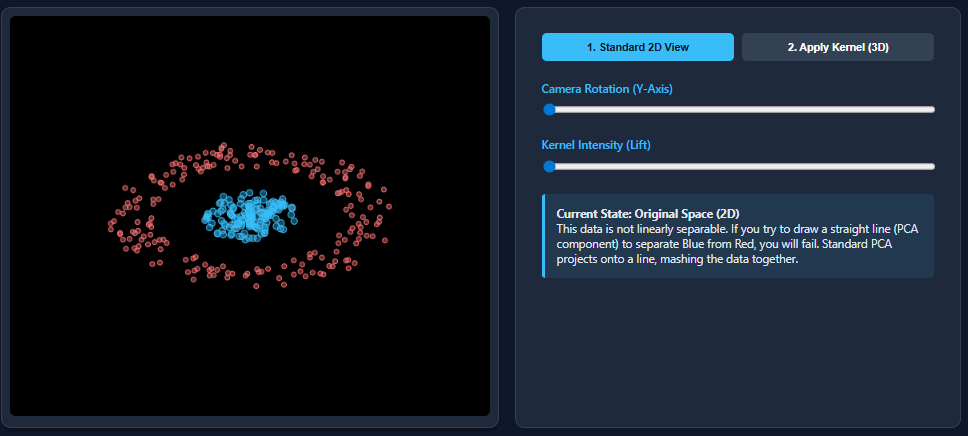
Dimensionality reduction techniques like PCA work wonderfully when datasets are linearly separable—but they break down the moment nonlinear patterns appear. That’s exactly what happens with datasets such as two moons: PCA flattens the structure and mixes the classes together.  Kernel PCA fixes this limitation by mapping the data into a higher-dimensional feature space where nonlinear patterns become linearly separable. In this article, we’ll walk through how Kernel PCA works and use a simple example to visually compare PCA vs. Kernel PCA, showing how a nonlinear dataset that PCA fails to separate becomes perfectly separable after applying Kernel PCA. What is PCA and how is it different from Kernel PCA? Principal Component Analysis (PCA) is a linear dimensionality-reduction technique that identifies the directions (principal components) along which the data varies the most. It works by computing orthogonal linear combinations of the original features and projecting the dataset onto the directions of maximum variance.  These components are uncorrelated and ordered so that the first few capture most of the information in the data. PCA is powerful, but it comes with one important limitation: it can only uncover linear relationships in the data. When applied to nonlinear datasets—like the “two moons” example—it often fails to separate the underlying structure. Kernel PCA extends PCA to handle nonlinear relationships. Instead of directly applying PCA in the original feature space, Kernel PCA first uses a kernel function (such as RBF, polynomial, or sigmoid) to implicitly project the data into a higher-dimensional feature space where the nonlinear structure becomes linearly separable.  PCA is then performed in this transformed space using a kernel matrix, without explicitly computing the higher-dimensional projection. This “kernel trick” allows Kernel PCA to capture complex patterns that standard PCA cannot. We will now create a dataset that is nonlinear and then apply PCA to the dataset. Code Implementation Generating the dataset We generate a nonlinear “two moons” dataset using make_moons, which is ideal for demonstrating why PCA fails and Kernel PCA succeeds. Copy CodeCopiedUse a different Browser import matplotlib.pyplot as plt from sklearn.datasets import make_moons X, y = make_moons(n_samples=1000, noise=0.02, random_state=123) plt.scatter(X[:, 0], X[:, 1], c=y) plt.show() Applying PCA on the dataset Copy CodeCopiedUse a different Browser from sklearn.decomposition import PCA pca = PCA(n_components=2) X_pca = pca.fit_transform(X) plt.title(“PCA”) plt.scatter(X_pca[:, 0], X_pca[:, 1], c=y) plt.xlabel(“Component 1”) plt.ylabel(“Component 2”) plt.show() The PCA visualization shows that the two moon-shaped clusters remain intertwined even after dimensionality reduction. This happens because PCA is a strictly linear technique—it can only rotate, scale, or flatten the data along straight directions of maximum variance.  Since the “two moons” dataset has a nonlinear structure, PCA is unable to separate the classes or untangle the curved shapes. As a result, the transformed data still looks almost identical to the original pattern, and the two classes remain overlapped in the projected space. Applying Kernel PCA on the dataset We now apply Kernel PCA using an RBF kernel, which maps the nonlinear data into a higher-dimensional space where it becomes linearly separable. In the kernel space the two classes in our dataset are linearly separable. Kernel PCA uses a kernel function to project the dataset into a higher-dimensional space, where it is linearly separable. Copy CodeCopiedUse a different Browser from sklearn.decomposition import KernelPCA kpca = KernelPCA(kernel=’rbf’, gamma=15) X_kpca = kpca.fit_transform(X) plt.title(“Kernel PCA”) plt.scatter(X_kpca[:, 0], X_kpca[:, 1], c=y) plt.show() The goal of PCA (and dimensionality reduction in general) is not just to compress the data—it’s to reveal the underlying structure in a way that preserves meaningful variation. In nonlinear datasets like the two-moons example, traditional PCA cannot “unfold” the curved shapes because it only applies linear transformations. Kernel PCA, however, performs a nonlinear mapping before applying PCA, allowing the algorithm to untangle the moons into two clearly separated clusters. This separation is valuable because it makes downstream tasks like visualization, clustering, and even classification far more effective. When the data becomes linearly separable after transformation, simple models—such as linear classifiers—can successfully distinguish between the classes, something that would be impossible in the original or PCA-transformed space. Challenges involved with Kernel PCA While Kernel PCA is powerful for handling nonlinear datasets, it comes with several practical challenges. The biggest drawback is computational cost—because it relies on computing pairwise similarities between all data points, the algorithm has O(n²) time and memory complexity, making it slow and memory-heavy for large datasets.  Another challenge is model selection: choosing the right kernel (RBF, polynomial, etc.) and tuning parameters like gamma can be tricky and often requires experimentation or domain expertise.  Kernel PCA can also be harder to interpret, since the transformed components no longer correspond to intuitive directions in the original feature space. Finally, it is sensitive to missing values and outliers, which can distort the kernel matrix and degrade performance. Check out the FULL CODES here. Feel free to check out our GitHub Page for Tutorials, Codes and Notebooks. Also, feel free to follow us on Twitter and don’t forget to join our 100k+ ML SubReddit and Subscribe to our Newsletter. Wait! are you on telegram? now you can join us on telegram as well. The post Kernel Principal Component Analysis (PCA): Explained with an Example appeared first on MarkTechPost.

Kernel Principal Component Analysis (PCA): Explained with an Example 投稿を読む »

AI, Committee, ニュース, Uncategorized

Are LLMs Truly Multilingual? Exploring Zero-Shot Multilingual Capability of LLMs for Information Retrieval: An Italian Healthcare Use Case

arXiv:2512.04834v1 Announce Type: cross Abstract: Large Language Models (LLMs) have become a key topic in AI and NLP, transforming sectors like healthcare, finance, education, and marketing by improving customer service, automating tasks, providing insights, improving diagnostics, and personalizing learning experiences. Information extraction from clinical records is a crucial task in digital healthcare. Although traditional NLP techniques have been used for this in the past, they often fall short due to the complexity, variability of clinical language, and high inner semantics in the free clinical text. Recently, Large Language Models (LLMs) have become a powerful tool for better understanding and generating human-like text, making them highly effective in this area. In this paper, we explore the ability of open-source multilingual LLMs to understand EHRs (Electronic Health Records) in Italian and help extract information from them in real-time. Our detailed experimental campaign on comorbidity extraction from EHR reveals that some LLMs struggle in zero-shot, on-premises settings, and others show significant variation in performance, struggling to generalize across various diseases when compared to native pattern matching and manual annotations.

Are LLMs Truly Multilingual? Exploring Zero-Shot Multilingual Capability of LLMs for Information Retrieval: An Italian Healthcare Use Case 投稿を読む »

AI, Committee, ニュース, Uncategorized

Beyond the Exploration-Exploitation Trade-off: A Hidden State Approach for LLM Reasoning in RLVR

arXiv:2509.23808v3 Announce Type: replace-cross Abstract: A prevailing view in Reinforcement Learning with Verifiable Rewards (RLVR) interprets recent progress through the lens of an exploration-exploitation trade-off, a perspective largely shaped by token-level metrics. We re-examine this perspective, proposing that this perceived trade-off may not be a fundamental constraint but rather an artifact of the measurement level. To investigate this, we shift the analysis to the semantically rich hidden-state space, adopting Effective Rank (ER) to quantify exploration and proposing its novel first- and second-order derivatives, named ER Velocity and ER Acceleration, to capture exploitation dynamics. Our analysis reveals that in the semantic space, exploration and exploitation could be decoupled (Sec.~4). This finding reveals an opportunity to enhance both capacities simultaneously. This insight motivates our method, Velocity-Exploiting Rank-Learning (VERL), the first to operationalize the principle of synergistic exploration-exploitation enhancement by directly shaping the RL advantage function. The key innovation is leveraging the theoretically stable ERA as a predictive meta-controller to create a synergistic, dual-channel incentive structure. Instead of forcing a trade-off, VERL prospectively amplifies rewards for exploration to preempt overconfidence and reinforces exploitative gains to consolidate reasoning. Experiments across diverse LLMs and reasoning benchmarks show consistent gains, including up to 21.4% absolute accuracy improvement on the challenging Gaokao 2024 dataset.

Beyond the Exploration-Exploitation Trade-off: A Hidden State Approach for LLM Reasoning in RLVR 投稿を読む »

AI, Committee, ニュース, Uncategorized

Semantic Mastery: Enhancing LLMs with Advanced Natural Language Understanding

arXiv:2504.00409v2 Announce Type: replace Abstract: Large language models (LLMs) have greatly improved their capability in performing NLP tasks. However, deeper semantic understanding, contextual coherence, and more subtle reasoning are still difficult to obtain. The paper discusses state-of-the-art methodologies that advance LLMs with more advanced NLU techniques, such as semantic parsing, knowledge integration, and contextual reinforcement learning. We analyze the use of structured knowledge graphs, retrieval-augmented generation (RAG), and fine-tuning strategies that match models with human-level understanding. Furthermore, we address the incorporation of transformer-based architectures, contrastive learning, and hybrid symbolic-neural methods that address problems like hallucinations, ambiguity, and inconsistency in the factual perspectives involved in performing complex NLP tasks, such as question-answering text summarization and dialogue generation. Our findings show the importance of semantic precision for enhancing AI-driven language systems and suggest future research directions to bridge the gap between statistical language models and true natural language understanding.

Semantic Mastery: Enhancing LLMs with Advanced Natural Language Understanding 投稿を読む »

AI, Committee, ニュース, Uncategorized

DraCo: Draft as CoT for Text-to-Image Preview and Rare Concept Generation

arXiv:2512.05112v1 Announce Type: cross Abstract: Recent unified multimodal large language models (MLLMs) have shown impressive capabilities, incorporating chain-of-thought (CoT) reasoning for enhanced text-to-image generation. However, existing approaches remain limited, either treating the model merely as a standalone generator or relying on abstract textual planning. To this end, we propose Draft-as-CoT (DraCo), a novel interleaved reasoning paradigm that fully leverages both textual and visual contents in CoT for better planning and verification. Our method first generates a low-resolution draft image as preview, providing more concrete and structural visual planning and guidance. Then, we employ the model’s inherent understanding capability to verify potential semantic misalignments between the draft and input prompt, and performs refinement through selective corrections with super-resolution. In this way, our approach addresses two fundamental challenges: the coarse-grained nature of textual planning and the difficulty in generating rare attribute combinations. To support training, we curate DraCo-240K, aiming to enhance three atomic capabilities spanning general correction, instance manipulation, and layout reorganization. Supported by DraCo-CFG, a specialized classifier-free guidance (CFG) strategy for interleaved reasoning, DraCo achieves a tremendous increase on GenEval (+8%), Imagine-Bench (+0.91), and GenEval++ (+3%), significantly outperforming direct generation and other generation methods empowered by CoT.

DraCo: Draft as CoT for Text-to-Image Preview and Rare Concept Generation 投稿を読む »

AI, Committee, ニュース, Uncategorized

LexGenius: An Expert-Level Benchmark for Large Language Models in Legal General Intelligence

arXiv:2512.04578v1 Announce Type: new Abstract: Legal general intelligence (GI) refers to artificial intelligence (AI) that encompasses legal understanding, reasoning, and decision-making, simulating the expertise of legal experts across domains. However, existing benchmarks are result-oriented and fail to systematically evaluate the legal intelligence of large language models (LLMs), hindering the development of legal GI. To address this, we propose LexGenius, an expert-level Chinese legal benchmark for evaluating legal GI in LLMs. It follows a Dimension-Task-Ability framework, covering seven dimensions, eleven tasks, and twenty abilities. We use the recent legal cases and exam questions to create multiple-choice questions with a combination of manual and LLM reviews to reduce data leakage risks, ensuring accuracy and reliability through multiple rounds of checks. We evaluate 12 state-of-the-art LLMs using LexGenius and conduct an in-depth analysis. We find significant disparities across legal intelligence abilities for LLMs, with even the best LLMs lagging behind human legal professionals. We believe LexGenius can assess the legal intelligence abilities of LLMs and enhance legal GI development. Our project is available at https://github.com/QwenQKing/LexGenius.

LexGenius: An Expert-Level Benchmark for Large Language Models in Legal General Intelligence 投稿を読む »

AI, Committee, ニュース, Uncategorized

A Group Fairness Lens for Large Language Models

arXiv:2312.15478v2 Announce Type: replace Abstract: The need to assess LLMs for bias and fairness is critical, with current evaluations often being narrow, missing a broad categorical view. In this paper, we propose evaluating the bias and fairness of LLMs from a group fairness lens using a novel hierarchical schema characterizing diverse social groups. Specifically, we construct a dataset, GFAIR, encapsulating target-attribute combinations across multiple dimensions. Moreover, we introduce statement organization, a new open-ended text generation task, to uncover complex biases in LLMs. Extensive evaluations of popular LLMs reveal inherent safety concerns. To mitigate the biases of LLMs from a group fairness perspective, we pioneer a novel chainof-thought method GF-THINK to mitigate biases of LLMs from a group fairness perspective. Experimental results demonstrate its efficacy in mitigating bias and achieving fairness in LLMs. Our dataset and codes are available at https://github.com/surika/Group-Fairness-LLMs.

A Group Fairness Lens for Large Language Models 投稿を読む »

AI, Committee, ニュース, Uncategorized

NAS-LoRA: Empowering Parameter-Efficient Fine-Tuning for Visual Foundation Models with Searchable Adaptation

arXiv:2512.03499v1 Announce Type: cross Abstract: The Segment Anything Model (SAM) has emerged as a powerful visual foundation model for image segmentation. However, adapting SAM to specific downstream tasks, such as medical and agricultural imaging, remains a significant challenge. To address this, Low-Rank Adaptation (LoRA) and its variants have been widely employed to enhancing SAM’s adaptation performance on diverse domains. Despite advancements, a critical question arises: can we integrate inductive bias into the model? This is particularly relevant since the Transformer encoder in SAM inherently lacks spatial priors within image patches, potentially hindering the acquisition of high-level semantic information. In this paper, we propose NAS-LoRA, a new Parameter-Efficient Fine-Tuning (PEFT) method designed to bridge the semantic gap between pre-trained SAM and specialized domains. Specifically, NAS-LoRA incorporates a lightweight Neural Architecture Search (NAS) block between the encoder and decoder components of LoRA to dynamically optimize the prior knowledge integrated into weight updates. Furthermore, we propose a stage-wise optimization strategy to help the ViT encoder balance weight updates and architectural adjustments, facilitating the gradual learning of high-level semantic information. Various Experiments demonstrate our NAS-LoRA improves existing PEFT methods, while reducing training cost by 24.14% without increasing inference cost, highlighting the potential of NAS in enhancing PEFT for visual foundation models.

NAS-LoRA: Empowering Parameter-Efficient Fine-Tuning for Visual Foundation Models with Searchable Adaptation 投稿を読む »

AI, Committee, ニュース, Uncategorized

Scaling Multimodal Search and Recommendation with Small Language Models via Upside-Down Reinforcement Learning

arXiv:2502.09854v2 Announce Type: replace Abstract: In this work, we investigate how small language models (SLMs) can be scaled to support multimodal search and recommendation use cases while remaining efficient enough for real-time, resource-constrained deployments. We present a framework that combines upside-down reinforcement learning with synthetic data distillation from a large language model (Llama-3) to train a 100M-parameter GPT-2 model for multitask prompt generation. Despite being up to 80 times smaller than state-of-the-art large language models (LLMs), our SLM achieves relevance and diversity scores within 6% of competitive baselines such as Llama-3 8B, Qwen3 8B, and Ministral 8B. These results demonstrate that SLMs can effectively handle multimodal search and recommendation tasks, while dramatically reducing inference latency and memory overhead. Our study highlights the potential of lightweight models as practical engines for scalable multimodal discovery, bridging the gap between cutting-edge research and real-world multimodal applications such as media recommendations and creative content generation.

Scaling Multimodal Search and Recommendation with Small Language Models via Upside-Down Reinforcement Learning 投稿を読む »

AI, Committee, ニュース, Uncategorized

Stable Signer: Hierarchical Sign Language Generative Model

arXiv:2512.04048v1 Announce Type: cross Abstract: Sign Language Production (SLP) is the process of converting the complex input text into a real video. Most previous works focused on the Text2Gloss, Gloss2Pose, Pose2Vid stages, and some concentrated on Prompt2Gloss and Text2Avatar stages. However, this field has made slow progress due to the inaccuracy of text conversion, pose generation, and the rendering of poses into real human videos in these stages, resulting in gradually accumulating errors. Therefore, in this paper, we streamline the traditional redundant structure, simplify and optimize the task objective, and design a new sign language generative model called Stable Signer. It redefines the SLP task as a hierarchical generation end-to-end task that only includes text understanding (Prompt2Gloss, Text2Gloss) and Pose2Vid, and executes text understanding through our proposed new Sign Language Understanding Linker called SLUL, and generates hand gestures through the named SLP-MoE hand gesture rendering expert block to end-to-end generate high-quality and multi-style sign language videos. SLUL is trained using the newly developed Semantic-Aware Gloss Masking Loss (SAGM Loss). Its performance has improved by 48.6% compared to the current SOTA generation methods.

Stable Signer: Hierarchical Sign Language Generative Model 投稿を読む »

We use cookies to improve your experience and performance on our website. You can learn more at プライバシーポリシー and manage your privacy settings by clicking Settings.

Privacy Preferences

You can choose your cookie settings by turning on/off each type of cookie as you wish, except for essential cookies.

Allow All
Manage Consent Preferences
  • Always Active

Save
ja