YouZum

ニュース

AI, Committee, ニュース, Uncategorized

The Download: Claude’s inner workings and OpenAI’s “super app”

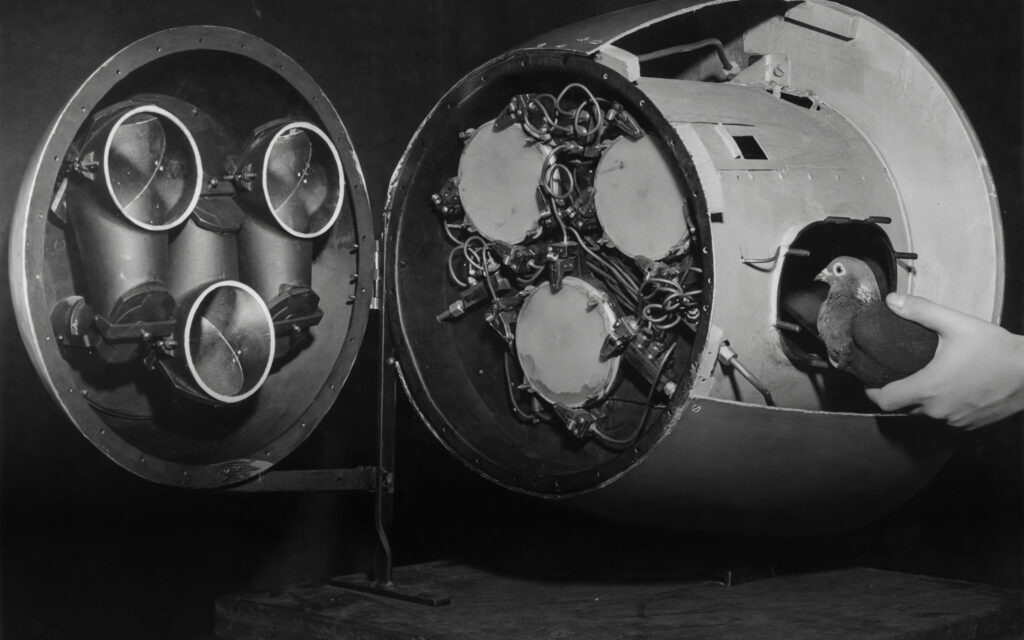
This is today’s edition of The Download, our weekday newsletter that provides a daily dose of what’s going on in the world of technology. Anthropic found a hidden space where Claude puzzles over concepts The AI firm Anthropic has got the clearest glimpse yet at what’s really going on inside large language models as they answer questions or carry out tasks. What they found ranges from the mundane to the unnerving.  Researchers at the company built a tool called the Jacobian lens (or J-lens) and used it to uncover a hidden area, which they named the J-space, inside its flagship LLM, Claude. The J-space contains words related to the response a model is working on but may not ultimately produce. If Claude were a person (which it is not), you might say these hidden words reveal what’s on its mind before it actually speaks.  Read the full story on what they found. —Will Douglas Heaven The must-reads I’ve combed the internet to find you today’s most fun/important/scary/fascinating stories about technology. 1 OpenAI has unveiled its long-awaited “super app” ChatGPT Work blends its chatbot, coding tool, and new models. (Reuters $)+ It’s designed to do your work for you and with you. (Ars Technica)+ And arrived the same day as OpenAI’s GPT 5.6 models. (NYT $)+ It’s also developing a fully automated researcher. (MIT Technology Review) 2  Humanoids have performed teleoperated surgery on living animalsIn the world-first, they removed gallbladders from pigs. (Ars Technica)+ The human work behind humanoids is hidden. (MIT Technology Review) 3 SK Hynix has landed the largest US listing by a foreign companyThe South Korean chip giant raised $26.5 billion. (CNN)+ Demand for AI data centres has led its profits to skyrocket. (Guardian)+ But its jumbo share sale may be a sign of overheated times. (FT $)+ South Korea’s hottest bachelors are chip workers. (MIT Technology Review) 4 Tencent is leading a deal to unwind Meta’s $2 billion Manus acquisitionIt’s in talks to become the Chinese AI startup’s largest shareholder. (FT $)+ Tencent will reportedly buy Manus for no less ​than $2 billion. (Reuters $)+ Beijing had ordered Meta to unwind the acquisition. (Bloomberg $) 5 Resuscitated human retinas responded to light 10 hours after deathIt’s a big step towards eye transplants that restore vision. (New Scientist $)+ As is a new device that revives dead eyeballs. (MIT Technology Review) 6 Meta has started charging for AI accessA new version of Muse Spark has a paid tier for developers. (Quartz) + Meta also plans to start producing an AI chip in September. (Reuters $) 7 OpenAI and Google have sold AI models to blacklisted China groupsVia Singapore-based subsidiaries of Alibaba, Baidu and Tencent. (FT $) 8 A daughter tested an AI “death bot” of her fatherThe technology provided both comfort and unease. (New Yorker $) 9 An astronomer says the hunt for alien life needs more statisticsHe wants to replace speculation with mathematical frameworks. (Quanta) 10 Pokémon Go players turned Times Square into a giant battlefieldMore than 1,500 fans finally fulfilled the game’s 2016 launch promise. (Wired $)+ Pokémon Go is also training world models. (MIT Technology Review) Quote of the day “When we’re talking about AI, we love the hype, we get excited about it. The damn thing never actually lands in practice.” —Vijay Janapa Reddi, an engineering professor at Harvard University, tells Wired why he’s skeptical about grand plans for AI. One More Thing B.F. SKINNER FOUNDATION Why we should thank pigeons for our AI breakthroughs In 1943, psychologist B.F. Skinner led a secret government project to make bombs more precise. His idea: teach pigeons to guide missiles by pecking at targets on a screen inside a warhead. To train them, Skinner rewarded the birds with food when they made the right decisions, using trial and error to shape their behavior. Unsurprisingly, the military never deployed Skinner’s kamikaze pigeons. Yet his experiments convinced him that pigeons were “an extremely reliable instrument” for studying learning.   Decades later, those same principles would help power reinforcement learning, the technology behind some of today’s most advanced AI systems. Discover how pigeons inspired one of AI’s most powerful techniques. —Ben Crair We can still have nice things A place for comfort, fun, and distraction to brighten up your day. (Got any ideas? Drop me a line.) + Here’s a splendid selection of this year’s NSW architecture award winners.+ Photographers have captured the Strawberry Moon’s golden glow in stunning detail.+ Idiocracy is the film that best exemplifies the “American experience,” according to a new poll. Look back at the prescient comedy with this Screen Junkies trailer.+ Get ready for the weekend with this psychedelic house journey from Jamie xx b2b Caribou.

The Download: Claude’s inner workings and OpenAI’s “super app” 投稿を読む »
AI, Committee, ニュース, Uncategorized

Four nuclear reactors hit a big milestone in the US

I was really looking forward to July 4, and not just because I love a poolside barbecue. This year the American holiday also marked a big symbolic deadline for US nuclear power. Last year the Trump administration set a goal to see three new microreactors achieve criticality, a technical milestone establishing that a reactor can sustain a chain reaction, by the nation’s 250th birthday. And just in time, four reactors did so. It was a lofty goal, and seeing not just three but four companies meet it is certainly a positive sign for emerging nuclear technologies at a time when the world is facing increased need to increase electricity supply and address climate change with emissions-free technologies. But achieving criticality doesn’t mean a reactor is ready to provide electricity for the grid (or at all, for that matter). Let’s untangle what this program’s success could mean for nuclear power in the US, and where these companies might go from here. The Reactor Pilot Program essentially opened a special door for prototype reactors to fast-track development. In August, the US Department of Energy selected 11 reactor projects for the program and offered them land and support from the national labs system. These are all microreactors; the large light-water reactors that dominate the grid today are tens or even hundreds of times their size.  Antares Nuclear was the first to achieve criticality, reaching the milestone in June in its Mark-0 test reactor. Reactors from Valar Atomics, Deployable Energy, and Aalo Atomics followed. (Aalo hit the mark in the early hours of July 4—an inspiring example of just barely meeting a deadline.) The speed with which these companies hit this milestone is impressive, especially in an industry known for massive projects that frequently blow past deadlines and stated budgets. (Valar, Antares, and Aalo were all founded in 2023, and Deployable started in 2025.) But reaching criticality and running a reactor that can produce electricity are two totally different things. All these reactors reached what’s called zero-power criticality. Basically, it’s a test of whether you can start a nuclear chain reaction, with no meaningful power coming from the reactor. “A zero-power-criticality test can be achieved without making real engineering progress on fuel or design,” Kathryn Huff, a former assistant secretary for nuclear energy and chair of the Department of Nuclear Engineering and Engineering Physics of the University of Wisconsin–Madison, said on an episode of the Catalyst podcast earlier this year. Now, with the completion of this program, the companies will need to continue their work to make power, which could involve some big technical challenges. In some cases they’ll need to add significant equipment, like the cooling systems to transfer the heat out of the reactor core. The companies are projecting aggressive timelines moving forward. Aalo says it’s already begun work on the second reactor and plans to produce 10 megawatts of electricity to power an on-site data center in 2027. Deployable Energy says it plans to deploy commercial reactors by 2028.  I tend to take timelines from startups, especially in nuclear, with a grain of salt. Not only are these remarkably complex technical machines, but companies often run into problems outside their own control, like regulatory challenges—which these new projects could soon face.  The Nuclear Regulatory Commission is in charge of civilian and commercial nuclear use in the US, and historically, the process to get nuclear reactors approved has been quite slow. The agency did propose a new framework for microreactor approvals earlier this year, which is designed to speed up the process—but it’s yet to be seen how quickly things will move. (And it’s worth noting here that some nuclear experts have questioned whether the agency under the Trump administration is loosening nuclear rules too much.) Some nuclear supporters aren’t applauding the microreactor milestone. Federal focus on the program is an “unhelpful diversion” from goals to meaningfully increase nuclear capacity, according to one analysis by Third Way, a public policy think tank. “Artificially accelerating project timelines is a short-term solution, not a long-term fix,” the memo reads.  Criticality is a big first step, but a lot will still have to happen for any of these microreactors to come online, much less for these small reactors to be a significant source of electricity for the grid.  This article is from The Spark, MIT Technology Review’s weekly climate newsletter. To receive it in your inbox every Wednesday, sign up here. 

Four nuclear reactors hit a big milestone in the US 投稿を読む »

AI, Committee, ニュース, Uncategorized

Datalab Lift vs the Field: How a 9B Schema-First Extractor Compares with NuExtract3, LlamaExtract, Marker, and Docling

Datalab’s Lift is a focused document extraction tool with a specific promise: give it a PDF or image plus a JSON Schema, and it returns schema-shaped JSON directly. Instead of converting a document to Markdown first and then asking another model to extract fields, Lift reads rendered page images and attempts to emit the final structured object in a single pass. According to Datalab, Lift is a 9B vision model for structured JSON extraction from PDFs and images, supports schema-constrained decoding, and returns JSON that matches the user’s schema. That positioning matters because Lift is not mainly an OCR engine, not mainly a PDF-to-Markdown converter, and not a full enterprise document review platform. It is best understood as a schema-first document extractor: a model for turning visually complex documents into application-ready fields. First, the distinction that organizes everything: parsing vs. extraction Most document AI tools solve one of two different problems: Parsers turn documents into faithful intermediate representations: Markdown, HTML, JSON blocks, layout trees, tables, headings, reading order, and chunks for retrieval. Tools such as Docling, MinerU, Marker, Unstructured, PyMuPDF, OCRmyPDF, and Surya primarily fall into this category. Their output is document-shaped. Extractors turn documents into the fields an application actually needs. You define a schema — for example, invoice_number, vendor_name, total, due_date, or line_items[] — and the system tries to return those values directly. Lift, NuExtract3, LlamaExtract, Reducto Extract, Extend, Azure Content Understanding, and other cloud extraction APIs belong closer to this category. Their output is schema-shaped. That distinction matters because many production systems still follow a parse-then-extract pattern: convert a PDF to Markdown or structured text, then send that representation to an LLM with a schema. Lift’s bet is to collapse that workflow into a single visual extraction pass. That can reduce pipeline complexity, but only when the real goal is field extraction rather than faithful document reconstruction. The competitive map Lift sits at the intersection of several overlapping categories: Open-weight extraction VLMs such as NuExtract3 Frontier multimodal LLMs with structured-output modes Cloud document AI systems such as Azure, Google, and AWS Commercial extraction platforms such as Reducto, Extend, LlamaExtract, and Datalab’s own API Open-source document parsers such as Docling, MinerU, Marker, and Unstructured Structured-generation libraries such as XGrammar, Outlines, Instructor, BAML, and related JSON-output systems The important point is that not all of these tools are direct competitors. Some compete with Lift directly. Others are adjacent infrastructure. A parser like Docling is not trying to solve the same problem as Lift. A constrained-decoding library is not a document model at all. A commercial extraction platform may include extraction models, citations, review workflows, and compliance infrastructure. Lift is narrower: it is the raw schema-first extractor. Lift vs. NuExtract3: the closest open-weight comparison NuExtract3 is probably Lift’s closest open-weight competitor. NuMind describes NuExtract3 as a unified 4B vision-language reasoning model for document understanding, combining structured information extraction with image-to-Markdown conversion for documents such as scans, receipts, forms, invoices, contracts, and tables. Its Hugging Face model card lists it under an Apache-2.0 license. The contrast is straightforward. Lift is larger at 9B and, in Datalab’s own benchmark, reports stronger field accuracy than NuExtract3: 90.2% versus 81.5%. NuExtract3 is smaller, more permissively licensed, and also positioned as a Markdown-conversion model. So the practical decision is not only accuracy. If the priorities are permissive licensing, smaller local deployment, and a single model that can also convert documents to Markdown, NuExtract3 is attractive. If the priority is schema-first field extraction with Datalab’s reported speed-accuracy trade-off, Lift becomes more compelling. Lift vs. frontier multimodal LLMs A common alternative is to send the document to a frontier multimodal LLM and ask for structured output. In Datalab’s benchmark, Gemini Flash 3.5 slightly outperforms Lift on field accuracy and full-document accuracy, while Lift is much faster in the reported setup: 9.5 seconds median latency for Lift versus 28.1 seconds for Gemini Flash 3.5. That does not mean Lift is always better. Frontier models remain attractive when volume is modest, setup time matters more than infrastructure control, and cloud processing is acceptable. Lift’s advantage appears when latency, data residency, repeatable self-hosting, and large-volume cost control matter. Lift vs. cloud document AI platforms Azure AI Document Intelligence, Azure Content Understanding, Google Document AI, and AWS Textract are managed cloud services rather than just models. They provide enterprise infrastructure for document processing, including deployment controls, service reliability, monitoring, procurement processes, and integration with broader cloud ecosystems. Microsoft describes Azure Content Understanding as a way to transform unstructured data into structured, machine-readable information while preserving structural relationships. In Datalab’s benchmark, Azure Content Understanding reports lower field accuracy and higher latency than Lift, but it includes citations, which Lift’s open weights do not. Datalab’s own hosted API also adds per-field verification, citations, and confidence scores beyond the open model. This is the cloud tradeoff. Cloud platforms are usually easier to adopt within companies already standardized on Azure, Google Cloud, or AWS. They may also be stronger choices when enterprise governance matters more than raw speed. Lift’s counterargument is portability: teams can run the extraction model locally or through their own vLLM deployment rather than sending every document to a hosted API. For handwriting-heavy, low-quality scans, clinical forms, annotation-heavy documents, or regulated workflows requiring traceability, the cloud and managed platforms should be benchmarked directly against Lift rather than assumed inferior. Lift vs. commercial extraction platforms Reducto, Extend, LlamaExtract, Mindee, and Datalab’s own hosted API occupy a different layer of the market. They are not only extraction models; they are extraction systems. Their value is not limited to field accuracy. They add provenance, review workflows, schema management, confidence scoring, citations, deployment controls, and enterprise compliance. Reducto’s Extract product is positioned around schema-typed JSON extraction with optional citations, while its Parse product emphasizes typed blocks, bounding boxes, and confidence scores. LlamaExtract similarly advertises custom-schema extraction with granular citations and confidence scores. This is where Lift’s open model is intentionally thinner. The open weights prioritize fast, schema-first extraction. Datalab’s hosted API adds the production features

Datalab Lift vs the Field: How a 9B Schema-First Extractor Compares with NuExtract3, LlamaExtract, Marker, and Docling 投稿を読む »

AI, Committee, ニュース, Uncategorized

NVIDIA Releases Nemotron-Labs-3-Puzzle-75B-A9B: A Compressed Hybrid MoE LLM Delivering 2.03x Server Throughput at Matched User Throughput

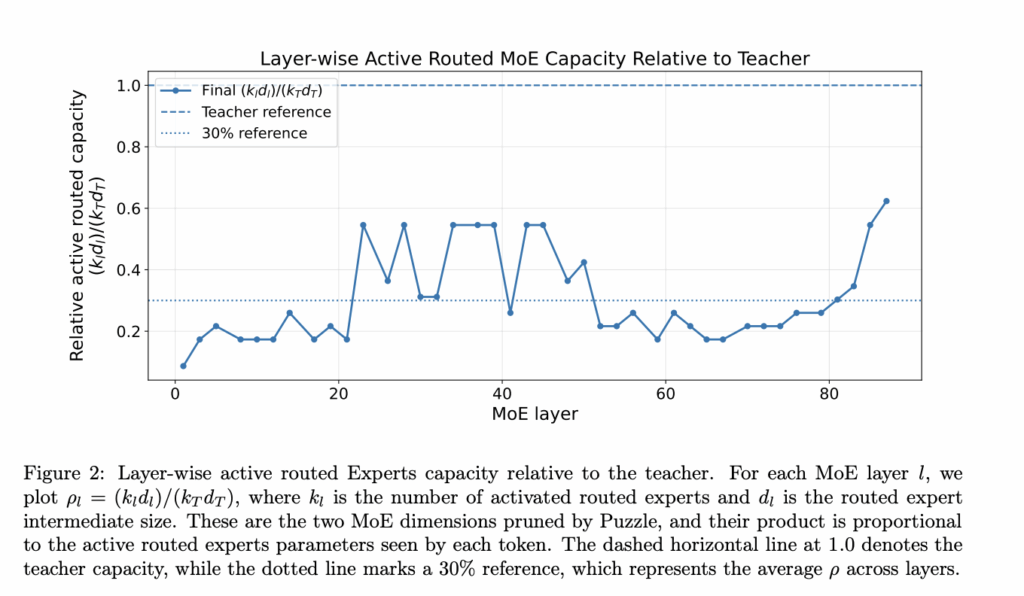
Large hybrid MoE models like Nemotron-3-Super are accurate but expensive to serve. Their active parameters, KV cache, and Mamba state cap how many users a node can hold at a given per-user token rate. NVIDIA AI team has released Nemotron-Labs-3-Puzzle-75B-A9B, a compressed variant of Nemotron-3-Super. The parent model has 120.7B total and 12.8B active parameters. The compressed model has 75.3B total and 9.3B active parameters. The deployment target was fixed before the architecture search began. Target one was 2x server throughput at 100 tokens per second per user. Target two was 8 concurrent 1M-token requests on a single H100. Three checkpoints on Hugging Face: BF16, FP8, and NVFP4. TL;DR 120.7B/12.8B active compresses to 75.3B/9.3B active, with the 88-block hybrid layout preserved. 8xB200 total throughput rises 1.60x to 2.14x over Super at matched NVFP4 and matched user throughput. Single-H100 1M-token concurrency goes 1 to 8, driven by a 70 GB to 44.5 GB weight drop. Iterative Puzzle beats single-step Puzzle by 0.57 average points at the same compression target. Arena-Hard-V2 (-4.2) and SWE-Bench (-2.6) are the real costs; RULER and AA-LCR barely move. Nemotron-Labs-3-Puzzle-75B-A9B Nemotron-3-Super is a hybrid Mamba-Transformer MoE model. Puzzle-75B-A9B preserves the parent’s block layout exactly. It has 88 blocks: 40 Mamba, 40 MoE, and 8 attention blocks. What changed is capacity inside those blocks: Quantity Super Puzzle-75B-A9B Ratio Total parameters 120.7B 75.3B 62.4% Active parameters 12.8B 9.3B 73.1% Mamba SSM state size 128 96 75% MoE routed expert intermediate size 2688 1280-2688 Mean 59.9% Activated routed experts per token 22 4-18 Mean 50% Active routed expert capacity (relative) 100% 8.7%-62.3% Mean 30.9% The number of routed experts, the shared expert size, and the MoE latent size are unchanged. Attention layers were left untouched. The proposed research’s stated reason is that Nemotron-3-Super is already very KV-cache efficient. Mamba layers were pruned uniformly, because inference frameworks do not support a different SSM state size per layer. https://arxiv.org/pdf/2607.04371 The result is not a uniformly scaled-down teacher. The above figure shows the allocation across depth. Puzzle preserved capacity in selected middle and late layers, and cut hard elsewhere. Benchmark and Performance The below table reports Pareto-optimal total throughput on a single 8xB200 node, with single-step decoding. Scenario (in/out) UT floor Super (tok/s) Puzzle-75B-A9B (tok/s) Boost 50K / 2K >= 100 5,128 8,210 1.60x 50K / 2K >= 125 3,784 6,412 1.69x 50K / 2K >= 150 2,532 4,523 1.79x 8K / 64K >= 100 20,939 42,601 2.03x 8K / 64K >= 125 13,074 27,918 2.14x 8K / 64K >= 150 8,522 18,047 2.12x Both models were served at matched NVFP4 weights, FP8 KV cache, and FP16 Mamba state. The gap therefore reflects compression, not a change in numeric format. The prefill-heavy 50K/2K regime gains least. The decode-heavy 8K/64K regime gains most. On a single 8xH100 node at UT = 100, the gains are smaller. They are 1.91x on 50K/2K and 1.82x on 8K/64K. Both models there use FP8 weights, FP8 KV cache, and FP32 Mamba state. On a single H100 at 1M context, the binding constraint flips from compute to memory. Super’s NVFP4 weights occupy about 70 GB of the 80 GB HBM budget. Each 1M-token request adds about 4 GB of KV cache. Effective concurrency is therefore 1. Puzzle-75B-A9B’s NVFP4 weights occupy about 44.5 GB. Attention layout is unchanged, so per-request KV cost is unchanged. Concurrency at 1M rises to 8. Aggregate decode throughput at that concurrency is roughly 4x Super’s single-request throughput. Prefill of a 990K-token prompt is about 1.2x faster. How Iterative Puzzle Works Puzzle is a decomposed neural architecture search framework, implemented here as Puzzletron. It defines a discrete search space of alternative layer implementations. Each alternative gets a quality score. A mixed-integer program then selects one alternative per layer under a deployment constraint. Three pruning techniques form the search space: Intermediate channel pruning: Channels inside each routed expert are ranked by contribution to the expert’s output. All experts within one MoE layer are pruned to a uniform size, for kernel compatibility. Top-k reduction: The number of experts a token is routed to varies per layer, up to the parent’s k=22. Mamba SSM pruning: The SSM state size drops from 128 to 96 channels. The SSM result is measured. Dropping 128 channels to 96 speeds the SSM kernel 1.2x to 1.3x during decode. This holds at batch sizes between 8 and 512. Channels were ranked by estimated contribution to the Mamba layer output. The estimate averaged over 67M tokens of validation data. Appendix A shows this beats random channel selection under aggressive pruning. The original formulation assumes replacement quality impacts are approximately additive. Each candidate block is scored inside the unmodified parent. That ignores higher-order interactions between replacements. Iterative Puzzle alternates bounded compression with short knowledge distillation recovery. It builds a sequence M0, M1, … MR instead of jumping to the target. Scores are recomputed against the current compressed model, not the original parent. Three stages were used: MoE weights to 75% of teacher capacity, Mamba SSM state to 75%. Healed for 24B tokens. MoE weights to 60% of teacher capacity. Healed for 43.2B tokens. Activated routed-expert budget to 50%, allocated heterogeneously. Healed for 52.8B tokens. https://arxiv.org/pdf/2607.04371 The above table compares this against a single-step Puzzle baseline at the same target. The three-step procedure averages 69.05 across ten benchmarks, against 68.48. Gains appear on MMLU-Pro, GPQA, HLE, AA-LCR, LiveCodeBench, SciCode, and RULER-256K. IFBench-Instruction fell 0.2 points and IFBench-Prompt fell 0.5. Recovery: Distillation, RL, and Verbosity Knowledge distillation ran on 30% pretraining data and 70% SFT data from Nemotron-3-Nano. During the Puzzle phase, KD used a 32K sequence length. Recovery then trained at 128K, and scaled to 512K. The budget was up to 100B tokens, with a 16M-token global batch, in Megatron-LM. RL post-training adopted Stage 2 of the Nemotron-3-Super RL pipeline, focused on software engineering. Phase 2.1 did single-step tool-use comparison. Phase 2.2 moved to end-to-end sandbox RL, where agents run up to 200 turns. Both phases used a KL penalty of 0. The team swept learning

NVIDIA Releases Nemotron-Labs-3-Puzzle-75B-A9B: A Compressed Hybrid MoE LLM Delivering 2.03x Server Throughput at Matched User Throughput 投稿を読む »

AI, Committee, ニュース, Uncategorized

The Download: a nuclear landmark, and China eyes Nvidia chips

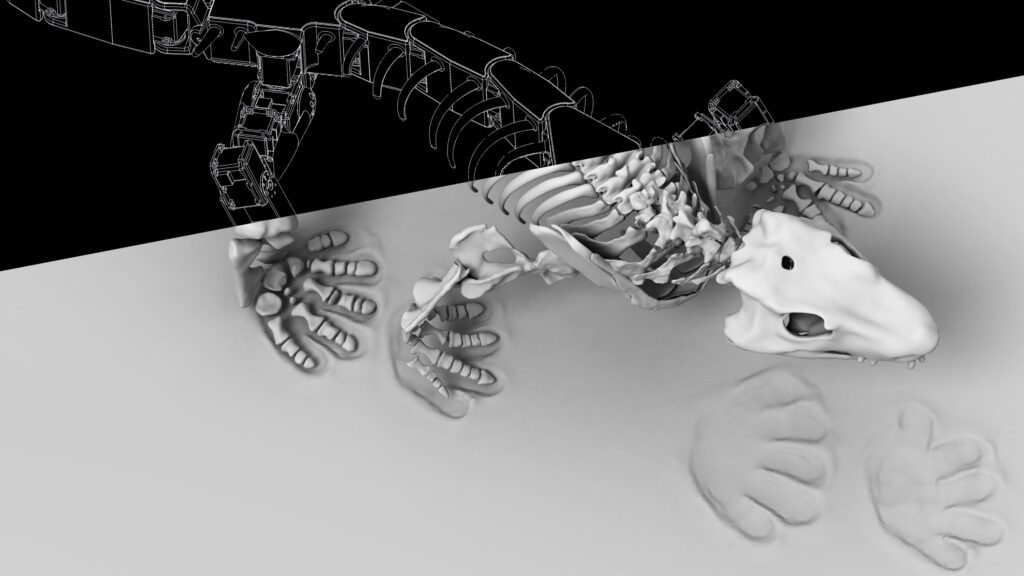
This is today’s edition of The Download, our weekday newsletter that provides a daily dose of what’s going on in the world of technology. Four nuclear reactors hit a big milestone in the US —Casey Crownhart I was really looking forward to July 4, and not just because I love a poolside barbecue. This year the American holiday also marked a big symbolic deadline for US nuclear power. Last year the Trump administration set a goal to see three new microreactors achieve criticality, a technical milestone establishing that a reactor can sustain a chain reaction, by the nation’s 250th birthday. And just in time, not just three, but four reactors did so. It’s a positive sign for nuclear technologies at a time of increasing need for electricity and emissions-free energy sources. But achieving criticality doesn’t mean a reactor is ready to provide electricity for the grid (or at all, for that matter). Here’s what the milestone could mean for nuclear power in the US—and where the four companies might go next. This story is from The Spark, our weekly climate tech newsletter. Sign up to receive it in your inbox every Wednesday. The must-reads I’ve combed the internet to find you today’s most fun/important/scary/fascinating stories about technology. 1 China plans to let its top AI firms buy Nvidia H200 chipsAlibaba, ByteDance, and DeepSeek are set to get permission. (Information $)+ China had previously withheld approval despite US authorization. (Reuters $) 2 NATO is building a network to stop Russian attackers in their tracksIt will use sensors, drones, satellites, and AI to detect them. (Business Insider)+ Troops are donning odd camouflage to elude drones. (Economist $)+ The US wants cheaper drones as Iran’s wrecking its Reapers. (Ars Technica) 3 Researchers have a new idea to fight future El Niños: dimming the sunDeflecting solar energy could cool the ocean and mitigate the risks. (Wired $)+ But there could be unexpected consequences. (New Scientist $)+ And geoengineering as a field is getting a reality check. (MIT Technology Review) 4 Meta is patenting an AI device that records users to analyse emotionsIt ostensibly aims to tailor workout plans to the user’s mood. (404 Media)+ AI memory is privacy’s next frontier. (MIT Technology Review) 5 Chipmakers are going vertical as Moore’s Law slowsThey’re stacking transistors to keep chips advancing. (Economist $)+ IBM is betting on the technique. (MIT Technology Review) 6 Ivy League students suspected of AI cheating saw scores fall in personFrom 96% all the way down to 48%. (Ars Technica)+ AI giants want to take over the classroom. (MIT Technology Review) 7 A new study says parents’ phone addictions damage bonds with kidsIt can exacerbate “insecure attachment” for life. (Bloomberg $)+ And make children more anxious and avoidant. (Gizmodo) 8 A judge approved Musk’s $1.5 million Twitter settlement with the SECDespite what she called “serious misgivings” and “red flags.” (Reuters $)+ Musk was accused of skirting stock disclosure rules. (Fortune) 9 Shoebox-sized “detector satellites” could find nuclear bombs in spaceCubesats carrying the detector could sense a bomb’s radiation. (Space)+ Russia is suspected of developing space-based nukes. (Reuters $) 10 A World Cup match drove Google Search traffic to a new recordThe milestone came after Argentina’s comeback against Egypt. (CNBC) Quote of the day “I talk about it on Tic Tac.” —President Donald Trump tells the public where to find his insights on the dangers of communism, Gizmodo reports. One More Thing Robots are bringing new life to extinct species Paleontologists aren’t easily deterred by evolutionary dead ends or a sparse fossil record. And in the last few years, they’ve developed a new trick for turning back time and studying prehistoric animals: building experimental robotic models of them.  In the absence of a living specimen, an ambling, flying, swimming, or slithering automaton is the next best thing for studying the behavior of extinct organisms. Learning more about how they moved can in turn shed light on their lives, such as their historic ranges and feeding habits. Scientists can simply sit back and observe their behavior in different environments.  Read the full story on the rise of paleo-inspired robots—and four examples that are shedding light on creatures of yore. —Shi En Kim We can still have nice things A place for comfort, fun, and distraction to brighten up your day. (Got any ideas? Drop me a line.) + Georgia Hill’s monochrome artworks are filled with visual harmony.+ AI has salvaged text from a papyrus scroll burned to a crisp when Mount Vesuvius erupted 2,000 years ago.+ Rare images taken by a Japanese space probe show a near-Earth asteroid resembling a cuddly snowman.+ “Another One Bites the Bee Gees” smoothly merges two classic tracks with a 4/4 time signature into the perfect song for applying CPR.

The Download: a nuclear landmark, and China eyes Nvidia chips 投稿を読む »

AI, Committee, ニュース, Uncategorized

The Download: a nuclear landmark, and China eyes Nvidia chips

This is today’s edition of The Download, our weekday newsletter that provides a daily dose of what’s going on in the world of technology. Four nuclear reactors hit a big milestone in the US —Casey Crownhart I was really looking forward to July 4, and not just because I love a poolside barbecue. This year the American holiday also marked a big symbolic deadline for US nuclear power. Last year the Trump administration set a goal to see three new microreactors achieve criticality, a technical milestone establishing that a reactor can sustain a chain reaction, by the nation’s 250th birthday. And just in time, not just three, but four reactors did so. It’s a positive sign for nuclear technologies at a time of increasing need for electricity and emissions-free energy sources. But achieving criticality doesn’t mean a reactor is ready to provide electricity for the grid (or at all, for that matter). Here’s what the milestone could mean for nuclear power in the US—and where the four companies might go next. This story is from The Spark, our weekly climate tech newsletter. Sign up to receive it in your inbox every Wednesday. The must-reads I’ve combed the internet to find you today’s most fun/important/scary/fascinating stories about technology. 1 China plans to let its top AI firms buy Nvidia H200 chipsAlibaba, ByteDance, and DeepSeek are set to get permission. (Information $)+ China had previously withheld approval despite US authorization. (Reuters $) 2 NATO is building a network to stop Russian attackers in their tracksIt will use sensors, drones, satellites, and AI to detect them. (Business Insider)+ Troops are donning odd camouflage to elude drones. (Economist $)+ The US wants cheaper drones as Iran’s wrecking its Reapers. (Ars Technica) 3 Researchers have a new idea to fight future El Niños: dimming the sunDeflecting solar energy could cool the ocean and mitigate the risks. (Wired $)+ But there could be unexpected consequences. (New Scientist $)+ And geoengineering as a field is getting a reality check. (MIT Technology Review) 4 Meta is patenting an AI device that records users to analyse emotionsIt ostensibly aims to tailor workout plans to the user’s mood. (404 Media)+ AI memory is privacy’s next frontier. (MIT Technology Review) 5 Chipmakers are going vertical as Moore’s Law slowsThey’re stacking transistors to keep chips advancing. (Economist $)+ IBM is betting on the technique. (MIT Technology Review) 6 Ivy League students suspected of AI cheating saw scores fall in personFrom 96% all the way down to 48%. (Ars Technica)+ AI giants want to take over the classroom. (MIT Technology Review) 7 A new study says parents’ phone addictions damage bonds with kidsIt can exacerbate “insecure attachment” for life. (Bloomberg $)+ And make children more anxious and avoidant. (Gizmodo) 8 A judge approved Musk’s $1.5 million Twitter settlement with the SECDespite what she called “serious misgivings” and “red flags.” (Reuters $)+ Musk was accused of skirting stock disclosure rules. (Fortune) 9 Shoebox-sized “detector satellites” could find nuclear bombs in spaceCubesats carrying the detector could sense a bomb’s radiation. (Space)+ Russia is suspected of developing space-based nukes. (Reuters $) 10 A World Cup match drove Google Search traffic to a new recordThe milestone came after Argentina’s comeback against Egypt. (CNBC) Quote of the day “I talk about it on Tic Tac.” —President Donald Trump tells the public where to find his insights on the dangers of communism, Gizmodo reports. One More Thing Robots are bringing new life to extinct species Paleontologists aren’t easily deterred by evolutionary dead ends or a sparse fossil record. And in the last few years, they’ve developed a new trick for turning back time and studying prehistoric animals: building experimental robotic models of them.  In the absence of a living specimen, an ambling, flying, swimming, or slithering automaton is the next best thing for studying the behavior of extinct organisms. Learning more about how they moved can in turn shed light on their lives, such as their historic ranges and feeding habits. Scientists can simply sit back and observe their behavior in different environments.  Read the full story on the rise of paleo-inspired robots—and four examples that are shedding light on creatures of yore. —Shi En Kim We can still have nice things A place for comfort, fun, and distraction to brighten up your day. (Got any ideas? Drop me a line.) + Georgia Hill’s monochrome artworks are filled with visual harmony.+ AI has salvaged text from a papyrus scroll burned to a crisp when Mount Vesuvius erupted 2,000 years ago.+ Rare images taken by a Japanese space probe show a near-Earth asteroid resembling a cuddly snowman.+ “Another One Bites the Bee Gees” smoothly merges two classic tracks with a 4/4 time signature into the perfect song for applying CPR.

The Download: a nuclear landmark, and China eyes Nvidia chips 投稿を読む »

AI, Committee, ニュース, Uncategorized

NVIDIA’s Cosmos-Framework Tutorial: Designing a Colab-Friendly Miniature of Cosmos 3 World Models with Omnimodal Mixture-of-Transformers

In this tutorial, we explore NVIDIA’s cosmos-framework from a practical Colab-friendly angle while staying honest about the hardware limits of running real Cosmos 3 checkpoints. We begin by checking the current runtime, GPU capabilities, CUDA availability, memory, and disk space to understand why full Cosmos 3 inference is not realistic on standard Colab hardware. Instead of stopping there, we use the framework’s real structure, CLI surface, input schema, and model modes as the foundation for a hands-on miniature implementation. We then build and train a compact omnimodal Mixture-of-Transformers world model that mirrors the core Cosmos idea: shared cross-modal attention with modality-specific expert routing for text, vision, and action streams. Using synthetic physical-world data, training-loss tracking, and an autoregressive rollout, we show how the model learns relationships across modalities and predicts future latent states in a simplified yet technically meaningful way. Probing Colab Hardware Limits Copy CodeCopiedUse a different Browser import os, sys, json, time, math, textwrap, subprocess, shutil, platform from pathlib import Path def rule(title=””): line = “=” * 86 print(“n” + line + (“n ” + title if title else “”) + “n” + line) def spark(vals, width=60): “””Tiny ASCII sparkline for a 1-D sequence (works with no plotting libs).””” if not vals: return “” blocks = “▁▂▃▄▅▆▇█” lo, hi = min(vals), max(vals) rng = (hi – lo) or 1.0 step = max(1, len(vals) // width) s = “”.join(blocks[min(len(blocks) – 1, int((v – lo) / rng * (len(blocks) – 1)))] for v in vals[::step]) return s rule(“SECTION 0 — Environment probe: what you have vs. what Cosmos 3 actually needs”) IN_COLAB = “google.colab” in sys.modules print(f”Running inside Google Colab : {IN_COLAB}”) print(f”Python : {platform.python_version()} ({platform.system()})”) try: import torch except ModuleNotFoundError: print(“torch not found — installing CPU build (a few seconds)…”) subprocess.run([sys.executable, “-m”, “pip”, “install”, “-q”, “torch”], check=False) import torch print(f”PyTorch : {torch.__version__}”) CUDA_OK = torch.cuda.is_available() DEVICE = torch.device(“cuda” if CUDA_OK else “cpu”) gpu_name, gpu_mem_gb, cc = “None (CPU)”, 0.0, (0, 0) if CUDA_OK: p = torch.cuda.get_device_properties(0) gpu_name = p.name gpu_mem_gb = p.total_memory / 1024**3 cc = torch.cuda.get_device_capability(0) print(f”CUDA build : {torch.version.cuda}”) print(f”GPU : {gpu_name}”) print(f”GPU memory : {gpu_mem_gb:.1f} GiB”) print(f”Compute capability : sm_{cc[0]}{cc[1]}”) try: free_gb = shutil.disk_usage(‘/’).free / 1024**3 print(f”Free disk : {free_gb:.0f} GiB”) except Exception: free_gb = 0.0 AMPERE = cc[0] >= 8 reqs = [ (“GPU architecture”, “Ampere+ (sm_80+, A100/RTX30xx)”, “OK” if AMPERE else “TOO OLD (T4=sm_75)”), (“GPU memory”, “>=80 GiB for Nano-16B (single H100)”, “OK” if gpu_mem_gb >= 79 else f”{gpu_mem_gb:.0f} GiB — insufficient”), (“CUDA toolkit”, “>=12.8”, “check” ), (“Free disk”, “~150 GiB first run (~1 TB HF cache)”, “OK” if free_gb >= 150 else f”{free_gb:.0f} GiB — insufficient”), (“Attention kernels”,”FlashAttn-3 (Hopper) / FA2 (Ampere)”, “needs Ampere+”), ] print(“n Can this machine run the REAL Cosmos 3 checkpoints?”) print(” ” + “-” * 82) print(f” {‘Requirement’:<18}{‘Cosmos 3 needs’:<38}{‘You have’}”) print(” ” + “-” * 82) for k, need, have in reqs: print(f” {k:<18}{need:<38}{have}”) print(” ” + “-” * 82) VERDICT = AMPERE and gpu_mem_gb >= 79 and free_gb >= 150 print(f” VERDICT: {‘This machine could attempt Nano-16B.’ if VERDICT else ‘NO — real Cosmos 3 inference is not possible here. Educational path below.’}”) We begin by preparing the runtime utilities and checking whether the current machine can realistically support Cosmos 3 inference. We inspect Python, PyTorch, CUDA, GPU memory, compute capability, and available disk space to compare our environment against the actual hardware requirements. We then print a clear verdict explaining why the real 16B+ Cosmos checkpoints cannot usually run on standard Colab hardware. Copy CodeCopiedUse a different Browser rule(“SECTION 1 — Clone & map the real cosmos_framework package (source of truth)”) Mapping The Cosmos-Framework Package Copy CodeCopiedUse a different Browser REPO = “https://github.com/NVIDIA/cosmos-framework.git” DST = Path(“/content/cosmos-framework”) if Path(“/content”).exists() else Path(“cosmos-framework”) cloned = False try: if not DST.exists(): print(f”Shallow-cloning {REPO} …”) subprocess.run([“git”, “clone”, “–depth”, “1”, REPO, str(DST)], check=True, capture_output=True, text=True, timeout=180) cloned = DST.exists() except Exception as e: print(f”(Clone skipped/failed — offline is fine, tutorial continues.) {e}”) if cloned: print(f”Repo at: {DST}n”) pkg = DST / “cosmos_framework” if pkg.exists(): print(“cosmos_framework/ subpackages (the real code layout):”) for child in sorted(pkg.iterdir()): if child.is_dir() and not child.name.startswith((“_”, “.”)): n_py = len(list(child.rglob(“*.py”))) print(f” • {child.name:<20} ({n_py:>3} .py files)”) example = DST / “inputs” / “omni” / “t2v.json” if example.exists(): print(f”nReal example input spec ({example.relative_to(DST)}):”) print(textwrap.indent(example.read_text().strip(), ” “)) else: print(“Proceeding without a local clone (we already extracted the real schema/CLI).”) print(“”” Real CLI surface (docs/inference.md): Single GPU : python -m cosmos_framework.scripts.inference \ –parallelism-preset=latency -i “inputs/omni/t2v.json” \ -o outputs/omni_nano –checkpoint-path Cosmos3-Nano –seed 0 Multi GPU : torchrun –nproc-per-node=8 -m cosmos_framework.scripts.inference \ –parallelism-preset=throughput -i “inputs/omni/*.json” \ -o outputs/omni_super –checkpoint-path Cosmos3-Super –seed 0 Models : Cosmos3-Nano (16B, all modes) | Cosmos3-Super (65B, t2i/t2v/i2v) Modes : text2image · text2video · image2video · video2video · forward_dynamics · inverse_dynamics · policy Parallelism: FSDP dp-shard / dp-replicate · context (cp) · CFG (cfgp) presets {latency, throughput} Guardrails : Cosmos-Guardrail1 + Qwen3Guard-Gen-0.6B + RetinaFace (on by default) “””) rule(“SECTION 2 — Omnimodal Mixture-of-Transformers (MoT) world model — the idea”) print(r””” Cosmos 3 unifies language, image, video, audio and ACTION in ONE model. The key trick is a Mixture-of-Transformers: every modality is turned into tokens placed on a SINGLE interleaved sequence; SELF-ATTENTION is SHARED across all modalities (so vision can be conditioned on text, actions on vision, etc.), but each token is processed by a MODALITY-SPECIFIC expert feed-forward block (“Mixture-of-Transformers” routing). text tokens vision tokens action tokens [t0 t1 t2 …] [v0 v1 v2 …] [a0 a1 …] | / | / +———– one sequence ———–+ | ┌─────────── shared causal self-attention (RoPE) ───────────┐ │ every token attends to all earlier tokens, ANY modality │ └───────────────────────────────────────────────────────────┘ | route each token to its modality’s EXPERT FFN (SwiGLU): text→Expert0 vision→Expert1 action→Expert2 | per-modality heads: next-token / next-latent / next-action Physical-AI modes fall right out of this one model: text2video = generate the vision-token stream from a text prompt image2video = condition vision stream on a first frame + text forward_dynamics= given frames + ACTIONS, roll future frames forward (a world model) inverse_dynamics= given frames, infer the ACTIONS that caused them policy =

NVIDIA’s Cosmos-Framework Tutorial: Designing a Colab-Friendly Miniature of Cosmos 3 World Models with Omnimodal Mixture-of-Transformers 投稿を読む »

AI, Committee, ニュース, Uncategorized

BlueMagpie-TTS: A Token-Efficient Tokenizer, Language Model, and TTS for Taiwanese-Accent Code-Switching Speech

arXiv:2607.06054v1 Announce Type: cross Abstract: Off-the-shelf TTS systems are poorly adapted to Taiwanese Mandarin. Their accent defaults to other Mandarin variants, their tokenizers over-segment common Taiwanese text, and their pronunciation degrades at code-switching boundaries where Chinese and English alternate within one utterance. These problems share one root: the text side lacks adaptation to the Taiwanese context. We address the text side from the bottom up. PangolinTokenizer, a byte-level BPE tokenizer trained on Taiwan-context data, reaches the lowest token rate (0.485 tokens/character) with the smallest vocabulary among nine tokenizers. Barbet, a billion-parameter Traditional-Chinese language model trained on PangolinTokenizer, serves as the text-semantic frontend and ranks first among comparable public models on a 14-task evaluation. BlueMagpie-TTS attaches Barbet to the pretrained acoustic stack of VoxCPM2 through a learned bridge, keeping the acoustic stack fixed. On a 1000-sentence Taiwan-localized test set, it lowers CER from 11.45% to 4.81% and WER from 14.83% to 5.36%, relative reductions of 58.0% and 63.9%. In a blind listening study on 500 of these sentences with ten listeners, 65.6% of majority votes prefer BlueMagpie-TTS.

BlueMagpie-TTS: A Token-Efficient Tokenizer, Language Model, and TTS for Taiwanese-Accent Code-Switching Speech 投稿を読む »

We use cookies to improve your experience and performance on our website. You can learn more at プライバシーポリシー and manage your privacy settings by clicking Settings.

Privacy Preferences

You can choose your cookie settings by turning on/off each type of cookie as you wish, except for essential cookies.

Allow All
Manage Consent Preferences
  • Always Active

Save
ja