YouZum

Committee

AI, Committee, ニュース, Uncategorized

Evaluating $n$-Gram Novelty of Language Models Using Rusty-DAWG

arXiv:2406.13069v4 Announce Type: replace Abstract: How novel are texts generated by language models (LMs) relative to their training corpora? In this work, we investigate the extent to which modern LMs generate $n$-grams from their training data, evaluating both (i) the probability LMs assign to complete training $n$-grams and (ii) $n$-novelty, the proportion of $n$-grams generated by an LM that did not appear in the training data (for arbitrarily large $n$). To enable arbitrary-length $n$-gram search over a corpus in constant time w.r.t. corpus size, we develop Rusty-DAWG, a novel search tool inspired by indexing of genomic data. We compare the novelty of LM-generated text to human-written text and explore factors that affect generation novelty, focusing on the Pythia models. We find that, for $n > 4$, LM-generated text is less novel than human-written text, though it is more novel for smaller $n$. Larger LMs and more constrained decoding strategies both decrease novelty. Finally, we show that LMs complete $n$-grams with lower loss if they are more frequent in the training data. Overall, our results reveal factors influencing the novelty of LM-generated text, and we release Rusty-DAWG to facilitate further pretraining data research.

Evaluating $n$-Gram Novelty of Language Models Using Rusty-DAWG 投稿を読む »

AI, Committee, ニュース, Uncategorized

Exploration of Plan-Guided Summarization for Narrative Texts: the Case of Small Language Models

arXiv:2504.09071v2 Announce Type: replace Abstract: Plan-guided summarization attempts to reduce hallucinations in small language models (SLMs) by grounding generated summaries to the source text, typically by targeting fine-grained details such as dates or named entities. In this work, we investigate whether plan-based approaches in SLMs improve summarization in long document, narrative tasks. Narrative texts’ length and complexity often mean they are difficult to summarize faithfully. We analyze existing plan-guided solutions targeting fine-grained details, and also propose our own higher-level, narrative-based plan formulation. Our results show that neither approach significantly improves on a baseline without planning in either summary quality or faithfulness. Human evaluation reveals that while plan-guided approaches are often well grounded to their plan, plans are equally likely to contain hallucinations compared to summaries. As a result, the plan-guided summaries are just as unfaithful as those from models without planning. Our work serves as a cautionary tale to plan-guided approaches to summarization, especially for long, complex domains such as narrative texts. Code available at https://github.com/amazon-science/plan-guided-summarization

Exploration of Plan-Guided Summarization for Narrative Texts: the Case of Small Language Models 投稿を読む »

AI, Committee, ニュース, Uncategorized

Collaborative Stance Detection via Small-Large Language Model Consistency Verification

arXiv:2502.19954v2 Announce Type: replace Abstract: Stance detection on social media aims to identify attitudes expressed in tweets towards specific targets. Current studies prioritize Large Language Models (LLMs) over Small Language Models (SLMs) due to the overwhelming performance improving provided by LLMs. However, heavily relying on LLMs for stance detection, regardless of the cost, is impractical for real-world social media monitoring systems that require vast data analysis. To this end, we propose textbf{underline{Co}}llaborative Stance Detection via Small-Large Language Model Consistency textbf{underline{Ver}}ification (textbf{CoVer}) framework, which enhances LLM utilization via context-shared batch reasoning and logical verification between LLM and SLM. Specifically, instead of processing each text individually, CoVer processes texts batch-by-batch, obtaining stance predictions and corresponding explanations via LLM reasoning in a shared context. Then, to exclude the bias caused by context noises, CoVer introduces the SLM for logical consistency verification. Finally, texts that repeatedly exhibit low logical consistency are classified using consistency-weighted aggregation of prior LLM stance predictions. Our experiments show that CoVer outperforms state-of-the-art methods across multiple benchmarks in the zero-shot setting, achieving 0.54 LLM queries per tweet while significantly enhancing performance. Our CoVer offers a more practical solution for LLM deploying for social media stance detection.

Collaborative Stance Detection via Small-Large Language Model Consistency Verification 投稿を読む »

AI, Committee, ニュース, Uncategorized

Detecting Hope, Hate, and Emotion in Arabic Textual Speech and Multi-modal Memes Using Large Language Models

arXiv:2508.15810v1 Announce Type: new Abstract: The rise of social media and online communication platforms has led to the spread of Arabic textual posts and memes as a key form of digital expression. While these contents can be humorous and informative, they are also increasingly being used to spread offensive language and hate speech. Consequently, there is a growing demand for precise analysis of content in Arabic text and memes. This paper explores the potential of large language models to effectively identify hope, hate speech, offensive language, and emotional expressions within such content. We evaluate the performance of base LLMs, fine-tuned LLMs, and pre-trained embedding models. The evaluation is conducted using a dataset of Arabic textual speech and memes proposed in the ArabicNLP MAHED 2025 challenge. The results underscore the capacity of LLMs such as GPT-4o-mini, fine-tuned with Arabic textual speech, and Gemini Flash 2.5, fine-tuned with Arabic memes, to deliver the superior performance. They achieve up to 72.1%, 57.8%, and 79.6% macro F1 scores for tasks 1, 2, and 3, respectively, and secure first place overall in the Mahed 2025 challenge. The proposed solutions offer a more nuanced understanding of both text and memes for accurate and efficient Arabic content moderation systems.

Detecting Hope, Hate, and Emotion in Arabic Textual Speech and Multi-modal Memes Using Large Language Models 投稿を読む »

AI, Committee, ニュース, Uncategorized

Bridging the Culture Gap: A Framework for LLM-Driven Socio-Cultural Localization of Math Word Problems in Low-Resource Languages

arXiv:2508.14913v2 Announce Type: replace Abstract: Large language models (LLMs) have demonstrated significant capabilities in solving mathematical problems expressed in natural language. However, multilingual and culturally-grounded mathematical reasoning in low-resource languages lags behind English due to the scarcity of socio-cultural task datasets that reflect accurate native entities such as person names, organization names, and currencies. Existing multilingual benchmarks are predominantly produced via translation and typically retain English-centric entities, owing to the high cost associated with human annotater-based localization. Moreover, automated localization tools are limited, and hence, truly localized datasets remain scarce. To bridge this gap, we introduce a framework for LLM-driven cultural localization of math word problems that automatically constructs datasets with native names, organizations, and currencies from existing sources. We find that translated benchmarks can obscure true multilingual math ability under appropriate socio-cultural contexts. Through extensive experiments, we also show that our framework can help mitigate English-centric entity bias and improves robustness when native entities are introduced across various languages.

Bridging the Culture Gap: A Framework for LLM-Driven Socio-Cultural Localization of Math Word Problems in Low-Resource Languages 投稿を読む »

AI, Committee, ニュース, Uncategorized

KL-based self-distillation for large language models

arXiv:2508.15807v1 Announce Type: new Abstract: Large pre-trained language models often struggle to incorporate new domain-specific terminology when fine-tuned on small, specialized corpora. In this work, we address the challenge of vocabulary expansion in frozen LLMs by introducing a mathematically grounded method for knowledge distillation via KL divergence, even when the original and extended models use different tokenizations. This allows the student model to inherit distributional knowledge from the teacher despite differing vocabularies. We compare our KL-based distillation approach to conventional cross-entropy training, evaluating both methods across multiple strategies for initializing new token embeddings. After embedding initialization, models are further fine-tuned to integrate the new vocabulary. Each trained model is benchmarked on approximately 2000 code-generation tasks, where our approach achieves the best performance across the board. Finally, through mechanistic interpretability, we analyze how models learn representations for the new tokens, providing an explanation for the observed gains and offering insight into the structure of embedding space during vocabulary expansion.

KL-based self-distillation for large language models 投稿を読む »

AI, Committee, ニュース, Uncategorized

Large Language Models LLMs vs. Small Language Models SLMs for Financial Institutions: A 2025 Practical Enterprise AI Guide

Table of contents 1. Regulatory and Risk Posture 2. Capability vs. Cost, Latency, and Footprint 3. Security and Compliance Trade-offs 4. Deployment Patterns 5. Decision Matrix (Quick Reference) 6. Concrete Use-Cases 7. Performance/Cost Levers Before “Going Bigger” EXAMPLES No single solution universally wins between Large Language Models (LLMs, ≥30B parameters, often via APIs) and Small Language Models (SLMs, ~1–15B, typically open-weights or proprietary specialist models). For banks, insurers, and asset managers in 2025, your selection should be governed by regulatory risk, data sensitivity, latency and cost requirements, and the complexity of the use case. SLM-first is recommended for structured information extraction, customer service, coding assistance, and internal knowledge tasks, especially with retrieval-augmented generation (RAG) and strong guardrails. Escalate to LLMs for heavy synthesis, multi-step reasoning, or when SLMs cannot meet your performance bar within latency/cost envelope. Governance is mandatory for both: treat LLMs and SLMs under your model risk management framework (MRM), align to NIST AI RMF, and map high-risk applications (such as credit scoring) to obligations under the EU AI Act. 1. Regulatory and Risk Posture Financial services are subject to mature model governance standards. In the US, Federal Reserve/OCC/FDIC SR 11-7 covers any model used for business decisioning, including LLMs and SLMs. This means required validation, monitoring, and documentation—irrespective of model size. The NIST AI Risk Management Framework (AI RMF 1.0) is the gold standard for AI risk controls, now widely adopted by financial institutions for both traditional and generative AI risks. In the EU, the AI Act is in force, with staged compliance dates (Aug 2025 for general purpose models, Aug 2026 for high-risk systems such as credit scoring per Annex III). High-risk means pre-market conformity, risk management, documentation, logging, and human oversight. Institutions targeting the EU must align remediation timelines accordingly. Core sectoral data rules apply: GLBA Safeguards Rule: Security controls and vendor oversight for consumer financial data. PCI DSS v4.0: New cardholder data controls—mandatory from March 31, 2025, with upgraded authentication, retention, and encryption. Supervisors (FSB/BIS/ECB) and standard setters highlight systemic risk from concentration, vendor lock-in, and model risk—neutral to model size. Key point: High-risk uses (credit, underwriting) require tight controls regardless of parameters. Both SLMs and LLMs demand traceable validation, privacy assurance, and sector compliance. 2. Capability vs. Cost, Latency, and Footprint SLMs (3–15B) now deliver strong accuracy on domain workloads, especially after fine-tuning and with retrieval augmentation. Recent SLMs (e.g., Phi-3, FinBERT, COiN) excel at targeted extraction, classification, and workflow augmentation, cut latency (<50ms), and allow self-hosting for strict data residency—and are feasible for edge deployment. LLMs unlock cross-document synthesis, heterogeneous data reasoning, and long-context operations (>100K tokens). Domain-specialized LLMs (e.g., BloombergGPT, 50B) outperform general models on financial benchmarks and multi-step reasoning tasks. Compute economics: Transformer self-attention scales quadratically with sequence length. FlashAttention/SlimAttention optimizations reduce compute costs, but don’t defeat the quadratic lower bound; long-context LLMs can be exponentially costlier at inference than short-context SLMs. Key point: Short, structured, latency-sensitive tasks (contact center, claims, KYC extraction, knowledge search) fit SLMs. If you need 100K+ token contexts or deep synthesis, budget for LLMs and mitigate cost via caching and selective “escalation.” 3. Security and Compliance Trade-offs Common risks: Both model types are exposed to prompt injection, insecure output handling, data leakage, and supply chain risks. SLMs: Preferred for self-hosting—satisfying GLBA/PCI/data sovereignty concerns and minimizing legal risks from cross-border transfers. LLMs: APIs introduce concentration and lock-in risks; supervisors require documented exit, fallback, and multi-vendor strategies. Explainability: High-risk uses require transparent features, challenger models, full decision logs, and human oversight; LLM reasoning traces cannot substitute for formal validation required by SR 11-7 / EU AI Act. 4. Deployment Patterns Three proven modes in finance: SLM-first, LLM fallback: Route 80%+ queries to a tuned SLM with RAG; escalate low-confidence/long-context cases to an LLM. Predictable cost/latency; good for call centers, operations, and form parsing. LLM-primary with tool-use: LLM as orchestrator for synthesis, with deterministic tools for data access, calculations, and protected by DLP. Suited for complex research, policy/regulatory work. Domain-specialized LLM: Large models adapted to financial corpora; higher MRM burden but measurable gains for niche tasks. Regardless, always implement content filters, PII redaction, least-privilege connectors, output verification, red-teaming, and continuous monitoring under NIST AI RMF and OWASP guidance. 5. Decision Matrix (Quick Reference) Criterion Prefer SLM Prefer LLM Regulatory exposure Internal assist, non-decisioning High-risk use (credit scoring) w/ full validation Data sensitivity On-prem/VPC, PCI/GLBA constraints External API with DLP, encryption, DPAs Latency & cost Sub-second, high QPS, cost-sensitive Seconds-latency, batch, low QPS Complexity Extraction, routing, RAG-aided draft Synthesis, ambiguous input, long-form context Engineering ops Self-hosted, CUDA, integration Managed API, vendor risk, rapid deployment 6. Concrete Use-Cases Customer Service: SLM-first with RAG/tools for common issues, LLM escalation for complex multi-policy queries. KYC/AML & Adverse Media: SLMs suffice for extraction/normalization; escalate to LLMs for fraud or multilingual synthesis. Credit Underwriting: High-risk (EU AI Act Annex III); use SLM/classical ML for decisioning, LLMs for explanatory narratives, always with human review. Research/Portfolio Notes: LLMs enable draft synthesis and cross-source collation; read-only access, citation logging, tool verification recommended. Developer Productivity: On-prem SLM code assistants for speed/IP safety; LLM escalation for refactoring or complex synthesis. 7. Performance/Cost Levers Before “Going Bigger” RAG optimization: Most failures are retrieval, not “model IQ.” Improve chunking, recency, relevance ranking before increasing size. Prompt/IO controls: Guardrails for input/output schema, anti-prompt-injection per OWASP. Serve-time: Quantize SLMs, page KV cache, batch/stream, cache frequent answers; quadratic attention inflates indiscriminate long contexts. Selective escalation: Route by confidence; >70% cost saving possible. Domain adaptation: Lightweight tuning/LoRA on SLMs closes most gaps; use large models only for clear, measurable lift in performance. EXAMPLES Example 1: Contract Intelligence at JPMorgan (COiN) JPMorgan Chase deployed a specialized Small Language Model (SLM), called COiN, to automate the review of commercial loan agreements—a process traditionally handled manually by legal staff. By training COiN on thousands of legal documents and regulatory filings, the bank slashed contract review times from several weeks to mere hours, achieving high accuracy and compliance traceability while drastically reducing operational cost. This targeted SLM solution

Large Language Models LLMs vs. Small Language Models SLMs for Financial Institutions: A 2025 Practical Enterprise AI Guide 投稿を読む »

AI, Committee, ニュース, Uncategorized

Prefix-RFT: A Unified Machine Learning Framework to blend Supervised Fine-Tuning (SFT) and Reinforcement Fine-Tuning (RFT)

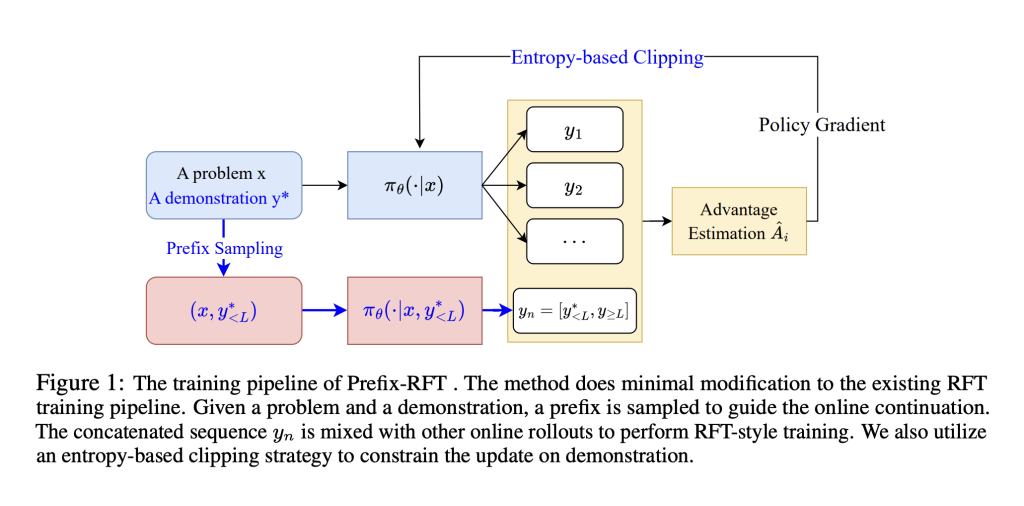
Large language models are typically refined after pretraining using either supervised fine-tuning (SFT) or reinforcement fine-tuning (RFT), each with distinct strengths and limitations. SFT is effective in teaching instruction-following through example-based learning, but it can lead to rigid behavior and poor generalization. RFT, on the other hand, optimizes models for task success using reward signals, which can improve performance but also introduce instability and reliance on a strong starting policy. While these methods are often used sequentially, their interaction remains poorly understood. This raises an important question: how can we design a unified framework that combines SFT’s structure with RFT’s goal-driven learning?  Research at the intersection of RL and LLM post-training has gained momentum, particularly for training reasoning-capable models. Offline RL, which learns from fixed datasets, often yields suboptimal policies due to the limited diversity of the data. This has sparked interest in combining offline and online RL approaches to improve performance. In LLMs, the dominant strategy is to first apply SFT to teach desirable behaviors, then use RFT to optimize outcomes. However, the dynamics between SFT and RFT are still not well understood, and finding effective ways to integrate them remains an open research challenge.  Researchers from the University of Edinburgh, Fudan University, Alibaba Group, Stepfun, and the University of Amsterdam propose a unified framework that combines supervised and reinforcement fine-tuning in a way called Prefix-RFT. This method guides exploration using partial demonstrations, allowing the model to continue generating solutions with flexibility and adaptability. Tested on math reasoning tasks, Prefix-RFT consistently outperforms standalone SFT, RFT, and mixed-policy methods. It integrates easily into existing frameworks and proves robust to changes in demonstration quality and quantity. Blending demonstration-based learning with exploration can lead to more effective and adaptive training of large language models.  https://arxiv.org/abs/2507.01679 The study presents Prefix Reinforcement Fine-Tuning (Prefix-RFT) as a way to blend the strengths of SFT and RFT. While SFT offers stability by mimicking expert demonstrations, RFT encourages exploration through the use of reward signals. Prefix-RFT bridges the two by using a partial demonstration (a prefix) and letting the model generate the rest. This approach guides learning without relying too heavily on full supervision. It incorporates techniques like entropy-based clipping and a cosine decay scheduler to ensure stable training and efficient learning. Compared to prior methods, Prefix-RFT offers a more balanced and adaptive fine-tuning strategy.  Prefix-RFT is a reward fine-tuning method that improves performance using high-quality offline math datasets, such as OpenR1-Math-220K (46k filtered problems). Tested on Qwen2.5-Math-7B, 1.5B, and LLaMA-3.1-8B, it was evaluated on benchmarks including AIME 2024/25, AMC, MATH500, Minerva, and OlympiadBench. Prefix-RFT achieved the highest avg@32 and pass@1 scores across tasks, outperforming RFT, SFT, ReLIFT, and LUFFY. Using Dr. GRPO, it updated only the top 20% high-entropy prefix tokens, with the prefix length decaying from 95% to 5%. It maintained intermediate SFT loss, indicating a strong balance between imitation and exploration, especially on difficult problems (Trainhard).  https://arxiv.org/abs/2507.01679 In conclusion, Prefix-RFT combines the strengths of SFT and RFT by utilizing sampled demonstration prefixes to guide learning. Despite its simplicity, it consistently outperforms SFT, RFT, and hybrid baselines across various models and datasets. Even with only 1% of the training data (450 prompts), it maintains strong performance (avg@32 drops only from 40.8 to 37.6), showing efficiency and robustness. Its top-20% entropy-based token update strategy proves most effective, achieving the highest benchmark scores with shorter outputs. Moreover, using a cosine decay scheduler for prefix length enhances stability and learning dynamics compared to a uniform strategy, particularly on complex tasks such as AIME.  Check out the Paper here. Feel free to check out our GitHub Page for Tutorials, Codes and Notebooks. Also, feel free to follow us on Twitter and don’t forget to join our 100k+ ML SubReddit and Subscribe to our Newsletter. The post Prefix-RFT: A Unified Machine Learning Framework to blend Supervised Fine-Tuning (SFT) and Reinforcement Fine-Tuning (RFT) appeared first on MarkTechPost.

Prefix-RFT: A Unified Machine Learning Framework to blend Supervised Fine-Tuning (SFT) and Reinforcement Fine-Tuning (RFT) 投稿を読む »

AI, Committee, ニュース, Uncategorized

JSON Prompting for LLMs: A Practical Guide with Python Coding Examples

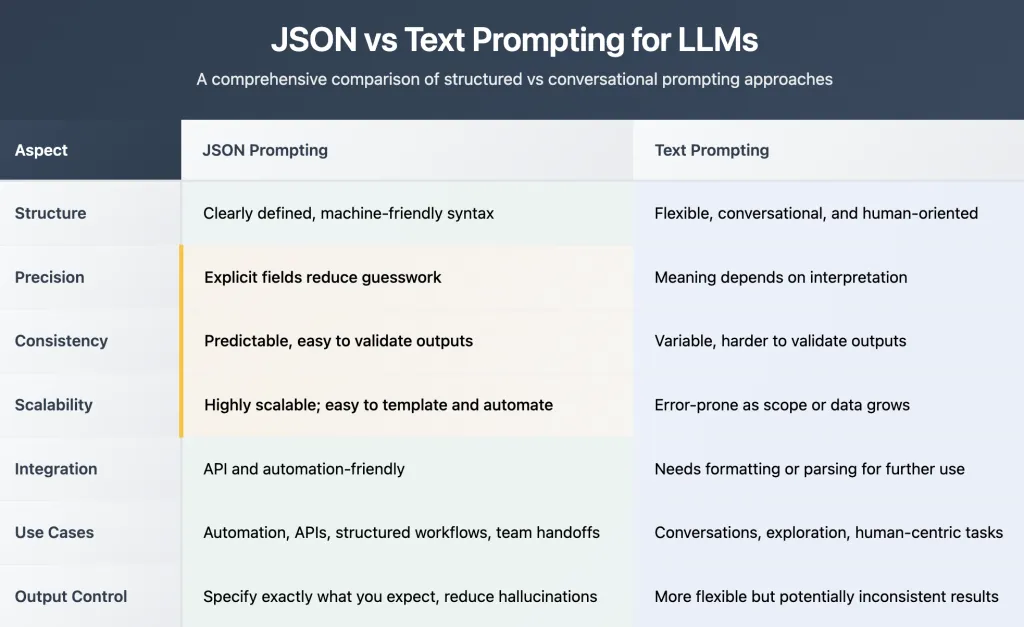
JSON Prompting is a technique for structuring instructions to AI models using the JavaScript Object Notation (JSON) format, making prompts clear, explicit, and machine-readable. Unlike traditional text-based prompts, which can leave room for ambiguity and misinterpretation, JSON prompts organize requirements as key-value pairs, arrays, and nested objects, turning vague requests into precise blueprints for the model to follow. This method greatly improves consistency and accuracy—especially for complex or repetitive tasks—by allowing users to specify things like task type, topic, audience, output format, and other parameters in an organized way that language models inherently understand. As AI systems increasingly rely on predictable, structured input for real-world workflows, JSON prompting has become a preferred strategy for generating sharper, more reliable results across major LLMs, including GPT-4, Claude, and Gemini. In this tutorial, we’ll dive deep into the power of JSON prompting and why it can transform the way you interact with AI models. We will walk you through the benefits of using JSON Prompting through coding examples —from simple text prompts to structured JSON prompts—and show you comparisons of their outputs. By the end, you’ll clearly see how structured prompts bring precision, consistency, and scalability to your workflows, whether you’re generating summaries, extracting data, or building advanced AI pipelines. Check out the FULL CODES here. Installing the dependencies Copy CodeCopiedUse a different Browser pip install openai Copy CodeCopiedUse a different Browser import os from getpass import getpass os.environ[“OPENAI_API_KEY”] = getpass(‘Enter OpenAI API Key: ‘) To get an OpenAI API key, visit https://platform.openai.com/settings/organization/api-keys and generate a new key. If you’re a new user, you may need to add billing details and make a minimum payment of $5 to activate API access. Check out the FULL CODES here. Copy CodeCopiedUse a different Browser from openai import OpenAI client = OpenAI() Structured Prompts Ensure Consistency Using structured prompts, such as JSON-based formats, forces you to think in terms of fields and values — a true advantage when working with LLMs. Check out the FULL CODES here. By defining a fixed structure, you eliminate ambiguity and guesswork, ensuring that every response follows a predictable pattern. Here’s a simple example: Copy CodeCopiedUse a different Browser Summarize the following email and list the action items clearly. Email: Hi team, let’s finalize the marketing plan by Tuesday. Alice, prepare the draft; Bob, handle the design. We’ll feed this prompt to the LLM in two ways and then compare the outputs generated by a free-form prompt versus a structured (JSON-based) prompt to observe the difference in clarity and consistency. Check out the FULL CODES here. Free-Form Prompt Copy CodeCopiedUse a different Browser prompt_text = “”” Summarize the following email and list the action items clearly. Email: Hi team, let’s finalize the marketing plan by Tuesday. Alice, prepare the draft; Bob, handle the design. “”” response_text = client.chat.completions.create( model=”gpt-5″, messages=[{“role”: “user”, “content”: prompt_text}] ) text_output = response_text.choices[0].message.content print(text_output) Copy CodeCopiedUse a different Browser Summary: The team needs to finalize the marketing plan by Tuesday. Alice will prepare the draft, and Bob will handle the design. Action items: – Alice: Prepare the draft of the marketing plan by Tuesday. – Bob: Handle the design by Tuesday. – Team: Finalize the marketing plan by Tuesday. JSON Prompt Copy CodeCopiedUse a different Browser prompt_json = “”” Summarize the following email and return the output strictly in JSON format: { “summary”: “short summary of the email”, “action_items”: [“task 1”, “task 2”, “task 3”], “priority”: “low | medium | high” } Email: Hi team, let’s finalize the marketing plan by Tuesday. Alice, prepare the draft; Bob, handle the design. “”” response_json = client.chat.completions.create( model=”gpt-5″, messages=[ {“role”: “system”, “content”: “You are a precise assistant that always replies in valid JSON.”}, {“role”: “user”, “content”: prompt_json} ] ) json_output = response_json.choices[0].message.content print(json_output) Copy CodeCopiedUse a different Browser { “summary”: “Finalize the marketing plan by Tuesday; Alice to draft and Bob to handle design.”, “action_items”: [ “Alice: prepare the draft”, “Bob: handle the design”, “Team: finalize the marketing plan by Tuesday” ], “priority”: “medium” } In this example, the use of a structured JSON prompt leads to a clear and concise output that is easy to parse and evaluate. By defining fields such as “summary”, “action_items”, and “priority”, the LLM response becomes more consistent and actionable. Instead of generating free-flowing text, which might vary in style and detail, the model provides a predictable structure that eliminates ambiguity. This approach not only improves the readability and reliability of responses but also makes it easier to integrate the output into downstream workflows, such as project trackers, dashboards, or automated email handlers. User can control the output When you frame your prompt in JSON, you remove ambiguity from both the instruction and the output. In this example, asking for a market summary, sentiment, opportunities, risks, and a confidence score can yield inconsistent formats when passed as plain text. However, by structuring the request in JSON — with clearly defined fields like “summary”, “sentiment”, “opportunities”, “risks”, and “confidence_score” — the response becomes predictable, machine-friendly, and easier to parse. This consistency ensures that, whether you’re generating content, analyzing reports, or extracting insights, your workflow remains streamlined and reliable, with no surprises — just clean, structured results every time. Check out the FULL CODES here. Free-Form Prompt Copy CodeCopiedUse a different Browser plain_text_prompt = “”” Analyze the following market update: Market Text: Tesla’s Q2 earnings beat expectations due to higher Model Y sales, but rising competition from BYD is a risk. Apple reported steady revenue growth driven by iPhone sales, but services revenue slightly declined. Amazon’s AWS division continues to dominate cloud computing, though regulatory scrutiny in Europe is increasing. Generate: – A 2-line market summary – Sentiment for each company (positive, negative, neutral) – Key growth opportunities and risks – A confidence score from 0 to 10 “”” response_plain = client.chat.completions.create( model=”gpt-5″, messages=[{“role”: “user”, “content”: plain_text_prompt}] ) plain_output = response_plain.choices[0].message.content print(plain_output) Copy CodeCopiedUse a different Browser Market summary: – Earnings updates skew constructive: Tesla beat on Q2 with strong Model Y, Apple grew on iPhone, and AWS remains the

JSON Prompting for LLMs: A Practical Guide with Python Coding Examples 投稿を読む »

We use cookies to improve your experience and performance on our website. You can learn more at プライバシーポリシー and manage your privacy settings by clicking Settings.

Privacy Preferences

You can choose your cookie settings by turning on/off each type of cookie as you wish, except for essential cookies.

Allow All
Manage Consent Preferences
  • Always Active

Save
ja