Scientists just created female clones of male mice
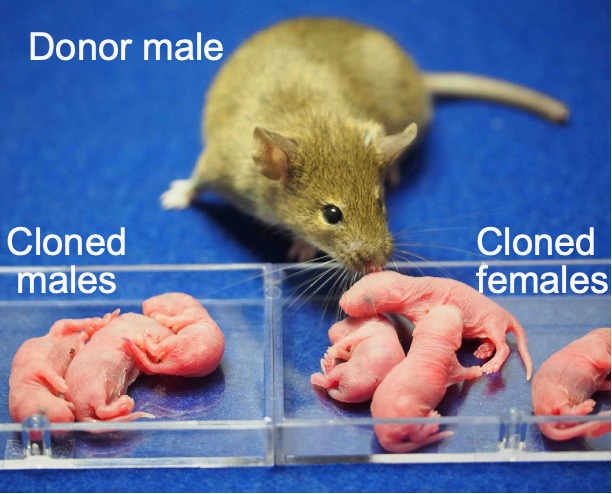
Scientists have deliberately turned male mouse embryos into females for the first time. A team based in Japan used a CRISPR-based approach to remove the Y chromosome from male cells and create female clones of male mice. “No one has done this before,” says Monika Ward, a reproductive biologist at the University of Hawaii, who was not involved in the research. The feat could change the way scientists think about reproduction, says Takashi Ishiuchi, a reproductive biologist at the University of Yamanashi, who co-led the work. The findings were published in a preprint paper shared on bioRxiv earlier this month, which has not yet been through the peer-review process. “There’s a fixed concept in our scientific field that we need both females and males for reproduction,” says Ishiuchi. “I think we could change this concept.” He and his colleague Shogo Matoba of the Riken BioResource Research Center in Ibaraki also hope their technique could help rescue endangered species, particularly in cases where only a few individuals remain. “It’s exciting to see,” says Ben Novak, lead scientist at the wildlife conservation organization Revive & Restore, who was not involved in the work. “I am confident there will be plenty of applications, particularly for conservation purposes.” Sex change Ishiuchi says he and his colleagues were inspired by the Okinawa rubble goby, a fish that can change its sex in certain situations. If no males are present, a female can do this in order to reproduce with the other females. Males can also change sex to female. This ability to change sex might be useful when it comes to rescuing endangered species, including mammals. There’s some precedent in the lab—albeit not intentional. In 2009, researchers reported the accidental birth of a single female pup in a batch of 27 clones created from male mouse cells. Sometimes the surviving population of a species falls so low that scientists will try to clone those animals. Cloning isn’t perfect—it can be tricky and inefficient, and it creates genetically identical individuals whose offspring might be more vulnerable to disease. But it has helped scientists with efforts to bring some species back from the brink of extinction, including black-footed ferrets and Przewalski’s horse. Cloning an individual can only replicate its genes, so cloning a male animal will create all male offspring, for example. That won’t help much in the hypothetical situation where only male individuals of a species are left. Ishiuchi has been working on a way to overcome this challenge by altering the chromosomes in cells. Mammals’ DNA is organized in pairs of chromosomes, including one pair of sex chromosomes. These sex chromosomes are typically XX in females and XY in males. It’s the Y chromosome that makes mammals male. Ishiuchi and his colleagues have developed a CRISPR-based tool to get rid of it. Their approach targets a section of the Y chromosome that plays an important role in ensuring that, each time a cell divides, the “daughter” cells inherit the Y chromosome. Cutting the Y When the researchers tested their technique—which they call Y-CUT—in early-stage mouse embryos, they found they were able to eliminate the Y chromosome. Treated XY embryos were transferred to surrogate mice, which gave birth to female pups. The effect can be described as a “sex reversal,” say the researchers. The female pups had XO chromosomes, which means they had one X chromosome rather than the usual two. But this didn’t seem to affect the animals, which grew up healthy and fertile, say Ishiuchi and Matoba. In a second experiment, the researchers found they could also use Y-CUT to create female clones from male mice. A standard approach to cloning involves taking the DNA-containing nucleus of a cell from an adult animal and inserting it into an egg cell that has had its own DNA removed. Under the right conditions, the resulting cell can develop into an animal that is genetically identical to the original donor. Matoba and his colleagues used a similar method. Once they had a glut of these cloned cells, they treated some with Y-CUT before transferring them to surrogate mice to carry the pregnancies. This allowed them to create female clones of male mice. The females are genetically identical to the original male, apart from the missing Y chromosome, says Matoba. “It’s like sci-fi,” says Ishiuchi. Courtesy of Takashi Ichiushi and Shogo Matoba, as published in their bioRxiv preprint. In other experiments, the scientists were able to create female clones from male cells that had been cryopreserved—and the cloned males and females could mate to produce healthy pups. This suggests the Y-CUT approach might allow scientists to create female clones from male samples in “frozen zoos” that store cryopreserved cells and tissues from a range of animal species. It could have uses beyond conservation efforts, too. “This could be used potentially for producing genetically engineered animals,” says Ward. Creating an animal with multiple genetic edits can be time-consuming and expensive; creating male and female clones of that animal could help scientists time and money. Ward also hopes the technique could be a useful tool to study the biology of sex chromosomes. Complementary techniques The Y-CUT approach isn’t perfect. For now, it still requires hollowed-out egg cells, which need to come from females of the same species or at least a closely related one. And it won’t be useful for endangered species in which only females survive. The technique works well in mice, partly because XO female mice are fertile. But while the approach might help some of the 355 endangered and vulnerable species of rodents, other mammals with XO chromosomes tend to experience infertility. But other new technologies could complement Y-CUT. In 2023, Katsuhiko Hayashi of Osaka University and his colleagues showed they could turn cells taken from male mice into egg cells. This enabled them to create mice with two dads—but the same approach could also provide the hollowed-out egg cells needed for the Y-CUT technique. “It’s a complementary story,” says Matoba. Ishiuchi is also working on
Scientists just created female clones of male mice 投稿を読む »