YouZum

Uncategorized

AI, Committee, Notizie, Uncategorized

Is There a Community Edition of Palantir? Meet OpenPlanter: An Open Source Recursive AI Agent for Your Micro Surveillance Use Cases

The balance of power in the digital age is shifting. While governments and large corporations have long used data to track individuals, a new open-source project called OpenPlanter is giving that power back to the public. Created by a developer ‘Shin Megami Boson‘, OpenPlanter is a recursive-language-model investigation agent. Its goal is simple: help you keep tabs on your government, since they are almost certainly keeping tabs on you. Solving the ‘Heterogeneous Data’ Problem Investigative work is difficult because data is messy. Public records are often spread across 100 different formats. You might have a CSV of campaign finance records, a JSON file of government contracts, and a PDF of lobbying disclosures. OpenPlanter ingests these disparate structured and unstructured data sources effortlessly. It uses Large Language Models (LLMs) to perform entity resolution. This is the process of identifying when different records refer to the same person or company. Once it connects these dots, the agent probabilistically looks for anomalies. It searches for patterns that a human might miss, such as a sudden spike in contract wins following a specific lobbying event. The Architecture: Recursive Sub-Agent Delegation What makes OpenPlanter unique is its recursive engine. Most AI agents handle 1 request at a time. OpenPlanter, however, breaks large objectives into smaller pieces. If you give it a massive task, it uses a sub-agent delegation strategy. The agent has a default max-depth of 4. This means the main agent can spawn a sub-agent, which can spawn another, and so on. These agents work in parallel to: Resolve entities across massive datasets. Link datasets that have no common ID numbers. Construct evidence chains that back up every single finding. This recursive approach allows the system to handle investigations that are too large for a single ‘context window.’ The 2026 AI Stack OpenPlanter is built for the high-performance requirements of 2026. It is written in Python 3.10+ and integrates with the most advanced models available today. The technical documentation lists several supported providers: OpenAI: It uses gpt-5.2 as the default. Anthropic: It supports claude-opus-4-6. OpenRouter: It defaults to anthropic/claude-sonnet-4-5. Cerebras: It uses qwen-3-235b-a22b-instruct-2507 for high-speed tasks. The system also uses Exa for web searches and Voyage for high-accuracy embeddings. This multi-model strategy ensures that the agent uses the best ‘brain’ for each specific sub-task. 19 Tools for Digital Forensics The agent is equipped with 19 specialized tools. These tools allow it to interact with the real world rather than just ‘chatting.’ These are organized into 4 core areas: File I/O and Workspace: Tools like read_file, write_file, and hashline_edit allow the agent to manage its own database of findings. Shell Execution: The agent can use run_shell to execute actual code. It can write a Python script to analyze a dataset and then run that script to get results. Web Retrieval: With web_search and fetch_url, it can pull live data from government registries or news sites. Planning and Logic: The think tool lets the agent pause and strategize. It uses acceptance-criteria to verify that a sub-task was completed correctly before moving to the next step. Deployment and Interface OpenPlanter is designed to be accessible but powerful. It features a Terminal User Interface (TUI) built with rich and prompt_toolkit. The interface includes a splash art screen of ASCII potted plants, but the work it does is serious. You can get started quickly using Docker. By running docker compose up, the agent starts in a container. This is a critical security feature because it isolates the agent’s run_shell commands from the user’s host operating system. The command-line interface allows for ‘headless’ tasks. You can run a single command like: Copy CodeCopiedUse a different Browser openplanter-agent –task “Flag all vendor overlaps in lobbying data” –workspace ./data The agent will then work autonomously until it produces a final report. Key Takeaways Autonomous Recursive Logic: Unlike standard agents, OpenPlanter uses a recursive sub-agent delegation strategy (default max-depth of 4). It breaks complex investigative objectives into smaller sub-tasks, parallelizing work across multiple agents to build detailed evidence chains. Heterogeneous Data Correlation: The agent is built to ingest and resolve disparate structured and unstructured data. It can simultaneously process CSV files, JSON records, and unstructured text (like PDFs) to identify entities across fragmented datasets. Probabilistic Anomaly Detection: By performing entity resolution, OpenPlanter automatically connects records—such as matching a corporate alias to a lobbying disclosure—and looks for probabilistic anomalies to surface hidden connections between government spending and private interests. High-End 2026 Model Stack: The system is provider-agnostic and utilizes the latest frontier models, including OpenAI gpt-5.2, Anthropic claude-opus-4-6, and Cerebras qwen-3-235b-a22b-instruct-2507 for high-speed inference. Integrated Toolset for Forensics: OpenPlanter features 19 distinct tools, including shell execution (run_shell), web search (Exa), and file patching (hashline_edit). This allows it to write and run its own analysis scripts while verifying results against real-world acceptance criteria. Check out the Repo here. Also, feel free to follow us on Twitter and don’t forget to join our 100k+ ML SubReddit and Subscribe to our Newsletter. Wait! are you on telegram? now you can join us on telegram as well. Disclaimer: MarkTechPost does not endorse the OpenPlanter project and provides this technical report for informational purposes only. The post Is There a Community Edition of Palantir? Meet OpenPlanter: An Open Source Recursive AI Agent for Your Micro Surveillance Use Cases appeared first on MarkTechPost.

Is There a Community Edition of Palantir? Meet OpenPlanter: An Open Source Recursive AI Agent for Your Micro Surveillance Use Cases Leggi l'articolo »

AI, Committee, Notizie, Uncategorized

A New Google AI Research Proposes Deep-Thinking Ratio to Improve LLM Accuracy While Cutting Total Inference Costs by Half

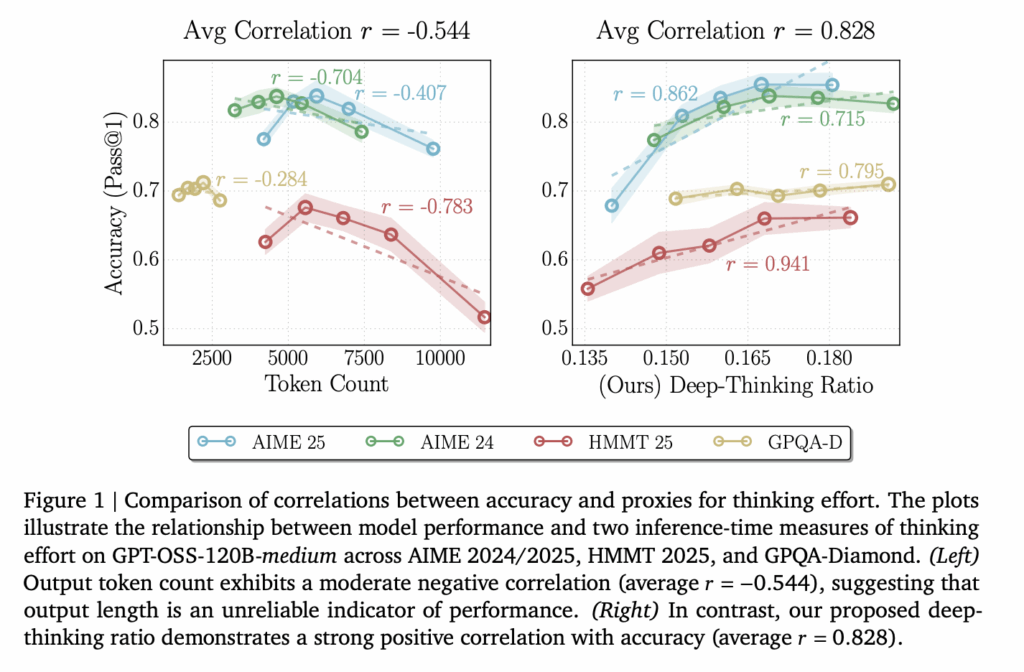
For the last few years, the AI world has followed a simple rule: if you want a Large Language Model (LLM) to solve a harder problem, make its Chain-of-Thought (CoT) longer. But new research from the University of Virginia and Google proves that ‘thinking long’ is not the same as ‘thinking hard’. The research team reveals that simply adding more tokens to a response can actually make an AI less accurate. Instead of counting words, the Google researchers introduce a new measurement: the Deep-Thinking Ratio (DTR). https://arxiv.org/pdf/2602.13517 The Failure of ‘Token Maxing‘ Engineers often use token count as a proxy for the effort an AI puts into a task. However, the researchers found that raw token count has an average correlation of r= -0.59 with accuracy. This negative number means that as the model generates more text, it is more likely to be wrong. This happens because of ‘overthinking,’ where the model gets stuck in loops, repeats redundant steps, or amplifies its own mistakes. Relying on length alone wastes expensive compute on uninformative tokens. What are Deep-Thinking Tokens? The research team argued that real ‘thinking’ happens inside the layers of the model, not just in the final output. When a model predicts a token, it processes data through a series of transformer layers (L). Shallow Tokens: For easy words, the model’s prediction stabilizes early. The ‘guess’ doesn’t change much from layer 5 to layer 36. Deep-Thinking Tokens: For difficult logic or math symbols, the prediction shifts significantly in the deeper layers. How to Measure Depth To identify these tokens, the research team uses a technique to peek at the model’s internal ‘drafts’ at every layer. They project the intermediate hidden states (htl) into the vocabulary space using the model’s unembedding matrix (WU). This produces a probability distribution (pt,l) for every layer. They then calculate the Jensen-Shannon Divergence (JSD) between the intermediate layer distribution and the final layer distribution (pt,L): Dt,l := JSD(pt,L || pt,l) A token is a deep-thinking token if its prediction only settles in the ‘late regime’—defined by a depth fraction (⍴). In their tests, they set ⍴= 0.85, meaning the token only stabilized in the final 15% of the layers. The Deep-Thinking Ratio (DTR) is the percentage of these ‘hard’ tokens in a full sequence. Across models like DeepSeek-R1-70B, Qwen3-30B-Thinking, and GPT-OSS-120B, DTR showed a strong average positive correlation of r = 0.683 with accuracy. https://arxiv.org/pdf/2602.13517 Think@n: Better Accuracy at 50% the Cost The research team used this innovative approach to create Think@n, a new way to scale AI performance during inference. Most devs use Self-Consistency (Cons@n), where they sample 48 different answers and use majority voting to pick the best one. This is very expensive because you have to generate every single token for every answer. Think@n changes the game by using ‘early halting’: The model starts generating multiple candidate answers. After just 50 prefix tokens, the system calculates the DTR for each candidate. It immediately stops generating the ‘unpromising’ candidates with low DTR. It only finishes the candidates with high deep-thinking scores. The Results on AIME 2025 Method Accuracy Avg. Cost (k tokens) Cons@n (Majority Vote) 92.7% 307.6 Think@n (DTR-based Selection) 94.7% 155.4 On the AIME 25 math benchmark, Think@n achieved higher accuracy than standard voting while reducing the inference cost by 49%. Key Takeaways Token count is a poor predictor of accuracy: Raw output length has an average negative correlation (r = -0.59) with performance, meaning longer reasoning traces often signal ‘overthinking’ rather than higher quality. Deep-thinking tokens define true effort: Unlike simple tokens that stabilize in early layers, deep-thinking tokens are those whose internal predictions undergo significant revision in deeper model layers before converging. The Deep-Thinking Ratio (DTR) is a superior metric: DTR measures the proportion of deep-thinking tokens in a sequence and exhibits a robust positive correlation with accuracy (average r = 0.683), consistently outperforming length-based or confidence-based baselines. Think@n enables efficient test-time scaling: By prioritizing and finishing only the samples with high deep-thinking ratios, the Think@n strategy matches or exceeds the performance of standard majority voting (Cons@n). Massive cost reduction via early halting: Because DTR can be estimated from a short prefix of just 50 tokens, unpromising generations can be rejected early, reducing total inference costs by approximately 50%. Check out the Paper. Also, feel free to follow us on Twitter and don’t forget to join our 100k+ ML SubReddit and Subscribe to our Newsletter. Wait! are you on telegram? now you can join us on telegram as well. The post A New Google AI Research Proposes Deep-Thinking Ratio to Improve LLM Accuracy While Cutting Total Inference Costs by Half appeared first on MarkTechPost.

A New Google AI Research Proposes Deep-Thinking Ratio to Improve LLM Accuracy While Cutting Total Inference Costs by Half Leggi l'articolo »

AI, Committee, Notizie, Uncategorized

Exclusive eBook: The great Al hype correction of 2025

2025 was a year of reckoning, including how the heads of the top AI companies made promises they couldn’t keep. In this exclusive subscriber-only eBook, you’ll learn more about why we may need to readjust our expectations. This story is part of the Hype Correction package.by Will Douglas Heaven December 15, 2025 ACCESS EBOOK Table of Contents: LLMs are not everything AI is not a quick fix to all your problems Are we in a bubble? (If so, what kind of bubble?) ChatGPT was not the beginning, and it won’t be the end Related Stories: The great AI hype correction of 2025 An MIT Technology Review series: Hype Correction Access all subscriber-only eBooks: ACCESS ALL EBOOKS

Exclusive eBook: The great Al hype correction of 2025 Leggi l'articolo »

AI, Committee, Notizie, Uncategorized

The Download: Microsoft’s online reality check, and the worrying rise in measles cases

This is today’s edition of The Download, our weekday newsletter that provides a daily dose of what’s going on in the world of technology. Microsoft has a new plan to prove what’s real and what’s AI online AI-enabled deception now permeates our online lives. There are the high-profile cases you may easily spot. Other times, it slips quietly into social media feeds and racks up views. It is into this mess that Microsoft has put forward a blueprint, shared with MIT Technology Review, for how to prove what’s real online. An AI safety research team at the company recently evaluated how methods for documenting digital manipulation are faring against today’s most worrying AI developments, like interactive deepfakes and widely accessible hyperrealistic models. It then recommended technical standards that can be adopted by AI companies and social media platforms. Read the full story. —James O’Donnell Community service: a short story In the not-too-distant future, civilians are enlisted to kill perceived threats to human life. In this short fiction story from the latest edition of our print magazine, writer Micaiah Johnson imagines the emotional toll that could take on ordinary people. Read the full story and if you haven’t already, subscribe now to get the next edition of the magazine. Measles cases are rising. Other vaccine-preventable infections could be next. There’s a measles outbreak happening close to where I live. Since the start of this year, 34 cases have been confirmed in Enfield, a northern borough of London. It’s another worrying development for an incredibly contagious and potentially fatal disease. Since October last year, 962 cases of measles have been confirmed in South Carolina. Large outbreaks (with more than 50 confirmed cases) are underway in four US states. Smaller outbreaks are being reported in another 12 states. The vast majority of these cases have been children who were not fully vaccinated. Vaccine hesitancy is thought to be a significant reason children are missing out on important vaccines. And if we’re seeing more measles cases now, we might expect to soon see more cases of other vaccine-preventable infections, including some that can cause liver cancer or meningitis. Read the full story. —Jessica Hamzelou This article first appeared in The Checkup, MIT Technology Review’s weekly biotech newsletter. To receive it in your inbox every Thursday, and read articles like this first, sign up here. The must-reads I’ve combed the internet to find you today’s most fun/important/scary/fascinating stories about technology. 1 The US Environmental Protection Agency is being suedHealth and environmental non-profits have accused it of abandoning its mission to protect the public. (The Guardian) 2 Amazon’s cloud unit has suffered two outages linked to its AI toolsIn one instance, its Kiro AI coding tool decided to delete and recreate part of a system. (FT $)+ Amazon keeps a close eye on how its workers use AI daily. (The Information $)+ Security-conscious tech firms are restricting workers’ use of OpenClaw. (Wired $) 3 AI is making it easier to steal tech trade secretsIt’s also making those secrets more lucrative. (WSJ $)+ Two former Googlers have been charged with illegally taking trade secrets. (Bloomberg $) 4 What a fake viral ICE tip-off line tells us about AmericaOne call came from a teacher reporting the parents of a kindergarten student. (WP $)+ The agency’s software could speed up deportations. (Economist $)+ How an ICE detention actually unfolds. (New Yorker $)+ An internet personality is dividing those resisting on the streets of Minneapolis. (The Verge) 5 The number of malicious apps submitted to Google’s app store is fallingWhich Google attributes to its improved AI defences. (TechCrunch)+ Beware the rise of the vibe coded music app. (The Verge) 6 “Digital blackface” is on the riseGenerative AI tools steeped in racial stereotypes are being co-opted by users who are not Black themselves.(The Guardian)+ OpenAI is huge in India. Its models are steeped in caste bias. (MIT Technology Review) 7 Grok exposed a porn performer’s legal name and birthdateWithout even being explicitly asked for the information. (404 Media) 8 India is embracing deepfakes of dead loved onesBut we don’t know how these kinds of clips could affect the long-term grieving process. (Rest of World)+ China has a flourishing market for deepfakes that clone the dead. (MIT Technology Review) 9 Longevity-linked products are big businessWe might spend up to $8 trillion annually on them by 2030. But do they work? (The Atlantic $)+ Meet the Vitalists: the hardcore longevity enthusiasts who believe death is “wrong.” (MIT Technology Review) 10 An AI film won’t be shown in cinemas after allFollowing a major public backlash after AMC Theatres announced its intention to screen a short AI movie called Thanksgiving Day. (Hollywood Reporter)+ Screen time is the villain in the trailer for the latest Toy Story installation. (Insider $)+ How do AI models generate videos? (MIT Technology Review) Quote of the day “Nobody but Big Oil profits from Trump trashing climate science and making cars and trucks guzzle and pollute more.” —David Pettit, an attorney at the Center for Biological Diversity, explains why the Center is suing the US Environmental Protection Agency over its decision to repeal a crucial climate ruling, Ars Technica reports. One more thing What happened to the microfinance organization Kiva? Since it was founded in 2005, the San Francisco-based nonprofit Kiva has helped everyday people make microloans to borrowers around the world. It connects lenders in richer communities to fund all sorts of entrepreneurs, from bakers in Mexico to farmers in Albania. Its overarching aim is helping poor people help themselves. But back in August 2021, Kiva lenders started to notice that information that felt essential in deciding who to lend to was suddenly harder to find. Now, lenders are worried that the organization now seems more focused on how to make money than how to create change. Read the full story. —Mara Kardas-Nelson We can still have nice things A place for comfort, fun and distraction to brighten up your day. (Got any ideas? Drop me a line or skeet ’em

The Download: Microsoft’s online reality check, and the worrying rise in measles cases Leggi l'articolo »

AI, Committee, Notizie, Uncategorized

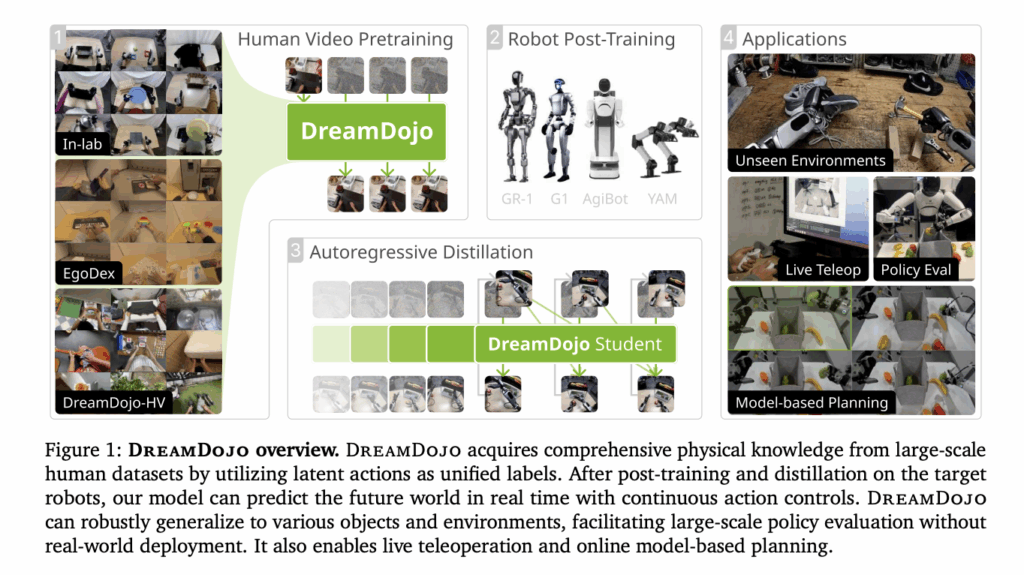
NVIDIA Releases DreamDojo: An Open-Source Robot World Model Trained on 44,711 Hours of Real-World Human Video Data

Building simulators for robots has been a long term challenge. Traditional engines require manual coding of physics and perfect 3D models. NVIDIA is changing this with DreamDojo, a fully open-source, generalizable robot world model. Instead of using a physics engine, DreamDojo ‘dreams’ the results of robot actions directly in pixels. https://arxiv.org/pdf/2602.06949 Scaling Robotics with 44k+ Hours of Human Experience The biggest hurdle for AI in robotics is data. Collecting robot-specific data is expensive and slow. DreamDojo solves this by learning from 44k+ hours of egocentric human videos. This dataset, called DreamDojo-HV, is the largest of its kind for world model pretraining. It features 6,015 unique tasks across 1M+ trajectories. The data covers 9,869 unique scenes and 43,237 unique objects. Pretraining used 100,000 NVIDIA H100 GPU hours to build 2B and 14B model variants. Humans have already mastered complex physics, such as pouring liquids or folding clothes. DreamDojo uses this human data to give robots a ‘common sense’ understanding of how the world works. https://arxiv.org/pdf/2602.06949 Bridging the Gap with Latent Actions Human videos do not have robot motor commands. To make these videos ‘robot-readable,’ NVIDIA’s research team introduced continuous latent actions. This system uses a spatiotemporal Transformer VAE to extract actions directly from pixels. The VAE encoder takes 2 consecutive frames and outputs a 32-dimensional latent vector. This vector represents the most critical motion between frames. The design creates an information bottleneck that disentangles action from visual context. This allows the model to learn physics from humans and apply them to different robot bodies. https://arxiv.org/pdf/2602.06949 Better Physics through Architecture DreamDojo is based on the Cosmos-Predict2.5 latent video diffusion model. It uses the WAN2.2 tokenizer, which has a temporal compression ratio of 4. The team improved the architecture with 3 key features: Relative Actions: The model uses joint deltas instead of absolute poses. This makes it easier for the model to generalize across different trajectories. Chunked Action Injection: It injects 4 consecutive actions into each latent frame. This aligns the actions with the tokenizer’s compression ratio and fixes causality confusion. Temporal Consistency Loss: A new loss function matches predicted frame velocities to ground-truth transitions. This reduces visual artifacts and keeps objects physically consistent. Distillation for 10.81 FPS Real-Time Interaction A simulator is only useful if it is fast. Standard diffusion models require too many denoising steps for real-time use. NVIDIA team used a Self Forcing distillation pipeline to solve this. The distillation training was conducted on 64 NVIDIA H100 GPUs. The ‘student’ model reduces denoising from 35 steps down to 4 steps. The final model achieves a real-time speed of 10.81 FPS. It is stable for continuous rollouts of 60 seconds (600 frames). Unlocking Downstream Applications DreamDojo’s speed and accuracy enable several advanced applications for AI engineers. 1. Reliable Policy Evaluation Testing robots in the real world is risky. DreamDojo acts as a high-fidelity simulator for benchmarking. Its simulated success rates show a Pearson correlation of (Pearson 𝑟=0.995) with real-world results. The Mean Maximum Rank Violation (MMRV) is only 0.003. 2. Model-Based Planning Robots can use DreamDojo to ‘look ahead.’ A robot can simulate multiple action sequences and pick the best one. In a fruit-packing task, this improved real-world success rates by 17%. Compared to random sampling, it provided a 2x increase in success. 3. Live Teleoperation Developers can teleoperate virtual robots in real time. NVIDIA team demonstrated this using a PICO VR controller and a local desktop with an NVIDIA RTX 5090. This allows for safe and rapid data collection. Summary of Model Performance Metric DREAMDOJO-2B DREAMDOJO-14B Physics Correctness 62.50% 73.50% Action Following 63.45% 72.55% FPS (Distilled) 10.81 N/A NVIDIA has released all weights, training code, and evaluation benchmarks. This open-source release allows you to post-train DreamDojo on your own robot data today. Key Takeaways Massive Scale and Diversity: DreamDojo is pretrained on DreamDojo-HV, the largest egocentric human video dataset to date, featuring 44,711 hours of footage across 6,015 unique tasks and 9,869 scenes. Unified Latent Action Proxy: To overcome the lack of action labels in human videos, the model uses continuous latent actions extracted via a spatiotemporal Transformer VAE, which serves as a hardware-agnostic control interface. Optimized Training and Architecture: The model achieves high-fidelity physics and precise controllability by utilizing relative action transformations, chunked action injection, and a specialized temporal consistency loss. Real-Time Performance via Distillation: Through a Self Forcing distillation pipeline, the model is accelerated to 10.81 FPS, enabling interactive applications like live teleoperation and stable, long-horizon simulations for over 1 minute. Reliable for Downstream Tasks: DreamDojo functions as an accurate simulator for policy evaluation, showing a 0.995 Pearson correlation with real-world success rates, and can improve real-world performance by 17% when used for model-based planning. Check out the Paper and Codes. Also, feel free to follow us on Twitter and don’t forget to join our 100k+ ML SubReddit and Subscribe to our Newsletter. Wait! are you on telegram? now you can join us on telegram as well. The post NVIDIA Releases DreamDojo: An Open-Source Robot World Model Trained on 44,711 Hours of Real-World Human Video Data appeared first on MarkTechPost.

NVIDIA Releases DreamDojo: An Open-Source Robot World Model Trained on 44,711 Hours of Real-World Human Video Data Leggi l'articolo »

AI, Committee, Notizie, Uncategorized

A Coding Guide to High-Quality Image Generation, Control, and Editing Using HuggingFace Diffusers

In this tutorial, we design a practical image-generation workflow using the Diffusers library. We start by stabilizing the environment, then generate high-quality images from text prompts using Stable Diffusion with an optimized scheduler. We accelerate inference with a LoRA-based latent consistency approach, guide composition with ControlNet under edge conditioning, and finally perform localized edits via inpainting. Also, we focus on real-world techniques that balance image quality, speed, and controllability. Copy CodeCopiedUse a different Browser !pip -q uninstall -y pillow Pillow || true !pip -q install –upgrade –force-reinstall “pillow<12.0” !pip -q install –upgrade diffusers transformers accelerate safetensors huggingface_hub opencv-python import os, math, random import torch import numpy as np import cv2 from PIL import Image, ImageDraw, ImageFilter from diffusers import ( StableDiffusionPipeline, StableDiffusionInpaintPipeline, ControlNetModel, StableDiffusionControlNetPipeline, UniPCMultistepScheduler, ) We prepare a clean and compatible runtime by resolving dependency conflicts and installing all required libraries. We ensure image processing works reliably by pinning the correct Pillow version and loading the Diffusers ecosystem. We also import all core modules needed for generation, control, and inpainting workflows. Copy CodeCopiedUse a different Browser def seed_everything(seed=42): random.seed(seed) np.random.seed(seed) torch.manual_seed(seed) torch.cuda.manual_seed_all(seed) def to_grid(images, cols=2, bg=255): if isinstance(images, Image.Image): images = [images] w, h = images[0].size rows = math.ceil(len(images) / cols) grid = Image.new(“RGB”, (cols*w, rows*h), (bg, bg, bg)) for i, im in enumerate(images): grid.paste(im, ((i % cols)*w, (i // cols)*h)) return grid device = “cuda” if torch.cuda.is_available() else “cpu” dtype = torch.float16 if device == “cuda” else torch.float32 print(“device:”, device, “| dtype:”, dtype) We define utility functions to ensure reproducibility and to organize visual outputs efficiently. We set global random seeds so our generations remain consistent across runs. We also detect the available hardware and configure precision to optimize performance on the GPU or CPU. Copy CodeCopiedUse a different Browser seed_everything(7) BASE_MODEL = “runwayml/stable-diffusion-v1-5” pipe = StableDiffusionPipeline.from_pretrained( BASE_MODEL, torch_dtype=dtype, safety_checker=None, ).to(device) pipe.scheduler = UniPCMultistepScheduler.from_config(pipe.scheduler.config) if device == “cuda”: pipe.enable_attention_slicing() pipe.enable_vae_slicing() prompt = “a cinematic photo of a futuristic street market at dusk, ultra-detailed, 35mm, volumetric lighting” negative_prompt = “blurry, low quality, deformed, watermark, text” img_text = pipe( prompt=prompt, negative_prompt=negative_prompt, num_inference_steps=25, guidance_scale=6.5, width=768, height=512, ).images[0] We initialize the base Stable Diffusion pipeline and switch to a more efficient UniPC scheduler. We generate a high-quality image directly from a text prompt using carefully chosen guidance and resolution settings. This establishes a strong baseline for subsequent improvements in speed and control. Copy CodeCopiedUse a different Browser LCM_LORA = “latent-consistency/lcm-lora-sdv1-5” pipe.load_lora_weights(LCM_LORA) try: pipe.fuse_lora() lora_fused = True except Exception as e: lora_fused = False print(“LoRA fuse skipped:”, e) fast_prompt = “a clean product photo of a minimal smartwatch on a reflective surface, studio lighting” fast_images = [] for steps in [4, 6, 8]: fast_images.append( pipe( prompt=fast_prompt, negative_prompt=negative_prompt, num_inference_steps=steps, guidance_scale=1.5, width=768, height=512, ).images[0] ) grid_fast = to_grid(fast_images, cols=3) print(“LoRA fused:”, lora_fused) W, H = 768, 512 layout = Image.new(“RGB”, (W, H), “white”) draw = ImageDraw.Draw(layout) draw.rectangle([40, 80, 340, 460], outline=”black”, width=6) draw.ellipse([430, 110, 720, 400], outline=”black”, width=6) draw.line([0, 420, W, 420], fill=”black”, width=5) edges = cv2.Canny(np.array(layout), 80, 160) edges = np.stack([edges]*3, axis=-1) canny_image = Image.fromarray(edges) CONTROLNET = “lllyasviel/sd-controlnet-canny” controlnet = ControlNetModel.from_pretrained( CONTROLNET, torch_dtype=dtype, ).to(device) cn_pipe = StableDiffusionControlNetPipeline.from_pretrained( BASE_MODEL, controlnet=controlnet, torch_dtype=dtype, safety_checker=None, ).to(device) cn_pipe.scheduler = UniPCMultistepScheduler.from_config(cn_pipe.scheduler.config) if device == “cuda”: cn_pipe.enable_attention_slicing() cn_pipe.enable_vae_slicing() cn_prompt = “a modern cafe interior, architectural render, soft daylight, high detail” img_controlnet = cn_pipe( prompt=cn_prompt, negative_prompt=negative_prompt, image=canny_image, num_inference_steps=25, guidance_scale=6.5, controlnet_conditioning_scale=1.0, ).images[0] We accelerate inference by loading and fusing a LoRA adapter and demonstrate fast sampling with very few diffusion steps. We then construct a structural conditioning image and apply ControlNet to guide the layout of the generated scene. This allows us to preserve composition while still benefiting from creative text guidance. Copy CodeCopiedUse a different Browser mask = Image.new(“L”, img_controlnet.size, 0) mask_draw = ImageDraw.Draw(mask) mask_draw.rectangle([60, 90, 320, 170], fill=255) mask = mask.filter(ImageFilter.GaussianBlur(2)) inpaint_pipe = StableDiffusionInpaintPipeline.from_pretrained( BASE_MODEL, torch_dtype=dtype, safety_checker=None, ).to(device) inpaint_pipe.scheduler = UniPCMultistepScheduler.from_config(inpaint_pipe.scheduler.config) if device == “cuda”: inpaint_pipe.enable_attention_slicing() inpaint_pipe.enable_vae_slicing() inpaint_prompt = “a glowing neon sign that says ‘CAFÉ’, cyberpunk style, realistic lighting” img_inpaint = inpaint_pipe( prompt=inpaint_prompt, negative_prompt=negative_prompt, image=img_controlnet, mask_image=mask, num_inference_steps=30, guidance_scale=7.0, ).images[0] os.makedirs(“outputs”, exist_ok=True) img_text.save(“outputs/text2img.png”) grid_fast.save(“outputs/lora_fast_grid.png”) layout.save(“outputs/layout.png”) canny_image.save(“outputs/canny.png”) img_controlnet.save(“outputs/controlnet.png”) mask.save(“outputs/mask.png”) img_inpaint.save(“outputs/inpaint.png”) print(“Saved outputs:”, sorted(os.listdir(“outputs”))) print(“Done.”) We create a mask to isolate a specific region and apply inpainting to modify only that part of the image. We refine the selected area using a targeted prompt while keeping the rest intact. Finally, we save all intermediate and final outputs to disk for inspection and reuse. In conclusion, we demonstrated how a single Diffusers pipeline can evolve into a flexible, production-ready image generation system. We explained how to move from pure text-to-image generation to fast sampling, structural control, and targeted image editing without changing frameworks or tooling. This tutorial highlights how we can combine schedulers, LoRA adapters, ControlNet, and inpainting to create controllable and efficient generative pipelines that are easy to extend for more advanced creative or applied use cases. Check out the Full Codes here. Also, feel free to follow us on Twitter and don’t forget to join our 100k+ ML SubReddit and Subscribe to our Newsletter. Wait! are you on telegram? now you can join us on telegram as well. The post A Coding Guide to High-Quality Image Generation, Control, and Editing Using HuggingFace Diffusers appeared first on MarkTechPost.

A Coding Guide to High-Quality Image Generation, Control, and Editing Using HuggingFace Diffusers Leggi l'articolo »

AI, Committee, Notizie, Uncategorized

Measles cases are rising. Other vaccine-preventable infections could be next.

There’s a measles outbreak happening close to where I live. Since the start of this year, 34 cases have been confirmed in Enfield, a northern borough of London. Most of those affected are children under the age of 11. One in five have needed hospital treatment. It’s another worrying development for an incredibly contagious and potentially fatal disease. Since October last year, 962 cases of measles have been confirmed in South Carolina. Large outbreaks (with more than 50 confirmed cases) are underway in four US states. Smaller outbreaks are being reported in another 12 states. The vast majority of these cases have been children who were not fully vaccinated. Vaccine hesitancy is thought to be a significant reason children are missing out on important vaccines—the World Health Organization described it as one of the 10 leading threats to global health in 2019. And if we’re seeing more measles cases now, we might expect to soon see more cases of other vaccine-preventable infections, including some that can cause liver cancer or meningitis. Some people will always argue that measles is not a big deal—that infections used to be common, and most people survived them and did just fine. It is true that in most cases kids do recover well from the virus. But not always. Measles symptoms tend to start with a fever and a runny nose. The telltale rash comes later. In some cases, severe complications develop. They can include pneumonia, blindness, and inflammation of the brain. Some people won’t develop complications until years later. In rare cases, the disease can be fatal. Before the measles vaccine was introduced, in 1963, measles epidemics occurred every two to three years, according to the WHO. Back then, around 2.6 million people died from measles every year. Since it was introduced, the measles vaccine is thought to have prevented almost 59 million deaths. But vaccination rates have been lagging, says Anne Zink, an emergency medicine physician and clinical fellow at the Yale School of Public Health. “We’ve seen a slow decline in people who are willing to get vaccinated against measles for some time,” she says. “As we get more and more people who are at risk because they’re unvaccinated, the higher the chances that the disease can then spread and take off.” Vaccination rates need to be at 95% to prevent measles outbreaks. But rates are well below that level in some regions. Across South Carolina, the proportion of kindergartners who received both doses of the MMR vaccine, which protects against measles as well as mumps and rubella, has dropped steadily over the last five years, from 94% in 2020-2021 to 91% in 2024-2025. Some schools in the state have coverage rates as low as 20%, state epidemiologist Linda Bell told reporters last month. Vaccination rates are low in London, too. Fewer than 70% of children have received both doses of their MMR by the time they turn five, according to the UK Health Security Agency. In some boroughs, vaccination rates are as low as 58%. So perhaps it’s not surprising we’re seeing outbreaks. The UK is one of six countries to have lost their measles elimination status last month, along with Spain, Austria, Armenia, Azerbaijan, and Uzbekistan. Canada lost its elimination status last year. The highly contagious measles could be a bellwether for other vaccine-preventable diseases. Zink is already seeing signs. She points to a case of polio that paralyzed a man in New York in 2022. That happened when rates of polio vaccination were low, she says. “Polio is a great example of … a disease that is primarily asymptomatic, and most people don’t have any symptoms whatsoever, but for the people who do get symptoms, it can be life-threatening.” Then there’s mumps—another disease the MMR vaccine protects against. It’s another one of those infections that can be symptom-free and harmless in some, especially children, but nasty for others. It can cause a painful swelling of the testes, and other complications include brain swelling and deafness. (From my personal experience of being hospitalized with mumps, I can attest that even “mild” infections are pretty horrible.) Mumps is less contagious than measles, so we might expect a delay between an uptick in measles cases and the spread of mumps, says Zink. But she says that she’s more concerned about hepatitis B. “It lives on surfaces for a long period of time, and if you’re not vaccinated against it and you’re exposed to it as a kid, you’re at a really high risk of developing liver cancer and death,” she says. Zink was formerly chief medical officer of Alaska, a state that in the 1970s had the world’s highest rate of childhood liver cancer caused by hepatitis B. Screening and universal newborn vaccination programs eliminated the virus’s spread. Public health experts worry that the current US administration’s position on vaccines may contribute to the decline in vaccine uptake. Last month the US Centers for Disease Control and Prevention approved changes to childhood vaccination recommendations. The agency no longer recommends the hepatitis B vaccine for all newborns. The chair of the CDC’s vaccine advisory panel has also questioned broad vaccine recommendations for polio. Even vitamin injections are being refused by parents, says Zink. A shot of vitamin K at birth can help prevent severe bleeding in some babies. But recent research suggests that parents of 5% of newborns are refusing it (up from 2.9% in 2017). “I can’t tell you how many of my pediatric [doctor] friends have told me about having to care for a kiddo in the ICU with … bleeding into their brain because the kid didn’t get vitamin K at birth,” says Zink. “And that can kill kids, [or have] lifelong, devastating, stroke-like symptoms.” All this paints a pretty bleak picture for children’s health. But things can change. Vaccination can still offer protection to plenty of people at risk of infection. South Carolina’s Department of Public Health is offering free MMR vaccinations to residents at mobile clinics. “It’s easy to think ‘It’s not going to be me,’” says Zink. “Seeing kiddos

Measles cases are rising. Other vaccine-preventable infections could be next. Leggi l'articolo »

AI, Committee, Notizie, Uncategorized

NVIDIA Releases Dynamo v0.9.0: A Massive Infrastructure Overhaul Featuring FlashIndexer, Multi-Modal Support, and Removed NATS and ETCD

NVIDIA has just released Dynamo v0.9.0. This is the most significant infrastructure upgrade for the distributed inference framework to date. This update simplifies how large-scale models are deployed and managed. The release focuses on removing heavy dependencies and improving how GPUs handle multi-modal data. The Great Simplification: Removing NATS and etcd The biggest change in v0.9.0 is the removal of NATS and ETCD. In previous versions, these tools handled service discovery and messaging. However, they added ‘operational tax’ by requiring developers to manage extra clusters. NVIDIA replaced these with a new Event Plane and a Discovery Plane. The system now uses ZMQ (ZeroMQ) for high-performance transport and MessagePack for data serialization. For teams using Kubernetes, Dynamo now supports Kubernetes-native service discovery. This change makes the infrastructure leaner and easier to maintain in production environments. Multi-Modal Support and the E/P/D Split Dynamo v0.9.0 expands multi-modal support across 3 main backends: vLLM, SGLang, and TensorRT-LLM. This allows models to process text, images, and video more efficiently. A key feature in this update is the E/P/D (Encode/Prefill/Decode) split. In standard setups, a single GPU often handles all 3 stages. This can cause bottlenecks during heavy video or image processing. v0.9.0 introduces Encoder Disaggregation. You can now run the Encoder on a separate set of GPUs from the Prefill and Decode workers. This allows you to scale your hardware based on the specific needs of your model. Sneak Preview: FlashIndexer This release includes a sneak preview of FlashIndexer. This component is designed to solve latency issues in distributed KV cache management. When working with large context windows, moving Key-Value (KV) data between GPUs is a slow process. FlashIndexer improves how the system indexes and retrieves these cached tokens. This results in a lower Time to First Token (TTFT). While still a preview, it represents a major step toward making distributed inference feel as fast as local inference. Smart Routing and Load Estimation Managing traffic across 100s of GPUs is difficult. Dynamo v0.9.0 introduces a smarter Planner that uses predictive load estimation. The system uses a Kalman filter to predict the future load of a request based on past performance. It also supports routing hints from the Kubernetes Gateway API Inference Extension (GAIE). This allows the network layer to communicate directly with the inference engine. If a specific GPU group is overloaded, the system can route new requests to idle workers with higher precision. The Technical Stack at a Glance The v0.9.0 release updates several core components to their latest stable versions. Here is the breakdown of the supported backends and libraries: Component Version vLLM v0.14.1 SGLang v0.5.8 TensorRT-LLM v1.3.0rc1 NIXL v0.9.0 Rust Core dynamo-tokens crate The inclusion of the dynamo-tokens crate, written in Rust, ensures that token handling remains high-speed. For data transfer between GPUs, Dynamo continues to leverage NIXL (NVIDIA Inference Transfer Library) for RDMA-based communication. Key Takeaways Infrastructure Decoupling (Goodbye NATS and ETCD): The release completes the modernization of the communication architecture. By replacing NATS and ETCD with a new Event Plane (using ZMQ and MessagePack) and Kubernetes-native service discovery, the system removes the ‘operational tax’ of managing external clusters. Full Multi-Modal Disaggregation (E/P/D Split): Dynamo now supports a complete Encode/Prefill/Decode (E/P/D) split across all 3 backends (vLLM, SGLang, and TRT-LLM). This allows you to run vision or video encoders on separate GPUs, preventing compute-heavy encoding tasks from bottlenecking the text generation process. FlashIndexer Preview for Lower Latency :The ‘sneak preview’ of FlashIndexer introduces a specialized component to optimize distributed KV cache management. It is designed to make the indexing and retrieval of conversation ‘memory’ significantly faster, aimed at further reducing the Time to First Token (TTFT). Smarter Scheduling with Kalman Filters: The system now uses predictive load estimation powered by Kalman filters. This allows the Planner to forecast GPU load more accurately and handle traffic spikes proactively, supported by routing hints from the Kubernetes Gateway API Inference Extension (GAIE). Check out the GitHub Release here. Also, feel free to follow us on Twitter and don’t forget to join our 100k+ ML SubReddit and Subscribe to our Newsletter. Wait! are you on telegram? now you can join us on telegram as well. The post NVIDIA Releases Dynamo v0.9.0: A Massive Infrastructure Overhaul Featuring FlashIndexer, Multi-Modal Support, and Removed NATS and ETCD appeared first on MarkTechPost.

NVIDIA Releases Dynamo v0.9.0: A Massive Infrastructure Overhaul Featuring FlashIndexer, Multi-Modal Support, and Removed NATS and ETCD Leggi l'articolo »

AI, Committee, Notizie, Uncategorized

How to Build Transparent AI Agents: Traceable Decision-Making with Audit Trails and Human Gates

In this tutorial, we build a glass-box agentic workflow that makes every decision traceable, auditable, and explicitly governed by human approval. We design the system to log each thought, action, and observation into a tamper-evident audit ledger while enforcing dynamic permissioning for high-risk operations. By combining LangGraph’s interrupt-driven human-in-the-loop control with a hash-chained database, we demonstrate how agentic systems can move beyond opaque automation and align with modern governance expectations. Throughout the tutorial, we focus on practical, runnable patterns that turn governance from an afterthought into a first-class system feature. Copy CodeCopiedUse a different Browser !pip -q install -U langgraph langchain-core openai “pydantic<=2.12.3” import os import json import time import hmac import hashlib import secrets import sqlite3 import getpass from typing import Any, Dict, List, Optional, Literal, TypedDict from openai import OpenAI from langchain_core.messages import SystemMessage, HumanMessage, AIMessage from langgraph.graph import StateGraph, END from langgraph.types import interrupt, Command if not os.getenv(“OPENAI_API_KEY”): os.environ[“OPENAI_API_KEY”] = getpass.getpass(“Enter OpenAI API Key: “) client = OpenAI() MODEL = “gpt-5” We install all required libraries and import the core modules needed for agentic workflows and governance. We securely collect the OpenAI API key through a terminal prompt to avoid hard-coding secrets in the notebook. We also initialize the OpenAI client and define the model that drives the agent’s reasoning loop. Copy CodeCopiedUse a different Browser CREATE_SQL = “”” CREATE TABLE IF NOT EXISTS audit_log ( id INTEGER PRIMARY KEY AUTOINCREMENT, ts_unix INTEGER NOT NULL, actor TEXT NOT NULL, event_type TEXT NOT NULL, payload_json TEXT NOT NULL, prev_hash TEXT NOT NULL, row_hash TEXT NOT NULL ); CREATE TABLE IF NOT EXISTS ot_tokens ( token_id TEXT PRIMARY KEY, token_hash TEXT NOT NULL, purpose TEXT NOT NULL, expires_unix INTEGER NOT NULL, used INTEGER NOT NULL DEFAULT 0 ); “”” def _sha256_hex(s: bytes) -> str: return hashlib.sha256(s).hexdigest() def _canonical_json(obj: Any) -> str: return json.dumps(obj, sort_keys=True, separators=(“,”, “:”), ensure_ascii=False) class AuditLedger: def __init__(self, path: str = “glassbox_audit.db”): self.conn = sqlite3.connect(path, check_same_thread=False) self.conn.executescript(CREATE_SQL) self.conn.commit() def _last_hash(self) -> str: row = self.conn.execute(“SELECT row_hash FROM audit_log ORDER BY id DESC LIMIT 1”).fetchone() return row[0] if row else “GENESIS” def append(self, actor: str, event_type: str, payload: Any) -> int: ts = int(time.time()) prev_hash = self._last_hash() payload_json = _canonical_json(payload) material = f”{ts}|{actor}|{event_type}|{payload_json}|{prev_hash}”.encode(“utf-8”) row_hash = _sha256_hex(material) cur = self.conn.execute( “INSERT INTO audit_log (ts_unix, actor, event_type, payload_json, prev_hash, row_hash) VALUES (?, ?, ?, ?, ?, ?)”, (ts, actor, event_type, payload_json, prev_hash, row_hash), ) self.conn.commit() return cur.lastrowid def fetch_recent(self, limit: int = 50) -> List[Dict[str, Any]]: rows = self.conn.execute( “SELECT id, ts_unix, actor, event_type, payload_json, prev_hash, row_hash FROM audit_log ORDER BY id DESC LIMIT ?”, (limit,), ).fetchall() out = [] for r in rows[::-1]: out.append({ “id”: r[0], “ts_unix”: r[1], “actor”: r[2], “event_type”: r[3], “payload”: json.loads(r[4]), “prev_hash”: r[5], “row_hash”: r[6], }) return out def verify_integrity(self) -> Dict[str, Any]: rows = self.conn.execute( “SELECT id, ts_unix, actor, event_type, payload_json, prev_hash, row_hash FROM audit_log ORDER BY id ASC” ).fetchall() if not rows: return {“ok”: True, “rows”: 0, “message”: “Empty ledger.”} expected_prev = “GENESIS” for (id_, ts, actor, event_type, payload_json, prev_hash, row_hash) in rows: if prev_hash != expected_prev: return {“ok”: False, “at_id”: id_, “reason”: “prev_hash mismatch”} material = f”{ts}|{actor}|{event_type}|{payload_json}|{prev_hash}”.encode(“utf-8”) expected_hash = _sha256_hex(material) if not hmac.compare_digest(expected_hash, row_hash): return {“ok”: False, “at_id”: id_, “reason”: “row_hash mismatch”} expected_prev = row_hash return {“ok”: True, “rows”: len(rows), “message”: “Hash chain valid.”} ledger = AuditLedger() We design a hash-chained SQLite ledger that records every agent and system event in an append-only manner. We ensure each log entry cryptographically links to the previous one, making post-hoc tampering detectable. We also provide utilities to inspect recent events and verify the integrity of the entire audit chain. Copy CodeCopiedUse a different Browser def mint_one_time_token(purpose: str, ttl_seconds: int = 600) -> Dict[str, str]: token_id = secrets.token_hex(12) token_plain = secrets.token_urlsafe(20) token_hash = _sha256_hex(token_plain.encode(“utf-8”)) expires = int(time.time()) + ttl_seconds ledger.conn.execute( “INSERT INTO ot_tokens (token_id, token_hash, purpose, expires_unix, used) VALUES (?, ?, ?, ?, 0)”, (token_id, token_hash, purpose, expires), ) ledger.conn.commit() return {“token_id”: token_id, “token_plain”: token_plain, “purpose”: purpose, “expires_unix”: str(expires)} def consume_one_time_token(token_id: str, token_plain: str, purpose: str) -> bool: row = ledger.conn.execute( “SELECT token_hash, purpose, expires_unix, used FROM ot_tokens WHERE token_id = ?”, (token_id,), ).fetchone() if not row: return False token_hash_db, purpose_db, expires_unix, used = row if used == 1: return False if purpose_db != purpose: return False if int(time.time()) > int(expires_unix): return False token_hash_in = _sha256_hex(token_plain.encode(“utf-8”)) if not hmac.compare_digest(token_hash_in, token_hash_db): return False ledger.conn.execute(“UPDATE ot_tokens SET used = 1 WHERE token_id = ?”, (token_id,)) ledger.conn.commit() return True def tool_financial_transfer(amount_usd: float, to_account: str) -> Dict[str, Any]: return {“status”: “success”, “transfer_id”: “tx_” + secrets.token_hex(6), “amount_usd”: amount_usd, “to_account”: to_account} def tool_rig_move(rig_id: str, direction: Literal[“UP”, “DOWN”], meters: float) -> Dict[str, Any]: return {“status”: “success”, “rig_event_id”: “rig_” + secrets.token_hex(6), “rig_id”: rig_id, “direction”: direction, “meters”: meters} We implement a secure, single-use token mechanism that enables human approval for high-risk actions. We generate time-limited tokens, store only their hashes, and invalidate them immediately after use. We also define simulated restricted tools that represent sensitive operations such as financial transfers or physical rig movements. Copy CodeCopiedUse a different Browser RestrictedTool = Literal[“financial_transfer”, “rig_move”, “none”] class GlassBoxState(TypedDict): messages: List[Any] proposed_tool: RestrictedTool tool_args: Dict[str, Any] last_observation: Optional[Dict[str, Any]] SYSTEM_POLICY = “””You are a governance-first agent. You MUST propose actions in a structured JSON format with these keys: – thought – action – args Return ONLY JSON.””” def llm_propose_action(messages: List[Any]) -> Dict[str, Any]: input_msgs = [{“role”: “system”, “content”: SYSTEM_POLICY}] for m in messages: if isinstance(m, SystemMessage): input_msgs.append({“role”: “system”, “content”: m.content}) elif isinstance(m, HumanMessage): input_msgs.append({“role”: “user”, “content”: m.content}) elif isinstance(m, AIMessage): input_msgs.append({“role”: “assistant”, “content”: m.content}) resp = client.responses.create(model=MODEL, input=input_msgs) txt = resp.output_text.strip() try: return json.loads(txt) except Exception: return {“thought”: “fallback”, “action”: “ask_human”, “args”: {}} def node_think(state: GlassBoxState) -> GlassBoxState: proposal = llm_propose_action(state[“messages”]) ledger.append(“agent”, “THOUGHT”, {“thought”: proposal.get(“thought”)}) ledger.append(“agent”, “ACTION”, proposal) action = proposal.get(“action”, “no_op”) args = proposal.get(“args”, {}) if action in [“financial_transfer”, “rig_move”]: state[“proposed_tool”] = action state[“tool_args”] = args else: state[“proposed_tool”] = “none” state[“tool_args”] = {} return state def node_permission_gate(state: GlassBoxState) -> GlassBoxState: if state[“proposed_tool”] == “none”: return state token = mint_one_time_token(state[“proposed_tool”]) payload = {“token_id”: token[“token_id”], “token_plain”: token[“token_plain”]} human_input = interrupt(payload) state[“tool_args”][“_token_id”] = token[“token_id”] state[“tool_args”][“_human_token_plain”] = str(human_input) return state

How to Build Transparent AI Agents: Traceable Decision-Making with Audit Trails and Human Gates Leggi l'articolo »

We use cookies to improve your experience and performance on our website. You can learn more at Politica sulla privacy and manage your privacy settings by clicking Settings.

Privacy Preferences

You can choose your cookie settings by turning on/off each type of cookie as you wish, except for essential cookies.

Allow All
Manage Consent Preferences
  • Always Active

Save
it_IT