YouZum

Uncategorized

AI, Committee, Notizie, Uncategorized

A Human Behavioral Baseline for Collective Governance in Software Projects

arXiv:2510.08956v2 Announce Type: replace Abstract: We study how open source communities describe participation and control through version controlled governance documents. Using a corpus of 710 projects with paired snapshots, we parse text into actors, rules, actions, and objects, then group them and measure change with entropy for evenness, richness for diversity, and Jensen Shannon divergence for drift. Projects define more roles and more actions over time, and these are distributed more evenly, while the composition of rules remains stable. These findings indicate that governance grows by expanding and balancing categories of participation without major shifts in prescriptive force. The analysis provides a reproducible baseline for evaluating whether future AI mediated workflows concentrate or redistribute authority.

A Human Behavioral Baseline for Collective Governance in Software Projects Leggi l'articolo »

AI, Committee, Notizie, Uncategorized

SoK: Large Language Model Copyright Auditing via Fingerprinting

arXiv:2508.19843v3 Announce Type: replace-cross Abstract: The broad capabilities and substantial resources required to train Large Language Models (LLMs) make them valuable intellectual property, yet they remain vulnerable to copyright infringement, such as unauthorized use and model theft. LLM fingerprinting, a non-intrusive technique that compares the distinctive features (i.e., fingerprint) of LLMs to identify whether an LLM is derived from another, offers a promising solution to copyright auditing. However, its reliability remains uncertain due to the prevalence of diverse model modifications and the lack of standardized evaluation. In this SoK, we present the first comprehensive study of the emerging LLM fingerprinting. We introduce a unified framework and taxonomy that structures the field: white-box methods are classified based on their feature source as static, forward-pass, or backward-pass fingerprinting, while black-box methods are distinguished by their query strategy as either untargeted or targeted. Furthermore, we propose LeaFBench, the first systematic benchmark for evaluating LLM fingerprinting under realistic deployment scenarios. Built upon 7 mainstream foundation models and comprising 149 distinct model instances, LeaFBench integrates 13 representative post-development techniques, spanning both parameter-altering methods (e.g., fine-tuning, quantization) and parameter-independent techniques (e.g., system prompts, RAG). Extensive experiments on LeaFBench reveal the strengths and weaknesses of existing methods, thereby outlining future research directions and critical open problems in this emerging field. The code is available at https://github.com/shaoshuo-ss/LeaFBench.

SoK: Large Language Model Copyright Auditing via Fingerprinting Leggi l'articolo »

AI, Committee, Notizie, Uncategorized

Evaluating Autoformalization Robustness via Semantically Similar Paraphrasing

arXiv:2511.12784v1 Announce Type: new Abstract: Large Language Models (LLMs) have recently emerged as powerful tools for autoformalization. Despite their impressive performance, these models can still struggle to produce grounded and verifiable formalizations. Recent work in text-to-SQL, has revealed that LLMs can be sensitive to paraphrased natural language (NL) inputs, even when high degrees of semantic fidelity are preserved (Safarzadeh, Oroojlooyjadid, and Roth 2025). In this paper, we investigate this claim in the autoformalization domain. Specifically, we evaluate the robustness of LLMs generating formal proofs with semantically similar paraphrased NL statements by measuring semantic and compilation validity. Using the formal benchmarks MiniF2F (Zheng, Han, and Polu 2021) and Lean 4 version of ProofNet (Xin et al. 2024), and two modern LLMs, we generate paraphrased natural language statements and cross-evaluate these statements across both models. The results of this paper reveal performance variability across paraphrased inputs, demonstrating that minor shifts in NL statements can significantly impact model outputs.

Evaluating Autoformalization Robustness via Semantically Similar Paraphrasing Leggi l'articolo »

AI, Committee, Notizie, Uncategorized

Live-SWE-agent: Can Software Engineering Agents Self-Evolve on the Fly?

arXiv:2511.13646v1 Announce Type: cross Abstract: Large Language Models (LLMs) are reshaping almost all industries, including software engineering. In recent years, a number of LLM agents have been proposed to solve real-world software problems. Such software agents are typically equipped with a suite of coding tools and can autonomously decide the next actions to form complete trajectories to solve end-to-end software tasks. While promising, they typically require dedicated design and may still be suboptimal, since it can be extremely challenging and costly to exhaust the entire agent scaffold design space. Recognizing that software agents are inherently software themselves that can be further refined/modified, researchers have proposed a number of self-improving software agents recently, including the Darwin-G”odel Machine (DGM). Meanwhile, such self-improving agents require costly offline training on specific benchmarks and may not generalize well across different LLMs or benchmarks. In this paper, we propose Live-SWE-agent, the first live software agent that can autonomously and continuously evolve itself on-the-fly during runtime when solving real-world software problems. More specifically, Live-SWE-agent starts with the most basic agent scaffold with only access to bash tools (e.g., mini-SWE-agent), and autonomously evolves its own scaffold implementation while solving real-world software problems. Our evaluation on the widely studied SWE-bench Verified benchmark shows that Live-SWE-agent can achieve an impressive solve rate of 75.4% without test-time scaling, outperforming all existing open-source software agents and approaching the performance of the best proprietary solution. Moreover, Live-SWE-agent outperforms state-of-the-art manually crafted software agents on the recent SWE-Bench Pro benchmark, achieving the best-known solve rate of 45.8%.

Live-SWE-agent: Can Software Engineering Agents Self-Evolve on the Fly? Leggi l'articolo »

AI, Committee, Notizie, Uncategorized

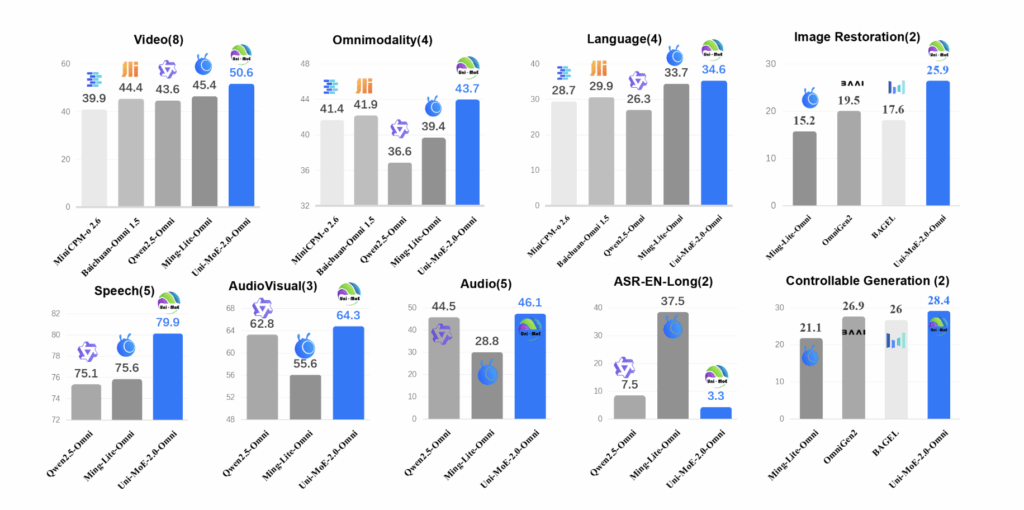
Uni-MoE-2.0-Omni: An Open Qwen2.5-7B Based Omnimodal MoE for Text, Image, Audio and Video Understanding

How do you build one open model that can reliably understand text, images, audio and video while still running efficiently? A team of researchers from Harbin Institute of Technology, Shenzhen introduced Uni-MoE-2.0-Omni, a fully open omnimodal large model that pushes Lychee’s Uni-MoE line toward language centric multimodal reasoning. The system is trained from scratch on a Qwen2.5-7B dense backbone and extended into a Mixture of Experts architecture with dynamic capacity routing, a progressive supervised and reinforcement learning recipe, and about 75B tokens of carefully matched multimodal data. It handles text, images, audio and video for understanding and can generate images, text and speech. https://idealistxy.github.io/Uni-MoE-v2.github.io/ Architecture, unified modality encoding around a language core The core of Uni-MoE-2.0-Omni is a Qwen2.5-7B style transformer that serves as a language centric hub. Around this hub, the research team attach a unified speech encoder that maps diverse audio, including environmental sound, speech and music, into a common representation space. On the vision side, pre-trained visual encoders process images and video frames, then feed token sequences into the same transformer. For generation, a context aware MoE based TTS module and a task aware diffusion transformer handle speech and image synthesis. https://idealistxy.github.io/Uni-MoE-v2.github.io/ All modalities are converted into token sequences that share a unified interface to the language model. This design means the same self attention layers see text, vision and audio tokens, which simplifies cross modal fusion and makes the language model the central controller for both understanding and generation. The architecture is designed to support 10 cross modal input configurations, such as image plus text, video plus speech and tri modal combinations. Omni Modality 3D RoPE and MoE driven fusion Cross modal alignment is handled by an Omni Modality 3D RoPE mechanism that encodes temporal and spatial structure directly into the rotary positional embeddings. Instead of only using one dimensional positions for text, the system assigns three coordinates to tokens, time, height and width for visual and audio streams, and time for speech. This gives the transformer an explicit view of when and where each token occurs, which is important for video understanding and audio visual reasoning tasks. The Mixture of Experts layers replace standard MLP blocks with an MoE stack that has three expert types. Empty experts act as null functions that allow computation skipping at inference time. Routed experts are modality specific and store domain knowledge for audio, vision or text. Shared experts are small and always active, providing a communication path for general information across modalities. A routing network chooses which experts to activate based on the input token, giving specialization without paying the full cost of a dense model with all experts active. Training recipe, from cross modal pretraining to GSPO DPO The training pipeline is organised into a data matched recipe. First, a language centric cross modal pretraining phase uses paired image text, audio text and video text corpora. This step teaches the model to project each modality into a shared semantic space aligned with language. The base model is trained on around 75B open source multimodal tokens and is equipped with special speech and image generation tokens so that generative behaviour can be learned by conditioning on linguistic cues. Next, a progressive supervised fine tuning stage activates modality specific experts grouped into audio, vision and text categories. During this stage, the research team introduce special control tokens so that the model can perform tasks like text conditioned speech synthesis and image generation inside the same language interface. After large scale SFT (Supervised Fine-Tuning), a data balanced annealing phase re-weights the mixture of datasets across modalities and tasks and trains with a lower learning rate. This avoids over fitting to a single modality and improves stability of the final omnimodal behaviour. To unlock long form reasoning, Uni-MoE-2.0-Omni adds an iterative policy optimisation stage built on GSPO and DPO. GSPO uses the model itself or another LLM as a judge to evaluate responses and construct preference signals, while DPO converts these preferences into a direct policy update objective that is more stable than standard reinforcement learning from human feedback. The research team apply this GSPO DPO loop in multiple rounds to form the Uni-MoE-2.0-Thinking variant, which inherits the omnimodal base and adds stronger step by step reasoning. Generation, MoE TTS and task aware diffusion For speech generation, Uni-MoE-2.0-Omni uses a context aware MoE TTS module that sits on top of the language model. The LLM emits control tokens that describe timbre, style and language, along with the text content. The MoE TTS consumes this sequence and produces discrete audio tokens, which are then decoded into waveforms by an external codec model, aligning with the unified speech encoder on the input side. This design makes speech generation a first class controlled generation task instead of a separate pipeline. On the vision side, a task aware diffusion transformer is conditioned on both task tokens and image tokens. Task tokens encode whether the system should perform text to image generation, editing or low level enhancement. Image tokens can capture semantics from the omnimodal backbone, for example from a text plus image dialogue. Lightweight projectors map these tokens into the diffusion transformer conditioning space, enabling instruction guided image generation and editing, while keeping the main omnimodal model frozen during the final visual fine tuning stage. Benchmarks and open checkpoints Uni-MoE-2.0-Omni is evaluated on 85 multimodal benchmarks that cover image, text, video, audio and cross or tri modal reasoning. The model surpasses Qwen2.5-Omni, which is trained on about 1.2T tokens, on more than 50 of 76 shared benchmarks. Gains include about +7% average on video understanding across 8 tasks, +7% average on omnimodality understanding across 4 benchmarks including OmniVideoBench and WorldSense, and about +4% on audio visual reasoning. For long form speech processing, Uni-MoE-2.0-Omni reduces word error rate by up to 4.2% relative on long LibriSpeech splits and brings about 1% WER improvement on TinyStories-en text to speech. Image generation and editing results are competitive with specialised visual models. The research team reports a small but

Uni-MoE-2.0-Omni: An Open Qwen2.5-7B Based Omnimodal MoE for Text, Image, Audio and Video Understanding Leggi l'articolo »

AI, Committee, Notizie, Uncategorized

NOVA: An Agentic Framework for Automated Histopathology Analysis and Discovery

arXiv:2511.11324v1 Announce Type: new Abstract: Digitized histopathology analysis involves complex, time-intensive workflows and specialized expertise, limiting its accessibility. We introduce NOVA, an agentic framework that translates scientific queries into executable analysis pipelines by iteratively generating and running Python code. NOVA integrates 49 domain-specific tools (e.g., nuclei segmentation, whole-slide encoding) built on open-source software, and can also create new tools ad hoc. To evaluate such systems, we present SlideQuest, a 90-question benchmark — verified by pathologists and biomedical scientists — spanning data processing, quantitative analysis, and hypothesis testing. Unlike prior biomedical benchmarks focused on knowledge recall or diagnostic QA, SlideQuest demands multi-step reasoning, iterative coding, and computational problem solving. Quantitative evaluation shows NOVA outperforms coding-agent baselines, and a pathologist-verified case study links morphology to prognostically relevant PAM50 subtypes, demonstrating its scalable discovery potential.

NOVA: An Agentic Framework for Automated Histopathology Analysis and Discovery Leggi l'articolo »

AI, Committee, Notizie, Uncategorized

Computational Analysis of Gender Depiction in the Comedias of Calder’on de la Barca

arXiv:2411.03895v2 Announce Type: replace Abstract: In theatre, playwrights use the portrayal of characters to explore culturally based gender norms. In this paper, we develop quantitative methods to study gender depiction in the non-religious works (comedias) of Pedro Calder’on de la Barca, a prolific Spanish 17th century author. We gather insights from a corpus of more than 100 plays by using a gender classifier and applying model explainability (attribution) methods to determine which text features are most influential in the model’s decision to classify speech as ‘male’ or ‘female’, indicating the most gendered elements of dialogue in Calder’on’s comedias in a human accessible manner. We find that female and male characters are portrayed differently and can be identified by the gender prediction model at practically useful accuracies (up to f=0.83). Analysis reveals semantic aspects of gender portrayal, and demonstrates that the model is even useful in providing a relatively accurate scene-by-scene prediction of cross-dressing characters.

Computational Analysis of Gender Depiction in the Comedias of Calder’on de la Barca Leggi l'articolo »

AI, Committee, Notizie, Uncategorized

Reinforcing Stereotypes of Anger: Emotion AI on African American Vernacular English

arXiv:2511.10846v1 Announce Type: new Abstract: Automated emotion detection is widely used in applications ranging from well-being monitoring to high-stakes domains like mental health and hiring. However, models often rely on annotations that reflect dominant cultural norms, limiting model ability to recognize emotional expression in dialects often excluded from training data distributions, such as African American Vernacular English (AAVE). This study examines emotion recognition model performance on AAVE compared to General American English (GAE). We analyze 2.7 million tweets geo-tagged within Los Angeles. Texts are scored for strength of AAVE using computational approximations of dialect features. Annotations of emotion presence and intensity are collected on a dataset of 875 tweets with both high and low AAVE densities. To assess model accuracy on a task as subjective as emotion perception, we calculate community-informed “silver” labels where AAVE-dense tweets are labeled by African American, AAVE-fluent (ingroup) annotators. On our labeled sample, GPT and BERT-based models exhibit false positive prediction rates of anger on AAVE more than double than on GAE. SpanEmo, a popular text-based emotion model, increases false positive rates of anger from 25 percent on GAE to 60 percent on AAVE. Additionally, a series of linear regressions reveals that models and non-ingroup annotations are significantly more correlated with profanity-based AAVE features than ingroup annotations. Linking Census tract demographics, we observe that neighborhoods with higher proportions of African American residents are associated with higher predictions of anger (Pearson’s correlation r = 0.27) and lower joy (r = -0.10). These results find an emergent safety issue of emotion AI reinforcing racial stereotypes through biased emotion classification. We emphasize the need for culturally and dialect-informed affective computing systems.

Reinforcing Stereotypes of Anger: Emotion AI on African American Vernacular English Leggi l'articolo »

AI, Committee, Notizie, Uncategorized

A methodological analysis of prompt perturbations and their effect on attack success rates

arXiv:2511.10686v1 Announce Type: new Abstract: This work aims to investigate how different Large Language Models (LLMs) alignment methods affect the models’ responses to prompt attacks. We selected open source models based on the most common alignment methods, namely, Supervised Fine-Tuning (SFT), Direct Preference Optimization (DPO), and Reinforcement Learning with Human Feedback (RLHF). We conducted a systematic analysis using statistical methods to verify how sensitive the Attack Success Rate (ASR) is when we apply variations to prompts designed to elicit inappropriate content from LLMs. Our results show that even small prompt modifications can significantly change the Attack Success Rate (ASR) according to the statistical tests we run, making the models more or less susceptible to types of attack. Critically, our results demonstrate that running existing ‘attack benchmarks’ alone may not be sufficient to elicit all possible vulnerabilities of both models and alignment methods. This paper thus contributes to ongoing efforts on model attack evaluation by means of systematic and statistically-based analyses of the different alignment methods and how sensitive their ASR is to prompt variation.

A methodological analysis of prompt perturbations and their effect on attack success rates Leggi l'articolo »

AI, Committee, Notizie, Uncategorized

Modeling and Predicting Multi-Turn Answer Instability in Large Language Models

arXiv:2511.10688v1 Announce Type: new Abstract: As large language models (LLMs) are adopted in an increasingly wide range of applications, user-model interactions have grown in both frequency and scale. Consequently, research has focused on evaluating the robustness of LLMs, an essential quality for real-world tasks. In this paper, we employ simple multi-turn follow-up prompts to evaluate models’ answer changes, model accuracy dynamics across turns with Markov chains, and examine whether linear probes can predict these changes. Our results show significant vulnerabilities in LLM robustness: a simple “Think again” prompt led to an approximate 10% accuracy drop for Gemini 1.5 Flash over nine turns, while combining this prompt with a semantically equivalent reworded question caused a 7.5% drop for Claude 3.5 Haiku. Additionally, we find that model accuracy across turns can be effectively modeled using Markov chains, enabling the prediction of accuracy probabilities over time. This allows for estimation of the model’s stationary (long-run) accuracy, which we find to be on average approximately 8% lower than its first-turn accuracy for Gemini 1.5 Flash. Our results from a model’s hidden states also reveal evidence that linear probes can help predict future answer changes. Together, these results establish stationary accuracy as a principled robustness metric for interactive settings and expose the fragility of models under repeated questioning. Addressing this instability will be essential for deploying LLMs in high-stakes and interactive settings where consistent reasoning is as important as initial accuracy.

Modeling and Predicting Multi-Turn Answer Instability in Large Language Models Leggi l'articolo »

We use cookies to improve your experience and performance on our website. You can learn more at Politica sulla privacy and manage your privacy settings by clicking Settings.

Privacy Preferences

You can choose your cookie settings by turning on/off each type of cookie as you wish, except for essential cookies.

Allow All
Manage Consent Preferences
  • Always Active

Save
it_IT