YouZum

Uncategorized

AI, Committee, Notizie, Uncategorized

OpenAI has Released the ‘circuit-sparsity’: A Set of Open Tools for Connecting Weight Sparse Models and Dense Baselines through Activation Bridges

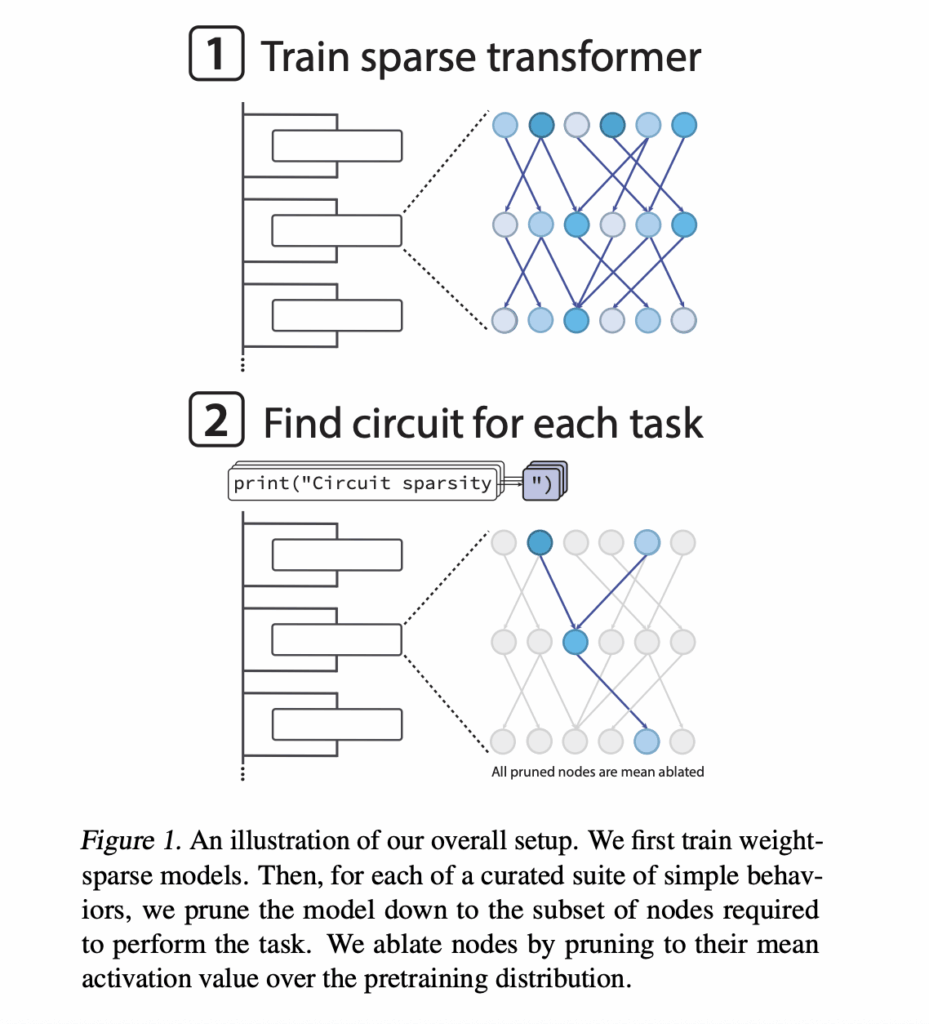
OpenAI team has released their openai/circuit-sparsity model on Hugging Face and the openai/circuit_sparsity toolkit on GitHub. The release packages the models and circuits from the paper ‘Weight-sparse transformers have interpretable circuits‘. https://arxiv.org/pdf/2511.13653 What is a weight sparse transformer? The models are GPT-2 style decoder only transformers trained on Python code. Sparsity is not added after training, it is enforced during optimization. After each AdamW step, the training loop keeps only the largest magnitude entries in every weight matrix and bias, including token embeddings, and zeros the rest. All matrices maintain the same fraction of nonzero elements. The sparsest models have approximately 1 in 1000 nonzero weights. In addition, the OpenAI team enforced mild activation sparsity so that about 1 in 4 node activations are nonzero, covering residual reads, residual writes, attention channels and MLP neurons. Sparsity is annealed during training. Models start dense, then the allowed nonzero budget gradually moves toward the target value. This design lets the research team scale width while holding the number of nonzero parameters fixed, and then study the capability interpretability tradeoff as they vary sparsity and model size. The research team show that, for a given pretraining loss, circuits recovered from sparse models are roughly 16 times smaller than those from dense models. https://arxiv.org/pdf/2511.13653 So, what is a sparse circuit? The central object in this research work is a sparse circuit. The research team defines nodes at a very fine granularity, each node is a single neuron, attention channel, residual read channel or residual write channel. An edge is a single nonzero entry in a weight matrix that connects two nodes. Circuit size is measured by the geometric mean number of edges across tasks. To probe the models, the research team built 20 simple Python next token binary tasks. Each task forces the model to choose between 2 completions that differ in one token. Examples include: single_double_quote, predict whether to close a string with a single or double quote bracket_counting, decide between ] and ]] based on list nesting depth set_or_string, track whether a variable was initialized as a set or a string For each task, they prune the model to find the smallest circuit that still achieves a target loss of 0.15 on that task distribution. Pruning operates at the node level. Deleted nodes are mean ablated, their activations are frozen to the mean over the pretraining distribution. A learned binary mask per node is optimized with a straight through style surrogate so that the objective trades off task loss and circuit size. https://arxiv.org/pdf/2511.13653 Example circuits, quote closing and counting brackets The most compact example is the circuit for single_double_quote. Here the model must emit the correct closing quote type given an opening quote. The pruned circuit has 12 nodes and 9 edges. The mechanism is two step. In layer 0.mlp, 2 neurons specialize: a quote detector neuron that activates on both ” and ‘ a quote type classifier neuron that is positive on ” and negative on ‘ A later attention head in layer 10.attn uses the quote detector channel as a key and the quote type classifier channel as a value. The final token has a constant positive query, so the attention output copies the correct quote type into the last position and the model closes the string correctly. https://arxiv.org/pdf/2511.13653 bracket_counting yields a slightly larger circuit but with a clear algorithm. The embedding of [ writes into several residual channels that act as bracket detectors. A value channel in a layer 2 attention head averages this detector activation over the context, effectively computing nesting depth and storing it in a residual channel. A later attention head thresholds this depth and activates a nested list close channel only when the list is nested, which leads the model to output ]]. A third circuit, for set_or_string_fixedvarname, shows how the model tracks the type of a variable called current. One head copies the embedding of current into the set() or “” token. A later head uses that embedding as query and key to copy the relevant information back when the model must choose between .add and +=. https://arxiv.org/pdf/2511.13653 https://arxiv.org/pdf/2511.13653 Bridges, connecting sparse models to dense models The research team also introduces bridges that connect a sparse model to an already trained dense model. Each bridge is an encoder decoder pair that maps dense activations into sparse activations and back once per sublayer. The encoder uses a linear map with an AbsTopK activation, the decoder is linear. Training adds losses that encourage hybrid sparse dense forward passes to match the original dense model. This lets the research team perturb interpretable sparse features such as the quote type classifier channel and then map that perturbation into the dense model, changing its behavior in a controlled way. https://arxiv.org/pdf/2511.13653 What Exactly has OpenAI Team released? The OpenAI team as released openai/circuit-sparsity model on Hugging Face. This is a 0.4B parameter model tagged with custom_code, corresponding to csp_yolo2 in the research paper. The model is used for the qualitative results on bracket counting and variable binding. It is licensed under Apache 2.0. Copy CodeCopiedUse a different Browser import torch from transformers import AutoModelForCausalLM, AutoTokenizer if __name__ == “__main__”: PROMPT = “def square_sum(xs):n return sum(x * x for x in xs)nnsquare_sum([1, 2, 3])n” tok = AutoTokenizer.from_pretrained(“openai/circuit-sparsity”, trust_remote_code=True) model = AutoModelForCausalLM.from_pretrained( “openai/circuit-sparsity”, trust_remote_code=True, torch_dtype=”auto”, ) model.to(“cuda” if torch.cuda.is_available() else “cpu”) inputs = tok(PROMPT, return_tensors=”pt”, add_special_tokens=False)[“input_ids”].to( model.device ) with torch.no_grad(): out = model.generate( inputs, max_new_tokens=64, do_sample=True, temperature=0.8, top_p=0.95, return_dict_in_generate=False, ) print(tok.decode(out[0], skip_special_tokens=True)) “` :contentReference[oaicite:14]{index=14} Key Takeaways Weight sparse training, not post hoc pruning: Circuit sparsity trains GPT-2 style decoder models with extreme weight sparsity enforced during optimization, most weights are zero so each neuron has only a few connections. Small, task specific circuits with explicit nodes and edges: The research team defines circuits at the level of individual neurons, attention channels and residual channels, and recovers circuits that often have tens of nodes and few edges for 20 binary Python next token tasks. Quote closing and type tracking are fully instantiated

OpenAI has Released the ‘circuit-sparsity’: A Set of Open Tools for Connecting Weight Sparse Models and Dense Baselines through Activation Bridges Leggi l'articolo »

AI, Committee, Notizie, Uncategorized

Southeast Asia seeks its place in space

__________________________Thai Space Expo October 16-18, 2025 ___Bangkok, Thailand It’s a scorching October day in Bangkok and I’m wandering through the exhibits at the Thai Space Expo, held in one of the city’s busiest shopping malls, when I do a double take. Amid the flashy space suits and model rockets on display, there’s a plain-looking package of Thai basil chicken. I’m told the same kind of vacuum-­sealed package has just been launched to the International Space Station. “This is real chicken that we sent to space,” says a spokesperson for the business behind the stunt, Charoen Pokphand Foods, the biggest food company in Thailand. It’s an unexpected sight, one that reflects the growing excitement within the Southeast Asian space sector. At the expo, held among designer shops and street-food stalls, enthusiastic attendees have converged from emerging space nations such as Vietnam, Malaysia, Singapore, and of course Thailand to showcase Southeast Asia’s fledgling space industry. While there is some uncertainty about how exactly the region’s space sector may evolve, there is plenty of optimism, too. “Southeast Asia is perfectly positioned to take leadership as a space hub,” says Candace Johnson, a partner in Seraphim Space, a UK investment firm that operates in Singapore. “There are a lot of opportunities.” A sample package of pad krapow was also on display.COURTESY OF THE AUTHOR For example, Thailand may build a spaceport to launch rockets in the next few years, the country’s Geo-Informatics and Space Technology Development Agency announced the day before the expo started. “We don’t have a spaceport in Southeast Asia,” says Atipat Wattanuntachai, acting head of the space economy advancement division at the agency. “We saw a gap.” Because Thailand is so close to the equator, those rockets would get an additional boost from Earth’s rotation. All kinds of companies here are exploring how they might tap into the global space economy. VegaCosmos, a startup based in Hanoi, Vietnam, is looking at ways to use satellite data for urban planning. The Electricity Generating Authority of Thailand is monitoring rainstorms from space to predict landslides. And the startup Spacemap, from Seoul, South Korea, is developing a new tool to better track satellites in orbit, which the US Space Force has invested in. It’s the space chicken that caught my eye, though, perhaps because it reflects the juxtaposition of tradition and modernity seen across Bangkok, a city of ancient temples nestled next to glittering skyscrapers. In June, astronauts on the space station were treated to this popular dish, known as pad krapow. It’s more commonly served up by street vendors, but this time it was delivered on a private mission operated by the US-based company Axiom Space. Charoen Pokphand is now using the stunt to say its chicken is good enough for NASA (sadly, I wasn’t able to taste it to weigh in). Other Southeast Asian industries could also lend expertise to future space missions. Johnson says the region could leverage its manufacturing prowess to develop better semiconductors for satellites, for example, or break into the in-space manufacturing market. I left the expo on a Thai longboat down the Chao Phraya River that weaves through Bangkok, with visions of astronauts tucking into some pad krapow in my head and imagining what might come next. Jonathan O’Callaghan is a freelance space journalist based in Bangkok who covers commercial spaceflight, astrophysics, and space exploration.

Southeast Asia seeks its place in space Leggi l'articolo »

AI, Committee, Notizie, Uncategorized

The Download: expanded carrier screening, and how Southeast Asia plans to get to space

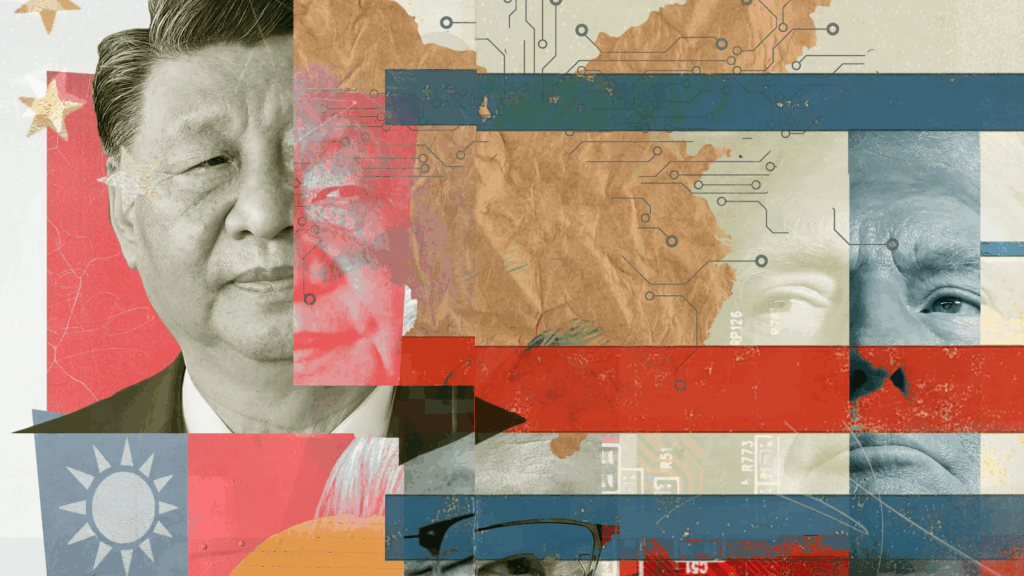
This is today’s edition of The Download, our weekday newsletter that provides a daily dose of what’s going on in the world of technology. Expanded carrier screening: Is it worth it? Carrier screening  tests would-be parents for hidden genetic mutations that might affect their children. It initially involved testing for specific genes in at-risk populations. Expanded carrier screening takes things further, giving would-be parents an option to test for a wide array of diseases in prospective parents and egg and sperm donors. The companies offering these screens “started out with 100 genes, and now some of them go up to 2,000,” Sara Levene, genetics counsellor at Guided Genetics, said at a meeting I attended this week. “It’s becoming a bit of an arms race amongst labs, to be honest.” But expanded carrier screening comes with downsides. And it isn’t for everyone. Read the full story. —Jessica Hamzelou This article first appeared in The Checkup, MIT Technology Review’s weekly biotech newsletter. To receive it in your inbox every Thursday, and read articles like this first, sign up here. Southeast Asia seeks its place in space It’s a scorching October day in Bangkok and I’m wandering through the exhibits at the Thai Space Expo, held in one of the city’s busiest shopping malls, when I do a double take. Amid the flashy space suits and model rockets on display, there’s a plain-looking package of Thai basil chicken. I’m told the same kind of vacuum-­sealed package has just been launched to the International Space Station. It’s an unexpected sight, one that reflects the growing excitement within the Southeast Asian space sector. And while there is some uncertainty about how exactly the region’s space sector may evolve, there is plenty of optimism, too. Read the full story. —Jonathan O’Callaghan This story is from the next print issue of MIT Technology Review magazine. If you haven’t already, subscribe now to receive future issues once they land. The must-reads I’ve combed the internet to find you today’s most fun/important/scary/fascinating stories about technology. 1 Disney just signed a major deal with OpenAIMeaning you’ll soon be able to create Sora clips starring 200 Marvel, Pixel and Star Wars characters. (Hollywood Reporter $)+ Disney used to be openly skeptical of AI. What changed? (WSJ $)+ It’s not feeling quite so friendly towards Google, however. (Ars Technica)+ Expect a load of AI slop making its way to Disney Plus. (The Verge) 2 Donald Trump has blocked US states from enforcing their own AI rulesBut technically, only Congress has the power to override state laws. (NYT $)+ A new task force will seek out states with “inconsistent” AI rules. (Engadget)+ The move is particularly bad news for California. (The Markup) 3 Reddit is challenging Australia’s social media ban for teensIt’s arguing that the ban infringes on their freedom of political communication. (Bloomberg $)+ We’re learning more about the mysterious machinations of the teenage brain. (Vox) 4 ChatGPT’s “adult mode” is due to launch early next yearBut OpenAI admits it needs to improve its age estimation tech first. (The Verge)+ It’s pretty easy to get DeepSeek to talk dirty. (MIT Technology Review) 5 The death of Running Tide’s carbon removal dreamThe company’s demise is a wake-up call to others dabbling in experimental tech. (Wired $)+ We first wrote about Running Tide’s issues back in 2022. (MIT Technology Review)+ What’s next for carbon removal? (MIT Technology Review) 6 That dirty-talking AI teddy bear wasn’t a one-offIt turns out that a wide range of LLM-powered toys aren’t suitable for children. (NBC News) + AI toys are all the rage in China—and now they’re appearing on shelves in the US too. (MIT Technology Review) 7 These are the cheapest places to create a fake online accountFor a few cents, scammers can easily set up bots. (FT $) 8 How professors are attempting to AI-proof examsChatGPT won’t help you cut corners to ace an oral examination. (WP $) 9 Can a font be woke?Marco Rubio seems to think so. (The Atlantic $) 10 Next year is all about maximalist circus decor That’s according to Pinterest’s trend predictions for 2026. (The Guardian) Quote of the day  “Trump is delivering exactly what his billionaire benefactors demanded—all at the expense of our kids, our communities, our workers, and our planet.”  —Senator Ed Markey criticizes Donald Trump’s decision to sign an order cracking down on US states’ ability to self-regulate AI, the Wall Street Journal reports. One more thing Taiwan’s “silicon shield” could be weakening Taiwanese politics increasingly revolves around one crucial question: Will China invade? China’s ruling party has wanted to seize Taiwan for more than half a century. But in recent years, China’s leader, Xi Jinping, has placed greater emphasis on the idea of “taking back” the island (which the Chinese Communist Party, or CCP, has never controlled). Many in Taiwan and elsewhere think one major deterrent has to do with the island’s critical role in semiconductor manufacturing. Taiwan produces the majority of the world’s semiconductors and more than 90% of the most advanced chips needed for AI applications. But now some Taiwan specialists and some of the island’s citi­zens are worried that this “silicon shield,” if it ever existed, is cracking. Read the full story. —Johanna M. Costigan We can still have nice things A place for comfort, fun and distraction to brighten up your day. (Got any ideas? Drop me a line or skeet ’em at me.) + Reasons to be cheerful: people are actually nicer than we think they are.+ This year’s Krampus Run in Whitby—the Yorkshire town that inspired Bram Stoker’s Dracula—looks delightfully spooky.+ How to find the magic in that most mundane of locations: the airport.+ The happiest of birthdays to Dionne Warwick, who turns 85 today.

The Download: expanded carrier screening, and how Southeast Asia plans to get to space Leggi l'articolo »

AI, Committee, Notizie, Uncategorized

Nanbeige4-3B-Thinking: How a 23T Token Pipeline Pushes 3B Models Past 30B Class Reasoning

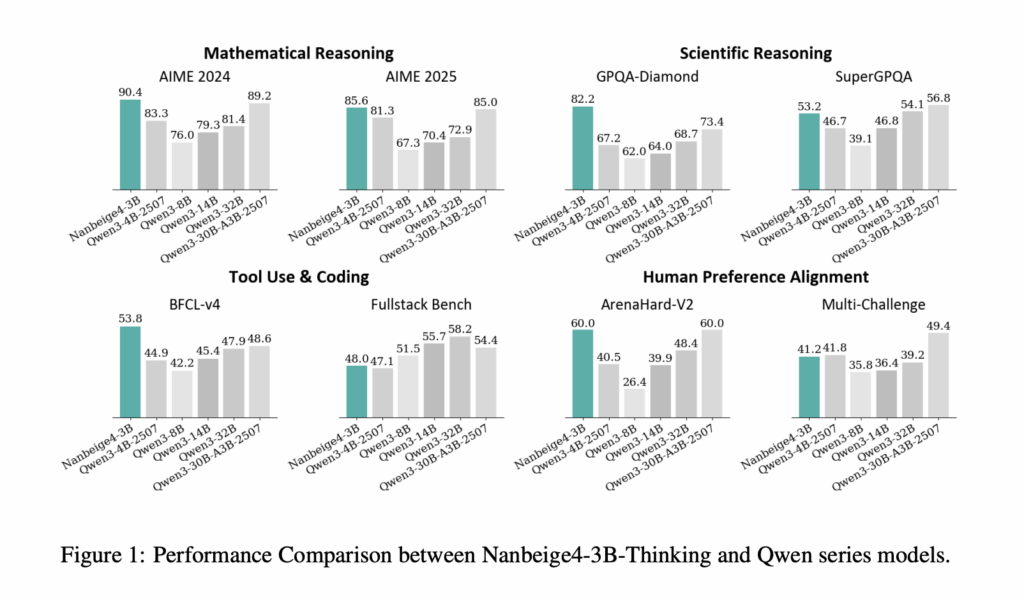
Can a 3B model deliver 30B class reasoning by fixing the training recipe instead of scaling parameters? Nanbeige LLM Lab at Boss Zhipin has released Nanbeige4-3B, a 3B parameter small language model family trained with an unusually heavy emphasis on data quality, curriculum scheduling, distillation, and reinforcement learning. The research team ships 2 primary checkpoints, Nanbeige4-3B-Base and Nanbeige4-3B-Thinking, and evaluates the reasoning tuned model against Qwen3 checkpoints from 4B up to 32B parameters. https://arxiv.org/pdf/2512.06266 Benchmark results On AIME 2024, Nanbeige4-3B-2511 reports 90.4, while Qwen3-32B-2504 reports 81.4. On GPQA-Diamond, Nanbeige4-3B-2511 reports 82.2, while Qwen3-14B-2504 reports 64.0 and Qwen3-32B-2504 reports 68.7. These are the 2 benchmarks where the research’s “3B beats 10× larger” framing is directly supported. The research team also showcase strong tool use gains on BFCL-V4, Nanbeige4-3B reports 53.8 versus 47.9 for Qwen3-32B and 48.6 for Qwen3-30B-A3B. On Arena-Hard V2, Nanbeige4-3B reports 60.0, matching the highest score listed in that comparison table inside the research paper. At the same time, the model is not best across every category, on Fullstack-Bench it reports 48.0, below Qwen3-14B at 55.7 and Qwen3-32B at 58.2, and on SuperGPQA it reports 53.2, slightly below Qwen3-32B at 54.1. https://arxiv.org/pdf/2512.06266 The training recipe, the parts that move a 3B model Hybrid Data Filtering, then resampling at scale For pretraining, the research team combine multi dimensional tagging with similarity based scoring. They reduce their labeling space to 20 dimensions and report 2 key findings, content related labels are more predictive than format labels, and a fine grained 0 to 9 scoring scheme outperforms binary labeling. For similarity based scoring, they build a retrieval database with hundreds of billions of entries supporting hybrid text and vector retrieval. They filter to 12.5T tokens of high quality data, then select a 6.5T higher quality subset and upsample it for 2 or more epochs, producing a final 23T token training corpus. This is the first place where the report diverges from typical small model training, the pipeline is not just “clean data”, it is scored, retrieved, and resampled with explicit utility assumptions. FG-WSD, a data utility scheduler instead of uniform sampling Most similar research projects treat warmup stable decay as a learning rate schedule only. Nanbeige4-3B adds a data curriculum inside the stable phase via FG-WSD, Fine-Grained Warmup-Stable-Decay. Instead of sampling a fixed mixture throughout stable training, they progressively concentrate higher quality data later in training. https://arxiv.org/pdf/2512.06266 In a 1B ablation trained on 1T tokens, the above Table shows GSM8K improving from 27.1 under vanilla WSD to 34.3 under FG-WSD, with gains across CMATH, BBH, MMLU, CMMLU, and MMLU-Pro. In the full 3B run, the research team splits training into Warmup, Diversity-Enriched Stable, High-Quality Stable, and Decay, and uses ABF in the decay stage to extend context length to 64K. https://arxiv.org/pdf/2512.06266 Multi-stage SFT, then fix the supervision traces Post training starts with cold start SFT, then overall SFT. The cold start stage uses about 30M QA samples focused on math, science, and code, with 32K context length, and a reported mix of about 50% math reasoning, 30% scientific reasoning, and 20% code tasks. The research team also claim that scaling cold start SFT instructions from 0.5M to 35M keeps improving AIME 2025 and GPQA-Diamond, with no early saturation in their experiments. https://arxiv.org/pdf/2512.06266 Overall SFT shifts to a 64K context length mix including general conversation and writing, agent style tool use and planning, harder reasoning that targets weaknesses, and coding tasks. This stage introduces Solution refinement plus Chain-of-Thought reconstruction. The system runs iterative generate, critique, revise cycles guided by a dynamic checklist, then uses a chain completion model to reconstruct a coherent CoT that is consistent with the final refined solution. This is meant to avoid training on broken reasoning traces after heavy editing. https://arxiv.org/pdf/2512.06266 DPD distillation, then multi stage RL with verifiers Distillation uses Dual-Level Preference Distillation, DPD. The student learns token level distributions from the teacher model, while a sequence level DPO objective maximizes the margin between positive and negative responses. Positives come from sampling the teacher Nanbeige3.5-Pro, negatives are sampled from the 3B student, and distillation is applied on both sample types to reduce confident errors and improve alternatives. Reinforcement learning is staged by domain, and each stage uses on policy GRPO. The research team describes on policy data filtering using avg@16 pass rate and retaining samples strictly between 10% and 90% to avoid trivial or impossible items. STEM RL uses an agentic verifier that calls a Python interpreter to check equivalence beyond string matching. Coding RL uses synthetic test functions, validated via sandbox execution, and uses pass fail rewards from those tests. Human preference alignment RL uses a pairwise reward model designed to produce preferences in a few tokens and reduce reward hacking risk compared to general language model rewarders. https://arxiv.org/pdf/2512.06266 Comparison Table Benchmark, metric Qwen3-14B-2504 Qwen3-32B-2504 Nanbeige4-3B-2511 AIME2024, avg@8 79.3 81.4 90.4 AIME2025, avg@8 70.4 72.9 85.6 GPQA-Diamond, avg@3 64.0 68.7 82.2 SuperGPQA, avg@3 46.8 54.1 53.2 BFCL-V4, avg@3 45.4 47.9 53.8 Fullstack Bench, avg@3 55.7 58.2 48.0 ArenaHard-V2, avg@3 39.9 48.4 60.0 Key Takeaways 3B can lead much larger open models on reasoning, under the paper’s averaged sampling setup. Nanbeige4-3B-Thinking reports AIME 2024 avg@8 90.4 vs Qwen3-32B 81.4, and GPQA-Diamond avg@3 82.2 vs Qwen3-14B 64.0. The research team is careful about evaluation, these are avg@k results with specific decoding, not single shot accuracy. AIME is avg@8, most others are avg@3, with temperature 0.6, top p 0.95, and long max generation. Pretraining gains are tied to data curriculum, not just more tokens. Fine-Grained WSD schedules higher quality mixtures later, and the 1B ablation shows GSM8K moving from 27.1 to 34.3 versus vanilla scheduling. Post-training focuses on supervision quality, then preference aware distillation. The pipeline uses deliberative solution refinement plus chain-of-thought reconstruction, then Dual Preference Distillation that combines token distribution matching with sequence level preference optimization. Check out the Paper and Model Weights. Feel free to check out our GitHub Page for Tutorials, Codes and Notebooks. Also, feel free to follow us on Twitter and don’t forget to join our 100k+ ML SubReddit and Subscribe to our Newsletter.

Nanbeige4-3B-Thinking: How a 23T Token Pipeline Pushes 3B Models Past 30B Class Reasoning Leggi l'articolo »

AI, Committee, Notizie, Uncategorized

5 AI Model Architectures Every AI Engineer Should Know

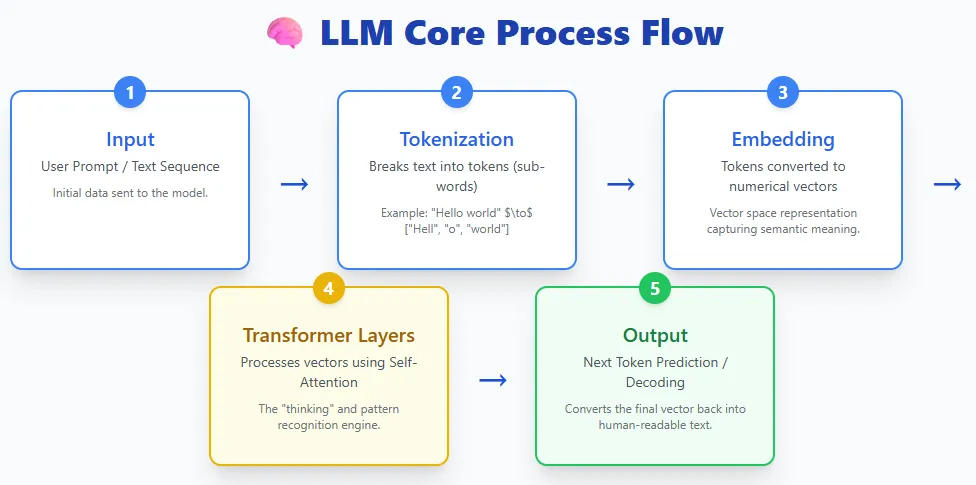
Everyone talks about LLMs—but today’s AI ecosystem is far bigger than just language models. Behind the scenes, a whole family of specialized architectures is quietly transforming how machines see, plan, act, segment, represent concepts, and even run efficiently on small devices. Each of these models solves a different part of the intelligence puzzle, and together they’re shaping the next generation of AI systems. In this article, we’ll explore the five major players: Large Language Models (LLMs), Vision-Language Models (VLMs), Mixture of Experts (MoE), Large Action Models (LAMs) & Small Language Models (SLMs). Large Language Models (LLMs) LLMs take in text, break it into tokens, turn those tokens into embeddings, pass them through layers of transformers, and generate text back out. Models like ChatGPT, Claude, Gemini, Llama, and others all follow this basic process. At their core, LLMs are deep learning models trained on massive amounts of text data. This training allows them to understand language, generate responses, summarize information, write code, answer questions, and perform a wide range of tasks. They use the transformer architecture, which is extremely good at handling long sequences and capturing complex patterns in language. Today, LLMs are widely accessible through consumer tools and assistants—from OpenAI’s ChatGPT and Anthropic’s Claude to Meta’s Llama models, Microsoft Copilot, and Google’s Gemini and BERT/PaLM family. They’ve become the foundation of modern AI applications because of their versatility and ease of use. Vision-Language Models (VLMs) VLMs combine two worlds: A vision encoder that processes images or video A text encoder that processes language Both streams meet in a multimodal processor, and a language model generates the final output. Examples include GPT-4V, Gemini Pro Vision, and LLaVA. A VLM is essentially a large language model that has been given the ability to see. By fusing visual and text representations, these models can understand images, interpret documents, answer questions about pictures, describe videos, and more. Traditional computer vision models are trained for one narrow task—like classifying cats vs. dogs or extracting text from an image—and they can’t generalize beyond their training classes. If you need a new class or task, you must retrain them from scratch. VLMs remove this limitation. Trained on huge datasets of images, videos, and text, they can perform many vision tasks zero-shot, simply by following natural language instructions. They can do everything from image captioning and OCR to visual reasoning and multi-step document understanding—all without task-specific retraining. This flexibility makes VLMs one of the most powerful advances in modern AI. Mixture of Experts (MoE) Mixture of Experts models build on the standard transformer architecture but introduce a key upgrade: instead of one feed-forward network per layer, they use many smaller expert networks and activate only a few for each token. This makes MoE models extremely efficient while offering massive capacity. In a regular transformer, every token flows through the same feed-forward network, meaning all parameters are used for every token. MoE layers replace this with a pool of experts, and a router decides which experts should process each token (Top-K selection). As a result, MoE models may have far more total parameters, but they only compute with a small fraction of them at a time—giving sparse compute. For example, Mixtral 8×7B has 46B+ parameters, yet each token uses only about 13B. This design drastically reduces inference cost. Instead of scaling by making the model deeper or wider (which increases FLOPs), MoE models scale by adding more experts, boosting capacity without raising per-token compute. This is why MoEs are often described as having “bigger brains at lower runtime cost.” Large Action Models (LAMs) Large Action Models go a step beyond generating text—they turn intent into action. Instead of just answering questions, a LAM can understand what a user wants, break the task into steps, plan the required actions, and then execute them in the real world or on a computer. A typical LAM pipeline includes: Perception – Understanding the user’s input Intent recognition – Identifying what the user is trying to achieve Task decomposition – Breaking the goal into actionable steps Action planning + memory – Choosing the right sequence of actions using past and present context Execution – Carrying out tasks autonomously Examples include Rabbit R1, Microsoft’s UFO framework, and Claude Computer Use, all of which can operate apps, navigate interfaces, or complete tasks on behalf of a user. LAMs are trained on massive datasets of real user actions, giving them the ability to not just respond, but act—booking rooms, filling forms, organizing files, or performing multi-step workflows. This shifts AI from a passive assistant into an active agent capable of complex, real-time decision-making. Small Language Models (SLMs) SLMs are lightweight language models designed to run efficiently on edge devices, mobile hardware, and other resource-constrained environments. They use compact tokenization, optimized transformer layers, and aggressive quantization to make local, on-device deployment possible. Examples include Phi-3, Gemma, Mistral 7B, and Llama 3.2 1B. Unlike LLMs, which may have hundreds of billions of parameters, SLMs typically range from a few million to a few billion. Despite their smaller size, they can still understand and generate natural language, making them useful for chat, summarization, translation, and task automation—without needing cloud computation. Because they require far less memory and compute, SLMs are ideal for: Mobile apps IoT and edge devices Offline or privacy-sensitive scenarios Low-latency applications where cloud calls are too slow SLMs represent a growing shift toward fast, private, and cost-efficient AI, bringing language intelligence directly onto personal devices. The post 5 AI Model Architectures Every AI Engineer Should Know appeared first on MarkTechPost.

5 AI Model Architectures Every AI Engineer Should Know Leggi l'articolo »

AI, Committee, Notizie, Uncategorized

Generate-Then-Validate: A Novel Question Generation Approach Using Small Language Models

arXiv:2512.10110v1 Announce Type: new Abstract: We explore the use of small language models (SLMs) for automatic question generation as a complement to the prevalent use of their large counterparts in learning analytics research. We present a novel question generation pipeline that leverages both the text generation and the probabilistic reasoning abilities of SLMs to generate high-quality questions. Adopting a “generate-then-validate” strategy, our pipeline first performs expansive generation to create an abundance of candidate questions and refine them through selective validation based on novel probabilistic reasoning. We conducted two evaluation studies, one with seven human experts and the other with a large language model (LLM), to assess the quality of the generated questions. Most judges (humans or LLMs) agreed that the generated questions had clear answers and generally aligned well with the intended learning objectives. Our findings suggest that an SLM can effectively generate high-quality questions when guided by a well-designed pipeline that leverages its strengths.

Generate-Then-Validate: A Novel Question Generation Approach Using Small Language Models Leggi l'articolo »

AI, Committee, Notizie, Uncategorized

Emotional Support with LLM-based Empathetic Dialogue Generation

arXiv:2507.12820v2 Announce Type: replace-cross Abstract: Emotional Support Conversation (ESC) aims to provide empathetic and effective emotional assistance through dialogue, addressing the growing demand for mental health support. This paper presents our solution for the NLPCC 2025 Task 8 ESC evaluation, where we leverage large-scale language models enhanced by prompt engineering and finetuning techniques. We explore both parameter-efficient Low-Rank Adaptation and full-parameter fine-tuning strategies to improve the model’s ability to generate supportive and contextually appropriate responses. Our best model ranked second in the competition, highlighting the potential of combining LLMs with effective adaptation methods for ESC tasks. Future work will focus on further enhancing emotional understanding and response personalization to build more practical and reliable emotional support systems.

Emotional Support with LLM-based Empathetic Dialogue Generation Leggi l'articolo »

AI, Committee, Notizie, Uncategorized

Semantic Reconstruction of Adversarial Plagiarism: A Context-Aware Framework for Detecting and Restoring “Tortured Phrases” in Scientific Literature

arXiv:2512.10435v1 Announce Type: new Abstract: The integrity and reliability of scientific literature is facing a serious threat by adversarial text generation techniques, specifically from the use of automated paraphrasing tools to mask plagiarism. These tools generate “tortured phrases”, statistically improbable synonyms (e.g. “counterfeit consciousness” for “artificial intelligence”), that preserve the local grammar while obscuring the original source. Most existing detection methods depend heavily on static blocklists or general-domain language models, which suffer from high false-negative rates for novel obfuscations and cannot determine the source of the plagiarized content. In this paper, we propose Semantic Reconstruction of Adversarial Plagiarism (SRAP), a framework designed not only to detect these anomalies but to mathematically recover the original terminology. We use a two-stage architecture: (1) statistical anomaly detection with a domain-specific masked language model (SciBERT) using token-level pseudo-perplexity, and (2) source-based semantic reconstruction using dense vector retrieval (FAISS) and sentence-level alignment (SBERT). Experiments on a parallel corpus of adversarial scientific text show that while zero-shot baselines fail completely (0.00 percent restoration accuracy), our retrieval-augmented approach achieves 23.67 percent restoration accuracy, significantly outperforming baseline methods. We also show that static decision boundaries are necessary for robust detection in jargon-heavy scientific text, since dynamic thresholding fails under high variance. SRAP enables forensic analysis by linking obfuscated expressions back to their most probable source documents.

Semantic Reconstruction of Adversarial Plagiarism: A Context-Aware Framework for Detecting and Restoring “Tortured Phrases” in Scientific Literature Leggi l'articolo »

AI, Committee, Notizie, Uncategorized

Stronger Normalization-Free Transformers

arXiv:2512.10938v1 Announce Type: cross Abstract: Although normalization layers have long been viewed as indispensable components of deep learning architectures, the recent introduction of Dynamic Tanh (DyT) has demonstrated that alternatives are possible. The point-wise function DyT constrains extreme values for stable convergence and reaches normalization-level performance; this work seeks further for function designs that can surpass it. We first study how the intrinsic properties of point-wise functions influence training and performance. Building on these findings, we conduct a large-scale search for a more effective function design. Through this exploration, we introduce $mathrm{Derf}(x) = mathrm{erf}(alpha x + s)$, where $mathrm{erf}(x)$ is the rescaled Gaussian cumulative distribution function, and identify it as the most performant design. Derf outperforms LayerNorm, RMSNorm, and DyT across a wide range of domains, including vision (image recognition and generation), speech representation, and DNA sequence modeling. Our findings suggest that the performance gains of Derf largely stem from its improved generalization rather than stronger fitting capacity. Its simplicity and stronger performance make Derf a practical choice for normalization-free Transformer architectures.

Stronger Normalization-Free Transformers Leggi l'articolo »

We use cookies to improve your experience and performance on our website. You can learn more at Politica sulla privacy and manage your privacy settings by clicking Settings.

Privacy Preferences

You can choose your cookie settings by turning on/off each type of cookie as you wish, except for essential cookies.

Allow All
Manage Consent Preferences
  • Always Active

Save
it_IT