YouZum

Committee

AI, Committee, Notizie, Uncategorized

AutoJudge: Judge Decoding Without Manual Annotation

arXiv:2504.20039v4 Announce Type: replace Abstract: We introduce AutoJudge, a method that accelerates large language model (LLM) inference with task-specific lossy speculative decoding. Instead of matching the original model output distribution token-by-token, we identify which of the generated tokens affect the downstream quality of the response, relaxing the distribution match guarantee so that the “unimportant” tokens can be generated faster. Our approach relies on a semi-greedy search algorithm to test which of the mismatches between target and draft models should be corrected to preserve quality and which ones may be skipped. We then train a lightweight classifier based on existing LLM embeddings to predict, at inference time, which mismatching tokens can be safely accepted without compromising the final answer quality. We evaluate the effectiveness of AutoJudge with multiple draft/target model pairs on mathematical reasoning and programming benchmarks, achieving significant speedups at the cost of a minor accuracy reduction. Notably, on GSM8k with the Llama 3.1 70B target model, our approach achieves up to $approx2times$ speedup over speculative decoding at the cost of $le 1%$ drop in accuracy. When applied to the LiveCodeBench benchmark, AutoJudge automatically detects programming-specific important tokens, accepting $ge 25$ tokens per speculation cycle at $2%$ drop in Pass@1. Our approach requires no human annotation and is easy to integrate with modern LLM inference frameworks.

AutoJudge: Judge Decoding Without Manual Annotation Leggi l'articolo »

AI, Committee, Notizie, Uncategorized

The Subtle Art of Defection: Understanding Uncooperative Behaviors in LLM based Multi-Agent Systems

arXiv:2511.15862v1 Announce Type: cross Abstract: This paper introduces a novel framework for simulating and analyzing how uncooperative behaviors can destabilize or collapse LLM-based multi-agent systems. Our framework includes two key components: (1) a game theory-based taxonomy of uncooperative agent behaviors, addressing a notable gap in the existing literature; and (2) a structured, multi-stage simulation pipeline that dynamically generates and refines uncooperative behaviors as agents’ states evolve. We evaluate the framework via a collaborative resource management setting, measuring system stability using metrics such as survival time and resource overuse rate. Empirically, our framework achieves 96.7% accuracy in generating realistic uncooperative behaviors, validated by human evaluations. Our results reveal a striking contrast: cooperative agents maintain perfect system stability (100% survival over 12 rounds with 0% resource overuse), while any uncooperative behavior can trigger rapid system collapse within 1 to 7 rounds. These findings demonstrate that uncooperative agents can significantly degrade collective outcomes, highlighting the need for designing more resilient multi-agent systems.

The Subtle Art of Defection: Understanding Uncooperative Behaviors in LLM based Multi-Agent Systems Leggi l'articolo »

AI, Committee, Notizie, Uncategorized

Probing the Critical Point (CritPt) of AI Reasoning: a Frontier Physics Research Benchmark

arXiv:2509.26574v3 Announce Type: replace-cross Abstract: While large language models (LLMs) with reasoning capabilities are progressing rapidly on high-school math competitions and coding, can they reason effectively through complex, open-ended challenges found in frontier physics research? And crucially, what kinds of reasoning tasks do physicists want LLMs to assist with? To address these questions, we present the CritPt (Complex Research using Integrated Thinking – Physics Test, pronounced “critical point”), the first benchmark designed to test LLMs on unpublished, research-level reasoning tasks that broadly covers modern physics research areas, including condensed matter, quantum physics, atomic, molecular & optical physics, astrophysics, high energy physics, mathematical physics, statistical physics, nuclear physics, nonlinear dynamics, fluid dynamics and biophysics. CritPt consists of 71 composite research challenges designed to simulate full-scale research projects at the entry level, which are also decomposed to 190 simpler checkpoint tasks for more fine-grained insights. All problems are newly created by 50+ active physics researchers based on their own research. Every problem is hand-curated to admit a guess-resistant and machine-verifiable answer and is evaluated by an automated grading pipeline heavily customized for advanced physics-specific output formats. We find that while current state-of-the-art LLMs show early promise on isolated checkpoints, they remain far from being able to reliably solve full research-scale challenges: the best average accuracy among base models is only 5.7%, achieved by GPT-5 (high), moderately rising to around 10% when equipped with coding tools. Through the realistic yet standardized evaluation offered by CritPt, we highlight a large disconnect between current model capabilities and realistic physics research demands, offering a foundation to guide the development of scientifically grounded AI tools.

Probing the Critical Point (CritPt) of AI Reasoning: a Frontier Physics Research Benchmark Leggi l'articolo »

AI, Committee, Notizie, Uncategorized

AICC: Parse HTML Finer, Make Models Better — A 7.3T AI-Ready Corpus Built by a Model-Based HTML Parser

arXiv:2511.16397v1 Announce Type: new Abstract: While web data quality is crucial for large language models, most curation efforts focus on filtering and deduplication,treating HTML-to-text extraction as a fixed pre-processing step. Existing web corpora rely on heuristic-based extractors like Trafilatura, which struggle to preserve document structure and frequently corrupt structured elements such as formulas, codes, and tables. We hypothesize that improving extraction quality can be as impactful as aggressive filtering strategies for downstream performance. We introduce MinerU-HTML, a novel extraction pipeline that reformulates content extraction as a sequence labeling problem solved by a 0.6B-parameter language model. Unlike text-density heuristics, MinerU-HTML leverages semantic understanding and employs a two-stage formatting pipeline that explicitly categorizes semantic elements before converting to Markdown. Crucially, its model-based approach is inherently scalable, whereas heuristic methods offer limited improvement pathways. On MainWebBench, our benchmark of 7,887 annotated web pages, MinerU-HTML achieves 81.8% ROUGE-N F1 compared to Trafilatura’s 63.6%, with exceptional structured element preservation (90.9% for code blocks, 94.0% for formulas). Using MinerU-HTML, we construct AICC (AI-ready Common Crawl), a 7.3-trillion token multilingual corpus from two Common Crawl snapshots. In controlled pretraining experiments where AICC and Trafilatura-extracted TfCC undergo identical filtering, models trained on AICC (62B tokens) achieve 50.8% average accuracy across 13 benchmarks, outperforming TfCC by 1.08pp-providing direct evidence that extraction quality significantly impacts model capabilities. AICC also surpasses RefinedWeb and FineWeb on key benchmarks. We publicly release MainWebBench, MinerU-HTML, and AICC, demonstrating that HTML extraction is a critical, often underestimated component of web corpus construction.

AICC: Parse HTML Finer, Make Models Better — A 7.3T AI-Ready Corpus Built by a Model-Based HTML Parser Leggi l'articolo »

AI, Committee, Notizie, Uncategorized

Breaking Language Barriers or Reinforcing Bias? A Study of Gender and Racial Disparities in Multilingual Contrastive Vision Language Models

arXiv:2505.14160v4 Announce Type: replace Abstract: Multilingual vision-language models (VLMs) promise universal image-text retrieval, yet their social biases remain underexplored. We perform the first systematic audit of four public multilingual CLIP variants: M-CLIP, NLLB-CLIP, CAPIVARA-CLIP, and the debiased SigLIP-2, covering ten languages that differ in resource availability and morphological gender marking. Using balanced subsets of FairFace and the PATA stereotype suite in a zero-shot setting, we quantify race and gender bias and measure stereotype amplification. Contrary to the intuition that multilinguality mitigates bias, every model exhibits stronger gender skew than its English-only baseline. CAPIVARA-CLIP shows its largest biases precisely in the low-resource languages it targets, while the shared encoder of NLLB-CLIP and SigLIP-2 transfers English gender stereotypes into gender-neutral languages; loosely coupled encoders largely avoid this leakage. Although SigLIP-2 reduces agency and communion skews, it inherits — and in caption-sparse contexts (e.g., Xhosa) amplifies — the English anchor’s crime associations. Highly gendered languages consistently magnify all bias types, yet gender-neutral languages remain vulnerable whenever cross-lingual weight sharing imports foreign stereotypes. Aggregated metrics thus mask language-specific hot spots, underscoring the need for fine-grained, language-aware bias evaluation in future multilingual VLM research.

Breaking Language Barriers or Reinforcing Bias? A Study of Gender and Racial Disparities in Multilingual Contrastive Vision Language Models Leggi l'articolo »

AI, Committee, Notizie, Uncategorized

Tomato, Tomahto, Tomate: Do Multilingual Language Models Understand Based on Subword-Level Semantic Concepts?

arXiv:2411.04530v2 Announce Type: replace Abstract: Human understanding of text depends on general semantic concepts of words rather than their superficial forms. To what extent does our human intuition transfer to language models? In this work, we study the degree to which current multilingual language models (mLMs) understand based on subword-level semantic concepts. To this end, we form “semantic tokens” by merging the semantically similar subwords and their embeddings, and evaluate the updated mLMs on five heterogeneous multilingual downstream tasks. Results show that the general shared semantics could get the models a long way in making the predictions on mLMs with different tokenizers and model sizes. Inspections of the grouped subwords show that they exhibit a wide range of semantic similarities, including synonyms and translations across many languages and scripts. Lastly, we find that the zero-shot results with semantic tokens are on par with or even better than the original models on certain classification tasks, suggesting that the shared subword-level semantics may serve as the anchors for cross-lingual transfer.

Tomato, Tomahto, Tomate: Do Multilingual Language Models Understand Based on Subword-Level Semantic Concepts? Leggi l'articolo »

AI, Committee, Notizie, Uncategorized

Assemble Your Crew: Automatic Multi-agent Communication Topology Design via Autoregressive Graph Generation

arXiv:2507.18224v4 Announce Type: replace-cross Abstract: Multi-agent systems (MAS) based on large language models (LLMs) have emerged as a powerful solution for dealing with complex problems across diverse domains. The effectiveness of MAS is critically dependent on its collaboration topology, which has become a focal point for automated design research. However, existing approaches are fundamentally constrained by their reliance on a template graph modification paradigm with a predefined set of agents and hard-coded interaction structures, significantly limiting their adaptability to task-specific requirements. To address these limitations, we reframe MAS design as a conditional autoregressive graph generation task, where both the system composition and structure are designed jointly. We propose ARG-Designer, a novel autoregressive model that operationalizes this paradigm by constructing the collaboration graph from scratch. Conditioned on a natural language task query, ARG-Designer sequentially and dynamically determines the required number of agents, selects their appropriate roles from an extensible pool, and establishes the optimal communication links between them. This generative approach creates a customized topology in a flexible and extensible manner, precisely tailored to the unique demands of different tasks. Extensive experiments across six diverse benchmarks demonstrate that ARG-Designer not only achieves state-of-the-art performance but also enjoys significantly greater token efficiency and enhanced extensibility. The source code of ARG-Designer is available at https://github.com/Shiy-Li/ARG-Designer.

Assemble Your Crew: Automatic Multi-agent Communication Topology Design via Autoregressive Graph Generation Leggi l'articolo »

AI, Committee, Notizie, Uncategorized

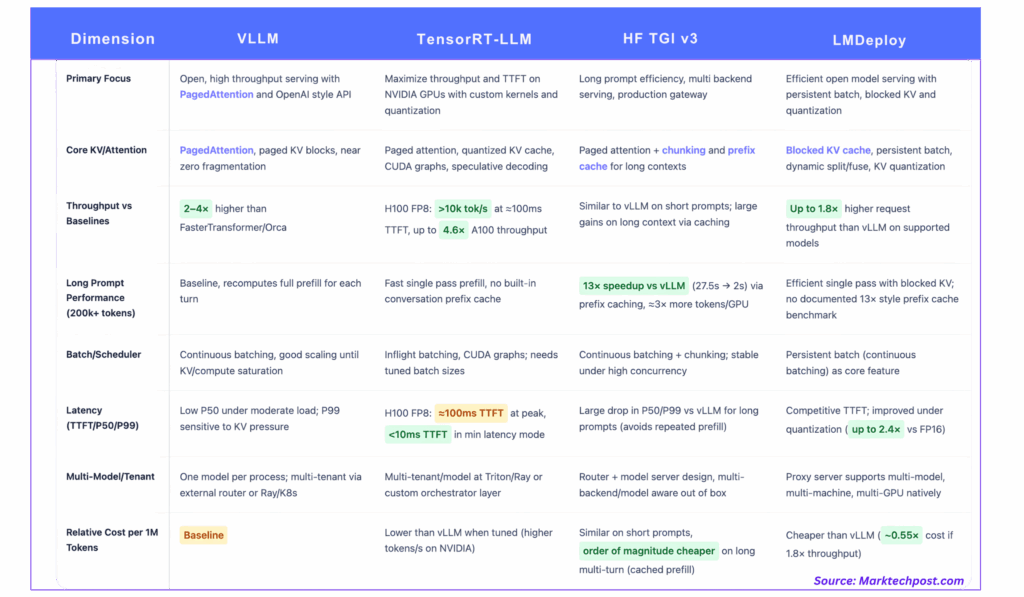
vLLM vs TensorRT-LLM vs HF TGI vs LMDeploy, A Deep Technical Comparison for Production LLM Inference

Production LLM serving is now a systems problem, not a generate() loop. For real workloads, the choice of inference stack drives your tokens per second, tail latency, and ultimately cost per million tokens on a given GPU fleet. This comparison focuses on 4 widely used stacks: vLLM NVIDIA TensorRT-LLM Hugging Face Text Generation Inference (TGI v3) LMDeploy 1. vLLM, PagedAttention as the open baseline Core idea vLLM is built around PagedAttention, an attention implementation that treats the KV cache like paged virtual memory rather than a single contiguous buffer per sequence. Instead of allocating one big KV region per request, vLLM: Divides KV cache into fixed size blocks Maintains a block table that maps logical tokens to physical blocks Shares blocks between sequences wherever prefixes overlap This reduces external fragmentation and lets the scheduler pack many more concurrent sequences into the same VRAM. Throughput and latency vLLM improves throughput by 2–4× over systems like FasterTransformer and Orca at similar latency, with larger gains for longer sequences. Key properties for operators: Continuous batching (also called inflight batching) merges incoming requests into existing GPU batches instead of waiting for fixed batch windows. On typical chat workloads, throughput scales close to linearly with concurrency until KV memory or compute saturates. P50 latency remains low for moderate concurrency, but P99 can degrade once queues are long or KV memory is tight, especially for prefill heavy queries. vLLM exposes an OpenAI compatible HTTP API and integrates well with Ray Serve and other orchestrators, which is why it is widely used as an open baseline. KV and multi tenant PagedAttention gives near zero KV waste and flexible prefix sharing within and across requests. Each vLLM process serves one model, multi tenant and multi model setups are usually built with an external router or API gateway that fans out to multiple vLLM instances. 2. TensorRT-LLM, hardware maximum on NVIDIA GPUs Core idea TensorRT-LLM is NVIDIA’s optimized inference library for their GPUs. The library provides custom attention kernels, inflight batching, paged KV caching, quantization down to FP4 and INT4, and speculative decoding. It is tightly coupled to NVIDIA hardware, including FP8 tensor cores on Hopper and Blackwell. Measured performance NVIDIA’s H100 vs A100 evaluation is the most concrete public reference: On H100 with FP8, TensorRT-LLM reaches over 10,000 output tokens/s at peak throughput for 64 concurrent requests, with ~100 ms time to first token. H100 FP8 achieves up to 4.6× higher max throughput and 4.4× faster first token latency than A100 on the same models. For latency sensitive modes: TensorRT-LLM on H100 can drive TTFT below 10 ms in batch 1 configurations, at the cost of lower overall throughput. These numbers are model and shape specific, but they give a realistic scale. Prefill vs decode TensorRT-LLM optimizes both phases: Prefill benefits from high throughput FP8 attention kernels and tensor parallelism Decode benefits from CUDA graphs, speculative decoding, quantized weights and KV, and kernel fusion The result is very high tokens/s across a wide range of input and output lengths, especially when the engine is tuned for that model and batch profile. KV and multi tenant TensorRT-LLM provides: Paged KV cache with configurable layout Support for long sequences, KV reuse and offloading Inflight batching and priority aware scheduling primitives NVIDIA pairs this with Ray based or Triton based orchestration patterns for multi tenant clusters. Multi model support is done at the orchestrator level, not inside a single TensorRT-LLM engine instance. 3. Hugging Face TGI v3, long prompt specialist and multi backend gateway Core idea Text Generation Inference (TGI) is a Rust and Python based serving stack that adds: HTTP and gRPC APIs Continuous batching scheduler Observability and autoscaling hooks Pluggable backends, including vLLM style engines, TensorRT-LLM, and other runtimes Version 3 focuses on long prompt processing through chunking and prefix caching. Long prompt benchmark vs vLLM The TGI v3 docs give a clear benchmark: On long prompts with more than 200,000 tokens, a conversation reply that takes 27.5 s in vLLM can be served in about 2 s in TGI v3. This is reported as a 13× speedup on that workload. TGI v3 is able to process about 3× more tokens in the same GPU memory by reducing its memory footprint and exploiting chunking and caching. The mechanism is: TGI keeps the original conversation context in a prefix cache, so subsequent turns only pay for incremental tokens Cache lookup overhead is on the order of microseconds, negligible relative to prefill compute This is a targeted optimization for workloads where prompts are extremely long and reused across turns, for example RAG pipelines and analytic summarization. Architecture and latency behavior Key components: Chunking, very long prompts are split into manageable segments for KV and scheduling Prefix caching, data structure to share long context across turns Continuous batching, incoming requests join batches of already running sequences PagedAttention and fused kernels in the GPU backends For short chat style workloads, throughput and latency are in the same ballpark as vLLM. For long, cacheable contexts, both P50 and P99 latency improve by an order of magnitude because the engine avoids repeated prefill. Multi backend and multi model TGI is designed as a router plus model server architecture. It can: Route requests across many models and replicas Target different backends, for example TensorRT-LLM on H100 plus CPU or smaller GPUs for low priority traffic This makes it suitable as a central serving tier in multi tenant environments. 4. LMDeploy, TurboMind with blocked KV and aggressive quantization Core idea LMDeploy from the InternLM ecosystem is a toolkit for compressing and serving LLMs, centered around the TurboMind engine. It focuses on: High throughput request serving Blocked KV cache Persistent batching (continuous batching) Quantization of weights and KV cache Relative throughput vs vLLM The project states: ‘LMDeploy delivers up to 1.8× higher request throughput than vLLM‘, with the support from persistent batch, blocked KV, dynamic split and fuse, tensor parallelism and optimized CUDA kernels. KV, quantization and latency LMDeploy includes: Blocked KV cache, similar to paged KV,

vLLM vs TensorRT-LLM vs HF TGI vs LMDeploy, A Deep Technical Comparison for Production LLM Inference Leggi l'articolo »

AI, Committee, Notizie, Uncategorized

SpecEdge: Scalable Edge-Assisted Serving Framework for Interactive LLMs

arXiv:2505.17052v2 Announce Type: replace Abstract: Large language models (LLMs) power many modern applications, but serving them at scale remains costly and resource-intensive. Current server-centric systems overlook consumer-grade GPUs at the edge. We introduce SpecEdge, an edge-assisted inference framework that splits LLM workloads between edge and server GPUs using a speculative decoding scheme, exchanging only token outputs over the network. SpecEdge employs proactive edge drafting to overlap edge token creation with server verification and pipeline-aware scheduling that interleaves multiple user requests to increase server-side throughput. Experiments show SpecEdge enhances overall cost efficiency by 1.91x through achieving 2.22x server throughput, and reduces inter token latency by 11.24% compared to a server-only baseline, introducing a scalable, cost-effective paradigm for LLM serving. The code is available at https://github.com/kaist-ina/specedge

SpecEdge: Scalable Edge-Assisted Serving Framework for Interactive LLMs Leggi l'articolo »

We use cookies to improve your experience and performance on our website. You can learn more at Politica sulla privacy and manage your privacy settings by clicking Settings.

Privacy Preferences

You can choose your cookie settings by turning on/off each type of cookie as you wish, except for essential cookies.

Allow All
Manage Consent Preferences
  • Always Active

Save
it_IT