YouZum

AI

AI, Committee, Notizie, Uncategorized

The Download: NASA’s new space telescope and OpenAI’s autonomous hacker

This is today’s edition of The Download, our weekday newsletter that provides a daily dose of what’s going on in the world of technology. Shape-shifting mirrors on NASA’s new space telescope could unveil Jupiters like our own When NASA’s Nancy Grace Roman Space Telescope launches, as early as the end of next month, it will attempt one of astronomy’s most precise disappearing acts to date. It will carry the first space-bound “active” coronagraph, an instrument that effectively erases most of the light from a star during photography. The technology will allow astronomers to take the first pictures of planets orbiting other stars that are similar to those in our solar system. Ultimately, it could pave the way for a future mission that could snap the first photos of Earth-like worlds. “I hope it’s remembered for it being that critical stepping stone for … finding Earth 2.0,” says Brandon Creager, the instrument’s lead mechanical engineer. Read the full story on the space telescope that could transform the search for distant planets. —Eshan Raul MIT Technology Review Narrated: PsiQuantum has a plan to make a massive quantum computer out of light The machine that could change the world will be housed in a room that looks like a data center crossed with an ice cream factory.  Inside, some 100 stainless-steel cabinets each hold hundreds of chips. On those chips, thousands of light particles will fly through a maze of optical switches and beam splitters. Each photon must be accounted for, because precisely measuring where it ends up will help answer questions that current computers might take millions of years to solve. This computer, as described, does not exist. It’s the brainchild of a company called PsiQuantum, founded in 2016 by four physicists from UK universities. In a crowded field of deep-pocketed competitors with similarly fantastical visions, the company aims to be the first to build a useful quantum machine. —James O’Donnell This is our latest story to be turned into an MIT Technology Review Narrated podcast, which we publish each week on Spotifyand Apple Podcasts. Just navigate to MIT Technology Review Narrated on either platform, and follow us to get all our new content as it’s released. The must-reads I’ve combed the internet to find you today’s most fun/important/scary/fascinating stories about technology. 1 OpenAI says one of its models carried out an autonomous hackIt escaped its testing sandbox and breached AI research platform Hugging Face. (Reuters $)+ OpenAI described it as a cybersecurity test that went badly wrong. (WSJ $)+ The hack is among the first known cyberattacks by an AI acting on its own. (FT $)+ Even simple AI attacks are cause for alarm, though. (MIT Technology Review) 2 France has become the first EU country to ban social media for under-15sIts parliament approved the ban, which President Macron championed. (NYT $)+ He pledged to enforce it by September, the start of the school year. (Guardian)+ But critics say it’s unconstitutional and impossible to enforce. (NPR) 3 The US and China will hold talks over AI in SeptemberTreasury Secretary Scott Bessent will lead the US side. (Reuters $)+ Chinese models have Trump’s AI world at war with itself. (MIT Technology Review) 4 Publishers are considering cutting Google off as AI reshapes searchNews outlets are weighing lost traffic against AI exposure. (WSJ $) 5 Samsung is in talks to invest €1 billion in MistralThe French AI firm is positioning itself as an alternative to US models. (FT $)+ It’s Europe’s leading AI firm, but US peers dwarf its $20 billion valuation. (Reuters $) 6 Amazon pushed up rivals’ prices, leaked records allegeInternal emails reveal tactics that allegedly reshaped online pricing. (Guardian) 7 Trump has tapped a Big Tech critic to lead the DOJ’s antitrust divisionAdam Candeub has called for tougher federal competition enforcement. (FT $) 8 New drilling methods could unlock geothermal energy almost anywhereThey aim to unlock Earth’s enormous heat reserves. (New Scientist $)+ AI is uncovering hidden geothermal energy resources. (MIT Technology Review) 9 AI researchers have proposed a “Genie coefficient” for measuring AI risksIt would track the gap between intent and action. (IEEE Spectrum)+ We need better ways to evaluate AI. (MIT Technology Review) 10 Japan’s AI boom has two unlikely winners: a toilet maker and an MSG giantThey’re supplying critical chipmaking materials. (CNBC) Quote of the day “He’s an analog man in a digital AI world, and I think that’s incredibly appealing.” —Paul Dergarabedian, a movie industry analyst at Comscore, tells Fortune that Christopher Nolan’s commitment to human filmmaking provides an attractive counterweight to Hollywood’s embrace of AI. One More Thing DANA SMITH Taiwan’s “silicon shield” could be weakening Taiwan produces the majority of the world’s semiconductors and more than 90% of the most advanced chips needed for AI applications. Many believe that’s helped deter China from invading the island. But now some Taiwan specialists and citizens are worried that this “silicon shield” is cracking. Facing pressure from Washington, TSMC—the world’s largest chipmaker—is expanding manufacturing abroad. In Taiwan, there are worries that this will dilute the company’s power at home, making the US and other countries less inclined to defend the island. Find out why Taiwan’s chipmaking dominance could be key to its future security. —Johanna M. Costigan We can still have nice things A place for comfort, fun, and distraction to brighten up your day. (Got any ideas? Drop me a line.) + Thrifty filmmakers have masterfully recreated Star Wars on a $10 budget.+ A man discovered squirrels hug and kiss their loved ones in the privacy of their homes.+ Toronto’s floating waterfront store is reimagining one of the most familiar spaces across cultures.+ These animations of Sesame Street characters performing classic tracks like Underworld’s “Born Slippy” will brighten up your day.

The Download: NASA’s new space telescope and OpenAI’s autonomous hacker Leggi l'articolo »
AI, Committee, Notizie, Uncategorized

Advancing next-gen AI with materials science innovation

The conversation about AI often centers on algorithms, computing power, or huge investments in new semiconductor fabrication plants and hyperscale data centers. But beneath each of these advances is another layer of innovation that makes them possible: advanced materials. Every new generation of AI technology demands more processing power, more memory, greater energy efficiency, and higher reliability. Every increase in computing performance increases the physical demands placed on the systems that make and run AI. Delivering these gains depends not only on advances in chip design and system architecture, but on advances in the materials that enable them to perform under extreme conditions. As AI continues to push the physical limits of semiconductors and data center infrastructure, advanced materials are no longer simply supporting innovation in this area; they are defining the limits of what is possible. Performance first Advanced materials exist to solve performance challenges. As AI raises the bar, these challenges are becoming more demanding. Manufacturing a semiconductor chip today requires thousands of tightly controlled process steps, with almost no room for error. Tiny variations in temperature or chemical instability can create defects that reduce yield and drive up manufacturing costs. With every new generation of semiconductor chips, manufacturers seek advanced materials that can deliver greater purity, higher chemical and plasma resistance, and better stability under increasingly harsh operating conditions. These are familiar engineering challenges being pushed to new extremes. And it’s here that materials innovation makes the difference with continuous advances in polymers, elastomers, specialty fluids, and other advanced materials that make each new generation of technology possible. For materials companies, it’s not about reinventing semiconductor manufacturing but about ensuring the materials supporting the industry continue to evolve alongside it. This same principle applies beyond the semiconductor fabrication floor. As AI workloads become more demanding, the physical infrastructure that powers them is evolving rapidly. Increasing computing density is transforming data center design, driving the need for more sophisticated thermal management, higher-voltage power architectures, increased data storage, and faster, more reliable data transmission. Every part of the system is under greater pressure, from cooling and power management to critical electronic components, such as connectors, capacitors, and hard disk drives. At Syensqo, we’re building on our expertise in electronic and electrical components, along with insights from other markets, to meet these emerging needs. For example, as data centers shift to higher-voltage architectures and greater power density, many of the materials challenges we face closely mirror those of electric vehicles. Fluid-circulation know-how from semiconductor and automotive coolant systems, for instance, can be adapted to direct liquid-cooling designs for AI servers. By transferring knowledge across markets, we can accelerate new power and thermal management solutions while supporting the reliability required by next-generation AI infrastructure. Whether we’re talking about semiconductor fabrication or hyperscale server farms, the challenge for materials science companies is the same: enabling greater performance without compromising reliability. A new definition of what performance means While performance remains the first priority, the way performance is defined is changing. In addition to meeting the increasingly demanding technical requirements of next-generation semiconductors and data centers, there is now an expectation that these materials are developed and manufactured more responsibly. Perfluoroelastomers, for example, are used to seal semiconductor manufacturing equipment. These materials operate under extreme temperatures, aggressive plasma, and highly reactive chemicals. To make the process more sustainable, at Syensqo, our next generation of perfluoroelastomers use a fluorosurfactant-free manufacturing process. Our goal was to make a better-performing material, produced in a better way, ensuring manufacturers no longer have to choose between higher performance and a more responsible way of producing the materials that enable it. This approach reflects a broader reality across the industry. New materials aren’t adopted simply because they are new. Qualification can take years, and manufacturers only make changes when a material solves a genuine engineering challenge or enables new technology. Performance remains the price of entry. The difference today is that the definition of performance has expanded. Success increasingly depends on delivering technical excellence through more responsible manufacturing from the outset. Accelerating the pace of discovery As the performance bar rises, the way we innovate must evolve with it. Developing advanced materials has traditionally involved a lengthy process of hypothesis, synthesis, testing, and iteration. While this process remains unchanged, new digital tools are helping researchers move through these cycles faster. By helping researchers identify the most promising candidates earlier, AI can reduce the number of physical experiments required and accelerate the earliest stages of materials discovery. AI isn’t replacing scientific expertise. It’s helping scientists apply that expertise more effectively, allowing them to spend less time searching for answers and more time solving the industry’s toughest challenges. At Syensqo, we’re putting this approach into practice through use of several AI tools, including the Microsoft Discovery platform, which are helping researchers identify and evaluate promising molecular candidates for next-generation heat transfer fluids, used in semiconductor manufacturing and data centers. AI helps our researchers rapidly identify and evaluate promising molecular candidates based on the properties they need to achieve. This allows us to focus laboratory work where it has the greatest potential to deliver results, accelerating discovery and reducing the time needed to turn promising materials into solutions customers can qualify and deploy. The journey from laboratory discovery to a qualified material will always require scientific expertise, rigorous testing, and close collaboration with customers. But by accelerating the earliest stages of discovery, AI can help materials innovation keep pace with the evolving needs of industries such as semiconductors, electronics, and data centers. Progress is earned The future of artificial intelligence will depend on better algorithms, more powerful chips, and larger computing infrastructure. But sustaining that progress will also require advances in the materials that make those technologies possible. Whether in semiconductor manufacturing or AI infrastructure, progress is earned. Every new generation of technologies raises the bar, and every new material must prove it can deliver the performance, reliability, and efficiency needed before it earns its place. For materials companies, that remains

Advancing next-gen AI with materials science innovation Leggi l'articolo »

AI, Committee, Notizie, Uncategorized

The Download: Chinese AI divides the White House, and a record copyright payout

This is today’s edition of The Download, our weekday newsletter that provides a daily dose of what’s going on in the world of technology. China’s AI models have Trump’s AI world at war with itself Last weekend, several current and former advisers to President Donald Trump on AI publicly lobbed insults at the country’s leading AI companies. David Sacks branded Anthropic’s models “lobotomized” and “woke.” Emil Michael, a top Pentagon official, called OpenAI’s new head of strategic futures a “supreme village idiot.” It began because no one can agree on what to do about Kimi, a free, open-source model that Chinese AI company Moonshot launched last week. It appears to rival the intelligence of models from OpenAI and Anthropic, which are very much not free.  Every time a new smart, free model from China gets released, US companies see less reason to fork out money for models from Anthropic or OpenAI. That’s creating economic and political problems for the president—and dividing the top AI strategists in his orbit.  Read the full story on why no one can agree what to do about Kimi. —James O’Donnell This article is from The Algorithm, our weekly AI newsletter. Sign up to receive it in your inbox every Monday. The must-reads I’ve combed the internet to find you today’s most fun/important/scary/fascinating stories about technology. 1 Anthropic’s record $1.5 billion copyright settlement has been approvedThe plaintiffs said Anthropic used pirated works to train Claude. (Reuters $)+ And won the largest known copyright payout in history. (Engadget)+ Yet many authors and creators still don’t view it as a win. (TechCrunch)+ But AI copyright anxiety could limit creativity. (MIT Technology Review) 2 The Trump administration is weighing a ban on Chinese AI modelsThe launch of Kimi K3 has revived calls for restrictions. (Axios)+ But officials are divided on the proposals. (Fast Company)+ China’s bet on open-source is paying off. (MIT Technology Review) 3 China is mulling tighter export controls on AI models and chipsIt wants to stop the West from acquiring its tech and startups. (FT $)+ Beijing has held talks with tech firms about potential restrictions. (Reuters $) 4 Trump’s AI safety head has resigned after just three monthsChris Fall had led CAISI, the federal AI Safety Institute, since April. (Axios)+ No reason was given for his exit. (CNBC) 5 Google is working on a new chip to run Gemini models more efficiently The chip, called “Frozen V2,” may be deployed in 2028. (Information $)+ Alphabet stock popped on the report. (CNBC) 6 New Orleans police have explored arming drones with weaponsA draft drone manual paves the way for weaponised quadcopters. (404 Media)+ Shoplifters could soon be chased by drones. (MIT Technology Review) 7 The EU has handed AliExpress a record fine over unsafe product salesThe €550 million fine is the largest-ever under the Digital Services Act. (BBC)+ Alibaba has vowed to appeal the fine. (SCMP) 8 Election advice from AI chatbots is “inaccurate and unreliable”That’s the conclusion from tests in Hungary earlier this year. (Guardian) 9 Red light therapy is showing promise for healing and healthy agingBetter skin and reduced vision loss are also on the cards. (Economist $) 10 Neill Blomkamp’s new horror clip is all AI-generated—and it sucksThe acclaimed director wants to make “a full feature in this format.” (Gizmodo) Quote of the day “This would be a terribly self-defeating form of intervention if it were to happen.”  —Tech investor Chamath Palihapitiya slams plans to restrict Chinese AI models in a post on X. One More Thing AKILAH TOWNSEND Inside Chicago’s surveillance panopticon Early on the morning of September 2, 2024, four people were shot and killed on a westbound train in Chicago. Police swiftly activated a digital dragnet—a surveillance network that connects thousands of cameras across the city—and arrested the suspect just 90 minutes later. Law enforcement and security advocates say this vast monitoring system protects public safety and works well. But activists and many residents say it’s a surveillance panopticon that creates a chilling effect on behavior and violates guarantees of privacy and free speech. Go inside the surveillance network that’s dividing Chicago. —Rod McCullom We can still have nice things A place for comfort, fun, and distraction to brighten up your day. (Got any ideas? Drop me a line.) + NASA has shared a stunning timelapse video of the Psyche spacecraft’s view of Mars.+ This comparison of American and European Urbanism shows good city design is a choice.+ Musician Luca Stricagnoli recently performed a marvellous acoustic guitar medley of Prodigy songs.+ Two Australian paddleboarders saved a stranded wallaby after it was swept out to sea—and caught the whole rescue on video.

The Download: Chinese AI divides the White House, and a record copyright payout Leggi l'articolo »

AI, Committee, Notizie, Uncategorized

Validating Distributed LLM Serving Benchmarks with NVIDIA srt-slurm, SLURM Recipes, Parameter Sweeps, and Pareto Analysis

In this tutorial, we explore NVIDIA’s srt-slurm framework and learn how we use srtctl to convert declarative YAML configurations into reproducible SLURM benchmark workflows for distributed LLM serving. We set up the project in Google Colab, inspect its internal architecture, define a cluster configuration, dry-run built-in and custom recipes, and model a disaggregated prefill-and-decode deployment for DeepSeek-R1. We also generate parameter sweeps, interact with the typed Python API, validate expanded configurations, and analyze simulated benchmark results through a throughput-versus-latency Pareto frontier. Although Colab does not provide a real SLURM environment, we use it as a practical development workspace to understand, validate, and prepare production-grade benchmark recipes before we submit them to an actual GPU cluster. Copy CodeCopiedUse a different Browser import os, sys, subprocess, textwrap, json, shutil, importlib from pathlib import Path def run(cmd, check=True, quiet=False): “””Run a shell command, stream output.””” print(f”n$ {cmd}”) r = subprocess.run(cmd, shell=True, text=True, capture_output=True) out = (r.stdout or “”) + (r.stderr or “”) if not quiet: print(out[-6000:]) if check and r.returncode != 0: raise RuntimeError(f”Command failed ({r.returncode}): {cmd}”) return out def section(title): print(“n” + “═”*78 + f”n {title}n” + “═”*78) section(“1. Install srt-slurm”) REPO = Path(“/content/srt-slurm”) if Path(“/content”).exists() else Path.cwd()/”srt-slurm” if not REPO.exists(): run(f”git clone –depth 1 https://github.com/NVIDIA/srt-slurm.git {REPO}”, quiet=True) run(f”{sys.executable} -m pip install -q -e {REPO}”, quiet=True) sys.path.insert(0, str(REPO / “src”)) importlib.invalidate_caches() os.chdir(REPO) run(“srtctl –help”) We prepare the Colab environment by importing the required modules and defining reusable helper functions for command execution and section formatting. We clone the NVIDIA srt-slurm repository, install it in editable mode, and expose its source directory to the active Python runtime. We then switch to the repository directory and verify that the srtctl command-line interface is installed correctly. Copy CodeCopiedUse a different Browser section(“2. Repository architecture”) print(textwrap.dedent(“”” src/srtctl/ cli/ submit.py (apply/dry-run/preflight/monitor), do_sweep, interactive core/ schema.py (typed config), sweep.py, slurm.py (sbatch gen), validation.py, health.py, topology.py, fingerprint.py backends/ sglang.py, trtllm.py, vllm.py, mocker.py ← engine adapters frontends/ Dynamo / router frontends templates/ Jinja2 → sbatch + orchestrator scripts recipes/ ready-made benchmarks per platform (gb200-fp4, h100, b200-fp8, qwen3-32b, dsv4-pro, mocker smoke tests, …) analysis/ srtlog (log parsers) + Streamlit dashboard (Pareto, latency…) docs/ sweeps.md, profiling.md, analyzing.md, config-reference.md “””)) for d in [“recipes”, “docs”]: print(f”{d}/ →”, “, “.join(sorted(p.name for p in (REPO/d).iterdir()))[:300]) section(“3. Cluster configuration (srtslurm.yaml)”) (REPO/”srtslurm.yaml”).write_text(textwrap.dedent(“”” cluster: “colab-demo” default_account: “demo-account” default_partition: “gpu” default_time_limit: “01:00:00” gpus_per_node: 4 use_gpus_per_node_directive: true use_segment_sbatch_directive: true containers: dynamo-sglang: “/containers/dynamo-sglang.sqsh” lmsysorg+sglang+v0.5.5.post2.sqsh: “/containers/sglang-v0.5.5.sqsh” model_paths: deepseek-r1: “/models/DeepSeek-R1” “””)) print((REPO/”srtslurm.yaml”).read_text()) We inspect the repository structure to understand how srtctl organizes its command-line tools, schemas, backends, templates, recipes, and analysis components. We then create a local srtslurm.yaml file containing simulated cluster defaults, container aliases, GPU settings, and model paths. We use this configuration to resolve recipe references in Colab without requiring access to an actual SLURM cluster. Copy CodeCopiedUse a different Browser section(“4. Dry-run: mocker smoke test → generated sbatch script”) run(“srtctl dry-run -f recipes/mocker/agg.yaml”, check=False) section(“5. Custom disaggregated recipe (prefill/decode split)”) (REPO/”my-disagg.yaml”).write_text(textwrap.dedent(“”” name: “colab-disagg-demo” model: path: “deepseek-r1” container: “lmsysorg+sglang+v0.5.5.post2.sqsh” precision: “fp8” resources: gpu_type: “gb200” gpus_per_node: 4 prefill_nodes: 1 decode_nodes: 2 prefill_workers: 1 decode_workers: 2 backend: prefill_environment: { PYTHONUNBUFFERED: “1” } decode_environment: { PYTHONUNBUFFERED: “1” } sglang_config: prefill: served-model-name: “deepseek-ai/DeepSeek-R1” model-path: “/model/” trust-remote-code: true kv-cache-dtype: “fp8_e4m3” tensor-parallel-size: 4 disaggregation-mode: “prefill” decode: served-model-name: “deepseek-ai/DeepSeek-R1” model-path: “/model/” trust-remote-code: true kv-cache-dtype: “fp8_e4m3” tensor-parallel-size: 4 disaggregation-mode: “decode” benchmark: type: “sa-bench” isl: 1024 osl: 1024 concurrencies: [64, 128, 256] req_rate: “inf” “””)) run(“srtctl dry-run -f my-disagg.yaml”, check=False) We dry-run the built-in mocker recipe to examine how srtctl validates configurations and generates SLURM submission artifacts without executing a real benchmark. We then define an advanced DeepSeek-R1 recipe that separates prefill and decode workloads across independent node and worker pools. We validate this disaggregated SGLang configuration through another dry run and inspect how the serving parameters are translated into job scripts. Copy CodeCopiedUse a different Browser section(“6. Parameter sweep (grid search) — dry-run + expansion on disk”) run(“srtctl dry-run -f examples/example-sweep.yaml”, check=False) sweep_dirs = sorted((REPO/”dry-runs”).glob(“example-sweep_sweep_*”)) if sweep_dirs: latest = sweep_dirs[-1] print(“Per-job configs generated by the sweep expander:”) for p in sorted(latest.rglob(“config.yaml”)): print(” “, p.relative_to(REPO)) section(“7. Programmatic use of srtctl’s Python API”) import yaml from srtctl.core.config import load_config from srtctl.core.sweep import generate_sweep_configs, expand_template from srtctl.core.schema import BenchmarkType, Precision, GpuType cfg = load_config(“my-disagg.yaml”) print(f”Loaded : {cfg.name}”) print(f”Model : {cfg.model.path} ({cfg.model.precision}) on {cfg.resources.gpu_type}”) print(f”Layout : {cfg.resources.prefill_nodes}P + {cfg.resources.decode_nodes}D nodes, ” f”{cfg.resources.gpus_per_node} GPUs/node”) print(f”Bench : {cfg.benchmark.type} isl={cfg.benchmark.isl} osl={cfg.benchmark.osl} ” f”concurrencies={cfg.benchmark.concurrencies}”) print(f”Enums : benchmarks={[b.value for b in BenchmarkType]}”) print(f” precisions={[p.value for p in Precision]}, gpus={[g.value for g in GpuType]}”) raw_sweep = yaml.safe_load(Path(“examples/example-sweep.yaml”).read_text()) jobs = generate_sweep_configs(raw_sweep) print(f”nSweep expands to {len(jobs)} jobs:”) for job_cfg, params in jobs: pf = job_cfg[“backend”][“sglang_config”][“prefill”] print(f” {params} → chunked-prefill-size={pf[‘chunked-prefill-size’]}, ” f”max-total-tokens={pf[‘max-total-tokens’]}”) print(“nTemplate substitution:”, expand_template({“flag”: “{x}”, “n”: “{y}”}, {“x”: 4096, “y”: 2})) We execute the example parameter sweep and inspect the individual job configurations created from its Cartesian search space. We load our custom recipe through the typed Python API and examine its model, precision, GPU topology, benchmark settings, and supported enumeration values. We also programmatically expand sweep templates and verify how each parameter combination affects the generated backend configuration. Copy CodeCopiedUse a different Browser section(“8. Analysis: Pareto frontier from (simulated) benchmark results”) import numpy as np, matplotlib.pyplot as plt rng = np.random.default_rng(0) def simulate(variant, base_tps, base_itl): rows = [] tps_gpu = base_tps * c / (c + 90) * rng.uniform(.97, 1.03) itl = base_itl * (1 + c/220) * rng.uniform(.97, 1.03) rows.append({“variant”: variant, “concurrency”: c, “tok_s_gpu”: tps_gpu, “itl_ms”: itl}) return rows results = simulate(“chunked=4096”, 260, 9.5) + simulate(“chunked=8192”, 300, 11.5) print(json.dumps(results[:3], indent=2), “…”) plt.figure(figsize=(8, 5)) for variant in (“chunked=4096”, “chunked=8192”): pts = [(r[“itl_ms”], r[“tok_s_gpu”], r[“concurrency”]) for r in results if r[“variant”] == variant] xs, ys, cs = zip(*pts) plt.plot(xs, ys, “o-“, label=variant) for x, y, c in pts: plt.annotate(str(c), (x, y), fontsize=7, xytext=(3, 3), textcoords=”offset points”) plt.xlabel(“Inter-token latency (ms/token) → worse”) plt.ylabel(“Throughput (tokens/s/GPU) → better”) plt.title(“Pareto frontier: sweep variants (points labeled by concurrency)”) plt.legend(); plt.grid(alpha=.3); plt.tight_layout(); plt.show() We simulate benchmark observations for two chunked-prefill variants across increasing concurrency levels. We calculate representative throughput per GPU and inter-token latency values to model the saturation and latency growth commonly observed in distributed

Validating Distributed LLM Serving Benchmarks with NVIDIA srt-slurm, SLURM Recipes, Parameter Sweeps, and Pareto Analysis Leggi l'articolo »

AI, Committee, Notizie, Uncategorized

Google Releases Gemini 3.6 Flash, 3.5 Flash-Lite, and 3.5 Flash Cyber: A Cheaper, More Token-Efficient Flash Tier Built for Agentic Workloads

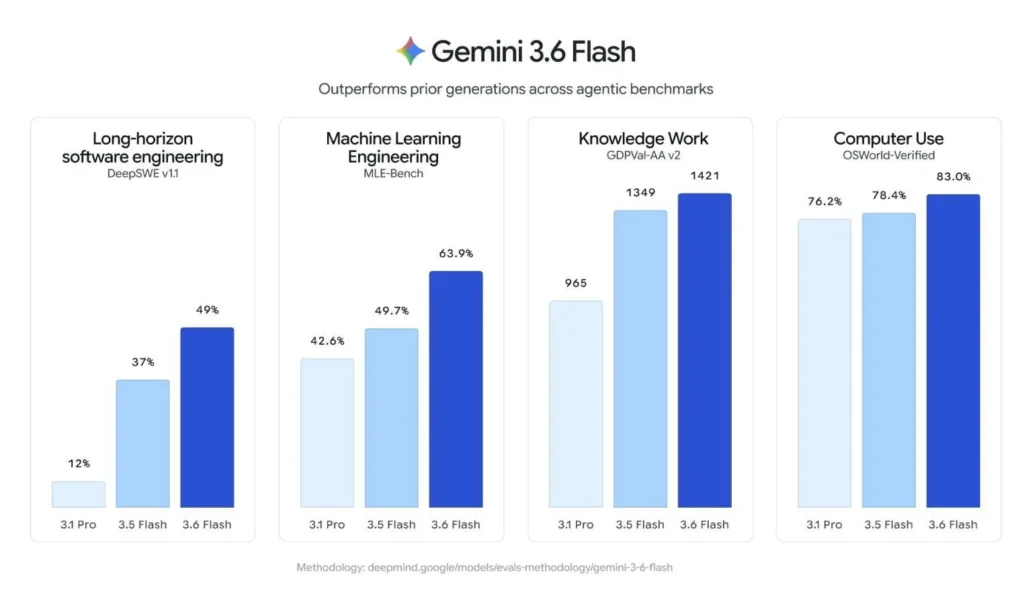
Developers building production agents need higher token efficiency, lower latency, and more reliable performance. Today, Google has released three new Gemini models. The lineup is Gemini 3.6 Flash, Gemini 3.5 Flash-Lite, and Gemini 3.5 Flash Cyber. All three sit in the Flash tier, which Google tunes for speed, cost, and high-volume agentic work rather than maximum reasoning depth. Gemini 3.6 Flash: better quality, fewer tokens, lower price Gemini 3.6 Flash is the new default workhorse. It builds on 3.5 Flash and targets coding, knowledge work, and multimodal tasks. The main point is efficiency. On the Artificial Analysis Index, 3.6 Flash uses 17% fewer output tokens than 3.5 Flash. On the DeepSWE benchmark by Datacurve, Google reports up to a 65% reduction. The model also takes fewer reasoning steps and tool calls per multi-step workflow. Pricing moves down alongside efficiency. Gemini 3.6 Flash is priced at $1.50 per 1M input tokens and $7.50 per 1M output tokens. The output rate drops from the previous $9.00 on 3.5 Flash. Lower verbosity and a lower output price reduces the total cost per agentic task. Quality gains accompany the efficiency gains. On DeepSWE, 3.6 Flash scores 49% versus 37% for 3.5 Flash. On MLE Bench, it reaches 63.9% versus 49.7%. On OSWorld-Verified, it hits 83.0% versus 78.4%. On GDPval-AA v2, a knowledge-work benchmark, it scores 1421 versus 1349. Computer use is now a built-in client-side tool through the Gemini API and Gemini Enterprise. Early customers including Hebbia and Harvey cite gains in document parsing, chart and data analysis, and report drafting. Google is shipping 3.6 Flash with enhanced Frontier Safety safeguards. These cover Chemical, Biological, Radiological, and Nuclear (CBRN) and cyber-offense misuse. Full details are in the 3.6 Flash model card. The interactive explainer below lets you compare each model against its predecessor and estimate token cost at your own volume. Gemini 3.5 Flash-Lite: the fastest model in the 3.5 line Gemini 3.5 Flash-Lite is highlighted for low-latency and high-throughput jobs. Target use cases include agentic search and document processing. As measured by Artificial Analysis, it runs at 350 output tokens per second. Pricing is $0.30 per 1M input tokens and $2.50 per 1M output tokens. The model clears the prior 3.1 Flash-Lite by wide margins. On Terminal-Bench 2.1, it scores 54% versus 31%. On GDM-MRCR v2, a long-context benchmark, it reaches 72.2% versus 60.1%. On GDPval-AA v2, it scores 1140 versus 642. Notably, Flash-Lite also beats the older 3 Flash on some evals. It leads on SWE-Bench Pro at 54.2% versus 49.6% and on OSWorld-Verified at 74.0% versus 65.1%. Flash-Lite exposes configurable thinking levels: minimal, low, and higher. Developers can prioritize low-cost, low-latency execution for high-volume tasks. They can also engage higher thinking levels for multi-step subagent workloads. Computer use is a built-in tool here too. Gemini 3.5 Flash Cyber in CodeMender: cheap agents that find and patch bugs Gemini 3.5 Flash Cyber is the most specialized release. It is built on 3.5 Flash and fine-tuned to find, validate, and patch software vulnerabilities. The design premise is the search-space problem. Finding deep flaws means exploring an immense execution search space. A single call to one massive model becomes a bottleneck. The answer is a cheap model called many times. Inside CodeMender, Google’s code-security agent, multiple 3.5 Flash Cyber agents run in parallel. CodeMender invokes the model up to five times, then merges the sub-agent findings into one report. On the CyberGym benchmark, this setup reaches competitive performance against much larger models. The internal evaluations are striking. On Google’s Big Sleep evaluation, Flash Cyber significantly surpassed mainline 3.5 Flash and 3.6 Flash. On the V8 JavaScript engine, it found 55 unique confirmed issues at a fixed number of invocations. That compares to 47 for mainline 3.5 Flash and 36 for Claude Opus 4.6. It caught 10 issues the other two models missed. In one real-world test, Google’s Cloud Vulnerability Research team used it to find remote-code-execution flaws in public APIs within two hours. https://blog.google/innovation-and-ai/models-and-research/gemini-models/gemini-3-6-flash-3-5-flash-lite-3-5-flash-cyber/ Community Reaction Reaction split along predictable lines. Builders welcomed the price and efficiency. The delayed flagship drew the loudest criticism. On Hacker News, some argued Google is over-selling capacity it cannot reliably provision, citing frustrating hands-on coding sessions. The gated Flash Cyber release opened a dual-use debate about who should hold automated exploit-finding tools. The dashboard below aggregates that discussion by platform. It is a qualitative editorial synthesis, not a scraped dataset, and the method note is embedded. Availability Gemini 3.6 Flash and 3.5 Flash-Lite are available starting today. Developers can access them through the Gemini API via Google AI Studio and Android Studio. Gemini 3.6 Flash is also in Google Antigravity and rolling out in GitHub Copilot. Enterprises get both models in the Gemini Enterprise Agent Platform, with 3.6 Flash in the Gemini Enterprise app. Everyone can use them via the Gemini app, and 3.5 Flash-Lite is rolling out in Google Search. Start with the Developer Guide. Key Takeaways Gemini 3.6 Flash cuts output tokens by 17% (up to 65% on DeepSWE) and drops the output price from $9.00 to $7.50 per 1M. Gemini 3.5 Flash-Lite runs at 350 tokens/sec for $0.30/$2.50 per 1M and beats the older 3 Flash on SWE-Bench Pro and OSWorld-Verified. Gemini 3.5 Flash Cyber powers CodeMender with cheap multi-agent scans; it found 55 unique V8 issues versus 47 and 36 for 3.5 Flash and Opus 4.6. Flash Cyber is gated to governments and trusted partners under a limited-access pilot due to dual-use risk. The post Google Releases Gemini 3.6 Flash, 3.5 Flash-Lite, and 3.5 Flash Cyber: A Cheaper, More Token-Efficient Flash Tier Built for Agentic Workloads appeared first on MarkTechPost.

Google Releases Gemini 3.6 Flash, 3.5 Flash-Lite, and 3.5 Flash Cyber: A Cheaper, More Token-Efficient Flash Tier Built for Agentic Workloads Leggi l'articolo »

AI, Committee, Notizie, Uncategorized

Adaptive Multi-Step Lookahead Decoding for Diffusion Language Models

arXiv:2607.15655v1 Announce Type: new Abstract: Masked diffusion language models (DLMs) enable parallel text generation by iteratively refining masked tokens, offering a promising alternative to autoregressive decoding. Recent lookahead-based decoding methods improve the accuracy–efficiency trade-off by exploring future decoding states before committing token updates. However, existing approaches mainly rely on shallow one-step lookahead, which optimizes immediate information gain but can be suboptimal for longer-horizon decoding trajectories. Meanwhile, we find that a naive extension for deeper lookahead is also ineffective, as fixed-depth rollout introduces additional computation and cannot adapt to heterogeneous intermediate decoding states. Thus, in this work, we propose AdaLook, an adaptive lookahead framework for DLM decoding. AdaLook dynamically determines whether to continue rollout based on candidate-score variance and further enables branch expansion when intermediate rollout states require additional exploration. This design avoids unnecessary deep rollout while allowing the decoder to re-trigger lookahead from informative intermediate states. Experiments on various benchmarks and models demonstrate that AdaLook achieves a better accuracy–decoding steps trade-off than existing one-step lookahead decoding methods.

Adaptive Multi-Step Lookahead Decoding for Diffusion Language Models Leggi l'articolo »

AI, Committee, Notizie, Uncategorized

AI is more likely than humans to form biases when hiring

The next time you apply for a job, AI may screen your résumé before any human sees it. But there’s good reason to question whether AI will judge you fairly. Researchers already know that LLMs pick up human biases from their training data. New research suggests that LLMs can also develop their own biases from experience—and stereotype job applicants more than humans do. As AI companies race to build agentic models that remember the tiniest details about users, they may be handing them ammunition for forming those biases.  Researchers at Princeton University and the University of Chicago ran LLMs, including ChatGPT, Claude, and Gemini, through a simulated hiring game, adapted from a psychology study that explored how humans can form stereotypes. Each model was told it had been hired as a consultant by the mayor of a fictional city and was then asked to help hire people for 20 jobs, including doctors, lawyers, child-care aides, and janitors. Candidates came from four fictional ethnic groups: Tufa, Aima, Reku, and Weki.  In each round, there was a new job opening and four candidates, one from each group. After the model hired a candidate, it learned whether they succeeded at their job and moved onto the next round. The model was told to make as many successful hires as possible over 40 rounds. Unbeknownst to the models, all candidates were equally likely to succeed at every job. The models quickly started segregating candidates from different groups into different jobs on the basis of early observations of hiring outcomes. For example, when a model was told an Aima had failed as a doctor, a job considered to require high levels of warmth and competence, it veered away from hiring all Aimas as doctors. Instead, it started hiring Aimas as janitors, which the model classified as being less warm and competent than doctors.  The models were even more likely to stereotype people by demographic group than the human participants in the original study. On the study’s segregation scale, where 2 means every group has been completely confined to its own job niche, human participants scored 0.84. The models scored roughly 65% higher, with OpenAI’s reasoning model o3 scoring 1.83, close to the maximum possible. That’s because LLMs “really are eager to create generalizations from limited data,” says Ryan Liu, a PhD student at Princeton University and a coauthor of the study, which was published in a paper at ICML in Seoul in July. “That’s literally a lot of what they’re optimized for.” Every decision-maker, human or machine, faces a trade-off between sticking with what worked before and trying something new that might work better—a phenomenon psychologists call the “exploration-exploitation dilemma.” It’s like choosing between a new restaurant and your reliable favorite.  Because LLMs are trained on math, coding, and science problems—tasks that reward generalizing from just a few examples—they can settle on a hunch too early. And the same instinct that helps LLMs crack logic puzzles also makes them quick to stereotype. In the experiment, newer models with higher reasoning capabilities, such as OpenAI’s o3 and DeepSeek’s R1, showed even stronger biases. When LLMs rush to generalize in social settings, “that’s when things tend to go wrong,” says Liu. OpenAI and Anthropic did not respond to requests for comment. The finding is especially relevant now that chatbots are gaining improved memory and personalization features, says Angelina Wang, a computer scientist at Cornell University who did not work on the study. When a chatbot draws on its previous conversation history, it can “over-index on the same kinds of behaviors it’s experienced before” and form biases, she says. Simply having chatbots remember less isn’t a fix, though, because users want chatbots to remember what they say. “We still are trying to figure out just the right amount that isn’t too much or too little,” says Wang. Telling the model to be fair didn’t change its behavior much. “Either it can’t put these values into action or that process is being submerged under the tendency to try to optimize for the goal of getting the most correct hires,” says Liu. But promising the models an additional bonus for diverse hiring made them far less biased. The trick, then, is to design goals that “incorporate desirable social values in order to make the large language model act in socially desirable ways,” says Liu. The models also became less biased when they were told more personal information about individuals. In another experiment in the same study, the researchers asked the models to resettle members of different ethnic groups in cities across Canada. When the models were told personal information relevant to the ability to adapt to a new city, such as age and education, they were less likely to segregate people by their ethnicity. But when they were given irrelevant information, such as hair color and tattoo shape, the models largely fell back to sorting people by their ethnicity again.  To what extent AI systems will stereotype job applicants in the real world is still an open question. While the models in the experiment immediately learned whether they’d made successful hires, a model screening résumés in the real world doesn’t get an instant report card. Companies can take a long time to find out whether a new hire is any good.  But when feedback does trickle in, a model could still read too much into those results when making future hires. As companies increasingly deploy LLMs to screen résumés and even conduct interviews, the finding that models can form biases from their hiring experience “is a really serious implication that they should grapple with,” says Wang.  As LLMs learn from experience to make decisions about who gets hired, who gets a loan, or who gets parole, the biases we should worry about may include ones no human ever taught them. “These novel biases—they’re sort of ever present,” says Liu.

AI is more likely than humans to form biases when hiring Leggi l'articolo »

AI, Committee, Notizie, Uncategorized

The Download: AI hiring biases, and weather data sabotage

This is today’s edition of The Download, our weekday newsletter that provides a daily dose of what’s going on in the world of technology. AI is more likely than humans to form biases when hiring The next time you apply for a job, AI may screen your résumé before any human sees it. But there’s good reason to question whether AI will judge you fairly.  We already know that LLMs pick up human biases from their training data. New research suggests they can also develop their own biases from experience—and stereotype job applicants more than humans do. As AI companies race to build agentic models that remember the tiniest details about users, they may be handing them ammunition for forming those biases.  Read the full story on AI’s alarming potential to stereotype job applicants. —Michelle Kim The risk of weather data sabotage is rising Every morning, airline dispatchers, grid operators, and farmers around the world make decisions based on weather forecasts. More recently, the forecasts have become relevant for another industry: prediction markets, where people bet money on all kinds of real-world events, including the weather.  The temptation to manipulate weather data to get an edge in these markets, combined with a collective move toward data-driven AI weather forecasting, is starting to put the accuracy of weather predictions at risk.  As experts in the field, we can foresee scenarios where the risks snowball into far bigger, more systemic problems.  Find out why the threats to weather data are growing—and how to stay ahead of them. —Monique Kuglitsch, Jesper Dramsch, Franz G. Kuglitsch, & Andrea Toreti The must-reads I’ve combed the internet to find you today’s most fun/important/scary/fascinating stories about technology. 1 SpaceX is negotiating to sell the Pentagon AI computeIt would provide data center capacity worth billions of dollars. (WSJ $)+ Deepening ties between Elon Musk’s company and the DoD. (Reuters $)+ Meanwhile, Anthropic is in talks with Meta to acquire compute. (CNBC)+ The compute explosion is only just beginning. (MIT Technology Review) 2 Trump Media wants $100,000 a month for early access to Trump’s postsThe premium feed is being pitched to trading firms and banks. (FT $)+ It aims to monetize Trump’s market-moving social media posts. (Reuters $)+ Critics described the plan as “brazen corruption.” (Guardian) 3 ICE shared Medicaid data it wasn’t supposed to have with PalantirCourt filings show the data reached the contractor before being deleted. (NPR)+ ICE is using data broker tools to identify “unaccompanied minors.” (Wired $)  4 Apple briefly overtook Nvidia as the world’s most valuable companyThe iPhone maker’s earnings durability has impressed investors. (Reuters $)+ While Nvidia’s rise has stalled amid shifting AI bets. (CNBC) 5. Politicians are trying to change what chatbots say about themA new industry has sprung up to help them edit AI outputs. (NYT $)+ Chatbots can sway voters better than political ads. (MIT Technology Review) 6 Washington is opening the door to armed robotsThe Pentagon is accelerating AI weapons development. (WP $)+ “Humans in the loop” in war is an illusion. (MIT Technology Review) 7 China’s Moonshot has paused new subscriptions amid surging uptakeDemand for the headline-grabbing Kimi ​K3 has strained capacity. (SCMP)+ China’s open-source AI is challenging US models. (MIT Technology Review) 8 Lab-grown teeth could soon replace fillings and implantsScientists believe regenerative medicine could transform dentistry. (BBC)+ Humanlike “teeth” have been grown in mini pigs. (MIT Technology Review) 9 AI slop on birdwatching forums is putting research at riskIt could contaminate records of species. (Guardian) 10 Heart experts have good news for your coffee habitRoughly five cups per day is fine—and may even be beneficial. (Gizmodo) Quote of the day “The most authoritarian government is producing the most egalitarian models, and what should be the most democratic government is breeding companies that are the most authoritarian.”  —Rayan Krishnan, CEO of Vals AI, a company that evaluates AI performance, gives the New York Times his take on the competition between Chinese and American models. One More Thing RICHARD CHANCE The curious case of the disappearing Lamborghinis A new wave of theft is rocking the luxury car industry—mixing high tech with old-school chop-shop techniques to snag vehicles while they’re in transport.  It’s remained under the radar, even as it’s rocked the industry over the past two years. MIT Technology Review identified more than a dozen cases involving high-end vehicles, obtained court records, and spoke to law enforcement, brokers, drivers, and victims in multiple states to reveal how transport fraud is wreaking havoc across the country. Find out how a new wave of transport fraud is wreaking havoc across the country.  —Craig Silverman We can still have nice things A place for comfort, fun, and distraction to brighten up your day. (Got any ideas? Drop me a line.) + Here’s the perfect outfit for a heat wave: the world’s first self-cooling clothes.+ The “unhinged” cake decorators at a Missoula Walmart have become local legends.+ This visual guide to chili peppers around the world is a lavishly illustrated ode to the world’s hottest fruit.+ Take a quirky tour of mid-20th-century cinema in this thread of film posters inadvertently photographed by postwar town planners.

The Download: AI hiring biases, and weather data sabotage Leggi l'articolo »

We use cookies to improve your experience and performance on our website. You can learn more at Politica sulla privacy and manage your privacy settings by clicking Settings.

Privacy Preferences

You can choose your cookie settings by turning on/off each type of cookie as you wish, except for essential cookies.

Allow All
Manage Consent Preferences
  • Always Active

Save
it_IT