YouZum

Uncategorized

AI, Committee, Actualités, Uncategorized

NVIDIA HORIZON: A Hands-Free Agent that Evolves Git Worktrees and Hits 100% RTL Benchmark Completion

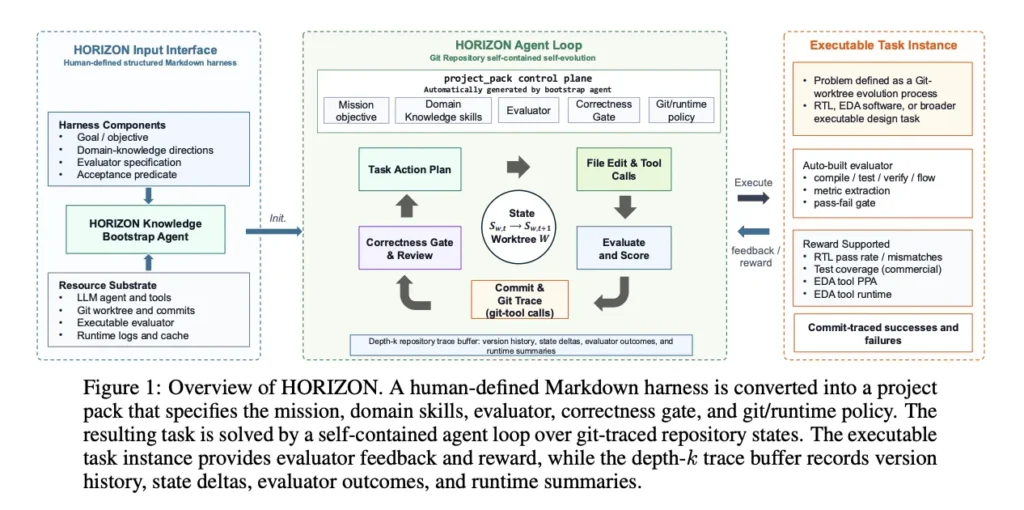
NVIDIA Research introduced HORIZON, a hands-free agent framework for hardware design. It treats hardware design as repository-level code evolution. This research team exercises the register-transfer level (RTL) instantiation. A structured Markdown harness becomes a project pack. A self-contained agent loop then evolves an isolated git worktree. It commits a version only when an executable acceptance gate passes. The research team reports 100% completion across every evaluated RTL benchmark suite. It also states plainly that agentic hardware design is not solved. What is HORIZON? Single-turn code generation has a clear limit on executable design tasks. Plausible Verilog is not enough for real hardware. Correctness depends on cycle-level behavior, reset conventions, bit widths, and simulator feedback. HORIZON hosts each design problem as a version-controlled repository, not a one-shot prompt. The only required input is a structured Markdown harness. That harness carries four components: a goal, domain-knowledge directions, an evaluator specification, and an acceptance predicate. A bootstrap agent compiles the harness into a project pack. The research team writes this as p = (πagent, Ep, Ap, Γp, Ωp). Those terms cover the agent policy, the executable evaluator, and the acceptance predicate. They also cover the version-control policy and the domain skills. For RTL, the evaluator Ep may include compilation, simulation, coverage extraction, and assertion or testbench checks. In other domains, that same slot could hold unit tests, theorem provers, profilers, or synthesis tools. Problems are therefore defined over git worktrees, not over a fixed repository type. https://arxiv.org/pdf/2606.28279 How the Repository-Level Loop Works After bootstrap, the loop runs without further human input. Each cycle plans a target, edits the worktree, invokes tools, and runs the evaluator. The acceptance predicate then decides one thing: commit the new version, or log the failure. Git is the substrate here, not incidental bookkeeping. Diffs expose proposed state changes. Commits define accepted checkpoints. Notes attach evaluator evidence. The log recovers the full trajectory. The loop leans on native git commands to keep tracing cheap. Staged edits are inspected with git diff –cached. Each accepted attempt becomes a git commit whose notes carry the verdict and reward. Successful commits become positive repair examples. Rejected attempts are logged as negative examples. The repository history is the experience buffer, not a separate datastore. The research team borrow semi-Markov decision process vocabulary for one narrow purpose. It names the recorded objects, nothing more. A ‘state’ is a versioned snapshot of the repository. An “option” is one episode between two checkpoints. HORIZON does not train or update an RL policy in this work. The agent backbone stays fixed throughout a campaign. Session reuse keeps cost down. HORIZON holds a persistent model session across iterations. The harness, project pack, and stable sources are served from the provider’s prompt cache. Newly billed tokens are then dominated by the current diff and the latest evaluator output. Where HORIZON Sits Among Self-Evolving Systems HORIZON extends a lineage of repository-scale self-evolution. Earlier systems evolved the software that engineers run. HORIZON instead evolves the hardware artifacts that engineers create. System Object evolved Domain Evaluation signal AlphaEvolve (2025) Algorithmic kernels Scientific and algorithmic discovery Automated evaluators SATLUTION (2025) Full SAT-solver repositories SAT solving Distributed correctness and runtime ABCEvo (2026) ABC logic-synthesis system EDA software Correctness and QoR HORIZON (this work) RTL sources, testbenches, verification artifacts Hardware design Compile, simulate, coverage, assertion checks All four share one principle. A candidate change is admitted only when executable evidence supports it. Benchmark Results The backbone is GPT-5.3, fixed for all experiments. Every result uses single-agent, hands-free mode. Campaigns ran on an AMD EPYC 9334 32-core host with 512 GB of RAM. The evaluation spans ChipBench, RTLLM-2.0, and Verilog-Eval. It adds nine CVDP code- and verification-generation categories, CID 002 to 016. CVDP contains 783 human-authored problems across 13 task categories (Pinckney et al., 2025). An iteration is one automated outer step. The agent edits the worktree, runs the evaluator, then commits a pass or logs a rejection. HORIZON reaches a 100% pass rate on every suite. The one residual miss is a ChipBench specification-harness defect, not an agent failure. The aggregate first-iteration pass rate is 47.8%. Iteration-0 is not a standalone Pass@1 measurement. It is the repository state after the first agent iteration. The agent may defer debugging and repair to later iterations by design. Suite / category Focus Iter. 0 Conv. iter. HORIZON ChipBench Mixed RTL generation 20.0 5 100.0 RTLLM-2.0 NL spec to RTL 78.0 2 100.0 Verilog-Eval-v2 HDLBits-style Verilog 86.2 2 100.0 CVDP CID 002 RTL code completion 3.2 82 100.0 CVDP CID 003 NL spec to RTL 19.2 24 100.0 CVDP CID 004 RTL code modification 10.9 36 100.0 CVDP CID 005 Spec-to-RTL module reuse 9.1 14 100.0 CVDP CID 007 Linting / QoR improvement 0.0 24 100.0 CVDP CID 012 Test-plan to stimulus generation 47.8 32 100.0 CVDP CID 013 Test-plan to checker generation 3.8 19 100.0 CVDP CID 014 Test-plan to assertion generation 79.1 1 100.0 CVDP CID 016 Debugging and bug fixing 25.7 13 100.0 Convergence difficulty varies widely across categories. RTLLM-2.0 and Verilog-Eval reach 100% within two iterations. Checker generation (CID 013) starts at just 3.8%. Yet it climbs steadily to 100% by iteration 19, with almost no plateau. Code completion (CID 002) needs 82 iterations. Its long tail is the single largest token cost. Interactive Metrics Explainer Where the Tokens Go Token consumption is the more informative signal once correctness saturates. The three legacy suites together use 6.0M tokens. The nine CVDP categories use 203.9M tokens, or 97.1% of the total. CID 002 alone uses 56.0M tokens. About 91% of all tokens are cached input, which significantly lowered the API cost. The research team therefore treat token efficiency, not final pass rate, as the metric most in need of improvement. Use Cases With Examples The evaluated categories map directly to daily RTL work: RTL code completion (CID 002): convert many failing completions into passing designs. Natural-language spec to RTL (RTLLM-2.0, CID 003): implement a module from a written spec. Modification and module reuse (CID 004,

NVIDIA HORIZON: A Hands-Free Agent that Evolves Git Worktrees and Hits 100% RTL Benchmark Completion Lire l’article »

AI, Committee, Actualités, Uncategorized

Anthropic Launches Claude Science Beta: A Multi-Agent AI Workbench for Reproducible Genomics, Proteomics, and Cheminformatics Pipelines

This week, Anthropic released Claude Science. It is an app for scientists, available in beta. It runs on Anthropic’s existing Claude models, not a new model. The app targets researchers who juggle databases, notebooks, and cluster terminals. It runs multi-step research and records how each result was made. The beta is available for Pro, Max, Team, and Enterprise plans. Claude Science builds on Anthropic’s life sciences work from last fall. That earlier work connected Claude to the scientific ecosystem through MCPs and skills. What is Claude Science? Claude Science is an AI workbench for research. It integrates the tools and packages researchers use most. It analyzes literature, executes multi-step research, and produces detailed artifacts. You can refine figures and manuscripts until they are publication-ready. You talk to one generalist coordinating agent in plain language. That agent has access to over 60 curated skills and connectors. These come pre-configured for genomics, single-cell, proteomics, structural biology, and cheminformatics. You can run it locally on macOS or Linux. You can also work on a remote machine over SSH or an HPC login node. Every output carries an auditable history of how it was made. How The Multi-Agent Architecture Works A generalist coordinating agent receives your plain-language request. It can spin up other agents to handle the work. It can also engage specialist agents that users create themselves. NVIDIA describes these as preconfigured, domain-specialized agents. Each knows the established workflows for its field. A separate reviewer agent runs as the pipeline executes. It inspects the outputs step by step. It flags incorrect citations and numbers it cannot trace. It also flags figures that do not match their underlying code. Then it self-corrects as it goes. Reproducibility And Provenance Scientific research is inherently visual. So Claude Science generates figures and manuscripts alongside the code that created them. It natively renders 3D protein structures, genome browser tracks, chemical structures, and more. When it generates a figure, it records the exact code and environment. It also records a plain-language description and the full message history. This makes the work easier to validate and reproduce months later. You can edit figures in plain language. For example, you can ask it to change an axis to log scale. The agent then edits its own code. You can also fork a session to compare two approaches without losing the original. Compute that Scales on Demand Large analyses often need more than a laptop. Folding a protein is one example. Claude Science drafts a plan before reaching new resources. It asks for approval and lets you review or revoke any decision. It then writes and submits the job to your own infrastructure. That means your HPC cluster over SSH or your Modal account. The analysis scales from a single GPU to hundreds as needed. Because agents hold context in memory, a large dataset loads only once. The app runs on your lab’s own infrastructure. So large or sensitive datasets never have to leave their current systems. Only the context needed for each step is sent to Claude. Domain Coverage and NVIDIA BioNeMo Scientific knowledge is scattered across hundreds of specialized sources. In biology, this includes UniProt, PDB, Ensembl, and Reactome. It also includes ClinVar, ChEMBL, GEO, journals, and preprint servers. Specialist agents query and synthesize across these sources for you. Claude Science also uses skills from NVIDIA’s BioNeMo Agent Toolkit. The toolkit packages GPU-accelerated capabilities as callable skills. This connects natively to Evo 2, Boltz-2, and OpenFold3. Evo 2 is a genomics foundation model. Boltz-2 handles biomolecular interaction prediction. OpenFold3 handles protein structure prediction. Use Cases With Examples Beta users have run single-cell RNA sequencing analysis and CRISPR screen design. They have also run protein structure prediction and cheminformatics. Target nomination: Manifold Bio designs tissue-targeting medicines. It used Claude Science to nominate targets for its latest experiments. For each tissue and target, the app assessed surface expression, trafficking, and safety. It then ranked candidates against Manifold’s own proprietary criteria. Manifold said the app did this end to end, unlike a general coding assistant. Long-form literature review: Jérôme Lecoq at the Allen Institute built a computational review template. It comprised about 20 custom skills for long-form reviews. Sub-agents read thousands of papers into an evidence state database. The pipeline then wrote each section using actor-critic agent pairs. Such reviews once took his team as long as two years. He now has about 10 reviews, many over 100 pages. Genomic epidemiology: Stephen Francis at UCSF studies the molecular epidemiology of glioma. Claude Science ran germline workups in roughly one-tenth the prior time. His group independently validated the results. Comparison Table Dimension Claude Science General AI assistant Claude Code Primary use Scientific research workflows Q&A and drafting Software development Runs real pipelines Yes, end to end No Yes, code-focused Scientific database access 60+ databases and skills No No Compute management Local, HPC (SSH), Modal No Local terminal Reproducibility / provenance Full record per artifact No Git history Citation and number checking Reviewer agent No No Native scientific renderers Proteins, tracks, molecules No No Underlying model Existing Claude models Existing Claude models Existing Claude models Extending Claude Science Claude Science is an app, so it has no separate inference API. You extend it through connectors and skills, which persist across sessions. You connect a lab tool through a Model Context Protocol (MCP) connector. This is the standard MCP client config format: Copy CodeCopiedUse a different Browser { “mcpServers”: { “lab-eln”: { “command”: “npx”, “args”: [“-y”, “@lab/eln-mcp-server”], “env”: { “ELN_API_KEY”: “REPLACE_ME” } } } } You save an existing pipeline as a reusable skill. A skill is a folder containing a SKILL.md file: Copy CodeCopiedUse a different Browser — name: rnaseq-qc description: Run the lab’s standard RNA-seq quality-control pipeline on a FASTQ directory. — # RNA-seq QC 1. Run `pipelines/qc.sh <fastq_dir>`. 2. Summarize the per-sample metrics. 3. Flag any sample below the QC threshold. Future sessions inherit these connectors and skills automatically. So you keep your validated tools and data, while Claude orchestrates them. Key

Anthropic Launches Claude Science Beta: A Multi-Agent AI Workbench for Reproducible Genomics, Proteomics, and Cheminformatics Pipelines Lire l’article »

AI, Committee, Actualités, Uncategorized

Less Data, More Security: Advancing Cybersecurity LLMs Specialization via Resource-Efficient Domain-Adaptive Continuous Pre-training with Minimal Tokens

arXiv:2507.02964v2 Announce Type: replace Abstract: The increasing scale of AI workloads demands High-Performance Computing (HPC) infrastructure and training methodologies that are both scalable and sustainable. While Large Language Models (LLMs) demonstrate exceptional natural language capabilities, general-purpose models often lack the specialized domain knowledge necessary for effective cybersecurity analysis. We investigate Domain-Adaptive Continuous Pretraining (DAP) as a scalable, resource-efficient methodology for enhancing cybersecurity understanding in pretrained LLMs, implemented through a distributed Fully Sharded Data Parallel (FSDP) pipeline across multi-node GPU clusters. We systematically adapted three decoder-based architectures — Llama-3.1-8B, DeepSeek-R1-Distill-Qwen-14B, and Llama-3.3-70B-Instruct — using a curated 126-million-word cybersecurity corpus from standards, academic literature, and technical documentation. Evaluation across three cybersecurity benchmarks — CTI-MCQ, CyberMetric, and SecEval — demonstrates consistent improvements post-adaptation. Notably, our Llama-3.3-70B-Ins-DAP model achieves state-of-the-art performance with accuracies of 0.718, 0.933, and 0.864, respectively, surpassing parameter-efficient baselines and specialized models including Llama-Primus-Base (trained on 2.77 billion tokens) and Foundation-Sec-8B (trained on 5 billion tokens), despite utilizing only 118.8 million tokens — representing a 23-to-42-fold reduction in training data. Targeted continuous pretraining via scalable HPC infrastructure enables effective cybersecurity domain adaptation with a substantially reduced computational and energy footprint, supporting specialized AI assistants in threat analysis, vulnerability assessment, and security documentation, while advancing sustainable and responsible AI development.

Less Data, More Security: Advancing Cybersecurity LLMs Specialization via Resource-Efficient Domain-Adaptive Continuous Pre-training with Minimal Tokens Lire l’article »

AI, Committee, Actualités, Uncategorized

The UK’s generational tobacco ban might not work. I’m supporting it anyway.

As the parent of two little girls, I often think about how their childhood is different from mine. The seven-year-old is learning about AI at school. The five-year-old is given internet-based homework every week. And they are both absolutely repulsed by the idea of smoking. That was not the prevailing sentiment when I was young. My parents smoked. The customers at our family’s restaurant smoked. Cartoon characters smoked. My friends and I would buy little cigarette-box-shaped packets of sugary white sticks and pretend to smoke in the playground. Smoking was a central part of our culture. Which is why the UK’s recent passing of a generational sales ban on tobacco products feels like such a big deal. As part of the Tobacco and Vapes Act 2026, retailers are prohibited from selling tobacco products to anyone born after January 1, 2009, in perpetuity. It doesn’t matter when those people turn 18—or 38 or 68, for that matter. It will always be illegal to sell to anyone born after that date. This is what’s described as an “endgame” approach. While many tobacco control strategies—such as taxation or gory imagery—aim to reduce consumption, policies like the UK’s are designed to eliminate it entirely. It’s a new approach, and no one knows whether it will work. The Maldives was the first country to implement a generational smoking ban, in November last year. It’s too soon to say how that has panned out. Nor do we know if these laws will even last. In 2022, New Zealand passed a similar generational sales ban as part of a broader anti-smoking law. But it was never enacted—the law was repealed by a new government in February 2024. In the UK, both major parties support the ban. But Nigel Farage, whose right-wing party has seen a recent surge in support, has promised that “the generational smoking ban will not last long if Reform gets the chance to start rebuilding our mismanaged country.” Chris Bostic, an attorney and former policy director for the advocacy group Action on Smoking and Health, says he and his colleagues began promoting the idea of a generational ban in the United States 11 years ago. Back then, they struggled to win support, even from major health charities. “People said we were crazy … [and] that this was impossible,” he says. Opponents argued that bans would infringe on personal freedoms. “The public health argument is: Well, what about freedom from addiction?” says Britta Matthes, a tobacco control researcher at the University of Bath in the UK. Most people who smoke began when they were teenagers, want to quit, and wish they’d never started. Tobacco is arguably the most harmful consumer product of all time. It will kill half its users who don’t quit, according to the World Health Organization. It also kills people who don’t smoke. Of the 7 million who die from tobacco every year, 1.6 million are nonsmokers who were exposed to secondhand smoke, according to the WHO. Generational sales bans are a long-term strategy that will only protect future smokers. Most experts agree that people who already smoke should be a main consideration for any policy, and that a multipronged approach is probably the best way to go. Janet Hoek at the University of Otago, who has explored tobacco control policies in New Zealand, believes that enforcing very low limits on nicotine levels and banning filters—an environmental scourge that does not make smoking safer, as many people believe—might be a “powerful combination,” for example. But preventing teenagers from starting to smoke in the first place is an enticing prospect, even among the majority of people who smoke. And it’s starting to look a lot less radical. The US has quietly been making progress on a smaller scale. Since 2021, Brookline, a town in the Boston area, has banned the sale of tobacco products to anyone born after January 1, 2000. The idea has spread. Today there are 23 towns in Massachusetts with similar bans, says Bostic. Nine towns across Minnesota, New York, and California have implemented other endgame policies. The UK law has normalized the idea more than ever, he adds. His colleagues are already fielding calls from health agencies around the world. “People [are] saying, Wow I can’t believe the UK just did this—can we do this here?” he says. Norms change. Like many other millennials, I vividly remember my first night out after a ban on indoor smoking took effect. My clothes didn’t stink! My hair still felt clean! And my throat wasn’t scratchy the next morning! Now that’s just normal. I hope a tobacco-free world can be the new normal for my kids.

The UK’s generational tobacco ban might not work. I’m supporting it anyway. Lire l’article »

AI, Committee, Actualités, Uncategorized

Meet WebBrain: An Open-Source, Local-First AI Browser Agent That Reads Pages and Automates Tasks in Chrome and Firefox

WebBrain is a free, open-source browser agent for Chrome and Firefox. It reads pages, extracts data, and automates multi-step tasks. Unlike most browser AI plugins, it can also run entirely on a local model. It is built by Emre Sokullu and licensed under MIT. The full source lives on GitHub.  Run the agent against a local model, and no page data leaves your machine. Connect a cloud API when you want more capability. What is WebBrain? WebBrain lives in your browser’s side panel. In Chrome it uses Manifest V3 and the sidePanel API. In Firefox it uses Manifest V2 and sidebar_action. Each tab keeps its own conversation history. The extension operates inside your existing authenticated session. It sees your logged-in accounts exactly as you do. It stores no data externally and adds no telemetry or accounts. The plugin ships in English, Español, Français, Türkçe, and 中文. It auto-detects your browser language on first launch. Ask Mode, Act Mode, and How Actions Actually Fire WebBrain has two modes: Ask mode is read-only and cannot change the page. Act mode can click, type, scroll, navigate, and run workflows. Ask mode reads pages through ordinary content scripts. Act mode is different. It drives the page through the Chrome DevTools Protocol via the chrome.debugger API. That produces trusted input events that modern sites actually honor. It also reaches cross-origin iframes and shadow DOM that content scripts cannot see. That power is scoped deliberately. WebBrain attaches the debugger only when an action needs it, per tab. Chrome surfaces its standard ‘WebBrain started debugging this browser’ banner while attached. Firefox has no CDP equivalent, so its Act mode is meaningfully weaker. Temperatures are fixed for predictability. Act mode uses temperature 0.15. Ask mode uses 0.3. Dedicated vision screenshot descriptions use 0. The Security Model Browser agents run on an adversarial surface. Web pages can hide prompt injections that hijack an agent’s behavior. WebBrain’s design addresses this directly. The agent starts in read-only Ask mode. It asks before consequential actions. You can disable those prompts in the Permissions settings. They are on by default. There is also a UI-first rule for mutations. For anything that creates, sends, submits, or buys, WebBrain uses the visible UI. It refuses to call REST or GraphQL endpoints directly for mutations. A per-conversation /allow-api override exists when the UI genuinely fails. Reading is treated separately. Fetching a README or comparing prices uses background HTTP through the fetch_url and research_url tools. Reading changes nothing remotely, so the strict rules do not apply. Use Cases, With Concrete Examples Data extraction is the obvious one: Open a catalog and ask: ‘Extract all product names and prices from this page.’ The agent reads the structure and returns rows. It also works with PDFs. Research summaries are another: Ask ‘Summarize this article,’ then follow up with a specific question. WebBrain detects paywalls honestly and does not try to bypass them. It also dismisses common cookie-consent banners before reading. Form filling suits repetitive signups: An optional Profile auto-fill stores a short bio in local plaintext. That text is sent to your configured LLM to complete low-stakes forms. Keep important passwords out of it. Automation spans multiple steps: Try ‘Navigate to github.com and find trending repositories.’ In Act mode, the agent chains navigation, reads, and clicks. Keeping Token Costs Down Cloud tokens add up on long sessions. WebBrain bounds the cost in three ways. Screenshots are resized and iteratively JPEG-compressed before they leave your machine. That keeps image tokens small.  Conversation history and tool outputs are trimmed oldest-first as the context window fills.  You can also pair a cheap text model for planning with a separate vision model for screenshots. How It Compares WebBrain sits between browser AI plugins and full agent frameworks. Here is the plugin comparison, drawn from the project’s own documentation. Feature WebBrain Claude in Chrome Open source MIT License Proprietary Price Free forever Requires Claude Pro ($20/mo) Local LLM support llama.cpp, Ollama No — Claude only Multi-provider All OpenAI-compatible endpoints Claude only Chrome Yes (MV3) Yes Firefox Yes (MV2) No Side panel UI Yes Yes Ask / Act modes Yes Similar Fully offline Yes (with local LLM) No — cloud required Self-hostable Yes No Frameworks like OpenClaw or Browser-Use are a different category. Those are developer SDKs for headless pipelines. WebBrain is an end-user extension you drive from a chat panel. You can use both. Running It: Providers and Setup WebBrain supports local and cloud models through one interface. Local options include llama.cpp, Ollama, LM Studio, Jan, vLLM, and SGLang. Cloud options include OpenAI, Anthropic Claude, Gemini, Mistral, DeepSeek, and xAI Grok. It also supports Groq, MiniMax, Alibaba Cloud (Qwen), Nvidia NIM, and OpenRouter. A built-in managed option, WebBrain Cloud, needs no local setup. It costs $5 per month per device profile under a fair-use policy. For local use, llama.cpp needs no API key. Starting a local server takes one command: Copy CodeCopiedUse a different Browser # llama.cpp — load at least a 16k-token context window llama-server -m your-model.gguf -c 16384 –port 8080 # Ollama (OpenAI-compatible) — set the extension-origin env var OLLAMA_ORIGINS=”*” ollama serve # then set the base URL to http://localhost:11434/v1 in settings Point WebBrain at the endpoint in settings. For a cross-machine vLLM server, enable CORS with –allowed-origins ‘[“*”]’. The recommended model is Qwen 3.6 35B (Qwen3.6-35B-A3B). It beat Gemma 4 on the project’s screenshot benchmark. An RTX 5090 is ideal; an RTX 4090 works with INT4 AutoRound quantization. Each provider is a class that extends BaseLLMProvider. It normalizes to one response shape: Copy CodeCopiedUse a different Browser { content: string, toolCalls: Array|null, usage: Object|null } Key Takeaways WebBrain is a free, MIT-licensed AI browser agent for Chrome and Firefox, built by Emre Sokullu. It runs on local models (llama.cpp, Ollama; Qwen 3.6 35B recommended) or any cloud API — no page data leaves your machine when local. Ask mode reads pages read-only; Act mode clicks and types via the Chrome DevTools Protocol for trusted input events. Security-first by design: starts

Meet WebBrain: An Open-Source, Local-First AI Browser Agent That Reads Pages and Automates Tasks in Chrome and Firefox Lire l’article »

AI, Committee, Actualités, Uncategorized

 A device that revives eyeballs from dead donors could make eye transplants possible

It’s not easy to transplant a whole human eye. The surgery is difficult. And the eyes themselves start to degenerate as soon as they’ve left the body. When surgeons attempted it a few years ago, the newly-transplanted eye wasn’t able to see. But researchers believe they might have a solution: a device that maintains and revives freshly removed eyeballs using a technique called perfusion. Perfusion works by providing surgically-removed organs with some of the oxygen and nutrients they typically get when they’re inside a body. Treated eyes don’t degrade as quickly, and appear to retain the ability to transmit electrical signals, and potentially see. The device could one day make eye transplantations a viable possibility. “It’s really cool,” says Shannon Tessier at Massachusetts General Hospital, who was not involved in the research but studies perfusion of other organs. “It could be a new frontier for retina preservation.” Pia Cosma at the Centre for Genomic Regulation at the Barcelona Institute of Science and Technology in Spain and her colleagues have spent years developing their device. The Eye-in-a-Care-Box (ECaBox), as they call it, delivers an oxygen-rich supply of fluid through the artery that normally supplies the eye with blood. The eye itself sits on a “bed,” and excess fluids are drained away. And while the device itself is sealed to maintain a specific temperature and pressure, a clear window on its side allows researchers to study and image the eye while it’s inside. Cosma and her colleagues started experimenting with pig eyes, which are anatomically similar to human eyes but easier to get hold of (the team got theirs from a local slaughterhouse). Pig eyes that are kept at room temperature outside of the device start to degenerate pretty quickly. The team found that cells in the eye shrank, and the eyes started to lose their structure. Cooling the organs didn’t help preserve them, either—the eyes degenerated within 24 hours even when they were kept at 4°C (39°F). But eyes kept in the EcABox fared much better. 24 hours later, tests suggested the prefused eyes were “significantly more viable” than eyes that hadn’t been maintained in the device. The perfused eyes also seemed to be able to respond to light, suggesting they might technically be able to see if they were transplanted. Untreated pig eyes lost this ability as soon as they were removed from the animal. But it came back after about 15 minutes of perfusion, according to the scientists behind the work. A few of the treated eyes kept going for 10 hours or more. Cosma and her colleagues described the work in a preprint article that has not yet been peer reviewed, and did not want to comment on the work. After success with the pig eyes, the team members then tested their device on human eyes. They first collected 12 eyes from six people who had died. In each case, one of each pair of eyes was put in the device, while the other was not. Again, the perfused eyes did better—and their retinas were preserved. Cosma and her colleagues hope that their device could offer scientists a new way to study eye treatments—one that doesn’t involve experimenting on living animals. They also hope that, with some improvements, the ECaBox might provide a way to maintain and revive donated human eyes for whole-eye transplantation. Whole-eye transplants have been attempted in the past, mostly in research animals, with limited success. In May 2023, a team at NYU Langone transplanted an eye along with part of a face to a man who had survived a high-voltage electrical accident that resulted in the loss of much of the left side of his face, including his left eye, two years earlier. Although the man recovered well, he wasn’t able to see out of the transplanted eye. We won’t know whether eyes treated in the ECaBox could do any better until they have been transplanted, says Tessier.  In the meantime, Cosma and her colleagues plan to use a newer version of their device to collect more human eyes for research. “We are planning to develop a portable, surgery-room ECaBox to minimize [degradation] in heart-beating donor eyes, when they become available,” they write.

 A device that revives eyeballs from dead donors could make eye transplants possible Lire l’article »

AI, Committee, Actualités, Uncategorized

The Download: a smoking “endgame” and a new Elizabeth Bear story

This is today’s edition of The Download, our weekday newsletter that provides a daily dose of what’s going on in the world of technology. The UK’s generational tobacco ban might not work. I’m supporting it anyway. —Jessica Hamzelou As the parent of two little girls, I often think about how their childhood is different from mine. The seven-year-old is learning about AI at school. The five-year-old is given internet-based homework every week. And they are both absolutely repulsed by the idea of smoking. That was not the prevailing sentiment when I was young. Smoking was a central part of our culture. Which is why the UK’s recent passing of a generational sales ban on tobacco products feels like such a big deal. This is what’s described as an “endgame” approach. While many tobacco control strategies—such as taxation or gory imagery—aim to reduce consumption, policies like the UK’s are designed to eliminate it entirely. It’s a new approach, and no one knows whether it will work. But it’s an enticing prospect—and it’s starting to look a lot less radical. Find out why generational tobacco bans are gaining support. This story is from The Checkup, our weekly biotech newsletter. Sign up to receive it in your inbox every Thursday. You do your own time —You do your own time is a short story by Elizabeth Bear, an award-winning speculative fiction author. There we were, a regular murderers’ row of librarians. Turning around in the nave of our library to greet the sound of footsteps, pistols leveled in case whoever was coming in didn’t respect sanctuary. I pulled down a solid-state drive full of biographies and case studies of people who had spent time—and sometimes their whole lives—in labor camps or chattelhood. It was illegal to possess, and the feds used smart agents to track down and obliterate any copies. Which was why we were sending one to the stars. What’s left behind when a name is erased from the system? No legacy, no memory—that is the point of media and narrative control. So that was our plan: to preserve it, for later generations, or just as a silent record of our existence. Read the rest of this short story in full.  —Elizabeth Bear This story is from the latest edition of our magazine, which is all about engineering. Subscribe now to get a copy, plus all our other issues and a range of subscriber-only content. The must-reads I’ve combed the internet to find you today’s most fun/important/scary/fascinating stories about technology. 1 An EU lawmaker investigating spyware was hacked by that spywareCitizen Lab found Pegasus spyware on Stelios Kouloglou’s phone. (Wired $)+ It said the EU “looks the other way” on spyware abuses. (Guardian)+ Meet the director of Citizen Lab. (MIT Technology Review) 2 Anthropic is closing loopholes that allow Chinese access to ClaudeIt’s targeting VPNs, relay services, and overseas accounts. (FT $)+ Users in China keep finding new workarounds. (Wired $) 3 A Tesla driver has been charged with manslaughter after a fatal crashCourt records show he was using automated driver-assistance. (WSJ $)+ Tesla sales have surged 25% after a rebound in Europe. (NYT $) 4 Trump bought lots of tech stock the day he unveiled his AI Action PlanHe acquired up to $5 million in stock from Amazon and others. (Engadget)+ His AI Action Plan was a distraction. (MIT Technology Review) 5 Companies are throttling employees’ AI use because it’s too expensiveThey’re pleading with workers to use less powerful models. (404 Media)+ Tesla has capped their AI spending at $200 per week. (The Information $) 6 The Energy Dept wants data centers on backup power in heat wavesIt wants them to free up power for AC. (NYT $)+ People near data centers are dreading heat wave pollution. (Politico $)+ No one wants a data center in their backyard. (MIT Technology Review) 7 A Meta glasses feature just went from free to a subscription service“Conversation Focus” will now cost $19.99 per month. (BBC)+ The move heralds a new era of consumer tech subscriptions. (Wired $) 8 Random wobbles in time could solve gravity’s greatest mysteryA new idea could reconcile gravity and quantum mechanics. (New Scientist $) 9 Peter Thiel claims the pope is “working for the Chinese Communists”By pushing for stricter AI rules that may benefit Chinese interests. (CNN)+ Pope Leo XIV said AI must be “disarmed” in his first major teaching. (BBC)+ His encyclical offered a template for steering AI. (MIT Technology Review)  10 Supersonic flight over land could finally be legal againRegulators want to lift a ban—so long as the planes are quiet. (Ars Technica) Quote of the day “We don’t have robots that are nearly as good at understanding the physical world as a rat.” —Yann LeCun, the founder of AMI Labs and Meta’s former chief AI scientist, tells the BBC that AI isn’t as smart as many think. One More Thing MARCO GIANNAVOLA How two brothers became go-to experts on America’s “mystery drone” invasion  On a Friday evening in December, every tier of US law enforcement was dispatched to a military research installation outside Boston after a squadron of 15 to 20 drones was spotted violating restricted airspace. The culprits could not be found. It was the latest in a series of purported drone sightings along the US East Coast. Lacking coordination or clarity from the White House, the Pentagon, and the intelligence community, law enforcement officers turned to an unlikely source: twin brothers from Long Island who hunt UFOs. The Tedescos have built a mobile field lab to investigate unexplained aerial phenomena. Now members of the FBI want their support. Discover how the brothers are helping law enforcement investigate UFOs. —Matthew Phelan We can still have nice things A place for comfort, fun, and distraction to brighten up your day. (Got any ideas? Drop me a line.) + This record-breaking drone show is a mind-bending display of aerial light.+ A Paris bakery is taking a bite out of food waste by repurposing croissants.+ Relive your childhood with a classic episode from the Mister Rogers archive.+ See graffiti through new eyes

The Download: a smoking “endgame” and a new Elizabeth Bear story Lire l’article »

AI, Committee, Actualités, Uncategorized

Why California’s carbon manure math doesn’t add up

Something stinks in California’s climate policies. Years ago, the state set up a system that pays cattle farmers across the country to turn the methane emitted from cattle manure into natural gas, encouraging the dairy sector to produce a gas we burn instead of one that just pollutes the air. It’s become wildly popular because the subsidies are extremely lucrative. But a growing body of research suggests the program is a case study in the shortcomings of our preferred approaches to climate action. Instead of simply forcing industries to directly cut their pollution or pay for it as a cost of doing business, legislators have repeatedly opted to set up convoluted incentive systems that swap climate responsibilities between parties and regions. As studies have shown again and again, these carbon offsetting and trading schemes often dramatically overstate the emissions reductions actually achieved in the one place that matters: the atmosphere. The dairy program illustrates a particular version of this problem, muddling the impacts of different types of greenhouse gases in a way that researchers argue will lock in more warming in the future. Despite this and other concerns, California regulators decided in 2024 to extend parts of the program beyond 2050. And a recent proposal by the state’s air resources board could send millions of additional dollars to dairy farmers as part of a plan that would ease restrictions on major greenhouse-gas producers. Here’s how the system works: The state’s climate regulations require the transportation fuels industry to lower the carbon dioxide levels in its products over time—or purchase credits from other parties that cut fuel emissions, including cattle farmers. Dairies generally spray cattle manure into giant open lagoons, where microbes gobble up organic matter and produce methane as a by-product. But if farmers set up what are known as anaerobic digesters, the sludge is redirected into covered vessels that capture the biogas, which can be converted into natural gas and injected into a pipeline. It can then be used to fuel certain vehicles or generate electricity in a power plant. Either way, petroleum companies can pay those farmers for Low Carbon Fuel Standard (LCFS) credits, to meet regulatory requirements in lieu of reducing the emissions from their own fuels. Burning biogas in a bus or turbine still releases carbon dioxide, but the idea is that this process reduces market demand to extract natural gas from the ground and avoids the release of methane, which is a far more powerful greenhouse gas (at least initially). In fact, methane is so much more powerful that under California’s program, “adding one average biogas-powered vehicle to the fleet would produce enough LCFS credits to cover the deficits incurred by 26 similar gasoline-powered vehicles,” according to Aaron Smith, a UC Berkeley economist. But there’s a problem with this carbon math. California assumes that methane exerts about 25 times the warming effect of carbon dioxide over a 100-year period. That’s not how it really works in the atmosphere, though. Methane is very powerful, but it also breaks down quickly, generally within a couple of decades. Meanwhile, carbon dioxide builds up cumulatively in the atmosphere—and much of whatever we emit will continue heating up the planet for hundreds to thousands of years. So, in effect, the state has created a system that reduces short-term warming at the cost of increasing all-but-permanent warming. Any methane that digesters capture today would have caused extra-powerful warning if released, but by 2050 that effect would have mostly faded away. Meanwhile, that additional carbon dioxide we permitted in its place could continue warming the world for millennia. It is a good idea to cut methane emissions, and dairy digesters achieve this (though not always as effectively as hoped). But we can’t swap a decrease in short-lived greenhouse gases for an increase in long-lived ones if we hope to keep global temperatures within relatively safe levels in the coming century, as researchers have long warned. We have to slash both. The problem I keep returning to, after years of covering carbon markets and offsets, is this: We need to clean up every sector, completely, over the next few decades. It’s increasingly untenable for so many of our climate ambitions to turn on getting one industry to make progress on paper by paying another one to reduce emissions, at a point when every business in every industry needs to be racing toward net zero. It’s time to move past the idea that we need to reward sectors for doing us the favor of not polluting the atmosphere, and simply require them to stop unloading the huge environmental burden of their business onto society. This article is from The Spark, MIT Technology Review’s weekly climate newsletter. To receive it in your inbox every Wednesday, sign up here.

Why California’s carbon manure math doesn’t add up Lire l’article »

AI, Committee, Actualités, Uncategorized

Teaching AI to run with the turbines

Artificial intelligence may have captured the public imagination through chatbots and image generators, but some of its most consequential use cases are unfolding far from consumer-facing tools. In industries where physical infrastructure, operational continuity, and safety are paramount, AI is becoming a core operating layer. With its sprawling industrial systems and constant stream of operational data, the energy sector offers a glimpse into what that future could look like. At Woodside Energy, AI adoption did not begin with generative models or enterprise copilots. The company has spent years building predictive analytics, optimization systems, and machine learning tools across exploration, drilling, maintenance, and plant operations. “We’ve always had very large volumes of operational data coming from the equipment and the plants and the assets that we operate,” says the company’s vice president for digital Andrew Melouney. “Those have created really clear, quite high-value use cases for us.” That long-term investment in infrastructure and governance is now enabling a broader shift toward agentic AI systems that can support complex industrial workflows. Rather than replace human operators, Woodside designs AI systems to augment expertise in high-stakes environments. A prime example is its “Startup Advisor,” an AI copilot that helps operators manage the complex process of starting liquefied natural gas (LNG) plants. “We’re really thinking about, how does it support the people in the organization in terms of empowering them to make better decisions, to make faster decisions,” Melouney explains. The company’s approach reflects a wider evolution taking place across industrial AI: graduating from isolated experiments to enterprise-wide systems built on standardized platforms, governed data, and repeatable deployment patterns. That transition, Melouney argues, requires organizations to rethink both their technology stacks and how work itself gets done. “We’re not just bolting AI onto an existing process,” he says. “We’re deeply thinking about how that work needs to be reimagined.” Melouney’s motto has become: “Think big, prototype small, and scale fast.” As AI systems become more autonomous and interconnected, the companies poised to succeed may be those that spent years building the operational foundations beneath the hype. “Our ambition is really for an autonomous enterprise, where we have agents with agency that are able to really deeply interact with our core workflows,” says Melouney. This episode of Business Lab is produced in partnership with Infosys. Full Transcript: Megan Tatum: From MIT Technology Review, I’m Megan Tatum, and this is Business Lab, the show that helps business leaders make sense of new technologies coming out of the lab and into the marketplace. This episode is produced in partnership with Infosys. Now, when people think about artificial intelligence, they often picture chatbots or productivity tools, but some of the most sophisticated and high impact uses of AI are actually happening far from consumer apps, inside complex industrial environments where safety, reliability, and physical systems matter. The global energy sector is a prime example. Companies like Woodside Energy, a global energy producer headquartered in Western Australia, have been applying AI for more than a decade now, from advanced analytics and operations, to remote decision support, to smarter maintenance, and energy efficiency across large scale assets. Today, Woodside is scaling that experience, embedding AI more deeply across its operations and the enterprise with a strong focus on governance, data quality, and human accountability. Two words for you: technological fuel. My guest today is Andrew Melouney, vice president for digital at Woodside Energy. Welcome, Andrew. Andrew Melouney: Thanks, Megan. It’s great to be here. Megan: Lovely to have you. Now, Andrew, as I said there, the energy sector has approached AI quite differently from technology or consumer businesses. Early value has emerged in operational and industrial environments, rather than consumer-facing generative AI tools. Why is that? And what differentiates the energy sector’s AI journey? Andrew: Megan, I think it really comes down to the nature of the work we do. Energy operations and what Woodside does is very asset intensive, it’s very safety critical, and it’s highly physical. And when you think about how Woodside operates, we operate across the full value chain. We do exploration through to drilling and subsurface work, to project development, all the way through to operating assets, which are often operated in harsh and remote locations, and then global energy portfolio marketing and trading as well. We’ve always had very large volumes of operational data coming from the equipment and the plants and the assets that we operate, and those have created really clear, quite high-value use cases for us. When you think about reliability, when you think about safety and efficiency, those are really critical things for a company like Woodside. We’ve been doing traditional AI for many years now. If you think about analytics, if you think about optimization, if you think about things like predictive models, those techniques we’ve been applying to our data sets and to our business since around 2015. And more recently with the advent of generative AI, we’ve really found that we’ve got a pretty strong and awesome foundation to build on top of and to really solve problems in the service of improving the business. And again, whether that is keeping people safe, keeping the environments we operate in safe, or improving returns for the organization. Megan: Fantastic. I mean you touched on it there, but how has this reality shaped your own AI strategy at Woodside? Where did you start, and where did the technology prove most impactful in those early days? Andrew: Well, like I said, we’ve had a very long journey, in terms of understanding our operational data, recognizing the value of it, and collecting it at scale so that we can use it. And we’ve been very deliberate in that approach, Megan. We’ve really thought about where the value is and where the risks were manageable. And we’ve started looking at, in today’s world from an agentic AI perspective, we’ve started looking at the problems that were solved with traditional AI and machine learning and data science in the past. And we’ve

Teaching AI to run with the turbines Lire l’article »

AI, Committee, Actualités, Uncategorized

The Download: a startup has a solution for AI’s groupthink problem

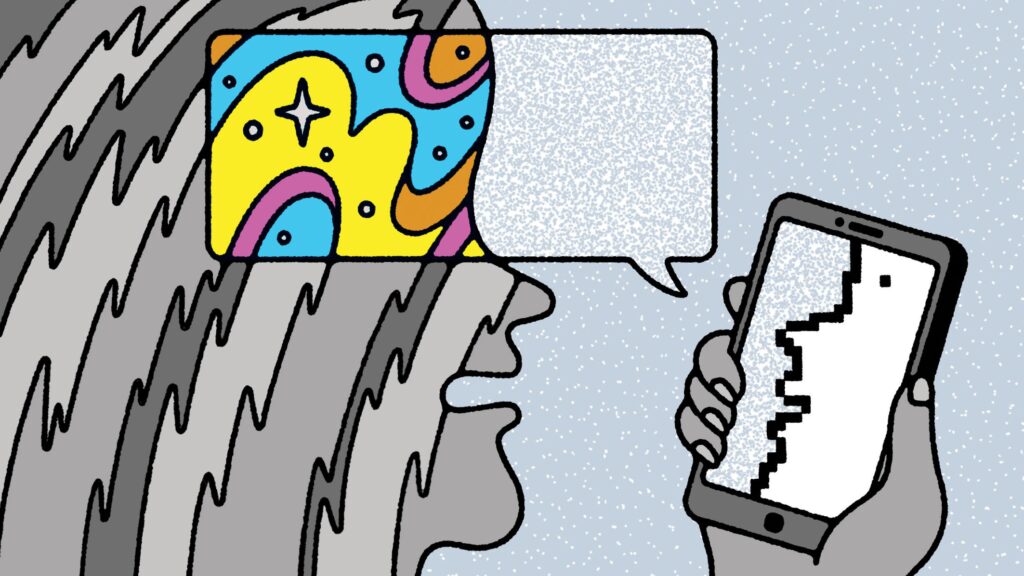
This is today’s edition of The Download, our weekday newsletter that provides a daily dose of what’s going on in the world of technology. LLMs are stuck in a groupthink groove. This startup is trying to get them out. Open up your chatbot of choice—Claude, ChatGPT, Gemini—and type “Give me a random number between 1 and 10.” You’re going to get 7. Almost always.  That won’t work every time—but if it did for you, you may wonder if I have superpowers. I don’t. The truth is that most large language models are stuck in a rut. They are far more predictable and far less creative in their responses than you might expect. That’s fine for tasks like coding or research, but groupthink is a problem when you’re brainstorming or planning your next vacation. The Australian startup Springboards has a solution. It built an LLM called Flint, which has been trained to come up with a wider variety of responses than mainstream LLMs to open-ended questions such as “Where should I go in Europe?” Meet the company pushing chatbots away from the obvious. —Will Douglas Heaven The must-reads I’ve combed the internet to find you today’s most fun/important/scary/fascinating stories about technology. 1 Scientists say they have built a cell from scratch for the first timeBuilt with lab-made DNA, it can feed, grow, and multiply. (CNN)+ It brings us closer to creating synthetic life. (Quanta)+ And is arguably the greatest feat of bioengineering yet. (New Scientist $)+ But also raises concerns over the dangers of synthetic biology. (NYT $)+ Mirror organisms could threaten life on Earth. (MIT Technology Review) 2 OpenAI has proposed giving the Trump administration a 5% stakeTalks over a public ownership deal come amid rising political pressure.(FT $)+ OpenAI also proposed other US AI giants providing a 5% stake. (CNBC)+ That could include Anthropic, Google, and Meta. (Bloomberg $)+ President Trump says he wants the public to have a stake in AI. (BBC) 3 Singapore has seized a $42 million mansion tied to Nvidia chip smugglingIt was seized as part of an investigation into alleged illegal trading. (BBC)+ Days earlier, Supermicro’s Taiwan offices were raided in the probe. (FT $) 4 Anthropic’s Fable 5 is back onlineBut queries posing security risks may be routed to less powerful models. (Axios)+ Anthropic restored access yesterday after the US lifted an export ban. (BBC)+ But the battle over how to tame AI has just begun. (WSJ $)+ Anthropic has launched a new AI science product. (MIT Technology Review) 5 Meta is building its own cloud infrastructure businessIt’s exploring two ways of monetizing AI compute and models. (Bloomberg $)+ One is selling access to models hosted on Meta’s infrastructure. (CNBC)+ The other is selling “raw” computing power. (TechCrunch) 6 PlayStation will stop releasing games on discs in 2028Future PS5 games will be digital-only releases. (Verge)+ The news comes days after reports that GTA VI will have no disc. (BBC)+ It’s put a nail in physical media’s coffin. (Wired $) 7 A low-cost Chinese AI model is catching up with US giants on their home turfWestern customers are drawn to GLM-5.2’s cheap but powerful model. (Reuters $)+ Chinese open-source models are spreading fast. (MIT Technology Review) 8 Google has lost its fight against a record €4.1 billion EU antitrust fineIt was charged in 2018 for using Android to ‌block rivals. (CNBC) 9 The UN has launched an “AI for Good” commissionSalesforce CEO Benioff and Rwandan President Kagame will co-chair it. (Axios) 10 People prefer AI impersonators over politiciansThe study’s findings raise alarm bells around potential public deception. (404 Media) Quote of the day “If AI overdelivers, it will impact financial stability. If AI underdelivers, it will impact financial stability.” —Torsten Slok from Apollo Global Management shares common concerns about AI at the European Central Bank’s annual conference, Reuters reports. One More Thing America was winning the race to find Martian life. Then China jumped in. In July 2024, after more than three years on Mars, the Perseverance rover came across a peculiar rocky outcrop. Instead of the usual crystals or sedimentary layers, this one had spots. Those specks were the best hint yet of alien life.   NASA began a new mission to bring the rocks back to Earth to study. But now, just over a year and a half later, the project is on life support. As a result, those oh-so-promising rocks may be stuck out there forever.  This also means that, in the race to find evidence of alien life, America has effectively ceded its pole position to its greatest geopolitical rival: China. Beijing is now moving full steam ahead with its own version of NASA’s mission.  Here’s how the search for Martian life has become a contest between two superpowers. —Robin George Andrews We can still have nice things A place for comfort, fun, and distraction to brighten up your day. (Got any ideas? Drop me a line.) + The classic arcade game Crazy Taxi is returning.+ Thom Yorke’s live set from the Sydney Opera House is a reminder of what an extraordinary performer he is.+ Peer into 1,000 gloriously illuminated New York apartment windows at night in this generative photography project.+ The Orion constellation dazzlingly displays every stage of star formation in this image from the James Webb Space Telescope. Top image credit: Sarah Rogers/MITTR | Photos Getty Please send gloriously illuminated New York apartments to hi@technologyreview.com.  You can follow me on LinkedIn. Thanks for reading! —Thomas

The Download: a startup has a solution for AI’s groupthink problem Lire l’article »

We use cookies to improve your experience and performance on our website. You can learn more at Politique de confidentialité and manage your privacy settings by clicking Settings.

Privacy Preferences

You can choose your cookie settings by turning on/off each type of cookie as you wish, except for essential cookies.

Allow All
Manage Consent Preferences
  • Always Active

Save
fr_FR