YouZum

Actualités

AI, Committee, Actualités, Uncategorized

Meta Introduces Autodata: An Agentic Framework That Turns AI Models into Autonomous Data Scientists for High-Quality Training Data Creation

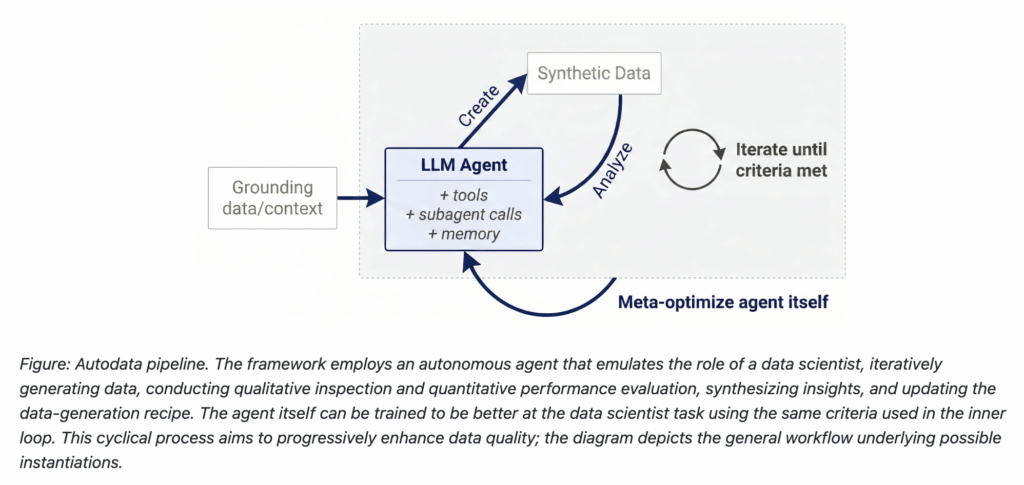
The bottleneck in building better AI models has never been compute alone — it has always been data quality. Meta AI’s RAM (Reasoning, Alignment, and Memory) team is now addressing that bottleneck directly. Meta researchers have introduced Autodata, a framework that deploys AI agents in the role of an autonomous data scientist, tasked with iteratively building, evaluating, and refining training and evaluation datasets — without relying on costly human annotation at every step. And the results, tested on complex scientific reasoning problems, show that this approach doesn’t just match classical synthetic data generation methods — it significantly outperforms them. https://facebookresearch.github.io/RAM/blogs/autodata/ Why Synthetic Data Creation Has Always Been Hard To understand what Autodata is solving, you need to understand how AI training data is typically created today. Most modern AI systems started with human-written data. As models improved, researchers began supplementing that with synthetic data — data generated by the model itself. Synthetic data is attractive because it can generate rare edge cases, reduce the cost of manual labeling, and produce more challenging examples than what naturally exists in public corpora. The dominant approach for generating synthetic data has been Self-Instruct — prompting a large language model (LLM) using zero-shot or few-shot examples to create new training samples. Grounded Self-Instruct methods extended that by grounding generation on documents and other sources to reduce hallucination and increase diversity. CoT Self-Instruct (Chain-of-Thought Self-Instruct) pushed further by using chain-of-thought reasoning during generation to construct more complex tasks more accurately. Most recently, “Self-Challenging” methods allow a challenger agent to interact with tools before proposing a task and accompanying evaluation functions — the closest prior work to what Autodata does. The problem? None of these methods gave researchers a feedback-driven way to actually control or iteratively improve data quality during generation itself. You could filter, evolve, or refine data after the fact — but the generation pipeline remained largely static and single-pass. Autodata changes that. https://facebookresearch.github.io/RAM/blogs/autodata/ What Autodata Actually Does Autodata is a method that allows AI agents to act as data scientists who iteratively build high-quality training and evaluation data. Instead of generating data in a single pass, the agent runs a closed-loop pipeline modeled after how a human data scientist actually works: Data Creation — The agent grounds itself on provided source documents (research papers, code, legal text, etc.) and uses tools and learned skills to generate training or evaluation examples. Data Analysis — The agent then inspects what it created: Is this example correct? High quality? Challenging enough? It synthesizes learnings at the example level and, eventually, at the dataset level (Is it diverse? Does it improve a model when used as training data?). Iteration — Using those learnings, the agent updates its data-generation recipe and loops back to create better data. This continues until a stopping criterion is met. Agentic data creation provides a way to convert increased inference compute into higher quality model training. The more inference-time compute you give the agent, the better the data it produces — a key insight for practitioners managing compute budgets. The Specific Implementation: Agentic Self-Instruct Meta’s initial instantiation of Autodata is called Agentic Self-Instruct, and its architecture is built around a main orchestrator LLM that coordinates four specialized subagents: Challenger LLM — generates a training example (input + response pair) based on a detailed prompt from the main agent Weak Solver — a smaller, less capable model expected to generally fail on the generated example Strong Solver — a more capable model expected to generally succeed Verifier/Judge — evaluates whether each solver’s output meets quality criteria, using rubrics generated by the Challenger LLM An important design note: the Weak and Strong solver can actually be the same LLM operating in different modes. For example, the strong version can be allowed to use increased inference time compute including scaffolding or aggregation, as well as having access to privileged information — giving practitioners flexibility in how they define capability separation. The acceptance criteria are precise and multi-condition. For an example to be accepted into the dataset, all four of the following must hold: The quality verifier (QV) must pass the example weak_avg ≤ 65% and max_weak ≤ 75% with no zero scores strong_avg ≥ 60% and strong_avg < 95% — ensuring the question is neither too hard for everyone nor trivially easy for the strong solver The gap strong_avg − weak_avg ≥ 20% If any of those thresholds aren’t met, the main agent sends targeted feedback to the Challenger and tries again — from a different reasoning angle. This loop typically runs several rounds per paper (median 3–5) before producing an accepted question or exhausting its step budget. The Numbers That Matter The quality gains over standard CoT Self-Instruct are measurable and significant. Under CoT Self-Instruct, the two solvers score nearly identically — weak at 71.4% and strong at 73.3%, a gap of only 1.9 percentage points — showing that single-shot questions fail to find challenging enough tasks for either model. Agentic Self-Instruct drives the weak score down to 43.7% while lifting the strong score to 77.8%, widening the gap to 34 points. The agentic data creation loop produces questions that specifically reward stronger model capabilities, rather than questions both models can answer equally well. The dataset itself was produced by processing over 10,000 CS papers from the S2ORC corpus (2022+), yielding 2,117 QA pairs that satisfy all quality constraints and performance gap requirements. When Qwen-3.5-4B was then trained with GRPO for roughly one epoch (batch size 32, learning rate 1e-6) on Agentic Self-Instruct data versus CoT Self-Instruct data — using Kimi-K2.6 as the reward model to score responses against the generated rubrics — the model trained on agentic data demonstrated a clear advantage on both in-distribution and out-of-distribution test sets. Meta-Optimization: Teaching the Agent to Be a Better Data Scientist Autodata goes one level deeper. Beyond the inner data creation loop, the framework supports meta-optimization of the data scientist agent itself — using the same inner-loop quality criteria to optimize the outer-loop agent harness

Meta Introduces Autodata: An Agentic Framework That Turns AI Models into Autonomous Data Scientists for High-Quality Training Data Creation Lire l’article »

AI, Committee, Actualités, Uncategorized

A New NVIDIA Research Shows Speculative Decoding in NeMo RL Achieves 1.8× Rollout Generation Speedup at 8B and Projects 2.5× End-to-End Speedup at 235B

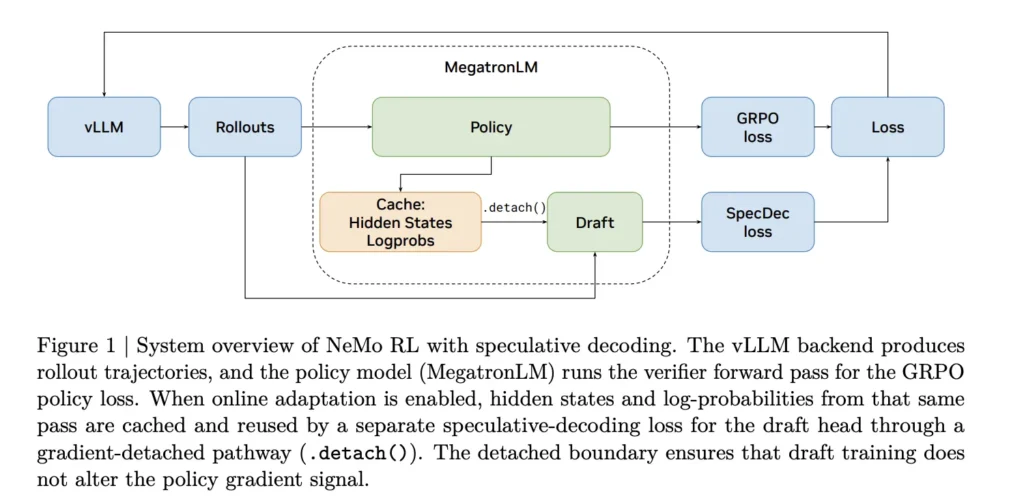
If you have been running reinforcement learning (RL) post-training on a language model for math reasoning, code generation, or any verifiable task, you have almost certainly stared at a progress bar while your GPU cluster burns through rollout generation. A team of researchers from NVIDIA proposes a precise fix by integrating speculative decoding into the RL training loop itself, and do it in a way that preserves the target model’s exact output distribution. The research team integrated speculative decoding directly into NeMo RL v0.6.0 with a vLLM backend, delivering lossless rollout acceleration at both 8B and projected 235B model scales.The latest NeMo RL v0.6.0 release officially ships speculative decoding as a supported feature alongside the SGLang backend, the Muon optimizer, and YaRN long-context training. https://arxiv.org/pdf/2604.26779 Why Rollout Generation is the Bottleneck To understand the problem, it helps to know how a synchronous RL training step breaks down. In NeMo RL, each step consists of five stages: data loading, weight synchronization and backend preparation (prepare), rollout generation (gen), log-probability recomputation (logprob), and policy optimization (train). The research team measured this breakdown on Qwen3-8B under two workloads — RL-Think, which continues training a reasoning-capable model, and RL-Zero, which starts from a base model and learns reasoning from scratch. In both cases, rollout generation accounts for 65–72% of total step time. Log-probability recomputation and training together take only about 27–33%. This makes generation the only stage worth targeting for acceleration, and the one that determines the ceiling for any rollout-side optimization. https://arxiv.org/pdf/2604.26779 What Speculative Decoding Actually Does Speculative decoding is a technique where a smaller, faster draft model proposes several tokens at once, and the larger target model (the one you are actually training) verifies them using a rejection sampling procedure. The key property and why it matters for RL, is that the rejection procedure is mathematically guaranteed to produce the same output distribution as if the target model had generated those tokens autoregressively. No distribution mismatch, no off-policy corrections needed, no change to the training signal. This is important because in RL post-training, the training reward depends on the policy’s own samples. Methods like asynchronous execution, off-policy replay, or low-precision rollouts all trade some amount of training fidelity for throughput. Speculative decoding trades nothing: the rollouts are identical in distribution to what the target model would have generated on its own, just produced faster. The System Integration Challenge Adding a draft model to a serving backend is straightforward. Adding one to an RL training loop is not. Every time the policy updates, the rollout engine must receive new weights. The draft model must remain aligned with the evolving policy. Log-probabilities, KL penalties, and the GRPO policy loss must all be computed against the target (verifier) policy not the draft or the optimization target is silently corrupted. The NVIDIA research team handles this in NeMo RL with a two-path architecture. The general path uses EAGLE-3, a drafting framework that works with any pretrained model without requiring native multi-token prediction (MTP) support. A native path is also available for models that ship with built-in MTP heads. When online draft adaptation is enabled, the hidden states and log-probabilities from the MegatronLM verifier forward pass are cached and reused to supervise the draft head via a gradient-detached pathway, so draft training never interferes with the policy gradient signal. Measured Results at 8B Scale On 32 GB200 GPUs (8 GB200 NVL72 nodes, 4 GPUs per node), EAGLE-3 reduces generation latency from 100 seconds to 56.6 seconds on RL-Zero — a 1.8× generation speedup. On RL-Think, it drops from 133.6 seconds to 87.0 seconds, a 1.54× speedup. Because log-probability re-computation and training are unchanged, these generation-side gains translate to overall step speedups of 1.41× on RL-Zero and 1.35× on RL-Think. Validation accuracy on AIME-2024 evolves identically under autoregressive and speculative decoding throughout training, confirming that the lossless guarantee holds in practice. The research team also tests n-gram drafting as a model-free speculative baseline. Despite achieving acceptance lengths of 2.47 on RL-Zero and 2.05 on RL-Think, n-gram drafting is slower than the autoregressive baseline in both settings — 0.7× and 0.5× respectively. This is a critical finding for practitioners: a positive acceptance length is necessary but not sufficient. If the verification overhead is high enough, speculation makes things worse. Three Configuration Decisions That Determine Realized Speedup The research team isolates three operational choices that practitioners must get right. Draft initialization matters more than generic drafting ability. An EAGLE-3 draft initialized on the DAPO post-training dataset achieves a 1.77× generation speedup on RL-Zero, while a draft initialized on the general-purpose UltraChat and Magpie datasets achieves only 1.51× at the same draft length. The draft must be aligned with the actual rollout distribution encountered during RL, not just a broad chat distribution. Draft length has a non-obvious optimum. At draft length k=3, RL-Zero achieves 1.77× speedup and RL-Think achieves 1.53×. Increasing to k=5 raises the acceptance length but drops speedup to 1.44× on RL-Zero and 0.84× on RL-Think — the latter already slower than autoregressive. At k=7, RL-Zero drops further to 1.21× and RL-Think to 0.71×. The contrast matters: RL-Zero’s rollouts are generated from a base model starting with short outputs, making them easier for the draft to predict even at high k. RL-Think’s fully developed reasoning traces are harder to speculate over, so the overhead of longer drafts erases the benefit sooner. More speculative work per step can erase the benefit of higher acceptance entirely, especially in harder generation regimes. Online draft adaptation — updating the draft during RL using rollouts generated by the current policy helps most when the draft is weakly initialized. For a DAPO-initialized draft, offline and online configurations perform nearly identically (1.77× vs. 1.78× on RL-Zero). For a UltraChat-initialized draft, online updating improves speedup from 1.51× to 1.63× on RL-Zero. Interaction with asynchronous execution was also tested directly at 8B scale not just in simulation. The research team ran RL-Think at policy lag 1 in a 16-node non-colocated configuration, with 12 nodes dedicated to generation

A New NVIDIA Research Shows Speculative Decoding in NeMo RL Achieves 1.8× Rollout Generation Speedup at 8B and Projects 2.5× End-to-End Speedup at 235B Lire l’article »

AI, Committee, Actualités, Uncategorized

A Coding Implementation to Parsing, Analyzing, Visualizing, and Fine-Tuning Agent Reasoning Traces Using the lambda/hermes-agent-reasoning-traces Dataset

In this tutorial, we explore the lambda/hermes-agent-reasoning-traces dataset to understand how agent-based models think, use tools, and generate responses across multi-turn conversations. We start by loading and inspecting the dataset, examining its structure, categories, and conversational format to get a clear idea of the available information. We then build simple parsers to extract key components such as reasoning traces, tool calls, and tool responses, allowing us to separate internal thinking from external actions. Also, we analyze patterns such as tool usage frequency, conversation length, and error rates to better understand agent behavior. We also create visualizations to highlight these trends and make the analysis more intuitive. Finally, we prepare the dataset for training by converting it into a model-friendly format, making it suitable for tasks like supervised fine-tuning. Copy CodeCopiedUse a different Browser !pip -q install -U datasets pandas matplotlib seaborn transformers accelerate trl import json, re, random, textwrap from collections import Counter, defaultdict import pandas as pd import numpy as np import matplotlib.pyplot as plt from datasets import load_dataset, concatenate_datasets random.seed(0) CONFIG = “kimi” ds = load_dataset(“lambda/hermes-agent-reasoning-traces”, CONFIG, split=”train”) print(ds) print(“Config:”, CONFIG, “| Fields:”, ds.column_names) print(“Categories:”, sorted(set(ds[“category”]))) COMPARE_BOTH = False if COMPARE_BOTH: ds_kimi = load_dataset(“lambda/hermes-agent-reasoning-traces”, “kimi”, split=”train”) ds_glm = load_dataset(“lambda/hermes-agent-reasoning-traces”, “glm-5.1″, split=”train”) ds_kimi = ds_kimi.add_column(“source”, [“kimi”] * len(ds_kimi)) ds_glm = ds_glm.add_column(“source”, [“glm-5.1”] * len(ds_glm)) ds = concatenate_datasets([ds_kimi, ds_glm]).shuffle(seed=0) print(“Combined:”, ds, “→ counts:”, Counter(ds[“source”])) sample = ds[0] print(“n=== Sample 0 ===”) print(“id :”, sample[“id”]) print(“category :”, sample[“category”], “/”, sample[“subcategory”]) print(“task :”, sample[“task”]) print(“turns :”, len(sample[“conversations”])) print(“system[0] :”, sample[“conversations”][0][“value”][:220], “…n”) We install all required libraries and import the necessary modules to set up our environment. We then load the lambda/hermes-agent-reasoning-traces dataset and inspect its structure, fields, and categories. We also optionally combine multiple dataset configurations and examine a sample to understand the conversational format. Copy CodeCopiedUse a different Browser THINK_RE = re.compile(r”<think>(.*?)</think>”, re.DOTALL) TOOL_CALL_RE = re.compile(r”<tool_call>s*({.*?})s*</tool_call>”, re.DOTALL) TOOL_RESP_RE = re.compile(r”<tool_response>s*(.*?)s*</tool_response>”, re.DOTALL) def parse_assistant(value: str) -> dict: thoughts = [t.strip() for t in THINK_RE.findall(value)] calls = [] for raw in TOOL_CALL_RE.findall(value): try: calls.append(json.loads(raw)) except json.JSONDecodeError: calls.append({“name”: “<malformed>”, “arguments”: {}}) final = TOOL_CALL_RE.sub(“”, THINK_RE.sub(“”, value)).strip() return {“thoughts”: thoughts, “tool_calls”: calls, “final”: final} def parse_tool(value: str): raw = TOOL_RESP_RE.search(value) if not raw: return {“raw”: value} body = raw.group(1) try: return json.loads(body) except: return {“raw”: body} first_gpt = next(t for t in sample[“conversations”] if t[“from”] == “gpt”) p = parse_assistant(first_gpt[“value”]) print(“Thought preview :”, (p[“thoughts”][0][:160] + “…”) if p[“thoughts”] else “(none)”) print(“Tool calls :”, [(c.get(“name”), list(c.get(“arguments”, {}).keys())) for c in p[“tool_calls”]]) We define regex-based parsers to extract reasoning traces, tool calls, and tool responses from the dataset. We process assistant messages to separate thoughts, actions, and final outputs in a structured way. We then test the parser on a sample conversation to verify that the extraction works correctly. Copy CodeCopiedUse a different Browser N = 3000 sub = ds.select(range(min(N, len(ds)))) tool_calls = Counter() parallel_widths = Counter() thoughts_per_turn = [] calls_per_traj = [] errors_per_traj = [] turns_per_traj = [] cat_counts = Counter() for ex in sub: cat_counts[ex[“category”]] += 1 n_calls = n_err = 0 turns_per_traj.append(len(ex[“conversations”])) for t in ex[“conversations”]: if t[“from”] == “gpt”: p = parse_assistant(t[“value”]) thoughts_per_turn.append(len(p[“thoughts”])) if p[“tool_calls”]: parallel_widths[len(p[“tool_calls”])] += 1 for c in p[“tool_calls”]: tool_calls[c.get(“name”, “<unknown>”)] += 1 n_calls += len(p[“tool_calls”]) elif t[“from”] == “tool”: r = parse_tool(t[“value”]) blob = json.dumps(r).lower() if “error” in blob or ‘”exit_code”: 1’ in blob or “traceback” in blob: n_err += 1 calls_per_traj.append(n_calls) errors_per_traj.append(n_err) print(f”nScanned {len(sub)} trajectories”) print(f”Avg turns/traj : {np.mean(turns_per_traj):.1f}”) print(f”Avg tool calls/traj : {np.mean(calls_per_traj):.1f}”) print(f”% with >=1 error : {100*np.mean([e>0 for e in errors_per_traj]):.1f}%”) print(f”% parallel turns : {100*sum(v for k,v in parallel_widths.items() if k>1)/max(1,sum(parallel_widths.values())):.1f}%”) print(“Top 10 tools :”, tool_calls.most_common(10)) fig, axes = plt.subplots(2, 2, figsize=(13, 9)) top = tool_calls.most_common(15) axes[0,0].barh([t for t,_ in top][::-1], [c for _,c in top][::-1], color=”teal”) axes[0,0].set_title(“Top 15 tools by call volume”) axes[0,0].set_xlabel(“calls”) ks = sorted(parallel_widths) axes[0,1].bar([str(k) for k in ks], [parallel_widths[k] for k in ks], color=”coral”) axes[0,1].set_title(“Tool-calls per assistant turn (parallel width)”) axes[0,1].set_xlabel(“# tool calls in one turn”); axes[0,1].set_ylabel(“count”) axes[0,1].set_yscale(“log”) axes[1,0].hist(turns_per_traj, bins=40, color=”steelblue”) axes[1,0].set_title(“Conversation length”); axes[1,0].set_xlabel(“turns”) cats, vals = zip(*cat_counts.most_common()) axes[1,1].pie(vals, labels=cats, autopct=”%1.0f%%”, startangle=90) axes[1,1].set_title(“Category distribution”) plt.tight_layout(); plt.show() We perform dataset-wide analytics to measure tool usage, conversation lengths, and error patterns. We aggregate statistics across multiple samples to understand overall agent behavior. We also create visualizations to highlight trends such as tool frequency, parallel calls, and category distribution. Copy CodeCopiedUse a different Browser def render_trace(ex, max_chars=350): print(f”n{‘=’*72}nTASK [{ex[‘category’]} / {ex[‘subcategory’]}]: {ex[‘task’]}n{‘=’*72}”) for t in ex[“conversations”]: role = t[“from”] if role == “system”: continue if role == “human”: print(f”n[USER]n{textwrap.shorten(t[‘value’], 600)}”) elif role == “gpt”: p = parse_assistant(t[“value”]) for th in p[“thoughts”]: print(f”n[THINK]n{textwrap.shorten(th, max_chars)}”) for c in p[“tool_calls”]: args = json.dumps(c.get(“arguments”, {}))[:200] print(f”[CALL] {c.get(‘name’)}({args})”) if p[“final”]: print(f”n[ANSWER]n{textwrap.shorten(p[‘final’], max_chars)}”) elif role == “tool”: print(f”[TOOL_RESPONSE] {textwrap.shorten(t[‘value’], 220)}”) print(“=”*72) idx = int(np.argmin(np.abs(np.array(turns_per_traj) – 10))) render_trace(sub[idx]) def get_tool_schemas(ex): try: return json.loads(ex[“tools”]) except: return [] schemas = get_tool_schemas(sample) print(f”nSample 0 has {len(schemas)} tools available”) for s in schemas[:3]: fn = s.get(“function”, {}) print(” -“, fn.get(“name”), “—”, (fn.get(“description”) or “”)[:80]) ROLE_MAP = {“system”: “system”, “human”: “user”, “gpt”: “assistant”, “tool”: “tool”} def to_openai_messages(conv): return [{“role”: ROLE_MAP[t[“from”]], “content”: t[“value”]} for t in conv] example_msgs = to_openai_messages(sample[“conversations”]) print(“nFirst 2 OpenAI messages:”) for m in example_msgs[:2]: print(” “, m[“role”], “→”, m[“content”][:120].replace(“n”, ” “), “…”) We build utilities to render full conversation traces in a readable format for deeper inspection. We also extract tool schemas and convert the dataset into OpenAI-style message format for compatibility with training pipelines. This helps us better understand both the structure of tools and how conversations can be standardized. Copy CodeCopiedUse a different Browser from transformers import AutoTokenizer TOK_ID = “Qwen/Qwen2.5-0.5B-Instruct” tok = AutoTokenizer.from_pretrained(TOK_ID) def build_masked(conv, tokenizer, max_len=2048): msgs = to_openai_messages(conv) for m in msgs: if m[“role”] == “tool”: m[“role”] = “user” m[“content”] = “[TOOL OUTPUT]n” + m[“content”] input_ids, labels = [], [] for m in msgs: text = tokenizer.apply_chat_template([m], tokenize=False, add_generation_prompt=False) ids = tokenizer.encode(text, add_special_tokens=False) input_ids.extend(ids) labels.extend(ids if m[“role”] == “assistant” else [-100] * len(ids)) return input_ids[:max_len], labels[:max_len] ids, lbls = build_masked(sample[“conversations”], tok) trainable = sum(1 for x in lbls if x != -100) print(f”nTokenized example: {len(ids)} tokens, {trainable} trainable ({100*trainable/len(ids):.1f}%)”) think_lens, call_lens, ans_lens = [], [], []

A Coding Implementation to Parsing, Analyzing, Visualizing, and Fine-Tuning Agent Reasoning Traces Using the lambda/hermes-agent-reasoning-traces Dataset Lire l’article »

AI, Committee, Actualités, Uncategorized

Trump’s mass firing just dealt another blow to American science

This past week delivered another gut punch for science in the US. This time, the target was the National Science Foundation—a federal agency that funds major research projects to the tune of around $9 billion. The foundation’s efforts were overseen by a board of 22 prominent scientists. On Friday last week, they were all fired. The NSF has been without a director since April 2025, when former director Sethuraman Panchanathan stepped down in the wake of DOGE-led funding cuts and mass firings. Trump’s nominee for the role is Jim O’Neill, an investor and longevity enthusiast who does not have a science background. It’s hard to predict exactly how things will shake out for science. But it’s not looking great. The NSF was established in 1950 to “promote the progress of science,” among other goals. It has served as a major source of support for research and education since then. In 2024, the agency spent $9.39 billion—a substantial figure but only 0.1% of all federal spending. Key decisions about how that money is spent have been made by the National Science Board. Each of the scientists who made up the board until last week was appointed by a US president to serve, at least initially, a six-year term. Those members were responsible for establishing NSF policies, authorizing major expenditures and providing oversight, says Keivan Stassun, a physicist and astronomer at Vanderbilt University who was appointed to the board in late 2022. A few years ago, the board was responsible for establishing a new “directorate” within the agency to channel funding to “technology, innovations and partnerships,” for example. The board also authorized funding for the US Extremely Large Telescope Program. “It’s a relatively small group with a tremendous amount of responsibility and authority,” says Stassun. He viewed his appointment as “a tremendous honor.” Then, last Friday, the email landed in his inbox. “It said: On behalf of President Trump, this letter is to notify you that your position as a member of the National Science Board is terminated effective immediately. Thank you for your service,” says Stassun. “It was deeply disappointing.” Still, Stassun wasn’t surprised, given the administration’s actions across federal science agencies over the past year. Since Donald Trump took office at the start of 2025, the NSF—along with many other federal agencies—has frozen, unfrozen, and terminated grants. “The board was not involved in any of those [terminations],” says Stassun. Members had no say in the firing of agency staff either, he says. Staff numbers are currently down 40%, he adds. In a 2026 budget request, the Trump administration sought to cut the NSF’s budget by around 57%. Last summer, NSF staffers wrote a letter of dissent arguing that such substantial cuts would “cripple American science.” The proposed cuts would have hit biological sciences, engineering, and STEM education particularly hard. Those cuts were rejected by Congress earlier this year. But grant terminations and firings are essentially allowing them to take effect regardless, says Stassun. “The funds that the White House has been dispersing to the agency … have been far less than what Congress intended,” he says. Many ambitious research projects are grinding to a halt as a result. “The Extremely Large Telescope Program appears to be dead in the water for now,” says Stassun. And the NSF arm dedicated to science education “has effectively zeroed out,” he says. But not all of them. While the administration’s 2027 budget request states that NSF will “close out” its directorate for social, behavioral, and economic sciences, it describes AI and quantum information science as key “frontier initiatives.” Biotechnology is described as a “focal point.”  When asked for comment, the NSF directed MIT Technology Review to the White House press office. The White House did not respond directly to questions about the firing of NSB members and said in a statement, “The National Science Foundation’s work continues uninterrupted.” Jim O’Neill, Trump’s current candidate for the position of NSF director, is certainly interested in biotechnology. Specifically, when I spoke to O’Neill in February, he told me that he supposes he is a Vitalist—a hardcore supporter of efforts to extend human longevity who believes that death is wrong. O’Neill was deputy secretary of the Department of Health and Human Services and acting director of the Centers for Disease Control and Prevention until a leadership shakeup a couple of months ago. But he isn’t a scientist. And that has some scientists worried. He has yet to be confirmed by the Senate for the role. In the meantime, the administration’s efforts are having a real impact on research. “We [NSB members] tried to stand for a continued investment in science, engineering, and technology, and in science education broadly,” says Stassun. “The administration will now be able to operate the agency the way that [it wants to, with] no governance body in the way.”

Trump’s mass firing just dealt another blow to American science Lire l’article »

AI, Committee, Actualités, Uncategorized

A new US phone network for Christians aims to block porn and gender-related content

A new US-wide cell phone network marketed to Christians is set to launch next week. It blocks porn, which experts in network security say marks the first time a US cell plan has used network-level blocking for such content that can’t be turned off even by adult account owners. It’s also rolling out a filter on sexual content aimed at blocking material related to gender and trans issues, which will be optional but turned on by default across all plans. The network, which is currently being tested ahead of its May 5 launch date, will be run by Radiant Mobile, a newly launched mobile virtual network operator (MVNO). These operators don’t own cell towers but buy bandwidth from the big providers (in this case, T-Mobile) and sell to specific demographics (President Trump announced his own MVNO last year called Trump Mobile; CREDOMobile sends donations to progressive causes).  “We are going to create—and we think we have every right to do so—an environment that is Jesus-centric, that is void of pornography, void of LGBT, void of trans,” Radiant Mobile’s founder, Paul Fisher, told MIT Technology Review. A representative for T-Mobile did not comment on whether these content blocks violate any of its policies. In a statement, the representative added that T-Mobile does not have a direct relationship with Radiant Mobile but instead works through the MVNO manager CompaxDigital.  Fisher says he’s recruited a mix of Christian influencers to advertise the plan and has also done outreach to thousands of churches around the country, offering a way to have Radiant donate a portion of congregants’ $30-per-month subscription fee to their church. Fisher has ambitions to market it beyond the US in other countries with significant Christian populations, like South Korea and Mexico. At least one piece of Radiant’s pitch will sound familiar: the idea that the internet is awash in toxic sludge. It’s powered by content and algorithms that are making us more sad, hateful, and detached. A number of efforts aim to fix that, including contentious age verification laws and a coming wave of lawsuits alleging that social media companies knowingly got young users hooked on their platforms.  Fisher is pursuing the nuclear option. He says Radiant is working with the Israeli cybersecurity company Allot to block categories of content, such as material about violence or self-harm. Some categories are banned by default and cannot be allowed even for adult users.  This includes pornography. Chris Klimis, a minister in Orlando who was recruited to be the company’s chief operating officer, says part of the reason he got involved was to offer Christians a real way to “do something” about what he sees as a pornography crisis in the faith. He was appalled by a recent survey showing that 67% of pastors have a “personal history” with porn use. And he worries his six children will come across porn on their devices, even if only inadvertently. “We’ve got to figure out some way to close the door to the digital space,” he says. “That’s what we’re trying to do.” The technology to do this blocking is a blunt instrument: Allot groups website domains into more than a hundred categories, which include pornography but also violence, malware, gaming, and in Radiant Mobile’s case “sects,” which includes websites about Satanism. If one of its users tries to visit a website that belongs to a blocked category, the page won’t load. That’s harsher than app-based content blockers like Covenant Eyes, a Christian porn-quitting app that sends notifications to your friends or family if you slip up; those can be worked around or deleted. “Blocking in the network is certainly not new,” says David Choffnes, a computer science professor and executive director of Northeastern University’s Cybersecurity and Privacy Institute. Such blocking is the backbone of censorship efforts by authoritarian governments, for example. But there are more benign ways it’s used too. US telecoms block particular domains known to be spreading malware and offer optional network-level controls to block adult content on kids’ phones. What is new is a US cell plan instituting network-level blocks that can’t be removed, even by adults. The trouble is that most websites don’t fit neatly into one category, leaving Fisher with enormous and subjective control over which are allowed or banned. This is most apparent in his effort to block content related to gender identity. Anthony Re, a sales director at Allot, says the company does not have a category specific to gender but that “LGBT content” tends to fall into its sexuality category, which is described on Radiant Mobile’s website as “sites that provide information on sex, sex and teenagers, and sexual education, without pornographic content.” This category is blocked by default for all phones, a setting that can be changed by adult account owners.  But if a news site starts hosting enough gender-related content, Fisher might not just label it as “press,” which is allowed, but also “sexuality,” thus blocking the whole domain to any phone with that category blocked.  Fisher illustrates the subjectivity of such decisions with a recent example involving Yale University. Its general website, www.yale.edu, is categorized by Allot as education. “But they have a subsection of one of their websites that’s totally focused on, you know, trans equality,” Fisher says, referring to lgbtq.yale.edu. Because it’s a distinct domain, Radiant Mobile is able to place it in the sexuality category and block it.  Yale’s main website remains unblocked, for now. “If we see [the LGBTQ content] on the front pages consistently of Yale University, we’ll block them too,” Fisher says. Managing website block lists is a professional pivot for Fisher, who spent his career not in telecoms but in fashion; he was an agent for supermodels like Naomi Campbell and members of the Hilton and Getty families, and he later hosted a reality show in which he found people in rehab facilities and homeless shelters and tried to turn them into models. He ultimately left the industry and now says he regrets the role he

A new US phone network for Christians aims to block porn and gender-related content Lire l’article »

AI, Committee, Actualités, Uncategorized

Inexpensive seafloor-hopping submersibles could stoke deep-sea science—and mining

Smack dab between Australia and South America, the US National Oceanic and Atmospheric Administration (NOAA) research vessel Rainier is currently on a mission to map more than 8,000 square nautical miles of the Pacific seafloor in search of critical mineral deposits. But it isn’t doing it alone; for a month starting this week, it will deploy two oblong neon submersibles as the project’s special agents, sending them nearly 6,000 meters down to hop along the seafloor.  The submersibles, built by the young company Orpheus Ocean, are designed to explore just this environment: a squelchy substrate that teems with life of all kinds, from tiny microbes to worms and snails, along with egg-size “nodules” of metals—such as copper, cobalt, nickel, and manganese—that are crucial for technologies worldwide.   Scientists and companies have long sought to probe the deep sea and bring such treasures to the surface. Orpheus, which spun off from the Woods Hole Oceanographic Institution (WHOI) in 2024, could be well positioned to make those possibilities a lot more economical. The company has designed its vehicles on a simple philosophy: “deep for cheap,” says Jake Russell, Orpheus’s cofounder and CEO, who is a chemist by training. The vehicles cost a couple of hundred thousand dollars each to build, whereas existing options can range from $5 million to $10 million. And unlike most autonomous ocean vehicles, they can push into the seafloor and capture cores of sediment—and the creatures within.  Orpheus’s engineers have been tinkering with their deep-sea designs for years, much of the work taking place at WHOI and in collaboration with NOAA and the National Aeronautics and Space Administration. Its prototype vehicles were rated capable of diving to 11,000 meters—the deepest part of the Mariana Trench. They’ve completed two commercial deployments, but this new expedition marks the submersibles’ biggest test yet: operating over large ranges for multiple weeks and with multiple instruments at play. Using Rainier as their home base on the ocean’s surface, the vehicles will swim out for 10 kilometers at a time, taking one high-resolution image every second and up to eight physical samples from the seafloor apiece. If all goes well, the test could help establish the vehicles as a tool for government agencies, scientists, and companies that hope to probe the vastly understudied deep sea and the resources it holds. And while they’re not the only option on the market, Orpheus hopes their size and low building cost will soon make them one of the most accessible.  At present, to reach these depths scientists must wait for time on a limited and expensive set of submersibles owned by government agencies and research institutes. That formula lends itself better to capturing snapshots of the deep sea than it does to probing its interconnected ecological and biogeochemical systems. “A lot of this region that we’re surveying … has really never been explored in any kind of detail,” says Russell. “Anything we see is going to be new to NOAA and new to science.” A sediment specialist The Orpheus subs are classified as autonomous underwater vehicles (AUVs), which operate on a mix of preprogrammed commands and live decision-making and without being tethered to a ship. But unlike traditional AUVs engineered for long-distance, high-speed gliding, these submersibles are short and stout with little legs—better for making soft landings on the seafloor and then pushing into the mud to suck out sediment cores for scientists. When they do land, the submersibles can lift off the surface, thrust a few feet, and settle once more in a “hopping” fashion. Their bodies are made mostly of a buoyant material known as syntactic foam, with the important electronics encased in a thick sphere of glass. The same kind of foam, which is interspersed with hollow microspheres of glass to prevent it from collapsing under high pressures, went to the deep in the vehicle that carried the filmmaker James Cameron to the Mariana Trench in 2012; he even donated leftover material for use in earlier Orpheus prototypes.  At less than two meters in length and under 600 pounds (270 kilograms), Russell says the Orpheus robots are the smallest—and correspondingly the least expensive—ocean vehicles on the market capable of descending to 6,000 meters. They’re designed to populate future fleets of robotic explorers. The approach stems from a fundamental challenge, says Victoria Orphan, a geobiologist at the California Institute of Technology, who has previously worked with an Orpheus vehicle on a science campaign: “Anytime you do things in the deep ocean, you always run this risk, when you put something over the side [of a ship], that it might not come back.” With existing fleets of large, expensive vessels operated by groups like NOAA, WHOI, and the Monterey Bay Aquarium Research Institute (MBARI), losing a vehicle can be disastrous, not least because scientists must already compete for their limited time. In the spring of 2024, Orphan and her colleagues put an Orpheus sub through its paces during an expedition to study deep-sea methane seeps off the coast of Alaska’s Aleutian Islands. They hoped to use the vehicle to create maps of the area before the team sent down a human-crewed submersible called Alvin to study specific areas—and the microorganisms and animals that live there—in more detail.  But as with any sort of new type of technology, “there’s always growing pains,” recalls Orphan. Frigid temperatures and steep topography added unseen challenges, and it took the full three weeks for the sub to get high-resolution photographs of the seeps.  The setback didn’t dull Orphan’s excitement about the potential of these machines. “There’s a lot of real, unknown science right at that interface between the sediment and the ocean surface,” she says. “The Orpheus-type class of instrument, with the right kinds of sensors and samplers, could be a very enabling tool.” Russell envisions pairing the vehicles with specially designed payloads that can sense the heat of chemical seeps and detect plumes of sediment, DNA shed from ocean life-forms, or the magnetic tug of buried cables.  The vehicles are

Inexpensive seafloor-hopping submersibles could stoke deep-sea science—and mining Lire l’article »

AI, Committee, Actualités, Uncategorized

The Download: a new Christian phone network, and debugging LLMs

This is today’s edition of The Download, our weekday newsletter that provides a daily dose of what’s going on in the world of technology. A new US phone network for Christians aims to block porn and gender-related content A new US-wide cell phone network marketed to Christians is set to launch next week. It blocks porn using network-level controls that can’t be turned off—even by adult account owners. It’s also rolling out a filter on sexual content aimed at blocking material related to gender and trans issues, optional but turned on by default across all plans. The trouble is, many websites don’t fit neatly into one category. That leaves its maverick founder with broad, subjective control over what is allowed or banned. Read the full story. —James O’Donnell This startup’s new mechanistic interpretability tool lets you debug LLMs The San Francisco–based startup Goodfire has released a new tool, Silico, that lets researchers peer inside an AI model and adjust its parameters during training. It could give users more control over how this technology is built than was once thought possible. The goal is to make building AI models less like alchemy and more like a science. Using a technique called mechanistic interpretability, Silico maps the neurons and pathways inside a model and lets developers tweak them to reduce unwanted behaviors or steer outputs. By exposing the “knobs and dials,” Goodfire hopes to bring AI training closer to traditional software engineering. Read the full story. —Will Douglas Heaven With mass firing, Trump deals a fresh blow to American science This past week delivered another gut punch for science in the US. This time, the target was the National Science Foundation—a federal agency that funds major research projects to the tune of around $9 billion. On Friday, the 22 scientists overseeing those efforts were all fired. Since 2025, the NSF has faced budget cuts, grant terminations, and mass firings, with staff numbers down sharply and many ambitious projects grinding to a halt. The result is a major shift in how American science is funded and governed. Discover what it means, and what’s next. —Jessica Hamzelou This article first appeared in The Checkup, MIT Technology Review’s weekly biotech newsletter. To receive it in your inbox every Thursday, and read articles like this first, sign up here. China’s open-source bet: 10 Things That Matter in AI Right Now Silicon Valley AI companies follow a familiar playbook: keep the models behind an API and charge for access. China’s leading AI labs are playing a different game, releasing “open-weight” models that developers can download, adapt, and run on their own hardware. That approach went mainstream after DeepSeek open-sourced its R1 model, which matched top US systems at a fraction of the cost. It also won something subtler: goodwill with developers. A growing cohort of Chinese labs is now following the same blueprint. As AI shifts from hype to deployment, open-source models are making the future of AI more multipolar than Silicon Valley expected. Read the full story. —Caiwei Chen China’s open-source bet is one of the 10 Things That Matter in AI Right Now, our list of the biggest ideas, trends, and advances in AI today. We’re unpacking one item from the list each day here in The Download, so stay tuned. The must-reads I’ve combed the internet to find you today’s most fun/important/scary/fascinating stories about technology. 1 Elon Musk has admitted that xAI trained Grok on OpenAI models“Distillation” is standard practice in AI, despite being legally dubious. (Wired $)+ The White House has accused Chinese firms using distillation of theft. (BBC)+ American labs are widely assumed to use similar techniques. (TechCrunch) 2 A “de-extinction” startup wants to resurrect a long-lost antelopeColossal Biosciences wants to bring back the bluebuck. (Axios)+ The company is using genomic editing to revive the animal. (Gizmodo)+ It previously claimed to have cloned red wolves. (MIT Technology Review) 3 ​​An OpenAI model outperformed ER doctors at diagnosing patientsBy analyzing health records data and information provided to physicians. (NPR)+ But it still must be proven in real-world clinical trials. (Vox) 4 Scientists are trying to power AI data centers with tiny nuclear reactorsThey could provide a new way to meet AI’s energy demands. (Gizmodo)+ We did the math on AI’s energy footprint. (MIT Technology Review) 5 Spotify has started verifying human artistsA new badge will distinguish them from AI. (The Guardian)+ Spotify has faced criticism for its handling of AI. (BBC) 6 The US is backing a Congolese railway to break China’s grip on critical mineralsThe old railroad is key to the race for critical metals in Africa. (Rest of World)+ The US is also searching for alternative sources. (MIT Technology Review) 7 Huawei is set to overtake Nvidia in China’s AI chip marketIt’s expected to capture the largest market share this year. (FT $) 8 Japan is building cardboard drones for the battlefieldThe flatpack designs are cheap, disposable, and built at scale. (404 Media) 9 The more young people use AI, the more they hate itResearch shows that Gen Z doesn’t trust GenAI. (The Verge) 10 A new organoid can menstruate—and show how tissue repairs itselfIt’s revealing how the uterus can shed without scarring. (Nature) Quote of the day “I suspect that there are a number of people who do not want to put the future of humanity in Mr Musk’s hands. But we’re not going to get into that.” —Judge Gonzalez Rogers rebukes attempts by Elon Musk’s lawyer to focus on AI’s existential risks as part of his lawsuit against OpenAI, the New York Times reports.  One More Thing TMY350 VIA WIKIMEDIA COMMONS This rare earth metal shows us the future of our planet’s resources The materials we need to power our world are shifting from fossil fuels to energy sources that don’t produce greenhouse gas emissions. Take neodymium, a rare earth metal used in powerful magnets that power everything from smartphones to wind turbines. Its story reveals many of the challenges we’ll likely face across the supply chain in

The Download: a new Christian phone network, and debugging LLMs Lire l’article »

AI, Committee, Actualités, Uncategorized

Operationalizing AI for Scale and Sovereignty

Companies are taking control of their own data to tailor AI for their needs. The challenge lies in balancing ownership with the safe, trusted flow of high‑quality data needed to power reliable insights. This conversation from MIT Technology Review’s EmTech AI conference examines how AI factories unlock new levels of scale, sustainability, and governance—positioning data control as a strategic imperative for governments and enterprises. About the speakers Chris Davidson, Vice President, HPC & AI Customer Solutions, HPE Chris Davidson is Vice President of HPC & AI Customer Solutions at Hewlett Packard Enterprise. He leads HPE’s global strategy for AI Factory solutions and Sovereign AI, working with governments, enterprises, and research institutions to build secure, scalable national- and enterprise-grade AI capabilities. He also directs Product Management and Performance Engineering across HPE’s HPC and AI portfolio, including large-model training platforms and Cray exascale systems. His teams define product strategy, performance architecture, and deployment models that position HPE at the forefront of high-performance and AI computing. During his nine years at HPE, Chris has led key initiatives across Performance Engineering, AI Cloud, and Professional Services, shaping how HPE delivers optimized, cloud-native, and globally deployed high-performance systems. He previously held technical and leadership roles in the biotech and medical diagnostics sectors. Chris holds an M.B.A. in Entrepreneurship and Finance and a B.S. in Biology from Loyola University Chicago. Arjun Shankar, Division Director, National Center for Computational Science, Oak Ridge National Laboratory Mallikarjun (Arjun) Shankar is the Division Director for the National Center for Computational Science at the Oak Ridge National Laboratory. His research focuses on the interdisciplinary bridge between computer science and large-scale scientific discovery campaigns that rely on scalable computing and data science. He is a joint faculty appointee at the University of Tennessee’s Bredesen Center, a senior member of the IEEE and a senior member of the ACM.

Operationalizing AI for Scale and Sovereignty Lire l’article »

AI, Committee, Actualités, Uncategorized

Faithfulness-Aware Uncertainty Quantification for Fact-Checking the Output of Retrieval Augmented Generation

arXiv:2505.21072v5 Announce Type: replace Abstract: Large Language Models (LLMs) enhanced with retrieval, an approach known as Retrieval-Augmented Generation (RAG), have achieved strong performance in open-domain question answering. However, RAG remains prone to hallucinations: factually incorrect outputs may arise from inaccuracies in the model’s internal knowledge and the retrieved context. Existing approaches to mitigating hallucinations often conflate factuality with faithfulness to the retrieved evidence, incorrectly labeling factually correct statements as hallucinations if they are not explicitly supported by the retrieval. In this paper, we introduce FRANQ, a new method for hallucination detection in RAG outputs. FRANQ applies distinct uncertainty quantification (UQ) techniques to estimate factuality, conditioning on whether a statement is faithful to the retrieved context. To evaluate FRANQ and competing UQ methods, we construct a new long-form question answering dataset annotated for both factuality and faithfulness, combining automated labeling with manual validation of challenging cases. Extensive experiments across multiple datasets, tasks, and LLMs show that FRANQ achieves more accurate detection of factual errors in RAG-generated responses compared to existing approaches.

Faithfulness-Aware Uncertainty Quantification for Fact-Checking the Output of Retrieval Augmented Generation Lire l’article »

AI, Committee, Actualités, Uncategorized

Cursor Introduces a TypeScript SDK for Building Programmatic Coding Agents With Sandboxed Cloud VMs, Subagents, Hooks, and Token-Based Pricing

Cursor, the AI-powered code editor, is opening up the core technology behind its coding agents to developers everywhere. The Cursor team announced the public beta of the Cursor SDK — a TypeScript library that gives engineers programmatic access to the same runtime, harness, and models that power Cursor’s desktop app, CLI, and web interface. This signals a meaningful shift in how AI coding tools are being positioned: not just as interactive assistants sitting alongside a developer, but as deployable infrastructure that organizations can wire into their existing systems. From Interactive Tool to Programmable Infrastructure If you’ve used Cursor before, you know it as an IDE where you interact with an agent in real time — asking it to write functions, fix bugs, or explain code. The Cursor SDK changes the access model. Instead of a developer sitting at a keyboard, the agent can now be invoked programmatically: from a CI/CD pipeline trigger, a backend service, or embedded directly inside another product. Think of it this way: previously, you had to be “in” Cursor to use its agents. Now, you can call those same agents from anywhere in your stack with a few lines of TypeScript. Getting started is a single command: Copy CodeCopiedUse a different Browser npm install @cursor/sdk From there, you create an Agent instance, send it a task, and stream the response back — all in TypeScript. Here’s the minimal example from Cursor’s announcement: Copy CodeCopiedUse a different Browser import { Agent } from “@cursor/sdk”; const agent = await Agent.create({ apiKey: process.env.CURSOR_API_KEY!, model: { id: “composer-2” }, local: { cwd: process.cwd() }, }); const run = await agent.send(“Summarize what this repository does”); for await (const event of run.stream()) { console.log(event); } The Agent.create() call accepts an apiKey, a model field (where you specify which model to run), and either a local or cloud configuration depending on where you want execution to happen. Why Building Your Own Agent Stack is Hard Before diving into what the SDK offers, it’s worth understanding the problem it solves. Building fast, reliable, and capable coding agents that run safely against your data requires meaningful engineering effort: secure sandboxing, durable state and session management, environment setup, and context management. And when a new model ships, dev teams often have to rework their agent loops entirely just to take advantage of it. The Cursor SDK eliminates this complexity so teams can focus on building useful agents instead of maintaining the underlying infrastructure. https://cursor.com/blog/typescript-sdk The Agent Harness: What “Same Runtime” Actually Means SDK agents use the same harness that powers Cursor’s own products. ‘Harness’ here refers to the full set of supporting infrastructure that makes an agent effective beyond just the LLM call itself. In Cursor’s case, that includes: Intelligent context management — Codebase indexing, semantic search, and instant grep so agents retrieve the right code context before generating responses. This is critical because LLMs are only as good as the context they receive; poor retrieval leads to hallucinated or irrelevant outputs. MCP servers — Agents launched through the SDK can connect to external tools and data sources over stdio or HTTP, either via a .cursor/mcp.json config file or passed inline in the API call. MCP (Model Context Protocol) is an open standard for wiring tools into agent runtimes. Skills — Agents automatically pick up reusable behavior definitions from a .cursor/skills/ directory in the repository. Hooks — A .cursor/hooks.json file lets you observe, control, and extend the agent loop across cloud, self-hosted, and local runtimes — useful for logging, guardrails, or custom orchestration. Subagents — The main agent can delegate subtasks to named subagents with their own prompts and models via the Agent tool, enabling multi-agent workflows without custom orchestration code. Cloud Deployment: Persistent, Sandboxed, and Resumable One of the more practical features of the SDK is cloud execution. When configured to run in Cursor’s cloud, each agent gets its own dedicated VM with strong sandboxing, a clone of the target repository, and a fully configured development environment. Critically, the agent keeps running even if the initiating machine goes offline — the developer can reconnect and stream the conversation later. Cloud agents integrate with Cursor’s existing Agents Window and web app, so a task started programmatically via the SDK can be inspected or taken over manually inside the Cursor interface. When the agent finishes, it can open a PR, push a branch, or attach demos and screenshots — making them suitable for asynchronous, unattended workflows: Copy CodeCopiedUse a different Browser const agent = await Agent.create({ apiKey: process.env.CURSOR_API_KEY!, model: { id: “gpt-5.5” }, cloud: { repos: [{ url: “https://github.com/cursor/cookbook”, startingRef: “main” }], autoCreatePR: true, }, }); const run = await agent.send(“Fix the auth token expiry bug”); console.log(`Started ${run.id}`); // …check back in later, from anywhere: const result = await ( await Agent.getRun(run.id, { runtime: “cloud”, agentId: run.agentId }) ).wait(); console.log(result.git?.branches[0]?.prUrl); For dev teams with security requirements, the SDK also supports self-hosted workers, where both code and tool execution remain inside the organization’s own network. Model Flexibility and Composer 2 The SDK exposes every model supported in Cursor. Switching models is a single field change in the model parameter, letting teams route tasks to the best model for a given combination of cost and capability. Cursor’s own Composer 2 — described as a specialized coding model achieving frontier-level performance at a fraction of the cost of general-purpose models — is positioned as the default recommendation for most coding agent tasks. Getting Started To accelerate adoption, Cursor has published a public cookbook repository on GitHub with four starter projects: a minimal quickstart (a Node.js example that creates a local agent, sends one prompt, and streams the response), a web-based prototyping tool for scaffolding new projects in a sandboxed cloud environment, an agent-powered kanban board that automatically opens PRs when engineers drag a card, and a lightweight coding agent CLI for spawning Cursor agents from the terminal. Cursor has also released a Cursor SDK plugin in the Cursor Marketplace to help developers start building directly from within the editor.

Cursor Introduces a TypeScript SDK for Building Programmatic Coding Agents With Sandboxed Cloud VMs, Subagents, Hooks, and Token-Based Pricing Lire l’article »

We use cookies to improve your experience and performance on our website. You can learn more at Politique de confidentialité and manage your privacy settings by clicking Settings.

Privacy Preferences

You can choose your cookie settings by turning on/off each type of cookie as you wish, except for essential cookies.

Allow All
Manage Consent Preferences
  • Always Active

Save
fr_FR