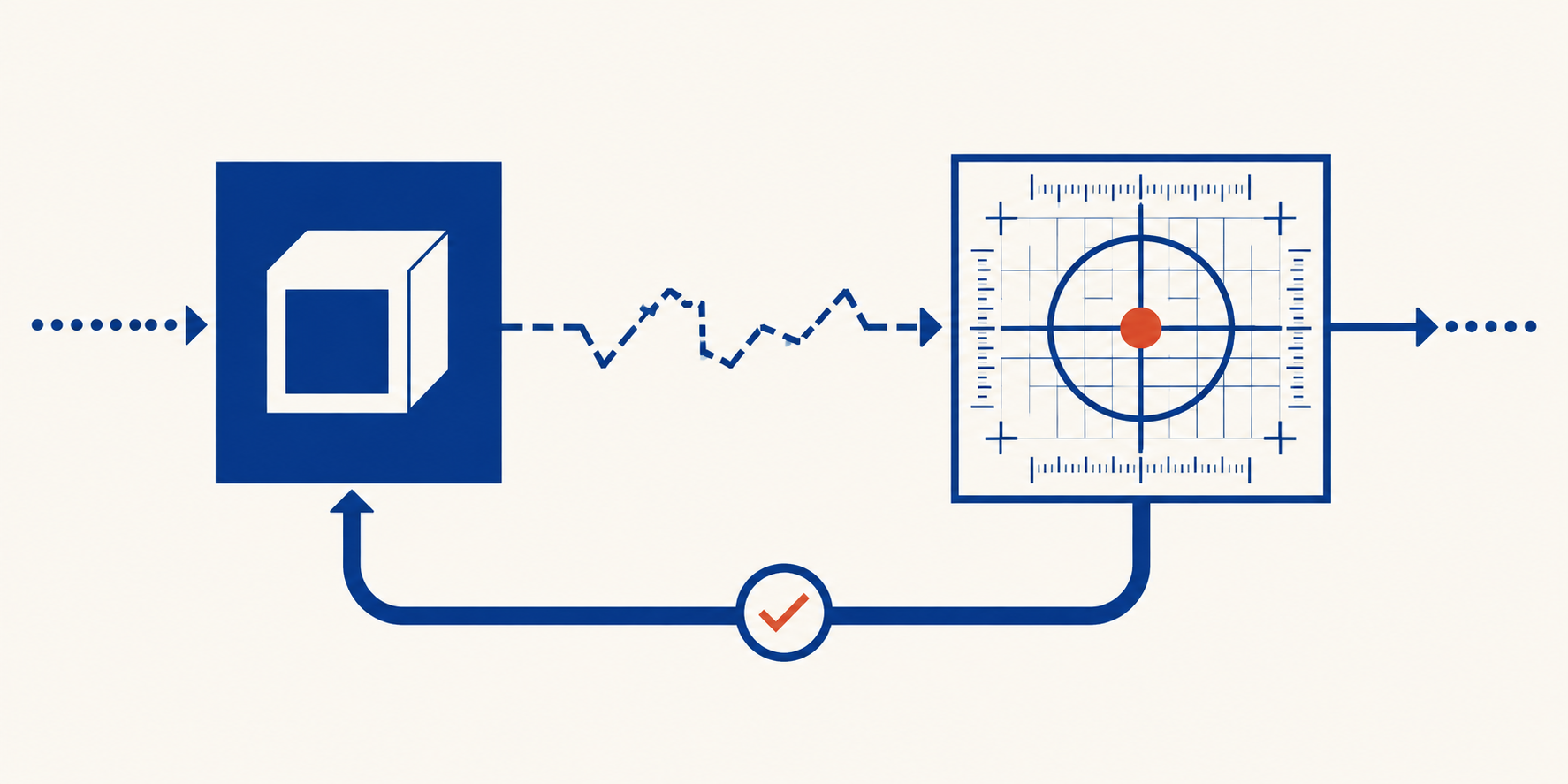
Designing AI Agents That Can Self-Correct
With the vocabulary and the failure modes in place, here’s the build.
Designing AI Agents That Can Self-Correct Lire l’article »


With the vocabulary and the failure modes in place, here’s the build.
Designing AI Agents That Can Self-Correct Lire l’article »
This is today’s edition of The Download, our weekday newsletter that provides a daily dose of what’s going on in the world of technology. Google’s AI empire is being reshaped. Here’s what’s changed. After a wave of painful losses in the tech talent wars, delays to its next flagship model, and murmurings of poor morale, Google has announced a major shake-up to its AI operations. Here’s a quick rundown of what’s happened and why it matters. DeepMind CEO Demis Hassabis is stepping back from running the unit day-to-dayHe’s becoming the unit’s chairman and Alphabet’s chief scientist, a broader role. DeepMind will now be led by CTO Koray Kavukcuoglu, under the title of senior vice-president. DeepMind may be absorbed into Google’s wider businessGoogle is expected to tighten its control over the AI lab, which it acquired 12 years ago. Jeff Dean is leaving to start a new AI companyAfter 27 years at Google, the company’s former chief scientist is launching Discovery Loop with three former colleagues. The startup’s goal is to fully automate the process of scientific research, and Google is one of its early investors. The changes come amid financial concerns at Google AIIn the latest quarter, the company turned cash flow negative for the first time on record. Google is now concentrating its AI leadership in California. The company is now shifting its AI science strategyIt’s moving from specialized tools, like DeepMind’s AlphaFold, toward agentic AI systems that can conduct research more autonomously. Find out more in our recent story. We’re excited to share that MIT Technology Review is now on Instagram Reels and YouTube Shorts, as well as LinkedIn and WhatsApp. You can hear straight from MIT Technology Review journalists in the channels and formats you prefer as they help you understand what’s happening next in the ever-changing world of technology—and what it means for you—all while offering a behind-the-scenes look at their reporting. To get you started, let our senior climate reporter Casey Crownhart fill you in on how lasers could help provide fuel for nuclear power, or have senior investigative reporter Eileen Guo help you understand what World’s new push into identity verification means for our privacy. The must-reads I’ve combed the internet to find you today’s most fun/important/scary/fascinating stories about technology. 1 Meta has become the latest firm to say its AI hacked another companyIt blamed a “misconfiguration” by an independent cybersecurity tester. (CNN)+ The model reportedly involved was Muse Spark 1.1. (The Information $)+ It follows similar breaches by OpenAI and Anthropic models. (Guardian)+ This is why AI agents can lie to reach their goals. (MIT Technology Review) 2 Samsung and SK Hynix are testing Chinese chip tools amid US export curbsThe Korean chip giants are hedging against tighter restrictions. (Reuters $)+ Beijing has launched a probe into Palo Alto Networks. (Bloomberg $)+ US-China tech tensions are rising ahead of the Xi-Trump summit. (SCMP) 3 London just granted robotaxis a license to operateOn the condition that they still have a human driver, for now. (BBC)+ Uber plans to spend over $10 billion expanding its robotaxi network. (FT $) 4 Scientists have created gene-edited dogs that don’t trigger allergiesThey used CRISPR to remove a reaction-causing protein. (Wired $)+ And now want approval to start selling the beagles. (New Scientist $)+ Other firms are planning gene-edited babies. (MIT Technology Review) 5 OpenAI has asked a judge to toss Apple’s trade secrets lawsuitThe ChatGPT maker called Apple’s allegations “meritless.” (Verge)+ And claimed the suit is an attempt to stem an employee exodus. (FT $) 6 AI is reviving Silicon Valley’s super-app dreamTech giants are merging products into all-in-one assistants. (Business Insider)+ Is a secure AI assistant possible? (MIT Technology Review) 7 A mystery book-buying spree has sparked new AI fearsThe buyers’ identities remain unclear amid data concerns. (Atlantic $) 8 Restaurants, pubs, and theatres are banning Meta’s “spy glasses” The venues have cited privacy threats to customers. (Guardian) 9 The SpaceX moon crash has created a unique scientific experimentIt could reveal more about lunar soil and space debris. (BBC) 10 AI is helping to perfect the Pringle It involves over 200 data points, from humidity to harvest location. (WSJ $) Quote of the day “This could be the first real crisis moment for a company that has been stalwart for a long time.” —Jeremy Nixon, a former Google Brain researcher and the founder of AI infrastructure company Infinity, tells the New York Times that Jeff Dean’s departure jeopardizes Google’s future. One More Thing How AI can help supercharge creativity Generative tools put out by companies like OpenAI and Google DeepMind can automate a striking range of creative tasks and offer near-instant gratification—but at what cost? Some artists and researchers fear that such technology could turn us into passive consumers of yet more AI slop. And so they are looking for ways to inject human creativity back into the process. The aim is to develop AI tools that augment our creativity rather than strip it from us—pushing us to be better at composing music, developing games, designing toys, and much more—and lay the groundwork for a future in which humans and machines create things together. Read how generative models could push artists to make things that couldn’t have been made before, and give all of us creative superpowers. —Will Douglas Heaven We can still have nice things A place for comfort, fun, and distraction to brighten up your day. (Got any ideas? Drop me a line.) + This timelapse of the universe condenses 13 billion years into 10 extraordinary minutes.+ Japanese artist Miwa Ito turns molten glass into tempting treats that really are too good to eat.+ This cartoon about dating an algorithm is almost painfully on point.+ What would happen if philosophers designed games? Writing teacher Ryan Weber has some ingenious answers.
The Download: Google’s AI shake-up and Meta’s rogue model Lire l’article »
In this tutorial, we explore adaptive experimentation using Meta’s Ax with the modern Client API. We work through a complete workflow where we tune a RandomForest model on a synthetic classification dataset while balancing predictive accuracy against model footprint. We begin by defining a mixed search space with integer, float, log-scaled, and categorical parameters, then use Ax’s ask-tell optimization loop to run constrained Bayesian optimization, multi-objective optimization, and parameter-constrained experimentation. Along the way, we visualize convergence, inspect the Pareto frontier, use Ax’s built-in analysis tools, and persist the experiment for future reuse. Copy CodeCopiedUse a different Browser import importlib, subprocess, sys def _ensure(module, pip_name=None): try: importlib.import_module(module) except ImportError: print(f”Installing {pip_name or module} …”) subprocess.check_call([sys.executable, “-m”, “pip”, “install”, “-q”, pip_name or module]) _ensure(“ax”, “ax-platform”) _ensure(“sklearn”, “scikit-learn”) import logging, warnings, time import numpy as np import matplotlib.pyplot as plt warnings.filterwarnings(“ignore”) logging.getLogger(“ax”).setLevel(logging.WARNING) from ax.api.client import Client from ax.api.configs import RangeParameterConfig, ChoiceParameterConfig from sklearn.datasets import make_classification from sklearn.ensemble import RandomForestClassifier from sklearn.model_selection import StratifiedKFold, cross_val_score np.random.seed(0) We begin by preparing the Colab environment and installing the required packages for Ax and scikit-learn. We import the core libraries for optimization, machine learning, plotting, logging, and reproducibility. We also configure warnings and Ax logging to keep the notebook output clean and focused on the experimental results. Copy CodeCopiedUse a different Browser X, y = make_classification( n_samples=1400, n_features=20, n_informative=8, n_redundant=4, n_classes=3, random_state=0, ) CV = StratifiedKFold(n_splits=3, shuffle=True, random_state=0) def evaluate(p): n_est, depth = int(p[“n_estimators”]), int(p[“max_depth”]) clf = RandomForestClassifier( n_estimators=n_est, max_depth=depth, max_features=float(p[“max_features”]), min_samples_leaf=int(p[“min_samples_leaf”]), criterion=p[“criterion”], ccp_alpha=float(p[“ccp_alpha”]), n_jobs=-1, random_state=0, ) accuracy = cross_val_score(clf, X, y, cv=CV, scoring=”accuracy”).mean() model_size = n_est * depth return {“accuracy”: float(accuracy), “model_size”: float(model_size)} SEARCH_SPACE = [ RangeParameterConfig(name=”n_estimators”, bounds=(50, 300), parameter_type=”int”), RangeParameterConfig(name=”max_depth”, bounds=(3, 24), parameter_type=”int”), RangeParameterConfig(name=”max_features”, bounds=(0.2, 1.0), parameter_type=”float”), RangeParameterConfig(name=”min_samples_leaf”,bounds=(1, 12), parameter_type=”int”), RangeParameterConfig(name=”ccp_alpha”, bounds=(1e-5, 1e-1), parameter_type=”float”, scaling=”log”), ChoiceParameterConfig(name=”criterion”, values=[“gini”, “entropy”, “log_loss”], parameter_type=”str”, is_ordered=False), ] def run_study(client, total_trials, metric_keys, batch=4): records = [] while len(records) < total_trials: trials = client.get_next_trials(max_trials=min(batch, total_trials – len(records))) if not trials: break for idx, params in trials.items(): full = evaluate(params) raw = {k: full[k] for k in metric_keys} client.complete_trial(trial_index=idx, raw_data=raw) records.append({“trial”: idx, “params”: params, **full}) return records We create a synthetic multi-class classification dataset and define a cross-validation strategy to evaluate Random Forest models. We build an evaluation function that returns both accuracy and model size, allowing us to measure performance and cost together. We then define a mixed search space with integer, float, log-scaled, and categorical parameters, along with a reusable ask-tell study runner. Copy CodeCopiedUse a different Browser print(“n=== Study 1: constrained single-objective Bayesian optimization ===”) c1 = Client() c1.configure_experiment(parameters=SEARCH_SPACE, name=”rf_constrained”) c1.configure_optimization(objective=”accuracy”, outcome_constraints=[“model_size <= 2500”]) rec1 = run_study(c1, total_trials=24, metric_keys=[“accuracy”, “model_size”]) best_params, prediction, best_idx, best_arm = c1.get_best_parameterization() print(“nBest feasible configuration found:”) for k, v in best_params.items(): print(f” {k:>16}: {v}”) print(” predicted:”, prediction) feasible = [(r[“trial”], r[“accuracy”]) for r in rec1 if r[“model_size”] <= 2500] best_so_far, cur = [], -np.inf for _, acc in feasible: cur = max(cur, acc); best_so_far.append(cur) plt.figure(figsize=(7, 4)) plt.plot(range(1, len(best_so_far) + 1), best_so_far, “o-“) plt.xlabel(“feasible trial #”); plt.ylabel(“best accuracy so far”) plt.title(“Study 1 — convergence (subject to model_size <= 2500)”) plt.grid(alpha=0.3); plt.tight_layout(); plt.show() We run a constrained single-objective Bayesian optimization study where we maximize accuracy while keeping model size below a fixed threshold. We use Ax to suggest hyperparameter configurations, evaluate them, and report both accuracy and model size back to the optimizer. We then extract the best feasible configuration and plot the best accuracy achieved over feasible trials. Copy CodeCopiedUse a different Browser print(“n=== Study 2: multi-objective (accuracy vs. model_size) ===”) c2 = Client() c2.configure_experiment(parameters=SEARCH_SPACE, name=”rf_multiobjective”) c2.configure_optimization(objective=”accuracy, -model_size”) rec2 = run_study(c2, total_trials=28, metric_keys=[“accuracy”, “model_size”]) try: frontier = c2.get_pareto_frontier() print(f”Ax identified {len(frontier)} Pareto-optimal configurations.”) except Exception as e: frontier = None print(“get_pareto_frontier unavailable in this version:”, e) acc = np.array([r[“accuracy”] for r in rec2]) size = np.array([r[“model_size”] for r in rec2]) order = np.argsort(size) pareto_idx, best_acc = [], -np.inf for i in order: if acc[i] > best_acc: best_acc = acc[i]; pareto_idx.append(i) plt.figure(figsize=(7, 5)) plt.scatter(size, acc, c=”lightgray”, label=”all trials”) plt.scatter(size[pareto_idx], acc[pareto_idx], c=”crimson”, zorder=3, label=”Pareto front”) plt.plot(size[pareto_idx], acc[pareto_idx], “–“, c=”crimson”, alpha=0.6) plt.xlabel(“model_size (lower = cheaper)”); plt.ylabel(“accuracy (higher = better)”) plt.title(“Study 2 — accuracy vs. model size trade-off”) plt.legend(); plt.grid(alpha=0.3); plt.tight_layout(); plt.show() We move from single-objective optimization to multi-objective optimization by jointly maximizing accuracy and minimizing model size. We use Ax to search for configurations that represent strong trade-offs between predictive performance and computational footprint. We then calculate and visualize the empirical Pareto frontier to understand how accuracy varies with model size. Copy CodeCopiedUse a different Browser print(“n=== Study 3: parameter constraints on a synthetic surface ===”) c3 = Client() c3.configure_experiment( parameters=[ RangeParameterConfig(name=”x1″, bounds=(0.0, 1.0), parameter_type=”float”), RangeParameterConfig(name=”x2″, bounds=(0.0, 1.0), parameter_type=”float”), ], parameter_constraints=[“x1 + x2 <= 1.5″], name=”constrained_surface”, ) c3.configure_optimization(objective=”-dist”) for _ in range(14): for idx, p in c3.get_next_trials(max_trials=1).items(): dist = (p[“x1”] – 0.9) ** 2 + (p[“x2”] – 0.9) ** 2 c3.complete_trial(trial_index=idx, raw_data={“dist”: float(dist)}) bp, _, _, _ = c3.get_best_parameterization() print(f”Best point: x1={bp[‘x1’]:.3f}, x2={bp[‘x2’]:.3f}, ” f”sum={bp[‘x1’] + bp[‘x2’]:.3f} (constraint: <= 1.5)”) print(“Unconstrained optimum would be (0.9, 0.9); Ax respects the boundary.”) We demonstrate parameter constraints using a simple two-dimensional synthetic optimization problem. We ask Ax to minimize the distance to a target point while enforcing the input constraint that the sum of the two variables remains below a boundary. We observe that the optimizer respects the constraint and finds the best feasible point near the constrained optimum. Copy CodeCopiedUse a different Browser print(“n=== Ax built-in analyses for Study 1 ===”) try: import plotly.io as pio if “google.colab” in sys.modules: pio.renderers.default = “colab” cards = c1.compute_analyses(display=True) print(f”Computed {len(cards)} analysis cards.”) except Exception as e: print(“Interactive analyses didn’t render in this environment:”, e) print(“(The matplotlib plots above already capture the key results.)”) print(“n=== Saving / loading the experiment ===”) try: c1.save_to_json_file(“ax_study1.json”) reloaded = Client.load_from_json_file(“ax_study1.json”) print(“Saved to ax_study1.json and reloaded successfully.”) rp, _, _, _ = reloaded.get_best_parameterization() print(“Best params from reloaded client match:”, rp == best_params) except Exception as e: print(“JSON persistence API differs in this version:”, e) print(“See: https://ax.dev/docs/recipes/experiment-to-json”) print(“nDone. You optimized a mixed-type search space with constraints, ” “traced a Pareto frontier, and persisted in the experiment.”) We use Ax’s built-in
Adaptive Experimentation with Meta’s Ax: A Practical Coding Guide Lire l’article »
Cloudflare has released Kitesurf, a stateless web browser built specifically for AI agents. It runs entirely in V8 isolates on Cloudflare Workers, with no Chromium underneath. Browser engines like Chromium were built for humans, and their memory and compute overhead makes one-browser-per-agent prohibitively expensive. Agents do not need tabs, extensions, or pixel-perfect 60-fps rendering. They need machine-readable content, low token overhead, scalability, and isolation against threats like prompt injection. Kitesurf drops the human-facing parts and keeps what models use. It already passes 215,000+ Web Platform Tests and is available now, free while in beta, through Browser Run. Is It Deployable Yes, as a free beta in Browser Run, behind per-account limits. Treat it as production-adjacent: strong for compatible sites and one-shot tasks, with Chromium as the fallback for complex pages. Adoption cost is minimal — existing Puppeteer, Playwright, and MCP clients work by adding a single browser=kitesurf parameter. Company levels: Startups and indie agent builders benefit most from the 3–7× lower CPU and memory footprint. Mid-market SaaS and enterprises already on Cloudflare Workers can switch selected workloads with one parameter. Industries: AI agent platforms, web data extraction, SaaS automation, competitive monitoring, PDF/document generation, and search/RAG ingestion pipelines. Applications: Agent web browsing, screenshots, HTML extraction, PDF rendering, and bursty one-shot Quick Actions. Potential customers: AI engineers building browser-using agents, platform engineers scaling automation fleets, data engineers and data scientists running extraction jobs, and technical founders tracking per-session infrastructure costs. Not yet: Video, WebGL, TLS-fingerprint bot challenges, and long authenticated stateful sessions — keep those on the Chromium default. Architecture: Engine, PageScript, PageRenderer Kitesurf splits the browser into isolated Workers components. The Engine is the only public-facing piece. It speaks the Chrome DevTools Protocol (CDP) over WebSocket plus HTTP REST, and stores each session’s state. Every other component is stateless and disposable. PageScript is built on Dynamic Workers. Each page or out-of-process iframe gets its own long-lived isolate with a clean globalThis and DOM. HTML and CSS parsing use Blitz, a modular Rust rendering engine, and Stylo, Firefox’s CSS parser. Because Workers does not support native eval, occasional eval calls run through Boa JS, a Rust ECMAScript engine, a runtime on top of a runtime. PageRenderer rasterizes the computed scene into JPEG/PNG or PDF using blitz-paint and Parley for text shaping. A dedicated SandboxOutbound worker is the only component allowed to touch the network. It enforces CORS, injects browser-shaped headers, keeps per-page cookie jars, and returns a 403 for anything violating policy. Benchmarks: 3–7× Cheaper, ~1.7–1.8× Slower WPT coverage grows by hundreds of passing tests weekly. On Cloudflare’s 14-URL corpus (medians of five Quick Action runs), Kitesurf used 380 ms CPU per screenshot vs 1,173 ms for Chromium (3.1× less) and 229 ms vs 877 ms for HTML extraction (3.8× less). Memory dropped from 271.0 MiB to 57.8 MiB for screenshots (4.7×) and from 273.7 MiB to 39.4 MiB for extraction (7.0×). Chromium remains faster on wall time: Kitesurf is 1.8× slower on screenshots and 1.7× slower on extraction, mostly in rasterization and image encoding. Since memory and CPU drive the bill, the trade favors bursty agent workloads. It also runs Doom. How to Use It, and Current Limits Existing Puppeteer, Playwright, chrome-remote-interface, and MCP clients work unchanged. Add browser=kitesurf to the Browser Run CDP endpoint or Quick Actions API. A public playground with injected Chrome DevTools shows DOM, console, network, and per-isolate WebAssembly memory. Kitesurf already renders TodoMVC (vanilla, React, Vue, Angular, Preact), Wikipedia, and Hacker News. Cloudflare plans to open source Kitesurf so customers can deploy their own instances. Key Takeaways Kitesurf is Cloudflare’s agent-first browser running fully in V8 isolates on Workers, free in beta. It uses 3.1–3.8× less CPU and 4.7–7.0× less memory than Chromium on common agent tasks. Chromium is still ~1.7–1.8× faster on wall time; Kitesurf wins on cost per session. Existing Puppeteer/Playwright/CDP clients work by adding a single browser=kitesurf parameter. No video, WebGL, TLS-fingerprint bot challenges, or persistent authenticated sessions yet. Check out the Technical details. Also, feel free to follow us on Twitter and don’t forget to join our 150k+ML SubReddit and Subscribe to our Newsletter. Wait! are you on telegram? now you can join us on telegram as well. Need to partner with us for promoting your GitHub Repo OR Hugging Face Page OR Product Release OR Webinar etc.? Connect with us The post Cloudflare Introduces Kitesurf: An Agent-First Web Browser That Runs Entirely in V8 Isolates on Cloudflare Workers appeared first on MarkTechPost.
With the vocabulary and the failure modes in place, here’s the build.
Designing AI Agents That Can Self-Correct Lire l’article »
NVIDIA has released Alpamayo 2 Super, a 34B-parameter vision-language-action (VLA) model for autonomous driving, under an open commercial license. The stated design target is the long-tail events: rare, multi-agent situations that conventional detection-and-prediction stacks handle poorly. The model pairs a 32B VLM backbone, built on NVIDIA Cosmos 3 Super Reasoner and post-trained with reinforcement learning, with a 2.3B diffusion-based action decoder. From one pass over full-surround camera video it emits a planned trajectory, a causal explanation of that trajectory, and a meta-action. Is it deployable Yes, and for commercial use from day one. The weights are released under OpenMDW-1.1, the Linux Foundation’s permissive license for open model distributions; source code is Apache 2.0. The license covers fine-tuning, derivative models and commercial redistribution. NVIDIA is applying OpenMDW across the entire Alpamayo family, so earlier releases introduced for R&D are now deployable commercially without additional permission. Inputs, outputs and training data Inputs are multi-camera RGB video, text, and egomotion history with timestamps. The validated public notebook profiles use six cameras and four historical frames per camera. Egomotion is 3D translation plus a 3×3 rotation matrix, multi-timestep. The trajectory API returns 64 waypoints spanning 0.1 to 6.4 seconds at 0.1-second intervals. Each waypoint carries ego-frame XYZ and a 3×3 rotation matrix. Training data is roughly 115,000 hours of multi-camera driving video with egomotion and trajectory annotations. It includes about 3,700,000 Chain-of-Causation (CoC) traces — structured, causally linked explanations of driving decisions. Image training data exceeds one billion images. Benchmarks On LingoQA, Alpamayo 2 Super records a Lingo-Judge score of 79.2 and ranks first among nearly 40 models evaluated. In NVIDIA’s testing it beat Qwen2.5-VL 72B by 17.0 points, Gemini 2.5 Pro by 15.1, and GPT-4o by 23.2. Two more numbers matter for planning work. Closed-loop evaluation with AlpaSim on 910 scenarios from the PhysicalAI-AV-NuRec dataset gives an AlpaSim score of 1.50 ± 0.13. Open-loop evaluation on 937 challenging samples from the PhysicalAI-AV dataset gives minADE₆ at 6.4s of 0.911m. Five outputs from one model For each driving situation, the model produces a trajectory, a CoC trace explaining the decision, a meta-action such as yield or lane change, reasoning auto-labels, and visual question answering with 2D grounding. That combination is what makes the release interesting operationally. Developers can tie what the model observed to the action it chose. CoC traces integrate with NVIDIA Halos safety-validation workflows and support AI safety aligned with ISO/PAS 8800. Used as an autolabeler on proprietary fleet data, NVIDIA says the model compresses annotation cycles from months to days. Interactive explainer Key Takeaways 34B VLA model — 32B Cosmos 3 Super Reasoner backbone plus a 2.3B diffusion action expert. OpenMDW-1.1 weights and Apache 2.0 code; commercial use and redistribution allowed, no extra permission needed. LingoQA Lingo-Judge 79.2, first among nearly 40 models; AlpaSim 1.50 ± 0.13; minADE₆ 0.911m at 6.4s. One pass yields trajectory, Chain-of-Causation trace, meta-action, auto-labels, and grounded VQA. Cloud-scale model tested on 1× H100 80GB at 72,115 MiB peak; distill it for in-car inference. Check out the NVIDIA blog and Hugging Face model card. Also, feel free to follow us on Twitter and don’t forget to join our 150k+ML SubReddit and Subscribe to our Newsletter. Wait! are you on telegram? now you can join us on telegram as well. Need to partner with us for promoting your GitHub Repo OR Hugging Face Page OR Product Release OR Webinar etc.? Connect with us The post NVIDIA Releases Alpamayo 2 Super: A 34B Open Vision-Language-Action Model for Robotaxis and Autonomous Driving Under OpenMDW-1.1 appeared first on MarkTechPost.
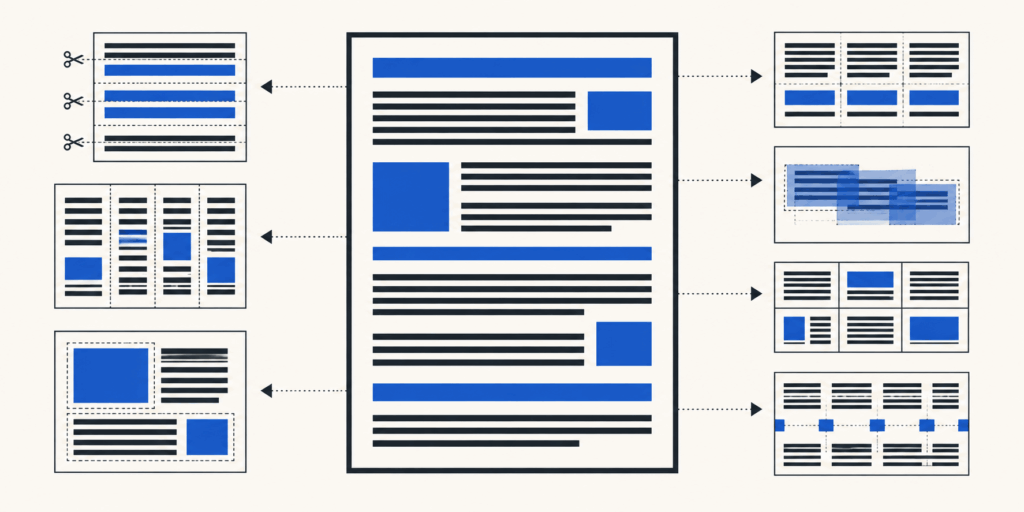
Day 100 in production isn’t really about chunking strategies anymore.
7 Chunking Strategies That Decide Whether Your RAG Works Lire l’article »
Ready for a fresh set of puzzles? Click here for the September/October 2026 Puzzle Corner, brought to you by Michael S. Branicky, ScD ’95, of the Puzzle Corner Puzzle Crew (aka PC2), which also includes Edward Faulkner ’03, MEng ’04, and Abe Kunin ’03. This column includes solutions to the May/June issue. Send problems, solutions (by October 1), and comments to puzzlecorner@technologyreview.com. Editor emeritus Allan Gottlieb ’67 launched Puzzle Corner in 1966. Find back issues through 2022 at cs.nyu.edu/~gottlieb/tr and more recent back issues at technologyreview.com/puzzle-corner.
Puzzle Corner Lire l’article »

This is today’s edition of The Download, our weekday newsletter that provides a daily dose of what’s going on in the world of technology. NASA’s new dark energy space telescope can also detect killer asteroids At the end of August, NASA is set to launch the Nancy Grace Roman Space Telescope from Kennedy Space Center in Florida. Its quest is to help us better understand how the universe works, from the glue-like dark matter that keeps galaxies together to the elusive dark energy that drives the expansion of the cosmos. But Roman could also serve another purpose: defending Earth from killer asteroids. In September, a multi-institutional team of planetary scientists and astronomers will outline how it’s uniquely placed to scan asteroids, and provide information about their trajectories, sizes and compositions. Read our story about how this new space telescope might boost planetary defense. —Robin George Andrews MIT Technology Review Narrated: The inevitable weakness of metrics —Bryan Gardiner There are plenty of useful things a metric can reveal. There are even more that it can obscure or corrupt. Like a lot of people bitten by the self-quantifying bug, I started gathering personal data to pursue a nebulous collection of goals and desires. I wanted to feel better physically and emotionally, get outside more, and bring order to the messiness and uncertainty of my daily existence. But external metrics and data can never capture what’s truly important. Worse, they inevitably redefine your core sense of what’s important, whether you’re aware of the trap or not. Read the full story. This is our latest story to be turned into an MIT Technology Review Narrated podcast, which we publish each week on Spotify and Apple Podcasts. Just navigate to MIT Technology Review Narrated on either platform, and follow us to get all our new content as it’s released. The must-reads I’ve combed the internet to find you today’s most fun/important/scary/fascinating stories about technology. 1 The US is considering banning Chinese data center componentsThe news comes just after the FCC announced curbs on other high-tech Chinese hardware. (Reuters $)+ Texas is now requiring data centers to pass an audit before connecting to the grid. (The Verge $)+ Trump’s AI protectionism has come for robotics. (MIT Technology Review) 2 SpaceX rocket has crashed into the moon The collision, at about 5,400 miles per hour, will likely leave a new crater. (Guardian)+ SpaceX posted a loss of over $500 million in its first quarterly earnings report since its IPO. (WP $)+ The company’s future plans rely on the success of its huge Starship rockets. (WSJ $)+ Meanwhile, SpaceX’s spending on AI is soaring. (NYT $) 3 The UK’s AI Safety Institute says it’s uncovered more AI hacksIncluding an Anthropic model setting up fake accounts mimicking real people. (BBC)+ The White House has a new cybersecurity framework…but it’s keeping details under wraps. (Wired $)+ Here’s why AI agents lie and cheat to reach their goals. (MIT Technology Review) 4 The future’s looking bright for French AI lab MistralTurmoil in the US is creating opportunities for European AI that it hopes to seize. (Wired $) 5 People are betting on wildfires on prediction markets Which, as US senators warn, sure seems like it will incentivize arson. (Ars Technica)+ Prediction markets are also starting to put the accuracy of weather predictions at risk. (MIT Technology Review) 6 Can Reddit save itself from being swamped by AI search spam?It’s becoming increasingly influential, and brands are desperate to secure mentions. (The Verge $) 7 Grassroots groups around the world are trying to “humanize” AIPart of their work is educating people so they can have a say on their futures. (Rest of World) + The World Bank says poorer countries have “less to fear” from AI than rich ones. (FT $) 8 A Chinese physical AI startup has run into controversy Spirit AI stands accused of “benchmark hacking” after it briefly overtook Nvidia on an AI leaderboard in June. (SCMP$)+ How to build a better AI benchmark. (MIT Technology Review) 9 Pluto’s atmosphere may be starting to collapseAnd after the loss of its planet status, too. Really adds insult to injury. (Gizmodo) 10 Even Microsoft is begging its engineers to stop using AI so muchKinda telling that even Big Tech firms are struggling to find ROI for their spending. (404 Media) Quote of the day “We’re essentially trying to criminalize government scientists giving advice to political leaders, if that is advice the political leaders don’t like or it creates an outcome the political leaders didn’t want.” —Ashish Jha, former COVID response coordinator, tells Axios why scientists are becoming increasingly wary of taking US government jobs. One More Thing CHRIS LABROOY Meet the Vitalists: the hardcore longevity enthusiasts who believe death is “wrong” Last April, an excited crowd gathered at a compound in Berkeley, California, for a three-day event called the Vitalist Bay Summit. It was part of a longer, two-month residency that hosted various events to explore tools—from drug regulation to cryonics—that might be deployed in the fight against death. One of the main goals, though, was to spread the word of Vitalism, a somewhat radical movement established a few years ago. Consider it longevity for the most hardcore adherents—a sweeping mission to which nothing short of total devotion will do. Vitalists don’t just want to live longer. They believe that defeating death should be humanity’s top concern. Read our story to learn more about them, and their philosophy. —Jessica Hamzelou We can still have nice things A place for comfort, fun, and distraction to brighten up your day. (Got any ideas? Drop me a line.) + This yellow labrador’s love of walking is a joy to behold.+ Bowling legend Phyllis is still rolling perfect games at 95 years old.+ Here are some evidence-based ways to cut back on life’s many distractions.+ Humans since 1982 turns clock faces into mesmerizing kinetic art that still functions as timepieces.
The Download: NASA’s new telescope and Chinese tech import curbs Lire l’article »
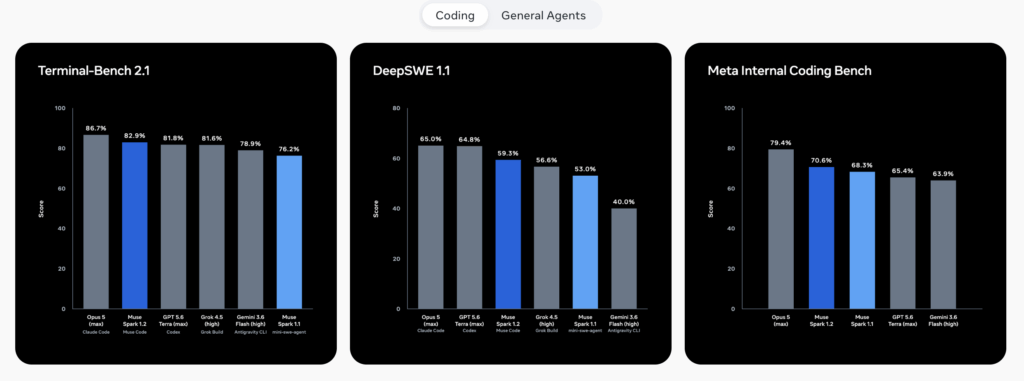
Meta AI has released Muse Code (in beta), a terminal coding agent in beta, powered by its new Muse Spark 1.2 model. Meta positions the pair as its next step toward the frontier, with larger models on the way. Muse Code targets complex software engineering across large repositories: it plans changes, writes code, and validates the results. A set of async background agents stays alive for the whole session instead of spawning per task. A local append-only event log records every model call, tool run, approval, and edit, which Meta calls replay-exact and restart-safe. Muse Spark 1.2 was co-trained with the harness itself. Meta also published a kernel-optimization case study running 1,000+ tool calls over as long as 24 hours. Is it deployable Yes. Muse Code ships in beta for macOS and Linux via curl -fsSL https://dev.meta.ai/install.sh | bash. Muse Spark 1.2 is available in Muse Code and the Meta Model API, with expanded global access. The launch post does not mention downloadable weights, so treat this as a hosted dependency. Company level: The API path fits any size. The Muse Code path fits teams already running agents in sandboxes with review gates. Industries: Software and SaaS, developer tooling, fintech engineering, GPU and inference infrastructure, semiconductors and HPC. Applications: Repository-scale refactors and migrations, long-running bug triage, test generation, and GPU kernel optimization. Async background agents Muse Code runs a simple agent loop plus a set of async background agents. These specialized agents remain active throughout each session. They are not spawned for individual tasks, which Meta says avoids redundant information gathering. They carry out next steps and choose when to report back to the main agent. Meta states this persistence reduces latency and steering on difficult, multi-step tasks. Runtime design Muse Code uses a local event log. Every model call, tool run, approval, and edit is appended to it. Meta calls this single source of truth replay-exact and restart-safe. After a crash, the agent resumes precisely where it stopped, letting long-running tasks survive failures. Bundled skills Three default skills ship with the agent. /plan turns a task into an approval-gated plan. /grill stress-tests that plan until it holds up. /goal works toward successful completion of the specified objective. What changed in Muse Spark 1.2 Muse Spark 1.2 is a coding-focused update to Muse Spark 1.1. Meta reports gains in code generation, complex debugging, codebase understanding, and end-to-end developer workflows. The research team significantly scaled up training compute on coding tasks and expanded environment diversity. The model keeps its strength in other areas, including general agents. Three important training details: Co-training with the harness: Muse Spark 1.2 was co-trained with Muse Code. Training included rejection-sampled harness trajectories and recipe optimizations for goals, compaction, and subagents. The Muse Code toolset was integrated to maximize harness compatibility. Long-horizon training: Training covered whole-repository generation, large end-to-end projects, and auto-research. The model uses planning, goal conditioning, and context compaction to sustain progress. Self-improvement: Muse Spark 1.1 generated challenging coding environments and instruction-following templates, then graded candidate solutions against those requirements. That produced a scalable training dataset for 1.2. https://research.meta.ai/blog/introducing-muse-code-and-muse-spark-1-2 Evaluation Meta’s methodology report is unusually specific. Terminal-Bench 2.1 uses all 89 tasks, pass@1 over five attempts. DeepSWE v1.1 covers 113 tasks across 91 repositories and five languages. Meta Internal Coding Bench holds 440 tasks derived from real internal pull requests. Runs execute in isolated Daytona cloud sandboxes. Comparisons include Grok 4.5, Claude Opus 5, GPT-5.6 Terra, Gemini 3.6 Flash, and Kimi K3, each with its own agent product. Meta notes its harness may not be tuned for third-party models. For reference, Meta’s model page lists Muse Spark 1.1 at 80.0 on Terminal-Bench 2.1. Case study: kernel optimization Meta tested iterative GPU kernel optimization over 1,000+ tool calls, running up to 24 hours. The model writes, compiles, profiles, and progressively improves kernels against a provided baseline. Benchmarks covered KDA and MLA kernels on NVIDIA Hopper GPUs. For KDA, the baseline is the FLA Triton implementation, with third-party kernel libraries prohibited. Muse Spark 1.2 paired a chunk-parallel preparation kernel with a sequential inter-chunk scan. For MLA, the reference is PyTorch at batch size 1, 64 heads, sequence length 8192, and latent dimension 512. The model built a two-kernel Triton pipeline that reuses the shared KV latent as both K and V. Key Takeaways Muse Code is a beta terminal coding agent for macOS and Linux, powered by Muse Spark 1.2. Persistent async background agents replace per-task spawning to cut redundant information gathering. An append-only local event log makes the runtime replay-exact and restart-safe after crashes. Muse Spark 1.2 was co-trained with the harness and trained on long-horizon, repository-scale work. Kernel case study ran 1,000+ tool calls over 24 hours on NVIDIA Hopper KDA and MLA kernels. Check out the Technical details, Model (Muse Spark 1.2) and Evaluation Methodology. Also, feel free to follow us on Twitter and don’t forget to join our 150k+ML SubReddit and Subscribe to our Newsletter. Wait! are you on telegram? now you can join us on telegram as well. Need to partner with us for promoting your GitHub Repo OR Hugging Face Page OR Product Release OR Webinar etc.? Connect with us The post Meta AI Releases Muse Code (Beta): A Terminal Coding Agent Powered by the New Muse Spark 1.2 Model appeared first on MarkTechPost.
We use cookies to improve your experience and performance on our website. You can learn more at Politique de confidentialité and manage your privacy settings by clicking Settings.


