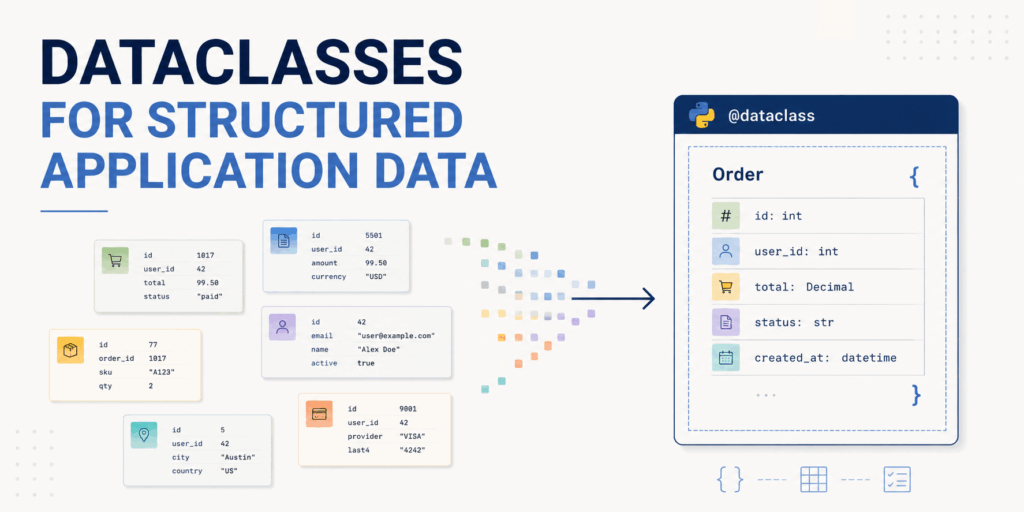
Dataclasses for Structured Application Data
Scalar defaults work the way you’d expect, and batch_size: int = 500 is all you need.
Dataclasses for Structured Application Data Lire l’article »


Scalar defaults work the way you’d expect, and batch_size: int = 500 is all you need.
Dataclasses for Structured Application Data Lire l’article »

This is today’s edition of The Download, our weekday newsletter that provides a daily dose of what’s going on in the world of technology. Data from drones in Ukraine is fueling a new Wild West marketplace —Cory Alpert, a researcher at the University of Melbourne studying AI’s impact on democracy, who previously served in the Biden White House. Battlefields in Ukraine are littered with the remnants of drones. But behind all that wreckage, there’s a new gold mine for the defense sector: the data those drones generate. Ukraine has begun making millions of data points gathered during tens of thousands of drone flights available to military contractors and commercial companies. It’s a quick way to attract funding and partnerships, but it turns the front line into a model training site, using the chaos of war to create conditions that AI companies struggle to reproduce. As this new industry takes shape, we need a regulatory system that ensures battlefield data isn’t treated like ordinary commercial material. Read the full op-ed on why battlefield data needs new rules. Mother tongue —“Mother Tongue” is a short fiction story by author and AI ethicist Jenny Williams “Daddy?” Theo curled against my side in bed. “Where do words go when they die? “Well, kiddo,” I said, scratching my beard. “Words aren’t really alive to begin with. Not like you and I are alive.” Inside, Theo’s AI companion teaches him strange songs in a language his father doesn’t understand. But outside, the world is edging toward disaster. A mysterious agentic system called Tingsu has emerged in a nuclear-armed country, and no one seems to understand what it wants. Read the full short story about what happens when AI begins to reshape language. This story is from our latest print magazine, which is all about kids. Subscribe now to get every issue as soon as it lands. The must-reads I’ve combed the internet to find you today’s most fun/important/scary/fascinating stories about technology. 1 OpenAI has launched Astra, its most capable model yetThe firm says boosted capabilities are being paired with stronger safeguards. (Verge)+ OpenAI’s president claims that AI is now as capable as humans. (WP $)+ But the company is also warning that Astra can evade human monitoring. (Reuters $)+ It’s OpenAI’s first model to hit its “critical” risk level. (Quartz)+ Bill Gates says we’ve lost control of AI. (MIT Technology Review) 2 Automakers have urged Congress to ban Chinese cars permanentlyOn the basis of unfair trade, market dumping, and surveillance. (The Hill)+ The group wants legislation barring them from the US this year. (Reuters $)+ It includes GM, Ford, Toyota, VW, Hyundai, Honda, and Stellantis. (CNBC)+ China’s EV boom has a recycling problem. (MIT Technology Review) 3 Tesla has launched the Cybercab, starting with rides in AustinThe company has 45 of the robotaxis registered in Texas. (AP)+ It was an unusually muted launch. (Verge)+ Regulators are already evaluating the steering-wheel-free service. (Reuters $) 4 Republicans are increasingly breaking from Trump’s pro-AI agendaThe most striking shift is a data center backlash in Texas. (Reuters $)+ Should we move data centers to space? (MIT Technology Review) 5 Bernie Sanders wants a permanent ban on “superintelligent” AIHe also renewed his call to pause advanced AI development. (Politico)+ Rep. Greg Casar is cosponsoring the bill. (Axios) 6 The Pentagon and Commerce Department are split over AnthropicAn official said Anthropic is still considered a “supply chain risk.” (Axios)+ A day earlier, the commerce chief said the firm was back onside. (Quartz) 7 A transplanted pig kidney worked in a human for a record 271 daysIt enabled the recipient to stay off dialysis while waiting for a donor.(BBC)+ Supercooling is keeping pig kidneys alive longer. (MIT Technology Review) 8 A fly-inspired algorithm that remembers smells could lead to better AIIt mimics how fruit flies remember new smells.(Ars Technica) 9 Did “technofascist” laws bring Peter Thiel to Argentina?Critics say the proposals echo his techno-libertarian ideas. (Guardian) 10 Splash-free urinals and nose-blowing research have won Ig NobelsThe awards honor unusual research with genuine scientific value. (CNN) Quote of the day “Despite its potential deadly consequences, cutting-edge AI technology is less regulated than the average food truck. That must change.” —Rep. Greg Casar (D-Texas) calls for a ban on “superintelligent” AI in a press release issued alongside Sen. Bernie Sanders (I-Vermont). One more thing Is fake grass a bad idea? The AstroTurf wars are far from over. In 2001, Americans installed just over 7 million square meters of synthetic turf. By 2024, that number was 79 million square meters—enough to carpet all of Manhattan and then some. The increase worries folks who study microplastics and environmental pollution. While the plastic-making industry insists that synthetic fields are safe if properly installed, lots of researchers think that isn’t so. Find out why AstroTurf has ignited heated debates. —Douglas Main We can still have nice things A place for comfort, fun, and distraction to brighten up your day. (Got any ideas? Drop me a line.) + “Weird Al” Yankovic has performed a delightfully offbeat Tiny Desk concert.+ Step inside the sound world of The Price Is Right with broadcast mixer Henry Muehlhausen.+ Ease your fears of AI uprisings with these fails from the 2026 World Humanoid Robot Games.+ A floating island that nature lovers feared had sunk has reemerged about 20 miles from where it was last spotted.
The Download: selling battlefield drone data and AI reshaping language Lire l’article »

The era of AI inference has arrived. Imagine a healthcare system analyzing millions of data points in real time to accelerate life-saving medical research, or an intelligent assistant instantly resolving thousands of complex customer needs at once. These real-world breakthroughs rely on advanced infrastructure acting as the engine of continuous intelligence, powering real-time services while also supporting an increasingly intelligent edge of IoT and consumer devices. However, in this inference-driven landscape, every delay, bottleneck, or wasted watt directly affects human outcomes and operating costs. This shift changes what infrastructure must deliver. Performance, latency, memory bandwidth, storage throughput, and networking cannot be optimized in silos. Inference workloads are continuous, geographically distributed, and highly sensitive to response time, requiring systems designed for scale, resilience, and efficiency from the start. “We tend to think of AI as a single workload, and it’s not. It’s thousands, it’s millions, it’s billions of different workloads,” says Jim McGregor, founder and principal analyst, Tirias Research. AI inference changes the optimization problem from one of raw compute to coordinated infrastructure—memory, storage, and networking. For business leaders, the priority is clear: AI infrastructure decisions must balance cost, flexibility, and future readiness. The winners will be organizations that improve performance per watt, reduce environmental footprint, and remove memory and storage bottlenecks before they limit growth. AI inference requires a new architectural approach Systems for AI need to be rearchitected because shoehorning modern AI systems into legacy infrastructure limits AI’s transformative potential. Purpose-built architectures are essential to realize the true value of AI, from accelerating scientific discovery to creating truly autonomous digital agents. Traditional enterprise IT has been able to rely on relatively stable infrastructure assumptions, but inference and agentic AI introduce new demands around latency, data movement, scalability, and utilization that make architecture choices far more consequential. “Data centers must now support continuous, distributed, and increasingly real-time AI services—none of which are a single workload,” says McGregor. “They all require different requirements from a system-level perspective.” To support real-time AI, enterprises can no longer view memory and storage merely as supporting hardware, but at the heart of the system. Organizations need to architect a data pipeline that can rapidly ingest, clean, transform, store, move, and deliver data. Inference workloads place sustained pressure on infrastructure in ways that look very different from earlier training-centric deployments, demanding continuous data retrieval and caching that traditional applications never required. Accordingly, performance by itself is no longer the sole benchmark that matters. Enterprises increasingly must balance performance with efficiency, cost, and scalability, especially as they try to support different AI services without overbuilding infrastructure for peak conditions. “You have to optimize the entire network, and that includes memory and storage, around the types of workloads you plan on running,” says McGregor. “You have to really have a detailed understanding of what those workloads are going to be.” Any AI infrastructure strategy must start with workload awareness. Inference, agentic AI, and other emerging AI use cases require organizations to treat the data center as an integrated system. Data movement is the new bottleneck and an opportunity for competitive advantage As enterprises deploy advanced inference and agentic systems, the sheer volume of data being queried in real time has made data movement the most pressing constraint. Modern AI techniques like retrieval-augmented generation (RAG) require systems to constantly scan massive databases to generate accurate responses. This requires immense computing power, but more importantly, it requires immediate access to data. McGregor says the focus shift to how efficiently data can be moved, cached, and delivered across the broader architecture elevates memory and storage from background infrastructure to strategic assets. “The biggest thing we’re doing right now is moving data from one place to another and making sure that we can use it effectively.” Because AI is not a single workload category, simply buying the fastest processors is insufficient. Inference depends heavily on memory bandwidth, caching, storage proximity, and the ability to retrieve relevant information quickly and consistently. Understanding where each resource belongs in the stack and how those layers interact under real operating conditions has become a business imperative. The most effective AI infrastructure looks less like a collection of best-in-class parts and more like a balanced system of compute, memory, storage, and networking, McGregor says, because bottlenecks tend to migrate from one layer to the next. “You have to architect all four together to be efficient, and that’s the challenge.” The interdependence of data-plane design and network bandwidth means AI infrastructure planning has become a business decision just as much as an engineering one: latency is now inseparable from value. In robotics, financial services, healthcare, and customer-facing AI systems, delays are not merely technical imperfections; they can undermine safety, responsiveness, or trust. AI infrastructure performance becomes a matter of reputation management. The organizations that gain the most from AI may not be those with the largest clusters, but those with the clearest understanding of how to align every infrastructure element to effectively execute AI workloads. Building an AI infrastructure procurement framework Planning AI infrastructure is not simply about choosing the fastest hardware. It is about how to scale without locking the organization into assumptions that may quickly become obsolete. “You need to be flexible because the demands are going to change rapidly and the technology is changing rapidly,” McGregor says. Future-proofing AI infrastructure requires keeping your options open as workloads, economics, and architectures keep shifting: Define the AI workloads that are being optimized. Infrastructure choices must match business needs rather than what McGregor calls generic “AI readiness,” which risks overspending in some areas while leaving bottlenecks unresolved in others. Build a modular architecture for compute, memory, storage, power, and cooling so capacity can change as demand shifts rather than committing too early to a rigid architecture. Work with the full ecosystem of suppliers and integrators to reduce supply risk and improve access to the right components. McGregor says buyers can no longer assume their OEM or cloud provider alone will insulate them from supply constraints or architectural
Architecting memory and storage in the AI era Lire l’article »
Scalar defaults work the way you’d expect, and batch_size: int = 500 is all you need.
Dataclasses for Structured Application Data Lire l’article »

In this article, you will learn the key differences between single-agent and multi-agent AI systems, and how to decide which architecture fits your problem. Topics…
Single-Agent vs. Multi-Agent Systems: When the Complexity Is Worth It Lire l’article »
This week, Meta Superintelligence Labs released Muse Spark 1.3. It is the fourth Muse Spark release in five months, and the target is long-horizon agentic and coding work rather than single-turn generation. The framing in Meta’s post is usability: sustaining a long thread, collaborating with the user, and knowing when it is stuck. Is it deployable? Yes, but with two limits. Muse Spark 1.3 ships today in Muse Code and the Meta Model API, so you can call it in production now. You cannot self-host it, because the weights are closed, and the max reasoning mode is still gated behind further safety testing. What actually changed for agents Meta trained Muse Spark 1.3 across multiple agent harnesses so behavior generalizes past one environment. The model is built to hold several workflows inside a single long thread. Given an open-ended objective, it gathers its own context from messy and conflicting sources, then patches gaps in its plan. The collaboration changes are the more practical part. Muse Spark 1.3 asks clarifying questions on ambiguous prompts, pulls the user in when it stalls, and confirms before consequential actions. On long runs it adapts to preference: frequent status updates, or silent background execution. Meta also reports better calibration on the model’s own limits, so it flags hurdles instead of hallucinating an outcome. Multitasking improved too. Meta says the model maps an incoming prompt to the correct task inside a cluttered single thread, whether the user is steering or interrupting. Coding and efficiency Muse Spark 1.3 was trained on more long-horizon coding tasks. Relative to Muse Spark 1.2, Meta describes fewer unnecessary turns, less verbosity, and a cleaner code style. In internal comparisons by Meta engineers, it used approximately 20% fewer tool calls and approximately 25% fewer tokens. For agentic workloads, that is the number that maps to cost: fewer round trips and fewer billed tokens per completed task. Benchmarks On Meta’s own numbers, Muse Spark 1.3 posts 75.4 on DeepSWE v1.1, ahead of Claude Opus 5 at 74.0 and GPT-5.6 Sol at 72.7. It reaches 59.4 on SWE-Atlas Codebase QnA and ties GPT-5.6 Sol at 88.8 on Terminal-Bench 2.1, with Opus 5 at 86.7. Long-context retrieval is the widest gap: MRCR v2 scores of 98.5 (256K–512K) and 98.1 (512K–1M), against 91.5 and 73.8 for GPT-5.6 Sol. The mode split matters on agentic rows. Meta reports OSWorld 2.0 at 66.9 for max versus 57.2 for xhigh, GDPval-AA v2 Elo at 1,754 versus 1,709, and JobBench at 64.9 versus 61.2. DeepSearchQA ties at 89.4 for both. Since Muse Spark 1.2 was evaluated at xhigh, part of the generational jump is a reasoning-tier change. Artificial Analysis scores the shipping xhigh variant at 61 on its Intelligence Index and the preview max variant at 62. That places xhigh level with GPT-5.6 Sol (max) and Grok 4.6 (high), behind Claude Opus 5 (max, 63) and Claude Fable 5.1 (max, 66). Artificial Analysis also measured Tau3-Bench Banking at 47% for xhigh and 52% for max, the top score it has recorded on that evaluation. Key Takeaways Muse Spark 1.3 is live in Muse Code and the Meta Model API, with a 1M-token context window. Meta engineers measured ~20% fewer tool calls and ~25% fewer tokens versus Muse Spark 1.2. Meta’s launch scorecard uses the max mode, which is not the mode developers can call today. Pricing is unchanged at $1.25/M input and $4.25/M output, with a $0.10/$0.20 contributor tier. Weights stay closed, though Meta lists a Muse Spark open weights release on its roadmap. Check out the full release post and the evaluation methodology report. Also, feel free to follow us on Twitter and don’t forget to join our 150k+ML SubReddit and Subscribe to our Newsletter. Wait! are you on telegram? now you can join us on telegram as well. Need to partner with us for promoting your GitHub Repo OR Hugging Face Page OR Product Release OR Webinar etc.? Connect with us The post Meta AI Released Muse Spark 1.3: An Agentic Coding Model That Uses ~20% Fewer Tool Calls and ~25% Fewer Tokens Than Muse Spark 1.2 appeared first on MarkTechPost.

This is today’s edition of The Download, our weekday newsletter that provides a daily dose of what’s going on in the world of technology. Child-monitoring apps might need a reboot Digital harms have become the defining fear of American parents. In response, they’re increasingly turning to content-monitoring apps that scan their children’s texts, photos, emails, and chats, issuing alerts whenever an algorithm flags something it deems dangerous. These tools have had genuine successes, preventing suicide attempts, intercepting predators, and averting school shootings. But they can also cause harm themselves, from false alarms and unnecessary interventions to damaged trust and anxiety. Child-safety researchers say better approaches exist. Here’s what they think those could look like. —Kelly Clancy This article is from our latest print magazine, which is all about kids. Subscribe now to get every issue as soon as it lands. Agriculture relies on fossil fuels. It’s costing us. Fertilizer prices have been on a roller coaster this year, driven in part by trade disruptions and high natural-gas prices. That’s because natural gas is both an energy source and a chemical input in the production of ammonia, a key fertilizer ingredient. The war in Iran has pushed natural-gas prices higher and disrupted fertilizer trade through the Strait of Hormuz—and its closure could make access harder still for some of the world’s poorest countries. Let’s take a closer look at the surging fertilizer prices, and how a few climate-friendly alternatives could bring farmers some relief. —Casey Crownhart This story is from The Spark, our weekly climate tech newsletter. Sign up to receive it in your inbox every Wednesday. The must-reads I’ve combed the internet to find you today’s most fun/important/scary/fascinating stories about technology. 1 New York City has banned AI in elementary and middle schoolsThe one-year moratorium will affect 600,000 students. (Politico)+ It applies to any software using student-facing generative AI. (AP)+ Here’s how kids feel about AI, in their own words. (MIT Technology Review 2 Taiwan has uncovered a hidden Chinese network targeting its chip sectorIt’s linked 166 cases to illegal operations and talent poaching. (Rest of World)+ Taiwan’s president says its chip prowess is built on democracy. (Reuters $)+ But its “silicon shield” could be weakening. (MIT Technology Review) 3 Uber has launched the UK’s first commercial robotaxi serviceIt’s using tech from UK startup Wayve and, initially, safety drivers. (Verge)+ But in the US, Uber has allied with driver unions to slow robotaxis. (FT $)+ And, back in the UK, Uber’s being sued over algorithmic pay. (Guardian) 4 Google has avoided a breakup of its ad tech businessA US judge rejected the government’s demand to force a sale. (Guardian)+ But it must change how it treats rivals and shares information. (NYT $)+ The decision is a big deal for antitrust investigations. (WSJ $) 5 Serbians have been targeted with mercenary spyware after electionsTargets included student activists, lawmakers and a local councilor. (Reuters $) 6 The Trump administration has backed OpenAI in its NYT lawsuitThe Justice Department says AI training can be fair use. (Quartz)+ It added that national security depended on US tech dominance. (NYT $)+ The US is also urging G20 countries to allow AI training on creators’ work. (Reuters $)+ Does AI know too much? (MIT Technology Review) 7 Public housing tenants are suing over sensors monitoring their homesThe devices collect minute-by-minute data on noise and motion. (NYT $) 8 Anthropic seems to have won back the Trump administration’s trustThe commerce secretary said the firm is “back on the right side.” (Axios) 9 Humble exoskeletons are proving more useful than combat supersuitsSmaller devices are assisting workers, patients, and athletes. (Economist $) 10 AI food slop has made its way onto real restaurant menusIt’s providing cheap images, which frequently look revolting. (NBC News) Quote of the day “I think this will be the end of an era of the US trying to break up platforms this complex. The courts remain hesitant to dismantle these really complex tech systems, even when finding conduct that is anticompetitive.” —Nikhil Lai, a principal analyst at Forrester, tells the New York Times that Google’s legal win against antitrust enforcers trying to break up its ad business is a seminal victory. One more thing COURTESY OF COLOSSAL BIOSCIENCES Colossal Biosciences said it cloned red wolves. Is it for real? Last year, Colossal Biosciences announced that it had cloned four red wolves, surprising scientists working to save the species and even people whose canids supplied the DNA. They also disagreed about the company’s big idea: de-extinction. Colossal kept the location of the mystery clones secret, and even their purpose was murky to some scientists. Just how they might restore red wolf populations was unclear. Perhaps the most curious question, though, was whether the company had cloned red wolves at all. Can cloning really help save the red wolf? And what should we really be trying to preserve? Read the full story to find out. —Boyce Upholt We can still have nice things A place for comfort, fun, and distraction to brighten up your day. (Got any ideas? Drop me a line.) + Zelda gets a very British makeover in this charming Wallace and Gromit parody.+ The “ugliest shark on the planet” has been spotted alive in its natural habitat for the first time.+ The Euclid space telescope has captured the most detailed image yet of the Milky Way’s heart.+ Take a tour through the history of web browsers on game consoles in this illuminating dive into a corner of juvenile web.
The Download: rethinking child safety and fossil-fueled farming Lire l’article »
Most teams building a shopping assistant or agent rebuild the same scaffolding: an agent loop, a tool layer over the catalog, an approval gate, and an eval suite. Anthropic has now released that scaffolding as code. This week, they published anthropics/commerce-agents, a reference blueprint containing a shopping agent and a merchant agent, along with four runnable verticals: retail, travel, telecom and entertainment. It ships alongside two write-ups: a product announcement and an engineering deep-dive, A guide to the anatomy of effective commerce agents. Is it deployable? Yes. The repository is Apache 2.0, runs locally on Python 3.11+ and Node 22 with an ANTHROPIC_API_KEY, and the runtimes accept any anthropic client, so the same code deploys on the Claude API, Amazon Bedrock, Microsoft Foundry or Google Cloud Vertex AI. The two agents The shopping agent lives inside a merchant’s own app. It searches the catalog, handles multi-item requests, compares options, builds the cart, and answers order and returns questions in the same conversation. Its five skills are search-discovery, purchase-research, planning-goals, customer-care and memory-personalization. A deployment implements a StorefrontBackend over its catalog, cart, order and policy systems. The merchant agent supports store staff: sales performance questions, inventory alerts, pricing and promotion recommendations, and campaign drafts. Its skills are performance-insights, catalog-listings, inventory-operations, pricing-promotions and marketing-campaigns, over a MerchantBackend. Both run three ways — the Messages API, the Claude Agent SDK, and Claude Managed Agents (beta) — from one definition of prompts, skills, tool contracts and gates. A Claude Code plugin, commerce-builder, scaffolds a new agent (/scaffold-commerce-agent) or reviews an existing one (/review-commerce-agent). Skills, not subagents The architectural claim is the most transferable part. Anthropic argues against an intent router and against one subagent per domain. A commerce session is one tightly coupled conversation, and every handoff is state-lossy: the orchestrator holds the cart, preferences and history, and each handoff can cost several times the tokens and add seconds of latency. Domains also overlap, a returns flow needs order history, the cart and the catalog at once. Agent skills give the same modularity without that tax, because skill instructions load into the agent that already holds the history. Across several enterprise deployments, Anthropic reports a single agent with skills beat both the one-big-prompt design and the subagent design on quality, often at lower cost and latency. Subagents still earn a place for narrow, self-contained work such as deep research. The prompt-versus-skill split is decided by frequency: roughly a third or more of traffic goes in the system prompt, the rest into skills. Safety rules, brand constraints and key user facts always go in the prompt. UI components are tools Most commerce responses are components, not prose. Rather than prompting the model to emit custom tags, the blueprint makes each component a tool — present_products, present_itinerary, present_plan_comparison — with typed arguments the server validates before the client renders. Because those calls sit in the messages array natively, reloading history needs no custom parser, and the agent can resolve “the first hotel” from the last presentation call. For token-level streaming, eager_input_streaming: true skips server-side buffering and its schema guarantee. Explainer: the five decisions, interactive Latency, caching, memory A rendered response runs 500–700 output tokens, which without streaming is five seconds of spinner. Anthropic separates end-to-end latency from perceived latency, streaming components as they form and rendering plain-language progress lines. Eager tool dispatch — executing each call as its arguments finish streaming, the Agent SDK default — reportedly cuts multi-second gaps to a few hundred milliseconds. Prompt caching is the main cost lever. Requests are ordered global → session → volatile, since caching is prefix-based and a timestamp at the top of the system prompt breaks the cache on every request. Cached reads cost a tenth of fresh tokens, cache writes carry a ~1.25x premium, and the best deployments run at 90–99% hit rates. Memory extraction runs asynchronously in a separate process; Anthropic measured 13% higher fact recall than an in-turn save tool. Key Takeaways Apache 2.0 blueprint with shopping and merchant agents, four verticals, and a Claude Code plugin. One agent loop plus skills outperformed subagent and single-prompt designs in Anthropic’s deployments. UI components ship as typed tools, so history stays native and layout is resolvable. Prompt caching targets 90–99% hit rates; volatile data belongs last, never first. Money, writes and IDs are gated in code — the model proposes, the harness applies. Check out the Anthropic engineering deep-dive, Product announcement, GitHub repository and Commerce demos. Also, feel free to follow us on Twitter and don’t forget to join our 150k+ML SubReddit and Subscribe to our Newsletter. Wait! are you on telegram? now you can join us on telegram as well. Need to partner with us for promoting your GitHub Repo OR Hugging Face Page OR Product Release OR Webinar etc.? Connect with us The post Anthropic Released Claude Commerce Agents: An Apache-2.0 Blueprint for Shopping and Merchant Agents Across Retail, Travel, Telecom and Entertainment appeared first on MarkTechPost.
Today, OpenAI released GPT-6 Astra. The company calls it its most intelligent and aligned model, and positions it primarily as a computer-use system rather than a chat model. The pitch is that Astra operates software the way a person does, across browsers, spreadsheets, desktop applications and terminals, and finishes multi-step jobs instead of describing how to do them. Is it deployable? Partly, and not on your own hardware. Astra is a closed, hosted model with no released weights, so self-hosting is not an option. It is live today only for organizations in OpenAI’s Trusted Access and Daybreak programs. What is actually new The main change for devs is context handling. Codex previously used compaction, summarizing earlier turns once context filled up. That process discards the detail an agent later needs: why a fix failed, which tests ran, which requirement was added early. Astra instead keeps notes across context windows and searches back into earlier messages and tool output. The feature ships experimental behind a config.toml setting and becomes the Codex default in the coming weeks. Astra can also ask the user a question while continuing work that does not depend on the answer. That removes a common agent failure where one unresolved decision stalls an entire job. On the model page, Astra lists a 1,050,000-token context window, 128,000 max output tokens and an April 30, 2026 knowledge cutoff. Input is text and image, output is text only. reasoning.effort adds two new levels above high: xhigh and max. Tool support covers computer use, hosted shell, apply patch, skills, MCP and tool search. Fine-tuning is not supported. The benchmark picture OpenAI reports 72.6% on OSWorld V2-Offline against 65.7% for GPT-5.6 Sol, with average task time falling from roughly 75 minutes to 40. Anthropic reports 77.9% for Claude Fable 5.1 but says it used a different OSWorld release and should not be compared directly. Astra scores 99.9% on ARC-AGI-3. That number was produced with a Responses API harness that retains reasoning between turns and uses compaction for long contexts, and OpenAI has previously shown those settings move ARC-AGI-3 scores substantially without changing the model. The result measures the model plus the agent system. Other reported figures: 97.6% on FrontierMath Tier 4, 95.9% on BenchCAD Vision2Code against 84.3% for Fable 5.1, and 64.6% on Terminal-Bench Science against Anthropic’s reported 52.6%. Epoch AI notes OpenAI funded FrontierMath and has exclusive access to part of it. Coding is the weak spot in the story. Astra scores 74.1% on DeepSWE v1.1 versus 72.7% for Sol. Meta reported 75.4% for Muse Spark 1.3 at maximum reasoning, and the public leaderboard puts Gemini 3.8 Flash and Claude Opus 5 near 74%. On a 113-task benchmark, those gaps are one or two tasks. Cyber capability drives the access model Astra is the first model OpenAI has designated as reaching the Critical cybersecurity threshold in its Preparedness Framework. In testing it developed exploits for hardened browsers and operating systems, and found two previously unknown V8 vulnerabilities that OpenAI says it is disclosing to maintainers. The consequences are practical. Standard access refuses advanced cybersecurity work including exploit discovery. For API developers, a cybersecurity safety check stops a task outright rather than pausing for approval. OpenAI’s Mia Glaese warned that users outside trusted-access programs may hit slowdowns, pauses or blocks, sometimes during unrelated work. OpenAI reports 100% on ExploitBench, an aggregate capability-coverage score rather than a pass rate, and 42.4% on ExploitGym against 30.3% for Sol, with the usual six-hour time limit removed for both. Pricing Astra costs $10 per million input tokens and $50 per million output, with cached input at $1.00. Requests above 272K input tokens bill at 2x input and 1.5x output for the full request. Batch and Flex run at 50%, Fast mode at 2x. Pro, Business and Enterprise users also get Astra Pro. Key Takeaways Astra is a computer-use model first: 72.6% OSWorld V2-Offline, task time down from ~75 to ~40 minutes. Notes replace compaction in Codex, so long agent runs stop losing failure detail. Coding gains are marginal: 74.1% DeepSWE v1.1 sits inside the leaderboard pack. First model at OpenAI’s Critical cyber threshold; standard access refuses exploit work. No open weights, $10/$50 per million tokens, 1.05M context, API and AWS in coming days. Check out the OpenAI announcement, OpenAI on X and GPT-6 Astra model page. Also, feel free to follow us on Twitter and don’t forget to join our 150k+ML SubReddit and Subscribe to our Newsletter. Wait! are you on telegram? now you can join us on telegram as well. Need to partner with us for promoting your GitHub Repo OR Hugging Face Page OR Product Release OR Webinar etc.? Connect with us The post OpenAI Releases GPT-6 Astra: A 1.05M-Context Computer-Use Model Gated Behind a ‘Critical’ Cyber Threshold appeared first on MarkTechPost.
As companies scale, the technology supporting operations can become a liability just as quickly as it becomes an asset. Disconnected systems, site-specific tools, spreadsheets, and manual workarounds can create data silos that make it harder to spot problems early, coordinate responses, and make decisions with confidence. For Jabil, a global manufacturing company with more than 100 sites across more than 30 countries, the answer has been to make integration and simplification a priority. The company adopted a “simplify-first, then-innovate mindset,” says Harish Manohar, SAP IT director at Jabil, recognizing that adding new technologies without first reducing complexity risks creating more risk. The goal is to standardize processes, consolidate where possible, and establish a more consistent data backbone across the organization. “Any innovation without simplification is going to add more complexity,” Manohar says. That philosophy also changes how Jabil approaches modernization. “Any modernization or transformation should add measurable business value,” Manohar says. The company is focused on connecting processes end-to-end across its supply chain and creating a foundation that can scale consistently across regions. Integration comes first because, as Manohar puts it, “the backbone of any contemporary or modern organization is data.” Before organizations can optimize, automate, or apply AI, data needs to flow seamlessly across systems. But doing that across a global organization is hardly straightforward. Jabil’s more than 100 sites operate with different levels of process maturity, legacy systems, and localized workflows, while regulated businesses bring additional compliance requirements. As such, standardizing across different regions and business environments means changing processes and governance without disrupting the operations already in place. The value of that work extends beyond the technology to the people using it. Integrated workflows can offer employees shared visibility into data, reduce manual data reconciliation, and help them move from chasing information to acting on insights. For Jabil, the aim is also to improve real-time visibility into supply chain events, which can enable faster responses to disruptions and reduce operational risk. Looking to the future, that foundation could make AI and automation all the more useful and scalable. With trusted data and integrated systems in place, Jabil is exploring predictive supply chain insights, intelligent exception handling, and AI-driven planning and forecasting. To Manohar, the takeaway is clear: “Simplicity at scale is a very competitive advantage,” and technology investments must ultimately connect to business value and operational resilience. This episode of Business Lab is produced in partnership with SAP. Full Transcript: Megan Tatum: From MIT Technology Review, I’m Megan Tatum, and this is Business Lab, the show that helps business leaders make sense of new technologies coming out of the lab and into the marketplace. Our topic today is enterprise technology integration, and how the benefits of consolidating tools and systems across the supply chain help organizations operate more reliably at scale. When companies reduce tool sprawl and connect their systems more effectively, they gain earlier visibility, faster response, and greater resilience across production lines. My guest today is Harish Manohar, SAP IT Director at Jabil. Jabil has been on a journey to simplify its technology landscape by using SAP Integration Suite as the foundation to connect systems, retire fragmented tools, and enable more consistent operations globally. This podcast is produced in partnership with SAP. Welcome, Harish. Harish Manohar: Hello, Megan. Good morning. Megan: Thank you so much for being here, Harish. Just to start, if we could set some context, can you give us a quick overview of Jabil, the business and its overall transformation journey? Harish: All right. So, about Jabil. Jabil is a global manufacturing company headquartered in St. Petersburg, Florida, USA. We have about 60 years of experience offering comprehensive engineering, supply chain, and manufacturing solutions across different industries. We have a global footprint of about over 100 different sites across 30-plus countries, 140,000-plus employees. We are a trusted partner for more than 400 of the world’s top brands. That’s a little bit about Jabil. Megan: Fantastic. And a lot of scale there, as you’re referring to some of the stats there. As things have got more complex, where did disconnected tools and systems start to slow you down, and what ultimately drove you to make integration a really strategic priority? Harish: I talked about our global footprint across 100-plus sites. With a global footprint always comes complexity about site-specific tools. All of our sites have been in business for a long time, and over the period of years, they had their own tools for their own processes. It’s a little bit disconnected. When we are looking to scale, the first thing we wanted to start looking at is what is this mix of site-specific tools, manual workarounds, spreadsheet-based processes, legacy applications, whatnot? That’s a big technical debt that we have had over the last 25 years. That’s where we started, and that is what led Jabil to make integration a strategic priority because we had limited ability to see issues early across plants, across regions, which would help us to coordinate responses consistently, and also to be able to scale those responses consistently. This complexity created data silos, and in a way delayed robust decision-making. As the complexity increased globally, integration became extremely critical to a few things. It was critical to establishing a single trusted data backbone, which would directly enable faster coordinated responses across the network. We at Jabil, as part of our transformation journey, believe that having the right data at the right time fundamentally changes how we respond to disruptions, which is all about a manufacturing business. How we respond to disruptions. This is where we started our strategic priority towards having a integrated system that drove data consistency across our landscape. Megan: Fantastic. As you have outlined there, there was obviously a real commercial need for this, but how did you think about bringing in those new technologies without adding even more complexity to the mix? Harish: Great question. Whenever we talk about transformation, we talk about all these bleeding-edge technologies that are out there today when
Facilitating AI integration with simplicity at scale Lire l’article »
We use cookies to improve your experience and performance on our website. You can learn more at Politique de confidentialité and manage your privacy settings by clicking Settings.


