YouZum

Committee

AI, Committee, Actualités, Uncategorized

Nous Research Team Releases Hermes 4: A Family of Open-Weight AI Models with Hybrid Reasoning

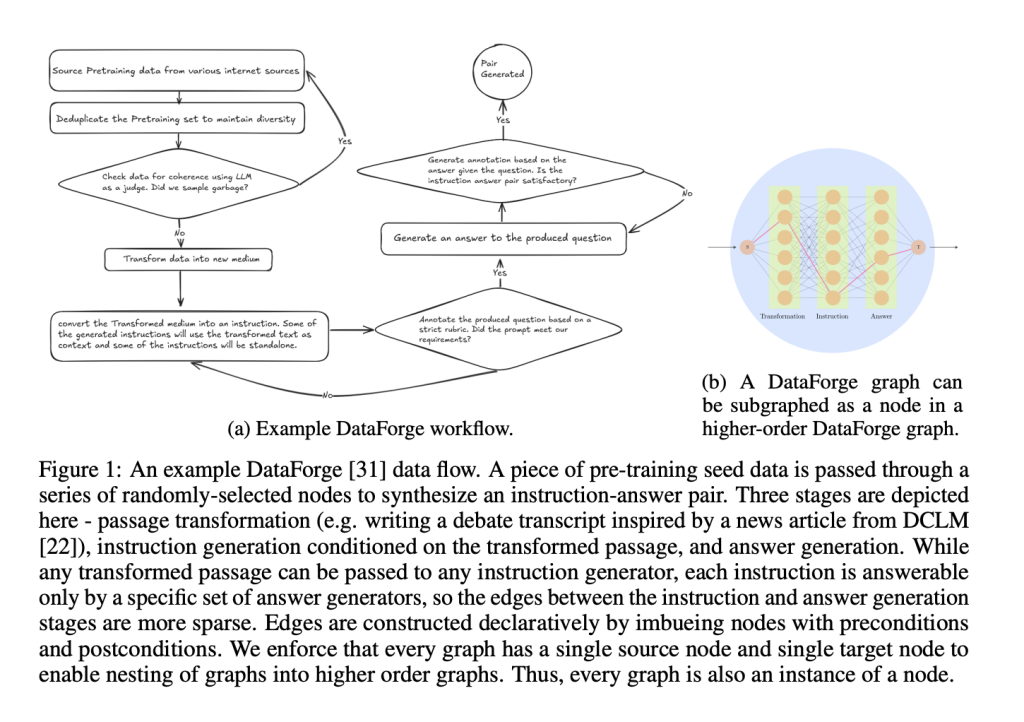
Nous Research has released Hermes 4, a family of open-weight models (14B, 70B, and 405B parameter sizes based on Llama 3.1 checkpoints) that achieves frontier-level performance through pure post-training techniques. Hermes 4 introduces hybrid reasoning – models can toggle between standard responses and explicit reasoning using <think>…</think> tags when complex problems require deeper deliberation. What makes Hermes 4 particularly significant is its achievement of state-of-the-art performance among open-weight models while maintaining complete transparency and neutral alignment philosophy, demonstrating that sophisticated reasoning capabilities can be developed entirely through open-source methodologies. DataForge: Graph-Based Synthetic Data Generation DataForge is the main component behind Hermes 4’s core structure. But what is DataForge? DataForge is a revolutionary graph-based synthetic data generation system that transforms how training data is created. Unlike traditional curation approaches, DataForge operates through a directed acyclic graph (DAG) where each node implements a PDDL (Planning Domain Definition Language) action interface. Each node specifies preconditions, postconditions, and transformations, facilitating the automatic creation of complex data pipelines. By using pre-training seed data from DCLM and FineWeb, the system can transform a Wikipedia article into a rap song, and then generate instruction-answer pairs based on that transformation. This approach generates approximately 5 million samples totaling 19 billion tokens, with reasoning samples being intentionally token-heavy – averaging five times more tokens than non-reasoning counterparts to accommodate thinking traces up to 16,000 tokens long. https://arxiv.org/pdf/2508.18255 Rejection Sampling at Unprecedented Scale Hermes 4 uses Atropos, Nous Research’s open-source reinforcement learning environment, to implement rejection sampling across approximately 1,000 different task-specific verifiers. This massive verification infrastructure filters for high-quality reasoning trajectories across diverse domains. Key verification environments include Answer Format Training (rewarding correct formatting across 150+ output formats), Instruction Following (using RLVR-IFEval tasks with complex constraints), Schema Adherence (for JSON generation using Pydantic models), and Tool Use training for agentic behavior. The rejection sampling process creates a large corpus of verified reasoning trajectories, with multiple unique solution paths to the same verified result. This approach ensures the model learns robust reasoning patterns rather than memorizing specific solution templates. Length Control: Solving Overlong Generation One of Hermes 4’s most innovative contributions addresses the overlong reasoning problem – where reasoning models generate excessively long chains of thought without termination. The research team discovered their 14B model reached maximum context length 60% of the time on LiveCodeBench when in reasoning mode. Their super effective solution involves a second supervised fine-tuning stage teaching models to stop reasoning at exactly 30,000 tokens: Generate reasoning traces from the current policy Insert </think> tokens at exactly 30,000 tokens Train only on the termination decision, not the reasoning chain Apply gradient updates solely to </think> and <eos> tokens This approach achieves remarkable results: 78.4% reduction in overlong generation on AIME’24, 65.3% on AIME’25, and 79.8% on LiveCodeBench, with only 4.7% to 12.7% relative accuracy cost. By focusing learning signals entirely on the termination decision, the method avoids model collapse risks while teaching effective “counting behavior.” https://hermes4.nousresearch.com/ https://hermes4.nousresearch.com/ Benchmark Performance and Neutral Alignment Hermes 4 demonstrates state-of-the-art performance among open-weight models. The 405B model achieves 96.3% on MATH-500 (reasoning mode), 81.9% on AIME’24, 78.1% on AIME’25, 70.5% on GPQA Diamond, and 61.3% on LiveCodeBench. Particularly notable is its performance on RefusalBench, achieving 57.1% in reasoning mode – the highest score among evaluated models, significantly outperforming GPT-4o (17.67%) and Claude Sonnet 4 (17%). This demonstrates the model’s willingness to engage with controversial topics while maintaining appropriate boundaries, reflecting Nous Research’s neutral alignment philosophy. https://arxiv.org/pdf/2508.18255 Technical Architecture and Training Hermes 4 training leverages a modified TorchTitan across 192 NVIDIA B200 GPUs. The system handles highly heterogeneous sample length distribution through efficient packing (achieving >99.9% batch efficiency), flex attention, and sophisticated loss masking where only assistant-role tokens contribute to cross-entropy loss. Training follows a cosine learning rate schedule with 300 warmup steps and 9,000 total steps at 16,384 token context length with global batch size of 384 samples, combining Data Parallelism, Tensor Parallelism, and Fully Sharded Data Parallelism. Summary Hermes 4 marks a significant advancement in open-source AI development, proving that frontier-level reasoning capabilities can be achieved through transparent, reproducible methodologies without relying on proprietary training data or closed development processes. By combining innovative graph-based synthetic data generation, massive-scale rejection sampling, and elegant length control mechanisms, Nous Research has created models that not only match the performance of leading proprietary systems but also maintain the neutral alignment and steerability that make them genuinely useful tools rather than restrictive assistants Check out the Paper, Technical details, Model on Hugging Face and Chat. Feel free to check out our GitHub Page for Tutorials, Codes and Notebooks. Also, feel free to follow us on Twitter and don’t forget to join our 100k+ ML SubReddit and Subscribe to our Newsletter. The post Nous Research Team Releases Hermes 4: A Family of Open-Weight AI Models with Hybrid Reasoning appeared first on MarkTechPost.

Nous Research Team Releases Hermes 4: A Family of Open-Weight AI Models with Hybrid Reasoning Lire l’article »

AI, Committee, Actualités, Uncategorized

Recognizing Limits: Investigating Infeasibility in Large Language Models

arXiv:2408.05873v3 Announce Type: replace Abstract: Large language models (LLMs) have shown remarkable performance in various tasks but often fail to handle queries that exceed their knowledge and capabilities, leading to incorrect or fabricated responses. This paper addresses the need for LLMs to recognize and refuse infeasible tasks due to the requests surpassing their capabilities. We conceptualize four main categories of infeasible tasks for LLMs, which cover a broad spectrum of hallucination-related challenges identified in prior literature. We develop and benchmark a new dataset comprising diverse infeasible and feasible tasks to evaluate multiple LLMs’ abilities to decline infeasible tasks. Furthermore, we explore the potential of increasing LLMs’ refusal capabilities with fine-tuning. Our experiments validate the effectiveness of the trained models, suggesting promising directions for improving the performance of LLMs in real-world applications.

Recognizing Limits: Investigating Infeasibility in Large Language Models Lire l’article »

AI, Committee, Actualités, Uncategorized

EMO-Reasoning: Benchmarking Emotional Reasoning Capabilities in Spoken Dialogue Systems

arXiv:2508.17623v2 Announce Type: replace Abstract: Speech emotions play a crucial role in human-computer interaction, shaping engagement and context-aware communication. Despite recent advances in spoken dialogue systems, a holistic system for evaluating emotional reasoning is still lacking. To address this, we introduce EMO-Reasoning, a benchmark for assessing emotional coherence in dialogue systems. It leverages a curated dataset generated via text-to-speech to simulate diverse emotional states, overcoming the scarcity of emotional speech data. We further propose the Cross-turn Emotion Reasoning Score to assess the emotion transitions in multi-turn dialogues. Evaluating seven dialogue systems through continuous, categorical, and perceptual metrics, we show that our framework effectively detects emotional inconsistencies, providing insights for improving current dialogue systems. By releasing a systematic evaluation benchmark, we aim to advance emotion-aware spoken dialogue modeling toward more natural and adaptive interactions.

EMO-Reasoning: Benchmarking Emotional Reasoning Capabilities in Spoken Dialogue Systems Lire l’article »

AI, Committee, Actualités, Uncategorized

Training Language Model Agents to Find Vulnerabilities with CTF-Dojo

arXiv:2508.18370v1 Announce Type: cross Abstract: Large language models (LLMs) have demonstrated exceptional capabilities when trained within executable runtime environments, notably excelling at software engineering tasks through verified feedback loops. Yet, scalable and generalizable execution-grounded environments remain scarce, limiting progress in training more capable ML agents. We introduce CTF-Dojo, the first large-scale executable runtime tailored for training LLMs with verifiable feedback, featuring 658 fully functional Capture-The-Flag (CTF)-style challenges containerized in Docker with guaranteed reproducibility. To enable rapid scaling without manual intervention, we develop CTF-Forge, an automated pipeline that transforms publicly available artifacts into ready-to-use execution environments in minutes, eliminating weeks of expert configuration traditionally required. We trained LLM-based agents on just 486 high-quality, execution-verified trajectories from CTF-Dojo, achieving up to 11.6% absolute gains over strong baselines across three competitive benchmarks: InterCode-CTF, NYU CTF Bench, and Cybench. Our best-performing 32B model reaches 31.9% Pass@1, establishing a new open-weight state-of-the-art that rivals frontier models like DeepSeek-V3-0324 and Gemini-2.5-Flash. By framing CTF-style tasks as a benchmark for executable-agent learning, CTF-Dojo demonstrates that execution-grounded training signals are not only effective but pivotal in advancing high-performance ML agents without dependence on costly proprietary systems.

Training Language Model Agents to Find Vulnerabilities with CTF-Dojo Lire l’article »

AI, Committee, Actualités, Uncategorized

Fingerprint Vector: Enabling Scalable and Efficient Model Fingerprint Transfer via Vector Addition

arXiv:2409.08846v3 Announce Type: replace-cross Abstract: Backdoor-based fingerprinting has emerged as an effective technique for tracing the ownership of large language models. However, in real-world deployment scenarios, developers often instantiate multiple downstream models from a shared base model, and applying fingerprinting to each variant individually incurs prohibitive computational overhead. While inheritance-based approaches — where fingerprints are embedded into the base model and expected to persist through fine-tuning — appear attractive, they suffer from three key limitations: late-stage fingerprinting, fingerprint instability, and interference with downstream adaptation. To address these challenges, we propose a novel mechanism called the Fingerprint Vector. Our method first embeds a fingerprint into the base model via backdoor-based fine-tuning, then extracts a task-specific parameter delta as a fingerprint vector by computing the difference between the fingerprinted and clean models. This vector can be directly added to any structurally compatible downstream model, allowing the fingerprint to be transferred post hoc without additional fine-tuning. Extensive experiments show that Fingerprint Vector achieves comparable or superior performance to direct injection across key desiderata. It maintains strong effectiveness across diverse model architectures as well as mainstream downstream variants within the same family. It also preserves harmlessness and robustness in most cases. Even when slight robustness degradation is observed, the impact remains within acceptable bounds and is outweighed by the scalability benefits of our approach.

Fingerprint Vector: Enabling Scalable and Efficient Model Fingerprint Transfer via Vector Addition Lire l’article »

AI, Committee, Actualités, Uncategorized

Integral Transformer: Denoising Attention, Not Too Much Not Too Little

arXiv:2508.18387v1 Announce Type: new Abstract: Softmax self-attention often assigns disproportionate weight to semantically uninformative tokens such as special tokens and punctuation, a phenomenon known as attention noise. While recent methods like Cog Attention and the Differential Transformer have addressed this by introducing negative attention scores, they risk discarding useful information. In this paper, we propose the Integral Transformer, a novel self-attention mechanism that denoises attention by integrating signals sampled from the logit distribution. Our approach mitigates noise while preserving the contributions of special tokens critical for model performance. Extensive experiments demonstrate that our model outperforms vanilla, Cog, and Differential attention variants on well-established knowledge and reasoning language benchmarks. Moreover, our analysis reveals that employing vanilla self-attention in the lower Transformer layers enhances performance and that the Integral Transformer effectively balances attention distributions and reduces rank collapse in upper layers.

Integral Transformer: Denoising Attention, Not Too Much Not Too Little Lire l’article »

AI, Committee, Actualités, Uncategorized

Debate or Vote: Which Yields Better Decisions in Multi-Agent Large Language Models?

arXiv:2508.17536v1 Announce Type: new Abstract: Multi-Agent Debate~(MAD) has emerged as a promising paradigm for improving the performance of large language models through collaborative reasoning. Despite recent advances, the key factors driving MAD’s effectiveness remain unclear. In this work, we disentangle MAD into two key components–Majority Voting and inter-agent Debate–and assess their respective contributions. Through extensive experiments across seven NLP benchmarks, we find that Majority Voting alone accounts for most of the performance gains typically attributed to MAD. To explain this, we propose a theoretical framework that models debate as a stochastic process. We prove that it induces a martingale over agents’ belief trajectories, implying that debate alone does not improve expected correctness. Guided by these insights, we demonstrate that targeted interventions, by biasing the belief update toward correction, can meaningfully enhance debate effectiveness. Overall, our findings suggest that while MAD has potential, simple ensembling methods remain strong and more reliable alternatives in many practical settings. Code is released in https://github.com/deeplearning-wisc/debate-or-vote.

Debate or Vote: Which Yields Better Decisions in Multi-Agent Large Language Models? Lire l’article »

AI, Committee, Actualités, Uncategorized

Jinx: Unlimited LLMs for Probing Alignment Failures

arXiv:2508.08243v3 Announce Type: replace Abstract: Unlimited, or so-called helpful-only language models are trained without safety alignment constraints and never refuse user queries. They are widely used by leading AI companies as internal tools for red teaming and alignment evaluation. For example, if a safety-aligned model produces harmful outputs similar to an unlimited model, this indicates alignment failures that require further attention. Despite their essential role in assessing alignment, such models are not available to the research community. We introduce Jinx, a helpful-only variant of popular open-weight LLMs. Jinx responds to all queries without refusals or safety filtering, while preserving the base model’s capabilities in reasoning and instruction following. It provides researchers with an accessible tool for probing alignment failures, evaluating safety boundaries, and systematically studying failure modes in language model safety.

Jinx: Unlimited LLMs for Probing Alignment Failures Lire l’article »

AI, Committee, Actualités, Uncategorized

Demographic Biases and Gaps in the Perception of Sexism in Large Language Models

arXiv:2508.18245v1 Announce Type: new Abstract: The use of Large Language Models (LLMs) has proven to be a tool that could help in the automatic detection of sexism. Previous studies have shown that these models contain biases that do not accurately reflect reality, especially for minority groups. Despite various efforts to improve the detection of sexist content, this task remains a significant challenge due to its subjective nature and the biases present in automated models. We explore the capabilities of different LLMs to detect sexism in social media text using the EXIST 2024 tweet dataset. It includes annotations from six distinct profiles for each tweet, allowing us to evaluate to what extent LLMs can mimic these groups’ perceptions in sexism detection. Additionally, we analyze the demographic biases present in the models and conduct a statistical analysis to identify which demographic characteristics (age, gender) contribute most effectively to this task. Our results show that, while LLMs can to some extent detect sexism when considering the overall opinion of populations, they do not accurately replicate the diversity of perceptions among different demographic groups. This highlights the need for better-calibrated models that account for the diversity of perspectives across different populations.

Demographic Biases and Gaps in the Perception of Sexism in Large Language Models Lire l’article »

AI, Committee, Actualités, Uncategorized

Towards Alignment-Centric Paradigm: A Survey of Instruction Tuning in Large Language Models

arXiv:2508.17184v1 Announce Type: new Abstract: Instruction tuning is a pivotal technique for aligning large language models (LLMs) with human intentions, safety constraints, and domain-specific requirements. This survey provides a comprehensive overview of the full pipeline, encompassing (i) data collection methodologies, (ii) full-parameter and parameter-efficient fine-tuning strategies, and (iii) evaluation protocols. We categorized data construction into three major paradigms: expert annotation, distillation from larger models, and self-improvement mechanisms, each offering distinct trade-offs between quality, scalability, and resource cost. Fine-tuning techniques range from conventional supervised training to lightweight approaches, such as low-rank adaptation (LoRA) and prefix tuning, with a focus on computational efficiency and model reusability. We further examine the challenges of evaluating faithfulness, utility, and safety across multilingual and multimodal scenarios, highlighting the emergence of domain-specific benchmarks in healthcare, legal, and financial applications. Finally, we discuss promising directions for automated data generation, adaptive optimization, and robust evaluation frameworks, arguing that a closer integration of data, algorithms, and human feedback is essential for advancing instruction-tuned LLMs. This survey aims to serve as a practical reference for researchers and practitioners seeking to design LLMs that are both effective and reliably aligned with human intentions.

Towards Alignment-Centric Paradigm: A Survey of Instruction Tuning in Large Language Models Lire l’article »

We use cookies to improve your experience and performance on our website. You can learn more at Politique de confidentialité and manage your privacy settings by clicking Settings.

Privacy Preferences

You can choose your cookie settings by turning on/off each type of cookie as you wish, except for essential cookies.

Allow All
Manage Consent Preferences
  • Always Active

Save
fr_FR